논문 해설
Margin-Guided Token Credit for Reinforcement Learning with Verifiable Rewards
검증 가능한 보상을 활용한 강화학습을 위한 마진 기반 토큰 크레딧
- 연구 문제 GRPO는 같은 문제의 completion 보상에서 얻은 advantage를 모든 토큰에 동일하게 줘서, 결과를 가르는 소수의 갈림 위치와 확신 있는 토큰을 구분하지 못합니다.
- 연구 방법 MCPO는 old-policy forward pass에서 얻은 top-2 margin을 고정 임계값으로 점수화하고, completion 평균 advantage를 유지하면서 토큰별 advantage를 재분배합니다.
- 주요 결과 MCPO는 MiniCPM5-2B-Base의 다섯 시드에서 macro avg@32를 평균 +6.55 포인트 높였고, Qwen3-4B-Base의 세 시드에서는 평균 +4.75 포인트 높였지만 후자는 통계적으로 확정되지 않았습니다.
GRPO의 균등한 토큰 신용 할당이라는 문제
GRPO는 같은 문제에 대한 여러 completion의 보상을 표준화해 group advantage Ai를 만들고, 이 값을 completion 안의 모든 토큰에 똑같이 줍니다. 그래서 풀이의 대부분 토큰인 'Let'이나 '='와 실제로 결과를 가르는 단계가 같은 크기의 신호를 받습니다. 저자들은 대부분의 토큰은 확신이 있는 상태에서 생성되고, 소수의 위치에서 모델이 두 개 이상의 연속 후보를 두고 고민하며 풀이의 방향이 정해진다고 봅니다. 이 연구는 이런 갈림 위치에 신용을 더 배분하는 것이 학습 결과를 바꾸는지를 묻습니다. 이 주장은 GRPO 기준선과의 비교 범위 안에서 검증되었습니다.
top-2 margin을 이용한 MCPO의 토큰 advantage 재분배
MCPO는 각 위치의 다음 토큰 분포에서 두 최상위 확률의 차이 M = p1 − p2를 계산합니다. 이 margin은 trainer가 이미 수행하는 old-policy forward pass의 로짓에서 얻으므로 추가 모델 평가가 필요하지 않습니다. 점수 h는 고정 임계값 ℓ=0.1과 u=0.7을 사용해 h = clip(((1−M)−ℓ)/(u−ℓ), 0, 1)로 정해집니다. 따라서 M이 0.9 이상이면 h는 0이고, M이 0.3 이하이면 h는 1이 되며, 그 사이는 선형입니다. 이 임계값은 batch 통계가 아니라 한 토큰의 분포에만 의존합니다. 토큰 가중치는 wi,t = e^{κ sign(Ai) hi,t}이고 Ai,t = Ai · wi,t / ((1/|Ti|) Σ w_i,t′)로 정규화됩니다.
여기서 분모는 같은 completion의 valid 토큰 가중치 평균이므로 completion 평균 토큰 advantage는 Ai로 유지됩니다. κ는 ln 4로 두었으며, 양수 advantage에서는 불확실한 토큰이 더 많은 advantage를 받고 음수 advantage에서는 불확실한 토큰이 penalty를 덜 받습니다.
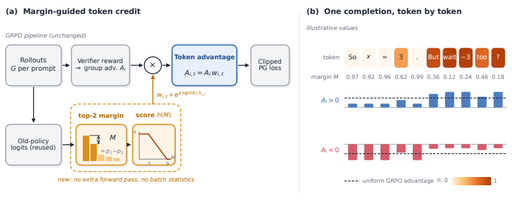
Figure 1 : Overview. (a) Relative to the GRPO baseline, the method changes only the token-level advantages; the new components are orange. The old-policy forward pass that the trainer already runs also gives the top-2 margin M = p1 − p2 at every position, and a fixed-threshold map turns it into a score h ∈ [0, 1]. (b) An illustrative completion. Tokens with a clear winner get h = 0 and close calls get h ≈ 1. In a positive completion the close calls receive more of the advantage; in a negative one they receive less of the penalty. The mean token advantage stays Ai .
원문 · CC BY 4.0 · Chi Liu, Xin Chen, Yuchuan Weng, Srinivasan Manoharan · Margin-Guided Token Credit for Reinforcement Learning with Verifiable Rewards · 원문 그림 인용 · 원본 PDF 2쪽에서 그림 영역을 추출했습니다.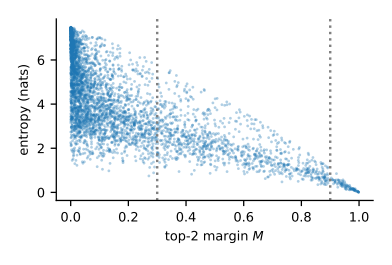
Figure 2 : Entropy vs. top-2 margin for 4,000 synthetic next-token distributions (random Gaussian logits over 2,000 tokens with 0–3 boosted candidates; not model outputs). Dotted lines: the thresholds 0.3 and 0.9. For M ∈ [0.3, 0.4) the 5th–95th percentile of the entropy is 1.5–4.8 nats.
원문 · CC BY 4.0 · Chi Liu, Xin Chen, Yuchuan Weng, Srinivasan Manoharan · Margin-Guided Token Credit for Reinforcement Learning with Verifiable Rewards · 원문 그림 인용 · 원본 PDF 3쪽에서 그림 영역을 추출했습니다.GRPO 기준선과의 동일 조건 비교 설계
실험은 MiniCPM5-2B-Base를 주 모델로 사용하고, LoRA(rank 32, α 64)로 200 optimizer step 동안 학습했습니다. 학습 문제는 DAPO-Math-17k에서 data seed에 따라 샘플링한 2,048개이며, 시드 43, 45, 100, 1024, 31415의 다섯 개 설정을 사용했습니다. 같은 recipe로 Qwen3-4B-Base를 세 개 시드(42, 43, 45)에서 반복했습니다. 평가는 AIME24, AIME25, AIME26, HMMT26, AMC23, MATH500 level 5의 297개 문제에서 문제당 32개 샘플로 수행하고, 여섯 벤치마크의 avg@32를 평균한 macro avg@32로 보고합니다.
학습 TRL seed는 고정되어 있으므로 시드 간 차이는 학습 문제의 차이만 반영하며, 최적화 노이즈에 대한 구간은 포함하지 않습니다.
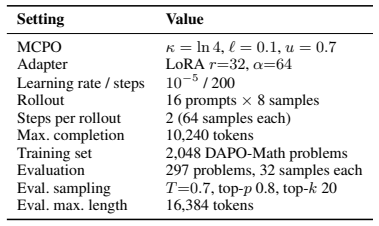
Table 1 : Settings shared by the GRPO and MCPO runs.
원문 · CC BY 4.0 · Chi Liu, Xin Chen, Yuchuan Weng, Srinivasan Manoharan · Margin-Guided Token Credit for Reinforcement Learning with Verifiable Rewards · 원문 그림 인용 · 원본 PDF 4쪽에서 그림 영역을 추출했습니다.시드별 macro avg@32 이득과 벤치마크 분포
Qwen3-4B-Base에서 세 시드의 평균 이득은 +4.75 포인트이며, 세 시드만 사용했기 때문에 t-test p 값은 0.083입니다. 저자들은 이 Qwen 결과를 확정된 결과가 아니라 부호가 일관된 결과로 다룹니다. 시드별 벤치마크 이득은 MiniCPM의 모든 벤치마크 평균에서 양수였고, AIME24에서 +12.13 포인트로 가장 컸습니다. HMMT26은 +2.97 포인트로 가장 작았습니다.
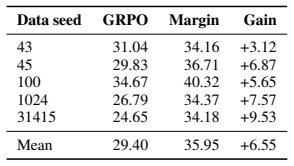
Table 2 : MiniCPM5-2B-Base: macro avg@32 (%) over six benchmarks. Bootstrap 95% CI of the mean gain [+4.14,+8.98];t-testp= 0.004(d f= 4).
원문 · CC BY 4.0 · Chi Liu, Xin Chen, Yuchuan Weng, Srinivasan Manoharan · Margin-Guided Token Credit for Reinforcement Learning with Verifiable Rewards · 원문 그림 인용 · 원본 PDF 4쪽에서 그림 영역을 추출했습니다.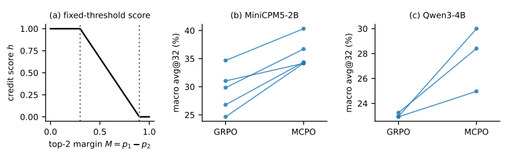
Figure 3 : (a) The fixed-threshold score h(M) of Equation 3. (b,c) Macro avg@32 over six benchmarks per data seed, GRPO vs. MCPO, for MiniCPM5-2B-Base (5 seeds) and Qwen3-4B-Base (3 seeds). Each line is one data seed.
원문 · CC BY 4.0 · Chi Liu, Xin Chen, Yuchuan Weng, Srinivasan Manoharan · Margin-Guided Token Credit for Reinforcement Learning with Verifiable Rewards · 원문 그림 인용 · 원본 PDF 5쪽에서 그림 영역을 추출했습니다.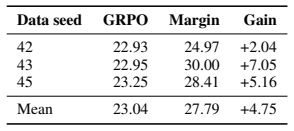
Table 3 : Qwen3-4B-Base: macro avg@32 (%). Boot- strap 95% CI [+2.06,+7.65] ; t-test p= 0.083 (d f= 2; three seeds, so thet-test has little power).
원문 · CC BY 4.0 · Chi Liu, Xin Chen, Yuchuan Weng, Srinivasan Manoharan · Margin-Guided Token Credit for Reinforcement Learning with Verifiable Rewards · 원문 그림 인용 · 원본 PDF 5쪽에서 그림 영역을 추출했습니다.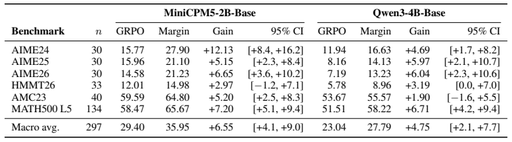
Table 4 : avg@32 (%) per benchmark, averaged over data seeds. The per-benchmark intervals are bootstrap 95% intervals overproblemsfor the seed-averaged gain (10,000 draws) and therefore do not include seed variation; the macro-average intervals are the two-level bootstrap intervals of Tables 2 and 3.
원문 · CC BY 4.0 · Chi Liu, Xin Chen, Yuchuan Weng, Srinivasan Manoharan · Margin-Guided Token Credit for Reinforcement Learning with Verifiable Rewards · 원문 그림 인용 · 원본 PDF 6쪽에서 그림 영역을 추출했습니다.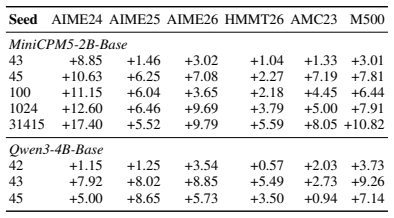
Table 7 : Gain (margin − GRPO) per data seed and benchmark (M500 = MATH500 level 5). All 48 entries are positive.
원문 · CC BY 4.0 · Chi Liu, Xin Chen, Yuchuan Weng, Srinivasan Manoharan · Margin-Guided Token Credit for Reinforcement Learning with Verifiable Rewards · 원문 그림 인용 · 원본 PDF 12쪽에서 그림 영역을 추출했습니다.문제 난이도별 이득과 pass@k 예산
GRPO 정확도 구간별 비교에서 이득은 GRPO가 일부만 푸는 문제에 집중되었습니다. 이 분석은 GRPO 첫 16개 샘플로 구간을 나누고 나머지 16개 샘플로 정확도를 계산해 회귀 편향을 줄였습니다. pass@k의 경우 MiniCPM에서 MCPO는 k=1부터 32까지 GRPO보다 높았고, 이득은 k=1의 +6.5 포인트에서 k=32의 +13.8 포인트로 커졌습니다. 같은 비교에서 Qwen의 이득은 +4.7에서 +9.3 포인트입니다. 이 pass@k 수치는 문제당 32개 샘플에서 비편향 추정기로 계산한 결과입니다.
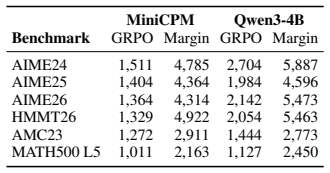
Table 5 : Accuracy (%) by difficulty bin. Bins use GRPO’s first 16 samples per problem, pooled over data seeds; all accuracies use the remaining 16 samples (held out from binning). Each problem counts equally.
원문 · CC BY 4.0 · Chi Liu, Xin Chen, Yuchuan Weng, Srinivasan Manoharan · Margin-Guided Token Credit for Reinforcement Learning with Verifiable Rewards · 원문 그림 인용 · 원본 PDF 6쪽에서 그림 영역을 추출했습니다.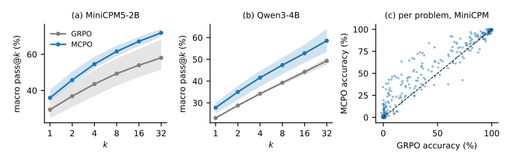
Figure 6 : (a,b) Macro pass@ k over the six benchmarks (mean over data seeds; band: min–max over seeds). (c) Per-problem accuracy, GRPO vs. MCPO, MiniCPM5-2B-Base, pooled over seeds (small jitter added); points above the dashed diagonal favor MCPO.
원문 · CC BY 4.0 · Chi Liu, Xin Chen, Yuchuan Weng, Srinivasan Manoharan · Margin-Guided Token Credit for Reinforcement Learning with Verifiable Rewards · 원문 그림 인용 · 원본 PDF 7쪽에서 그림 영역을 추출했습니다.답변 길이와 정확도의 함께 움직임
그래서 일부 이득은 짧은 답변을 피한 효과일 수 있다고 저자들은 해석합니다. 실행 단위의 상관은 MiniCPM에서 r=0.87, Qwen에서 r=0.97이지만, 이는 답변 길이가 정확도와 함께 움직인다는 관찰이며 길이가 원인이라는 증거가 아닙니다. 저자들은 길이를 맞춘 GRPO 기준선이 있어야 신용 신호 효과와 길이 효과를 분리할 수 있다고 밝힙니다.
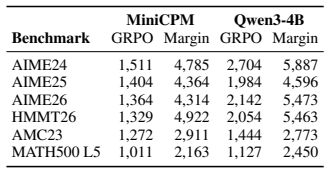
Table 6 : Mean answer length in tokens per bench- mark, averaged over data seeds (mean of per-benchmark means).
원문 · CC BY 4.0 · Chi Liu, Xin Chen, Yuchuan Weng, Srinivasan Manoharan · Margin-Guided Token Credit for Reinforcement Learning with Verifiable Rewards · 원문 그림 인용 · 원본 PDF 6쪽에서 그림 영역을 추출했습니다.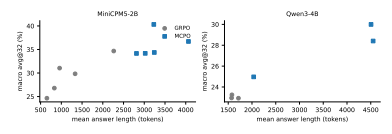
Figure 5 : Macro avg@32 vs. mean answer length for every run (one point per method and data seed).
원문 · CC BY 4.0 · Chi Liu, Xin Chen, Yuchuan Weng, Srinivasan Manoharan · Margin-Guided Token Credit for Reinforcement Learning with Verifiable Rewards · 원문 그림 인용 · 원본 PDF 6쪽에서 그림 영역을 추출했습니다.비교 범위와 해석의 한계
이 연구는 MCPO를 GRPO와만 비교했습니다. 엔트로피 기반 신용 점수나 무작위 점수 대조, κ=0 실행을 수행하지 않았으므로 margin이 엔트로피보다 우수한지, 토큰 선택 자체가 중요한지는 본 실험에서 확인되지 않습니다. 기준선도 200 step, LoRA, 기본 학습률의 한 설정이므로 더 긴 학습이나 튜닝된 GRPO에서는 차이가 줄어들 수 있습니다. 두 모델과 한 과제 계열만 사용했고, 고정 임계값과 κ는 모델이나 학습 단계에 적응하지 않습니다. 또한 학습 TRL seed가 고정되어 시드 구간이 최적화 노이즈를 포함하지 않으며, Qwen3-4B-Base 결과는 세 시드에서 통계적으로 확정되지 않았습니다.
논문 정보
- 저자
- Chi Liu, Xin Chen, Yuchuan Weng, Srinivasan Manoharan
- 학회·저널
- arXiv · 프리프린트
- 최초 공개일
- 2026년 11월 10일
- 등록일
- 2026년 11월 11일
- 수정일
- 2026년 11월 10일
- 버전
- v1
- arXiv
- 2611.14015
- 분류
- cs.LG · cs.AI
- 원문 이용 조건
- CC BY 4.0
- 제공 범위
- 논문 정보, 해설, 허용된 원문 그림
AI 해설은 논문 원문과 별개의 설명이며 오류가 있을 수 있습니다. 원문과 그림은 각 출처의 이용 조건과 따로 표시된 권리를 따릅니다.
초록
In reinforcement learning with verifiable rewards, a language model is rewarded for a correct final answer, and GRPO passes that reward to every token of the solution in equal measure. We instead place the credit where the model hesitated, in a method we call MCPO (Margin-Credit Policy Optimization). We measure hesitation by the top-2 margin $M=p_1-p_2$ of the policy's next-token distribution, map it to a score with two fixed thresholds, and spread each solution's advantage over its tokens so that the mean stays unchanged. The margin is read from a forward pass the trainer already performs, so the method needs no extra model evaluation and no batch statistics. We train MiniCPM5-2B-Base with LoRA for 200 steps on 2,048 DAPO-Math problems and evaluate on six competition-math benchmarks. MCPO beats an unmodified GRPO baseline for all five data seeds, by 6.55 points of macro avg@32 on average (95\% CI $[4.1, 9.0]$), and a Qwen3-4B-Base replication improves for all three seeds ($+4.75$). The gain is largest on problems that GRPO solves only some of the time and grows with $k$ in pass@$k$, reaching 13.8 points at pass@32. MCPO models also write two to three times longer answers, and runs that write longer score higher; our experiments do not separate the two effects.
원문 인용
Chi Liu, Xin Chen, Yuchuan Weng, Srinivasan Manoharan (2026). Margin-Guided Token Credit for Reinforcement Learning with Verifiable Rewards. arXiv:2611.14015v1. https://arxiv.org/abs/2611.14015v1
BibTeX
@misc{liu2026margin,
  title = {{Margin-Guided Token Credit for Reinforcement Learning with Verifiable Rewards}},
  author = {Chi Liu and Xin Chen and Yuchuan Weng and Srinivasan Manoharan},
  year = {2026},
  eprint = {2611.14015},
  archivePrefix = {arXiv},
  url = {https://arxiv.org/abs/2611.14015v1}
}