論文解説
Margin-Guided Token Credit for Reinforcement Learning with Verifiable Rewards
検証可能な報酬による強化学習のためのマージン誘導型トークンクレジット
- 課題 GRPOは、同じ問題に対する複数のcompletionの報酬から得たadvantageを、すべてのトークンに同じ大きさで与えます。そのため、結果を左右する少数の分岐位置と、確信のあるトークンを区別できません。
- 手法 MCPOは、old-policy forward passで得たtop-2 marginを固定閾値で点数化します。そのうえで、completionの平均advantageを保ったまま、トークンごとのadvantageを再配分します。
- 結果 MCPOは、MiniCPM5-2B-Baseの5つのシードでmacro avg@32を平均+6.55ポイント向上させました。Qwen3-4B-Baseの3つのシードでは平均+4.75ポイント向上しましたが、後者は統計的に確定していません。
GRPOの均等なトークン信用割り当て
GRPOは、同じ問題に対する複数のcompletionの報酬を標準化してgroup advantage Aiを作り、その値をcompletion内のすべてのトークンに同じ大きさで与えます。そのため、大部分のトークンである'Let'や'='と、実際に結果を左右するステップが、同じ大きさの信号を受け取ります。著者らは、大部分のトークンは確信のある状態で生成され、少数の位置でモデルが二つ以上の連続する候補で迷い、解法の方向が決まると考えています。この研究は、こうした分岐位置により多くの信用を配分すると学習結果が変わるかを問います。この主張は、GRPOのベースラインとの比較の範囲内で検証されました。
top-2 marginを用いたMCPOのトークンadvantage再配分
MCPOは、各位置の次のトークンの分布から、上位2つの確率の差 M = p1 − p2 を計算します。このmarginは、trainerがすでに実行しているold-policy forward passのロジットから得るため、追加のモデル評価は必要ありません。点数hは、固定閾値ℓ=0.1とu=0.7を用いて、h = clip(((1−M)−ℓ)/(u−ℓ), 0, 1)で決まります。したがって、Mが0.9以上ならhは0、Mが0.3以下ならhは1になり、その間は線形に変化します。この閾値はbatchの統計ではなく、1つのトークンの分布だけに依存します。トークンの重みはwi,t = e^{κ sign(Ai) hi,t}で、Ai,t = Ai · wi,t / ((1/|Ti|) Σ w_i,t′)のように正規化されます。
分母は同じcompletionの有効なトークンの重みの平均なので、completion内のトークンの平均advantageはAiのまま保たれます。κはln 4に設定しました。正のadvantageでは不確実なトークンがより多くのadvantageを受け取り、負のadvantageでは不確実なトークンのペナルティが小さくなります。
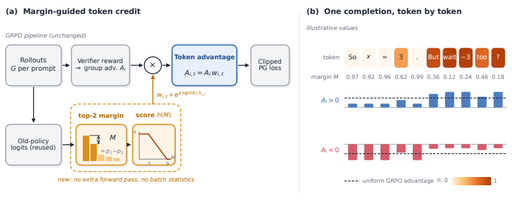
Figure 1 : Overview. (a) Relative to the GRPO baseline, the method changes only the token-level advantages; the new components are orange. The old-policy forward pass that the trainer already runs also gives the top-2 margin M = p1 − p2 at every position, and a fixed-threshold map turns it into a score h ∈ [0, 1]. (b) An illustrative completion. Tokens with a clear winner get h = 0 and close calls get h ≈ 1. In a positive completion the close calls receive more of the advantage; in a negative one they receive less of the penalty. The mean token advantage stays Ai .
出典 · CC BY 4.0 · Chi Liu, Xin Chen, Yuchuan Weng, Srinivasan Manoharan · Margin-Guided Token Credit for Reinforcement Learning with Verifiable Rewards · 論文の図を引用 · 元のPDFの2ページ目から図の部分を抽出しています。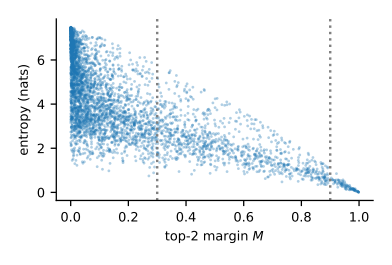
Figure 2 : Entropy vs. top-2 margin for 4,000 synthetic next-token distributions (random Gaussian logits over 2,000 tokens with 0–3 boosted candidates; not model outputs). Dotted lines: the thresholds 0.3 and 0.9. For M ∈ [0.3, 0.4) the 5th–95th percentile of the entropy is 1.5–4.8 nats.
出典 · CC BY 4.0 · Chi Liu, Xin Chen, Yuchuan Weng, Srinivasan Manoharan · Margin-Guided Token Credit for Reinforcement Learning with Verifiable Rewards · 論文の図を引用 · 元のPDFの3ページ目から図の部分を抽出しています。GRPOベースラインとの同一条件での比較設計
実験では、MiniCPM5-2B-Baseを主なモデルとして使い、LoRA(rank 32, α 64)で200 optimizer stepの学習を行いました。学習問題は、DAPO-Math-17kからdata seedに応じてサンプリングした2,048個で、シード43、45、100、1024、31415の5つの設定を使いました。同じレシピでQwen3-4B-Baseを3つのシード(42、43、45)で繰り返しました。評価は、AIME24、AIME25、AIME26、HMMT26、AMC23、MATH500 level 5の297個の問題で、問題あたり32個のサンプルを用いて行い、6つのベンチマークのavg@32を平均したmacro avg@32で報告しています。
学習TRLのseedは固定されているため、シード間の差は学習問題の違いだけを反映し、最適化ノイズに対する区間は含まれていません。
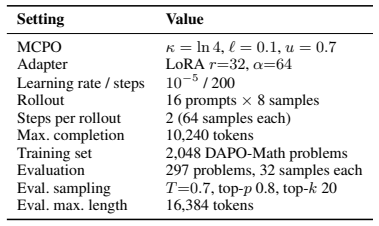
Table 1 : Settings shared by the GRPO and MCPO runs.
出典 · CC BY 4.0 · Chi Liu, Xin Chen, Yuchuan Weng, Srinivasan Manoharan · Margin-Guided Token Credit for Reinforcement Learning with Verifiable Rewards · 論文の図を引用 · 元のPDFの4ページ目から図の部分を抽出しています。シードごとのmacro avg@32の向上幅とベンチマークの分布
Qwen3-4B-Baseで3つのシードの平均の向上幅は+4.75ポイントです。3つのシードしか使っていないため、t-testのp値は0.083です。著者らは、このQwenの結果を確定したものではなく、符号が一貫した結果として扱っています。シードごとのベンチマークの向上幅は、MiniCPMではすべてのベンチマークの平均で正でした。AIME24で+12.13ポイントと最も大きく、HMMT26は+2.97ポイントと最も小さい値でした。
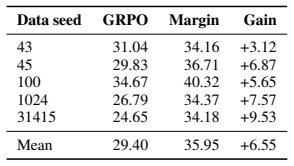
Table 2 : MiniCPM5-2B-Base: macro avg@32 (%) over six benchmarks. Bootstrap 95% CI of the mean gain [+4.14,+8.98];t-testp= 0.004(d f= 4).
出典 · CC BY 4.0 · Chi Liu, Xin Chen, Yuchuan Weng, Srinivasan Manoharan · Margin-Guided Token Credit for Reinforcement Learning with Verifiable Rewards · 論文の図を引用 · 元のPDFの4ページ目から図の部分を抽出しています。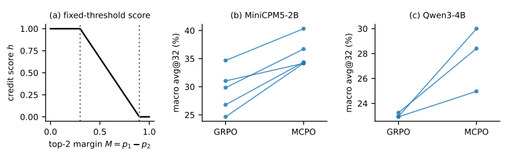
Figure 3 : (a) The fixed-threshold score h(M) of Equation 3. (b,c) Macro avg@32 over six benchmarks per data seed, GRPO vs. MCPO, for MiniCPM5-2B-Base (5 seeds) and Qwen3-4B-Base (3 seeds). Each line is one data seed.
出典 · CC BY 4.0 · Chi Liu, Xin Chen, Yuchuan Weng, Srinivasan Manoharan · Margin-Guided Token Credit for Reinforcement Learning with Verifiable Rewards · 論文の図を引用 · 元のPDFの5ページ目から図の部分を抽出しています。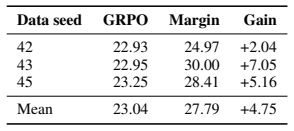
Table 3 : Qwen3-4B-Base: macro avg@32 (%). Boot- strap 95% CI [+2.06,+7.65] ; t-test p= 0.083 (d f= 2; three seeds, so thet-test has little power).
出典 · CC BY 4.0 · Chi Liu, Xin Chen, Yuchuan Weng, Srinivasan Manoharan · Margin-Guided Token Credit for Reinforcement Learning with Verifiable Rewards · 論文の図を引用 · 元のPDFの5ページ目から図の部分を抽出しています。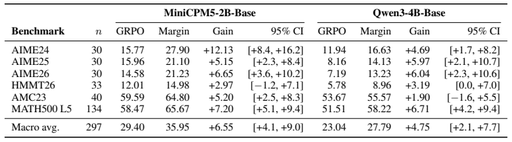
Table 4 : avg@32 (%) per benchmark, averaged over data seeds. The per-benchmark intervals are bootstrap 95% intervals overproblemsfor the seed-averaged gain (10,000 draws) and therefore do not include seed variation; the macro-average intervals are the two-level bootstrap intervals of Tables 2 and 3.
出典 · CC BY 4.0 · Chi Liu, Xin Chen, Yuchuan Weng, Srinivasan Manoharan · Margin-Guided Token Credit for Reinforcement Learning with Verifiable Rewards · 論文の図を引用 · 元のPDFの6ページ目から図の部分を抽出しています。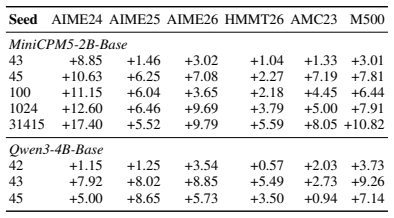
Table 7 : Gain (margin − GRPO) per data seed and benchmark (M500 = MATH500 level 5). All 48 entries are positive.
出典 · CC BY 4.0 · Chi Liu, Xin Chen, Yuchuan Weng, Srinivasan Manoharan · Margin-Guided Token Credit for Reinforcement Learning with Verifiable Rewards · 論文の図を引用 · 元のPDFの12ページ目から図の部分を抽出しています。問題の難易度別の向上幅とpass@kの予算
GRPOの正答率の区間別の比較では、向上はGRPOが一部しか解けない問題に集中しました。この分析では、GRPOの最初の16サンプルで区間を分け、残りの16サンプルで正答率を計算して、回帰バイアスを減らしました。pass@kについては、MiniCPMではMCPOがk=1から32までGRPOを上回り、向上幅はk=1の+6.5ポイントからk=32の+13.8ポイントへ広がりました。同じ比較で、Qwenの向上幅は+4.7から+9.3ポイントです。このpass@kの数値は、問題ごとの32サンプルから不偏推定量で計算した結果です。
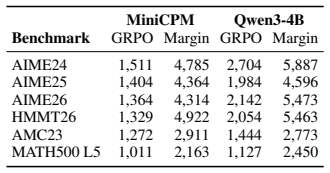
Table 5 : Accuracy (%) by difficulty bin. Bins use GRPO’s first 16 samples per problem, pooled over data seeds; all accuracies use the remaining 16 samples (held out from binning). Each problem counts equally.
出典 · CC BY 4.0 · Chi Liu, Xin Chen, Yuchuan Weng, Srinivasan Manoharan · Margin-Guided Token Credit for Reinforcement Learning with Verifiable Rewards · 論文の図を引用 · 元のPDFの6ページ目から図の部分を抽出しています。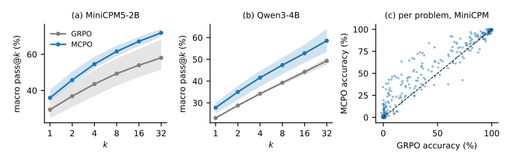
Figure 6 : (a,b) Macro pass@ k over the six benchmarks (mean over data seeds; band: min–max over seeds). (c) Per-problem accuracy, GRPO vs. MCPO, MiniCPM5-2B-Base, pooled over seeds (small jitter added); points above the dashed diagonal favor MCPO.
出典 · CC BY 4.0 · Chi Liu, Xin Chen, Yuchuan Weng, Srinivasan Manoharan · Margin-Guided Token Credit for Reinforcement Learning with Verifiable Rewards · 論文の図を引用 · 元のPDFの7ページ目から図の部分を抽出しています。回答の長さと正答率の連動
そのため、一部の向上は短い回答を避けたことによる効果かもしれないと、著者らは解釈しています。実行単位の相関は、MiniCPMでr=0.87、Qwenでr=0.97でしたが、これは回答の長さが正答率と一緒に動くという観察であり、長さが原因だという証拠ではありません。著者らは、長さをそろえたGRPOのベースラインがあれば、信用信号の効果と長さの効果を分離できると述べています。
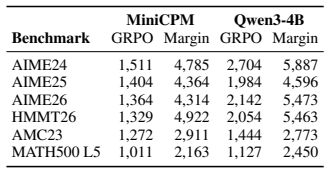
Table 6 : Mean answer length in tokens per bench- mark, averaged over data seeds (mean of per-benchmark means).
出典 · CC BY 4.0 · Chi Liu, Xin Chen, Yuchuan Weng, Srinivasan Manoharan · Margin-Guided Token Credit for Reinforcement Learning with Verifiable Rewards · 論文の図を引用 · 元のPDFの6ページ目から図の部分を抽出しています。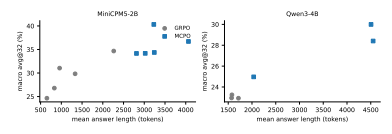
Figure 5 : Macro avg@32 vs. mean answer length for every run (one point per method and data seed).
出典 · CC BY 4.0 · Chi Liu, Xin Chen, Yuchuan Weng, Srinivasan Manoharan · Margin-Guided Token Credit for Reinforcement Learning with Verifiable Rewards · 論文の図を引用 · 元のPDFの6ページ目から図の部分を抽出しています。比較の範囲と解釈の限界
この研究はMCPOをGRPOとだけ比較しました。エントロピーに基づく信用スコア、ランダムなスコアとの対照、κ=0の実行は行っていないため、marginがエントロピーより優れているか、トークン選択そのものが重要かどうかは、本実験では確認されていません。ベースラインも200 step、LoRA、既定の学習率という一つの設定のみなので、より長い学習やチューニングされたGRPOでは差が小さくなる可能性があります。使用したのは2つのモデルと1つのタスク系列だけで、固定閾値とκはモデルや学習段階に適応しません。また、学習TRLのseedが固定されているため、シードの区間には最適化ノイズが含まれず、Qwen3-4B-Baseの結果は3つのシードでは統計的に確定していません。
論文情報
- 著者
- Chi Liu, Xin Chen, Yuchuan Weng, Srinivasan Manoharan
- 学会・ジャーナル
- arXiv · プレプリント
- 公開日
- 2026年11月10日
- 登録日
- 2026年11月11日
- 更新日
- 2026年11月10日
- バージョン
- v1
- arXiv
- 2611.14015
- カテゴリ
- cs.LG · cs.AI
- ライセンス
- CC BY 4.0
- 掲載内容
- 論文情報・解説・論文の図
この解説は、Refivuの韓国語解説をAIで翻訳したものです。不正確な翻訳や誤りが含まれる可能性があります。論文と図の利用条件は各出典に従います。
アブストラクト
In reinforcement learning with verifiable rewards, a language model is rewarded for a correct final answer, and GRPO passes that reward to every token of the solution in equal measure. We instead place the credit where the model hesitated, in a method we call MCPO (Margin-Credit Policy Optimization). We measure hesitation by the top-2 margin $M=p_1-p_2$ of the policy's next-token distribution, map it to a score with two fixed thresholds, and spread each solution's advantage over its tokens so that the mean stays unchanged. The margin is read from a forward pass the trainer already performs, so the method needs no extra model evaluation and no batch statistics. We train MiniCPM5-2B-Base with LoRA for 200 steps on 2,048 DAPO-Math problems and evaluate on six competition-math benchmarks. MCPO beats an unmodified GRPO baseline for all five data seeds, by 6.55 points of macro avg@32 on average (95\% CI $[4.1, 9.0]$), and a Qwen3-4B-Base replication improves for all three seeds ($+4.75$). The gain is largest on problems that GRPO solves only some of the time and grows with $k$ in pass@$k$, reaching 13.8 points at pass@32. MCPO models also write two to three times longer answers, and runs that write longer score higher; our experiments do not separate the two effects.
この論文を引用
Chi Liu, Xin Chen, Yuchuan Weng, Srinivasan Manoharan (2026). Margin-Guided Token Credit for Reinforcement Learning with Verifiable Rewards. arXiv:2611.14015v1. https://arxiv.org/abs/2611.14015v1
BibTeX
@misc{liu2026margin,
  title = {{Margin-Guided Token Credit for Reinforcement Learning with Verifiable Rewards}},
  author = {Chi Liu and Xin Chen and Yuchuan Weng and Srinivasan Manoharan},
  year = {2026},
  eprint = {2611.14015},
  archivePrefix = {arXiv},
  url = {https://arxiv.org/abs/2611.14015v1}
}