논문 해설
A Generalist Agent
일반화 에이전트
- 연구 문제 Gato는 텍스트, 이미지, 제어 행동을 하나의 가중치 집합으로 다루는 다중 모달·다중 과제 에이전트입니다.
- 연구 방법 모든 데이터를 정수 토큰 시퀀스로 직렬화하고, 디코더 전용 트랜스포머가 다음 토큰을 예측하도록 학습합니다.
- 주요 결과 하나의 Gato 모델은 604개 과제 중 450개 이상에서 전문가 점수의 50% 이상을 얻고, 실제 로봇 RGB Stacking에서는 기준선과 비슷한 성공률을 보입니다.
하나의 에이전트로 여러 과제를 다루려는 이유
Gato는 언어 모델의 확장 방식을 텍스트 출력 바깥의 에이전트에 적용하려는 시도입니다. 기존 제어 정책은 과제마다 입력 형식, 관측 방식, 행동 명세에 맞춘 모델을 따로 설계하는 경우가 많습니다. 이 논문은 텍스트, 이미지, 고유수용감각, 연속 제어와 이산 행동을 모두 하나의 시퀀스 모델로 다룰 수 있는지를 묻습니다.
이 질문은 세 가지 목표로 나뉩니다. 첫째, 같은 가중치의 한 신경망이 여러 모달과 여러 구현체를 함께 다룰 수 있는지입니다. 둘째, 많은 과제에서 학습한 에이전트가 소량의 추가 데이터로 새로운 과제에 적응할 수 있는지입니다. 셋째, 모델 규모를 키울 때 같은 토큰 수에서 성능이 어떻게 달라지는지입니다. 저자들은 Gato가 실시간 로봇 제어를 할 수 있는 규모인 약 1.2B 파라미터를 기준으로 삼았다고 밝힙니다. 이 규모는 현재 하드웨어와 모델 구조에서의 운영점이며, 모든 과제에서 최적임을 뜻하지 않습니다.
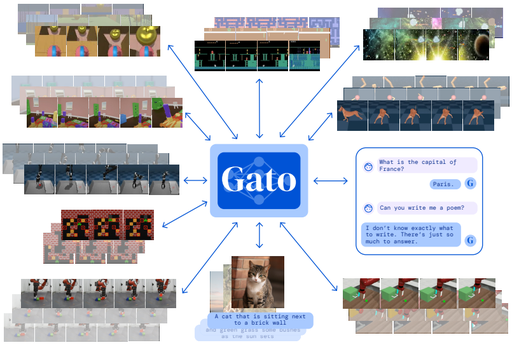
Figure 1 :A generalist agent.Gato can sense and act with different embodiments across a wide range of environments using a single neural network with the same set of weights. Gato was trained on 604 distinct tasks with varying modalities, observations and action specifications.
원문 · CC BY 4.0 · Scott Reed, Konrad Zolna, Emilio Parisotto, Sergio Gomez Colmenarejo, Alexander Novikov, Gabriel Barth-Maron, Mai Gimenez, Yury Sulsky, Jackie Kay, Jost Tobias Springenberg, Tom Eccles, Jake Bruce, Ali Razavi, Ashley Edwards, Nicolas Heess, Yutian Chen, Raia Hadsell, Oriol Vinyals, Mahyar Bordbar, Nando de Freitas · A Generalist Agent · 원문 그림 인용 · 원본 PDF 1쪽에서 그림 영역을 추출했습니다.모든 데이터를 같은 토큰 시퀀스로 바꾸는 방법
Gato의 핵심 설계는 학습 데이터의 형식을 나누지 않고 모두 정수 토큰의 평탄한 시퀀스로 바꾸는 것입니다. 텍스트는 SentencePiece로 32000개의 서브워드 정수에 대응합니다. 이미지는 16×16 패치를 래스터 순서로 나누고, 각 픽셀을 [−1, 1] 범위로 정규화한 뒤 패치 크기의 제곱근으로 나눕니다. 이산 값은 행 우선 순서의 정수 열로 바뀝니다.
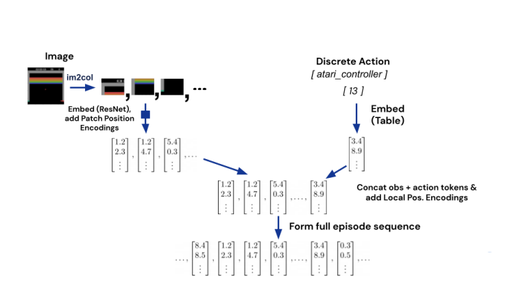
Figure 15 :A visualization of tokenizing and sequencing images and discrete values.
원문 · CC BY 4.0 · Scott Reed, Konrad Zolna, Emilio Parisotto, Sergio Gomez Colmenarejo, Alexander Novikov, Gabriel Barth-Maron, Mai Gimenez, Yury Sulsky, Jackie Kay, Jost Tobias Springenberg, Tom Eccles, Jake Bruce, Ali Razavi, Ashley Edwards, Nicolas Heess, Yutian Chen, Raia Hadsell, Oriol Vinyals, Mahyar Bordbar, Nando de Freitas · A Generalist Agent · 원문 그림 인용 · 원본 PDF 32쪽에서 그림 영역을 추출했습니다.연속 값은 먼저 필요하면 μ-law로 [−1, 1] 범위에 압축하고, 이후 1024개의 균일한 구간으로 이산화합니다. 이 이산 정수는 텍스트 토큰과 겹치지 않도록 32000에서 33024 사이로 옮겨집니다. 따라서 텍스트, 연속 제어 값, 이산 행동이 모두 같은 어휘 공간의 정수 열로 처리됩니다.
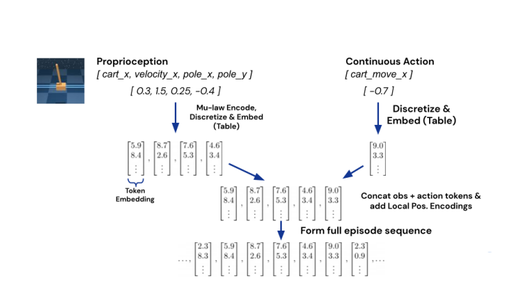
Figure 14 :A visualization of tokenizing and sequencing continuous values, e.g. proprioception.
원문 · CC BY 4.0 · Scott Reed, Konrad Zolna, Emilio Parisotto, Sergio Gomez Colmenarejo, Alexander Novikov, Gabriel Barth-Maron, Mai Gimenez, Yury Sulsky, Jackie Kay, Jost Tobias Springenberg, Tom Eccles, Jake Bruce, Ali Razavi, Ashley Edwards, Nicolas Heess, Yutian Chen, Raia Hadsell, Oriol Vinyals, Mahyar Bordbar, Nando de Freitas · A Generalist Agent · 원문 그림 인용 · 원본 PDF 32쪽에서 그림 영역을 추출했습니다.토큰 순서도 명시되어 있습니다. 텍스트는 원문 순서를 따르고, 이미지 패치는 래스터 순서를 따릅니다. 한 시간 단계에서는 관측 토큰, 구분자, 행동 토큰 순으로 놓이며 에피소드는 시간 순서로 이어집니다. 이 설계 덕분에 여러 도메인의 데이터를 하나의 언어 모델형 시퀀스로 학습할 수 있습니다.
자기회귀 학습과 프롬프트 조건화
학습은 토큰 열에 대한 다음 토큰 예측으로 이루어집니다. 각 위치의 토큰은 앞선 토큰들을 조건으로 한 확률로 모델링되며, 손실은 텍스트 토큰과 기록된 에이전트 행동 토큰에만 적용됩니다. 이미지 토큰과 에이전트의 비텍스트 관측 토큰은 예측 대상에서 제외되어 손실 계산에서 마스크됩니다.
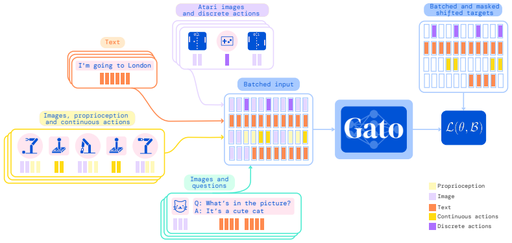
Figure 2 :Training phase of Gato. Data from different tasks and modalities is serialized into a flat sequence of tokens, batched, and processed by a transformer neural network akin to a large language model. Masking is used such that the loss function is applied only to target outputs, i.e. text and various actions.
원문 · CC BY 4.0 · Scott Reed, Konrad Zolna, Emilio Parisotto, Sergio Gomez Colmenarejo, Alexander Novikov, Gabriel Barth-Maron, Mai Gimenez, Yury Sulsky, Jackie Kay, Jost Tobias Springenberg, Tom Eccles, Jake Bruce, Ali Razavi, Ashley Edwards, Nicolas Heess, Yutian Chen, Raia Hadsell, Oriol Vinyals, Mahyar Bordbar, Nando de Freitas · A Generalist Agent · 원문 그림 인용 · 원본 PDF 2쪽에서 그림 영역을 추출했습니다.Gato는 1.2B 파라미터의 디코더 전용 트랜스포머를 사용합니다. 층은 24개이고 임베딩 크기는 2048, 피드포워드 은닉 크기는 8196입니다. 같은 도메인 안의 서로 다른 과제가 같은 구현체와 관측 형식, 행동 명세를 공유할 수 있으므로 모델은 과제를 구별할 추가 문맥이 필요합니다. 저자들은 one-hot 과제 식별자 대신 프롬프트 조건화를 사용합니다. 학습 배치의 25% 시퀀스에는 같은 소스 에이전트와 같은 과제의 에피소드에서 얻은 프롬프트가 앞에 붙습니다. 프롬프트의 절반은 에피소드 끝부분이고, 나머지 절반은 에피소드에서 균일하게 샘플링됩니다.
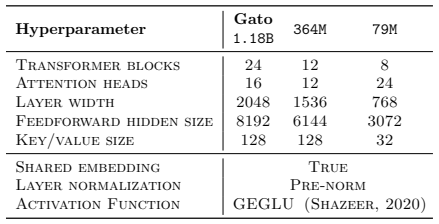
Table 5 :Gato transformer hyperparameters.
원문 · CC BY 4.0 · Scott Reed, Konrad Zolna, Emilio Parisotto, Sergio Gomez Colmenarejo, Alexander Novikov, Gabriel Barth-Maron, Mai Gimenez, Yury Sulsky, Jackie Kay, Jost Tobias Springenberg, Tom Eccles, Jake Bruce, Ali Razavi, Ashley Edwards, Nicolas Heess, Yutian Chen, Raia Hadsell, Oriol Vinyals, Mahyar Bordbar, Nando de Freitas · A Generalist Agent · 원문 그림 인용 · 원본 PDF 33쪽에서 그림 영역을 추출했습니다.학습은 16x16 TPU v3 슬라이스에서 1M 스텝, 배치 512, 토큰 길이 1024로 수행되며 약 4일이 걸린다고 보고됩니다. 배포할 때는 프롬프트를 토큰화해 초기 시퀀스를 만들고, 관측을 토큰으로 추가한 뒤 행동 토큰을 한 개씩 자기회귀적으로 샘플링합니다. 샘플링된 행동은 행동 명세에 따라 다시 값으로 되돌려져 환경에 전달됩니다.
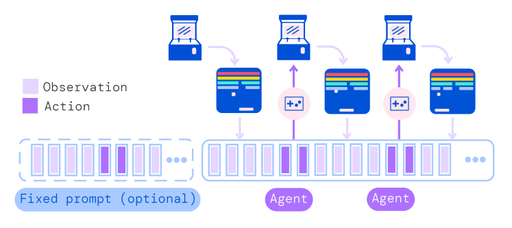
Figure 3 :Running Gato as a control policy.Gato consumes a sequence of interleaved tokenized observations, separator tokens, and previously sampled actions to produce the next action in standard autoregressive manner. The new action is applied to the environment – a game console in this illustration, a new set of observations is obtained, and the process repeats.
원문 · CC BY 4.0 · Scott Reed, Konrad Zolna, Emilio Parisotto, Sergio Gomez Colmenarejo, Alexander Novikov, Gabriel Barth-Maron, Mai Gimenez, Yury Sulsky, Jackie Kay, Jost Tobias Springenberg, Tom Eccles, Jake Bruce, Ali Razavi, Ashley Edwards, Nicolas Heess, Yutian Chen, Raia Hadsell, Oriol Vinyals, Mahyar Bordbar, Nando de Freitas · A Generalist Agent · 원문 그림 인용 · 원본 PDF 5쪽에서 그림 영역을 추출했습니다.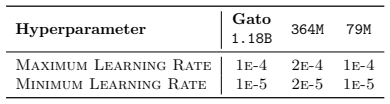
Table 6 :Learning rate schedule hyperparameters for the different model scales.
원문 · CC BY 4.0 · Scott Reed, Konrad Zolna, Emilio Parisotto, Sergio Gomez Colmenarejo, Alexander Novikov, Gabriel Barth-Maron, Mai Gimenez, Yury Sulsky, Jackie Kay, Jost Tobias Springenberg, Tom Eccles, Jake Bruce, Ali Razavi, Ashley Edwards, Nicolas Heess, Yutian Chen, Raia Hadsell, Oriol Vinyals, Mahyar Bordbar, Nando de Freitas · A Generalist Agent · 원문 그림 인용 · 원본 PDF 35쪽에서 그림 영역을 추출했습니다.학습 데이터와 전문가 반환 필터링
Gato는 시뮬레이션 제어 데이터, 실제 로봇 데이터, 텍스트 데이터, 시각 언어 데이터를 함께 사용합니다. 제어 데이터에는 Meta-World, Sokoban, BabyAI, DM Control Suite, DM Lab, ALE Atari, Procgen, Modular RL, DM Manipulation Playground 등이 포함됩니다. 텍스트는 MassiveText에서, 시각 언어 데이터는 ALIGN, LTIP, COCO 캡션 등에서 가져옵니다.
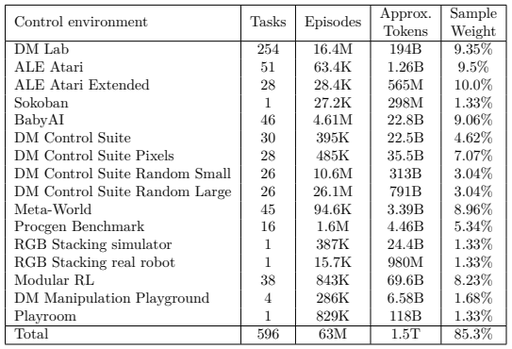
Table 1 :Datasets. Left: Control datasets used to train Gato. Right: Vision & language datasets. Sample weight means the proportion of each dataset, on average, in the training sequence batches.
원문 · CC BY 4.0 · Scott Reed, Konrad Zolna, Emilio Parisotto, Sergio Gomez Colmenarejo, Alexander Novikov, Gabriel Barth-Maron, Mai Gimenez, Yury Sulsky, Jackie Kay, Jost Tobias Springenberg, Tom Eccles, Jake Bruce, Ali Razavi, Ashley Edwards, Nicolas Heess, Yutian Chen, Raia Hadsell, Oriol Vinyals, Mahyar Bordbar, Nando de Freitas · A Generalist Agent · 원문 그림 인용 · 원본 PDF 6쪽에서 그림 영역을 추출했습니다.제어 데이터는 전문가 또는 근접 SoTA 에이전트가 기록한 경험입니다. 저자들은 과제별 전문가 반환값의 80% 이상인 에피소드만 선택해 학습했다고 밝힙니다. 전문가 반환값은 여러 윈도우의 평균 반환 중 최댓값으로 정의되고, 윈도우 크기는 전체 데이터의 10%와 최소 1000 에피소드 중 작은 값입니다. 이 필터링은 데이터의 품질을 높이는 선택이지만, 필터 아래의 시연이 어떤 영향을 주는지는 이 논문의 범위에 포함되지 않습니다.
각 배치는 도메인 전반에 대략 균일하게 섞이며, 큰 데이터셋과 품질이 높다고 판단된 데이터셋에는 수동 가중치가 더해집니다. 이 구성은 학습 시 샘플 비율을 정하는 방법이지, 과제별 최적 성능을 보장하는 방법은 아닙니다.
시뮬레이션 제어 과제의 전문가 점수 비교
시뮬레이션 평가에서 Gato는 단일 pre-training 모델과 같은 가중치를 유지한 채 604개 과제에서 실행됩니다. 각 과제마다 정책을 환경에서 50회 롤아웃하고 정의된 점수를 평균합니다. 점수는 과제별 전문가 점수를 100%, 무작위 정책을 0%로 둔 백분율입니다. 이 방식으로 Gato는 604개 과제 중 450개 이상에서 전문가 점수의 50%를 넘는 것으로 나타납니다.
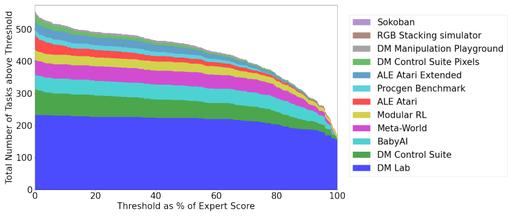
Figure 5 :Gato’s performance on simulated control tasks.Number of tasks where the performance of the pretrained model is above a percentage of expert score, grouped by domain. Here values on the x-axis represent a specific percentage of expert score, where 0 corresponds to random agent performance. The y-axis is the number of tasks where the pretrained model’s mean performance is equal to or above that percentage. That is, the width of each colour band indicates the number of tasks where Gato’s mean performance is above a percentage of the maximum score obtained by a task-specific expert.
원문 · CC BY 4.0 · Scott Reed, Konrad Zolna, Emilio Parisotto, Sergio Gomez Colmenarejo, Alexander Novikov, Gabriel Barth-Maron, Mai Gimenez, Yury Sulsky, Jackie Kay, Jost Tobias Springenberg, Tom Eccles, Jake Bruce, Ali Razavi, Ashley Edwards, Nicolas Heess, Yutian Chen, Raia Hadsell, Oriol Vinyals, Mahyar Bordbar, Nando de Freitas · A Generalist Agent · 원문 그림 인용 · 원본 PDF 8쪽에서 그림 영역을 추출했습니다.도메인별 결과는 같은 척도에서 다르게 나타납니다. ALE Atari에서는 23개 게임에서 평균 인간 이상의 점수를 얻고, 11개 게임에서는 인간 점수의 두 배 이상을 얻습니다. 저자들은 이 결과가 온라인 단일 과제 에이전트보다 낮다는 점을 인정하며, 용량 증가나 오프라인 RL 학습으로 줄일 수 있다고 해석합니다. BabyAI에서는 대부분의 레벨에서 전문가 점수의 80% 이상을 얻습니다. Meta-World에서는 45개 과제 중 44개에서 50% 이상, 35개 과제에서 80% 이상, 3개 과제에서 90% 이상을 얻습니다. DM Control Suite 상태 입력에서는 30개 과제 중 21개에서 50% 이상을 얻습니다.
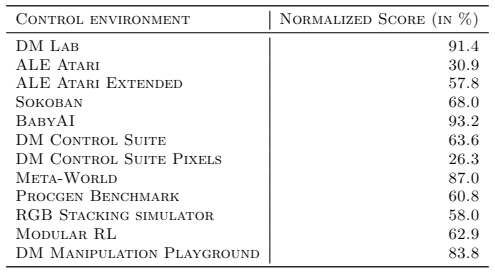
Table 8 :Normalized Gato per-domain scores.Averaged over 50 evaluations.
원문 · CC BY 4.0 · Scott Reed, Konrad Zolna, Emilio Parisotto, Sergio Gomez Colmenarejo, Alexander Novikov, Gabriel Barth-Maron, Mai Gimenez, Yury Sulsky, Jackie Kay, Jost Tobias Springenberg, Tom Eccles, Jake Bruce, Ali Razavi, Ashley Edwards, Nicolas Heess, Yutian Chen, Raia Hadsell, Oriol Vinyals, Mahyar Bordbar, Nando de Freitas · A Generalist Agent · 원문 그림 인용 · 원본 PDF 42쪽에서 그림 영역을 추출했습니다.이 결과들은 모두 하나의 pre-training 모델의 시뮬레이션 평가입니다. 실제 로봇 결과와 구분해서 읽어야 하며, 다른 전문가 기준이나 다른 환경 설정에서 얻은 점수와 직접 같은 조건으로 비교하면 안 됩니다.
RGB Stacking의 실제 로봇 평가
로봇 평가는 RGB Stacking 벤치마크의 두 과제로 나뉩니다. Skill Generalization은 학습 데이터에 없는 다섯 물체 삼중항을 쌓는 과제입니다. Skill Mastery는 평가에 쓰는 물체 형태의 데이터를 학습에 포함한 과제입니다. Skill Generalization 실제 로봇 평가에서 Gato는 테스트 삼중항마다 200 에피소드를 수행했고, 평균 성공률은 50.2%입니다. 같은 표의 BC-IMP 기준선은 49%입니다.
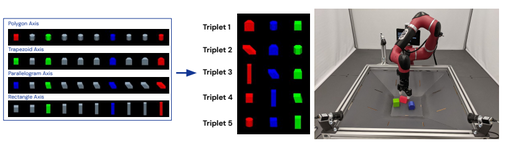
Figure 4 :RGB Stacking environment with the Sawyer robot arm.Blocks vary along several shape axes, with 5 held out test triplets. The goal is to stack red on blue, ignoring green.
원문 · CC BY 4.0 · Scott Reed, Konrad Zolna, Emilio Parisotto, Sergio Gomez Colmenarejo, Alexander Novikov, Gabriel Barth-Maron, Mai Gimenez, Yury Sulsky, Jackie Kay, Jost Tobias Springenberg, Tom Eccles, Jake Bruce, Ali Razavi, Ashley Edwards, Nicolas Heess, Yutian Chen, Raia Hadsell, Oriol Vinyals, Mahyar Bordbar, Nando de Freitas · A Generalist Agent · 원문 그림 인용 · 원본 PDF 7쪽에서 그림 영역을 추출했습니다.
Table 2 :Gato real robot Skill Generalization results.In addition to performing hundreds of other tasks, Gato also stacks competitively with the comparable published baseline.
원문 · CC BY 4.0 · Scott Reed, Konrad Zolna, Emilio Parisotto, Sergio Gomez Colmenarejo, Alexander Novikov, Gabriel Barth-Maron, Mai Gimenez, Yury Sulsky, Jackie Kay, Jost Tobias Springenberg, Tom Eccles, Jake Bruce, Ali Razavi, Ashley Edwards, Nicolas Heess, Yutian Chen, Raia Hadsell, Oriol Vinyals, Mahyar Bordbar, Nando de Freitas · A Generalist Agent · 원문 그림 인용 · 원본 PDF 10쪽에서 그림 영역을 추출했습니다.Skill Mastery의 실제 로봇 결과는 Appendix H의 이전 버전 Gato 구조를 사용하며 fine-tuning을 하지 않았습니다. 이 결과에서 Gato의 평균 성공률은 75.6%이고, 필터링된 BC-IMP 기준선은 74.6%입니다. 두 실제 로봇 결과는 모두 기준선과 근소한 차이만 보입니다. 따라서 저자들은 Gato가 기준선과 비슷한 수준이라고 보고하며, 큰 우위를 주장하지 않습니다.

Table 3 :Real robot Skill Mastery results.Gato is competitive with the filtered BC baseline.
원문 · CC BY 4.0 · Scott Reed, Konrad Zolna, Emilio Parisotto, Sergio Gomez Colmenarejo, Alexander Novikov, Gabriel Barth-Maron, Mai Gimenez, Yury Sulsky, Jackie Kay, Jost Tobias Springenberg, Tom Eccles, Jake Bruce, Ali Razavi, Ashley Edwards, Nicolas Heess, Yutian Chen, Raia Hadsell, Oriol Vinyals, Mahyar Bordbar, Nando de Freitas · A Generalist Agent · 원문 그림 인용 · 원본 PDF 14쪽에서 그림 영역을 추출했습니다.소수 시연 fine-tuning과 모델 규모
pre-training 뒤에는 새 과제에 대한 적응을 확인합니다. 저자들은 긴 프롬프트 문맥으로 적응하는 방식보다, 한 과제의 소수 시연에서 파라미터를 미세조정하는 방식을 택했습니다. 메모리 제약과 토큰화된 시연의 긴 시퀀스 때문에 문맥으로 충분한 정보를 제공하기 어렵기 때문입니다. fine-tuning은 학습률 스케줄을 제외하면 pre-training과 비슷합니다.
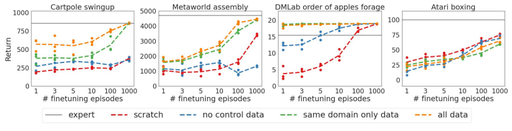
Figure 9 :Few-shot performance, ablating over various pretraining settings.Orange corresponds to the base Gato pretrained on all data. Red is trained from scratch only on the few-shot data.364M parameter variants of Gato were used for this experiment to save compute.
원문 · CC BY 4.0 · Scott Reed, Konrad Zolna, Emilio Parisotto, Sergio Gomez Colmenarejo, Alexander Novikov, Gabriel Barth-Maron, Mai Gimenez, Yury Sulsky, Jackie Kay, Jost Tobias Springenberg, Tom Eccles, Jake Bruce, Ali Razavi, Ashley Edwards, Nicolas Heess, Yutian Chen, Raia Hadsell, Oriol Vinyals, Mahyar Bordbar, Nando de Freitas · A Generalist Agent · 원문 그림 인용 · 원본 PDF 11쪽에서 그림 영역을 추출했습니다.모델 규모 비교에서는 79M, 364M, 1.18B 세 크기를 사용했습니다. 1.18B 모델은 소수 fine-tuning 데이터가 늘어날 때 더 적은 에피소드로 적응하는 경향을 보입니다. 364M 모델은 한 에피소드에서 과적합해 성능이 떨어지는 구간이 있습니다. 79M 모델은 세 크기 중 가장 낮은 성능을 보입니다. 저자들은 이 결과를 큰 모델이 pre-training 데이터에서 얻은 표현을 테스트 시점에 더 잘 활용한다는 해석으로 제시합니다.
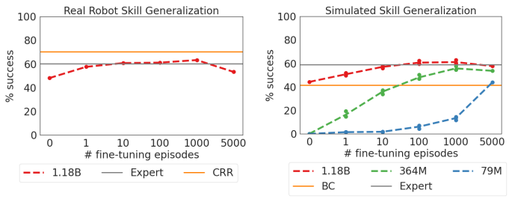
Figure 10 :Robotics fine-tuning results.Left: Comparison of real robot Skill Generalization success rate averaged across test triplets for Gato, expert, and CRR trained on 35k expert episodes (upper bound). Right: Comparison of simulated robot Skill Generalization success rate averaged across test triplets for a series of ablations on the number of parameters, including scores for expert and a BC baseline trained on 5k episodes.
원문 · CC BY 4.0 · Scott Reed, Konrad Zolna, Emilio Parisotto, Sergio Gomez Colmenarejo, Alexander Novikov, Gabriel Barth-Maron, Mai Gimenez, Yury Sulsky, Jackie Kay, Jost Tobias Springenberg, Tom Eccles, Jake Bruce, Ali Razavi, Ashley Edwards, Nicolas Heess, Yutian Chen, Raia Hadsell, Oriol Vinyals, Mahyar Bordbar, Nando de Freitas · A Generalist Agent · 원문 그림 인용 · 원본 PDF 12쪽에서 그림 영역을 추출했습니다.분포 밖 과제 실험에서는 Stack blue on green처럼 학습 데이터에 없는 목표 변화를 다룹니다. 이 과제에서 500개의 실제 로봇 시연으로 미세조정한 Gato는 60% 성공률을 얻고, 처음부터 학습한 BC 기준선은 0.5%(200 중 1 에피소드)를 얻습니다. 이 결과는 해당 과제와 데이터 구성의 범위 안에서 읽어야 합니다.
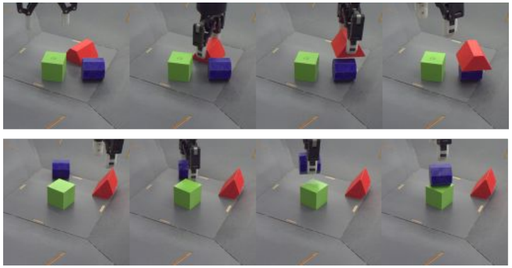
Figure 11 :Comparing training/test task goal variations.Top: the standard “stack red on blue” task tested in the Skill Generalization benchmark. Bottom: the novel “stack blue on green” task demonstrating Gato’s out of distribution adaptation to perceptual variations.
원문 · CC BY 4.0 · Scott Reed, Konrad Zolna, Emilio Parisotto, Sergio Gomez Colmenarejo, Alexander Novikov, Gabriel Barth-Maron, Mai Gimenez, Yury Sulsky, Jackie Kay, Jost Tobias Springenberg, Tom Eccles, Jake Bruce, Ali Razavi, Ashley Edwards, Nicolas Heess, Yutian Chen, Raia Hadsell, Oriol Vinyals, Mahyar Bordbar, Nando de Freitas · A Generalist Agent · 원문 그림 인용 · 원본 PDF 13쪽에서 그림 영역을 추출했습니다.단일 도메인 전문 에이전트와 Gato의 차이
논문은 Gato와 별도로 단일 도메인 전문 에이전트를 학습합니다. Meta-World 전문 에이전트는 79M 구조를 사용하고 50개 과제 전체로 학습되며, 과제별 MPO 전문가를 만든 뒤 궤적을 하나의 에이전트로 증류한 결과입니다. 이 에이전트는 50개 과제 평균 96.6% 성공률을 보고합니다.
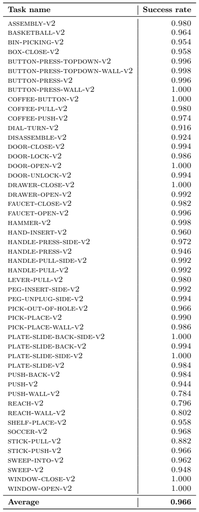
Table 7 :Success rates of specialist Meta-World agent.Averaged over 500 evaluations.
원문 · CC BY 4.0 · Scott Reed, Konrad Zolna, Emilio Parisotto, Sergio Gomez Colmenarejo, Alexander Novikov, Gabriel Barth-Maron, Mai Gimenez, Yury Sulsky, Jackie Kay, Jost Tobias Springenberg, Tom Eccles, Jake Bruce, Ali Razavi, Ashley Edwards, Nicolas Heess, Yutian Chen, Raia Hadsell, Oriol Vinyals, Mahyar Bordbar, Nando de Freitas · A Generalist Agent · 원문 그림 인용 · 원본 PDF 41쪽에서 그림 영역을 추출했습니다.ALE Atari 전문 에이전트는 51개 과제 전체로 학습되며 1.18B 구조를 사용합니다. 이 에이전트는 44개 게임에서 평균 인간 이상의 성능을 보입니다. 저자들은 다른 7개 게임의 온라인 전문가도 평균 인간보다 낮았다고 설명합니다. 따라서 초인간 데이터가 있었던 게임에서 전문 에이전트가 초인간 성능을 얻었다고 해석할 수 있습니다. 이 전문 Atari 에이전트는 Gato의 23개 게임보다 많은 게임에서 높은 성능을 보입니다. 그러나 전문 에이전트는 단일 도메인에 특화된 결과이므로 Gato의 다중 도메인 성능과 같은 대상으로 보면 안 됩니다.
문맥 길이와 데이터 확보의 한계
Gato의 문맥 길이는 1024 토큰입니다. 이 제한 때문에 이미지 관측이 많은 환경에서는 데모 에피소드의 일부만 입력에 들어갈 수 있습니다. 저자들은 다양한 프롬프트 구조를 시도했을 때 성능이 비슷했고, 프롬프트 기반 문맥 학습도 프롬프트 없는 평가보다 뚜렷하게 나아지지 않았다고 보고합니다. 이 한계는 자기주의의 제곱 규모 증가와 관련된다고 설명됩니다.
데이터 측면의 한계도 있습니다. Gato는 모방 학습 방식으로 학습되므로 웹 규모의 제어 데이터가 현재 쉽게 얻어지지 않습니다. 저자들은 오프라인 RL 데이터셋, 시뮬레이션, 실제 데이터, 관측만 있는 데이터가 대안이 될 수 있다고 논의합니다. 다만 이 대안들은 이 논문의 실험에서 검증된 결과가 아닙니다. 또한 로봇 실험은 특정 Sawyer 로봇과 RGB Stacking 과제에 한정되며, 다른 구현체로의 일반화는 이 논문에서 확인하지 않았습니다.
논문 정보
- 저자
- Scott Reed, Konrad Zolna, Emilio Parisotto, Sergio Gomez Colmenarejo, Alexander Novikov, Gabriel Barth-Maron, Mai Gimenez, Yury Sulsky, Jackie Kay, Jost Tobias Springenberg, Tom Eccles, Jake Bruce, Ali Razavi, Ashley Edwards, Nicolas Heess, Yutian Chen, Raia Hadsell, Oriol Vinyals, Mahyar Bordbar, Nando de Freitas
- 학회·저널
- arXiv · 프리프린트
- 최초 공개일
- 2022년 5월 12일
- 등록일
- 2026년 10월 20일
- 수정일
- 2022년 11월 11일
- 버전
- v3
- arXiv
- 2205.06175
- 분류
- cs.AI · cs.CL · cs.LG · cs.RO
- 원문 이용 조건
- CC BY 4.0
- 제공 범위
- 논문 정보, 해설, 허용된 원문 그림
AI 해설은 논문 원문과 별개의 설명이며 오류가 있을 수 있습니다. 원문과 그림은 각 출처의 이용 조건과 따로 표시된 권리를 따릅니다.
초록
Inspired by progress in large-scale language modeling, we apply a similar approach towards building a single generalist agent beyond the realm of text outputs. The agent, which we refer to as Gato, works as a multi-modal, multi-task, multi-embodiment generalist policy. The same network with the same weights can play Atari, caption images, chat, stack blocks with a real robot arm and much more, deciding based on its context whether to output text, joint torques, button presses, or other tokens. In this report we describe the model and the data, and document the current capabilities of Gato.
원문 인용
Scott Reed, Konrad Zolna, Emilio Parisotto, Sergio Gomez Colmenarejo, Alexander Novikov, Gabriel Barth-Maron, Mai Gimenez, Yury Sulsky, Jackie Kay, Jost Tobias Springenberg, Tom Eccles, Jake Bruce, Ali Razavi, Ashley Edwards, Nicolas Heess, Yutian Chen, Raia Hadsell, Oriol Vinyals, Mahyar Bordbar, Nando de Freitas (2022). A Generalist Agent. arXiv:2205.06175v3. https://arxiv.org/abs/2205.06175v3
BibTeX
@misc{reed2022generalist,
  title = {{A Generalist Agent}},
  author = {Scott Reed and Konrad Zolna and Emilio Parisotto and Sergio Gomez Colmenarejo and Alexander Novikov and Gabriel Barth-Maron and Mai Gimenez and Yury Sulsky and Jackie Kay and Jost Tobias Springenberg and Tom Eccles and Jake Bruce and Ali Razavi and Ashley Edwards and Nicolas Heess and Yutian Chen and Raia Hadsell and Oriol Vinyals and Mahyar Bordbar and Nando de Freitas},
  year = {2022},
  eprint = {2205.06175},
  archivePrefix = {arXiv},
  url = {https://arxiv.org/abs/2205.06175v3}
}