論文解説
A Generalist Agent
一般化エージェント
- 課題 Gatoは、テキスト、画像、制御行動を1つの重み集合で扱う、マルチモーダル・マルチタスクのエージェントです。
- 手法 すべてのデータを整数トークンの系列に直列化し、デコーダ専用のTransformerが次のトークンを予測するように学習します。
- 結果 1つのGatoモデルは、604個のタスクのうち450個以上で専門家スコアの50%以上を得ており、実ロボットのRGB Stackingではベースラインと同程度の成功率です。
1つのエージェントで複数のタスクを扱う理由
Gatoは、言語モデルのスケーリングの方法を、テキスト出力以外のエージェントに適用しようとする試みです。既存の制御ポリシーは、タスクごとに入力形式、観測方式、行動仕様に合わせてモデルを個別に設計する場合が多いです。この論文は、テキスト、画像、固有受容感覚、連続制御と離散行動をすべて1つのシーケンスモデルで扱えるかを問うています。
この問いは3つの目標に分かれます。第一に、同じ重みの1つのニューラルネットワークが、複数のモダリティと複数の実装体を同時に扱えるかどうかです。第二に、多くのタスクで学習したエージェントが、少量の追加データで新しいタスクに適応できるかどうかです。第三に、モデルの規模を大きくしたとき、同じトークン数で性能がどう変わるかです。著者らは、Gatoがリアルタイムのロボット制御を行える規模である約1.2Bパラメータを基準にしたと説明しています。この規模は、現在のハードウェアとモデル構造における運用点であり、すべてのタスクで最適であることを意味するわけではありません。
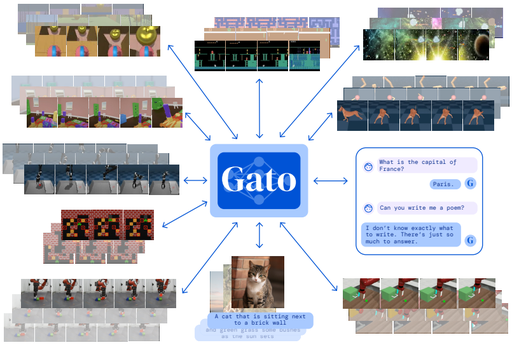
Figure 1 :A generalist agent.Gato can sense and act with different embodiments across a wide range of environments using a single neural network with the same set of weights. Gato was trained on 604 distinct tasks with varying modalities, observations and action specifications.
出典 · CC BY 4.0 · Scott Reed, Konrad Zolna, Emilio Parisotto, Sergio Gomez Colmenarejo, Alexander Novikov, Gabriel Barth-Maron, Mai Gimenez, Yury Sulsky, Jackie Kay, Jost Tobias Springenberg, Tom Eccles, Jake Bruce, Ali Razavi, Ashley Edwards, Nicolas Heess, Yutian Chen, Raia Hadsell, Oriol Vinyals, Mahyar Bordbar, Nando de Freitas · A Generalist Agent · 論文の図を引用 · 元のPDFの1ページ目から図の部分を抽出しています。すべてのデータを同じトークン系列に変換する方法
Gatoの中心となる設計は、学習データの形式を分けず、すべてを整数トークンの平らな系列に変換することです。テキストはSentencePieceによって、32000個のサブワード整数に対応づけられます。画像は16×16のパッチにラスター順で分割し、各ピクセルを[−1, 1]の範囲に正規化したうえで、パッチサイズの平方根で割ります。離散値は、行優先順の整数列に変換されます。
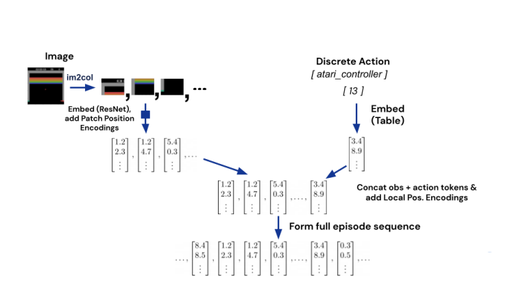
Figure 15 :A visualization of tokenizing and sequencing images and discrete values.
出典 · CC BY 4.0 · Scott Reed, Konrad Zolna, Emilio Parisotto, Sergio Gomez Colmenarejo, Alexander Novikov, Gabriel Barth-Maron, Mai Gimenez, Yury Sulsky, Jackie Kay, Jost Tobias Springenberg, Tom Eccles, Jake Bruce, Ali Razavi, Ashley Edwards, Nicolas Heess, Yutian Chen, Raia Hadsell, Oriol Vinyals, Mahyar Bordbar, Nando de Freitas · A Generalist Agent · 論文の図を引用 · 元のPDFの32ページ目から図の部分を抽出しています。連続値は、必要であればまずμ-lawによって[−1, 1]の範囲に圧縮し、その後1024個の均一な区間に離散化します。この離散整数は、テキストのトークンと重ならないように、32000から33024の間にずらされます。したがって、テキスト、連続制御値、離散行動はすべて同じ語彙空間の整数列として処理されます。
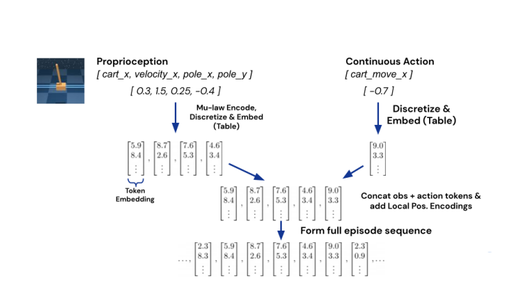
Figure 14 :A visualization of tokenizing and sequencing continuous values, e.g. proprioception.
出典 · CC BY 4.0 · Scott Reed, Konrad Zolna, Emilio Parisotto, Sergio Gomez Colmenarejo, Alexander Novikov, Gabriel Barth-Maron, Mai Gimenez, Yury Sulsky, Jackie Kay, Jost Tobias Springenberg, Tom Eccles, Jake Bruce, Ali Razavi, Ashley Edwards, Nicolas Heess, Yutian Chen, Raia Hadsell, Oriol Vinyals, Mahyar Bordbar, Nando de Freitas · A Generalist Agent · 論文の図を引用 · 元のPDFの32ページ目から図の部分を抽出しています。トークンの順序も定められています。テキストは書かれた順序に従い、画像パッチはラスター順に従います。1つの時間ステップでは、観測トークン、区切りトークン、行動トークンの順に並び、エピソードは時間順に連結されます。この設計により、複数のドメインのデータを1つの言語モデル型の系列として学習できます。
自己回帰学習とプロンプト条件付け
学習は、トークン列に対する次のトークン予測として行われます。各位置のトークンは、それより前のトークンを条件とした確率としてモデル化され、損失はテキストトークンと記録されたエージェントの行動トークンにのみ適用されます。画像トークンと、エージェントのテキスト以外の観測トークンは予測対象から外れ、損失計算ではマスクされます。
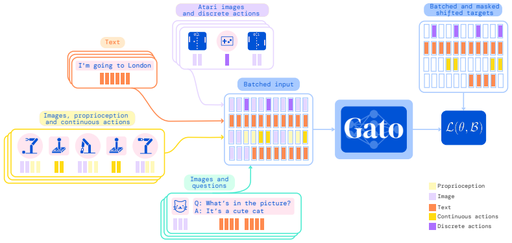
Figure 2 :Training phase of Gato. Data from different tasks and modalities is serialized into a flat sequence of tokens, batched, and processed by a transformer neural network akin to a large language model. Masking is used such that the loss function is applied only to target outputs, i.e. text and various actions.
出典 · CC BY 4.0 · Scott Reed, Konrad Zolna, Emilio Parisotto, Sergio Gomez Colmenarejo, Alexander Novikov, Gabriel Barth-Maron, Mai Gimenez, Yury Sulsky, Jackie Kay, Jost Tobias Springenberg, Tom Eccles, Jake Bruce, Ali Razavi, Ashley Edwards, Nicolas Heess, Yutian Chen, Raia Hadsell, Oriol Vinyals, Mahyar Bordbar, Nando de Freitas · A Generalist Agent · 論文の図を引用 · 元のPDFの2ページ目から図の部分を抽出しています。Gatoは1.2Bパラメータのデコーダ専用Transformerを使用します。層は24で、埋め込みサイズは2048、フィードフォワードの隠れ層サイズは8196です。同じドメイン内の異なるタスクは、同じ実装体、観測形式、行動仕様を共有できるため、モデルがタスクを区別するには追加の文脈が必要です。著者らは、one-hotのタスク識別子の代わりにプロンプト条件付けを用いると説明しています。学習バッチの25%のシーケンスには、同じソースエージェントかつ同じタスクのエピソードから得たプロンプトが前置されます。プロンプトの半分はエピソードの終わりの部分で、残りの半分はエピソードから一様にサンプリングされます。
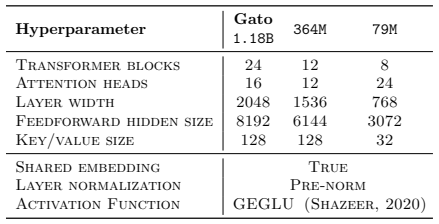
Table 5 :Gato transformer hyperparameters.
出典 · CC BY 4.0 · Scott Reed, Konrad Zolna, Emilio Parisotto, Sergio Gomez Colmenarejo, Alexander Novikov, Gabriel Barth-Maron, Mai Gimenez, Yury Sulsky, Jackie Kay, Jost Tobias Springenberg, Tom Eccles, Jake Bruce, Ali Razavi, Ashley Edwards, Nicolas Heess, Yutian Chen, Raia Hadsell, Oriol Vinyals, Mahyar Bordbar, Nando de Freitas · A Generalist Agent · 論文の図を引用 · 元のPDFの33ページ目から図の部分を抽出しています。学習は16x16のTPU v3スライスで、1Mステップ、バッチ512、トークン長1024で行われ、約4日かかると報告されています。デプロイ時には、プロンプトをトークン化して初期系列を作り、観測をトークンとして追加したうえで、行動トークンを1つずつ自己回帰的にサンプリングします。サンプリングされた行動は、行動仕様に従って再び値に戻され、環境に渡されます。
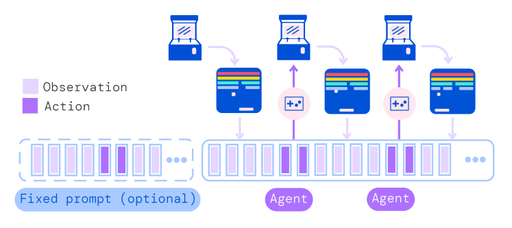
Figure 3 :Running Gato as a control policy.Gato consumes a sequence of interleaved tokenized observations, separator tokens, and previously sampled actions to produce the next action in standard autoregressive manner. The new action is applied to the environment – a game console in this illustration, a new set of observations is obtained, and the process repeats.
出典 · CC BY 4.0 · Scott Reed, Konrad Zolna, Emilio Parisotto, Sergio Gomez Colmenarejo, Alexander Novikov, Gabriel Barth-Maron, Mai Gimenez, Yury Sulsky, Jackie Kay, Jost Tobias Springenberg, Tom Eccles, Jake Bruce, Ali Razavi, Ashley Edwards, Nicolas Heess, Yutian Chen, Raia Hadsell, Oriol Vinyals, Mahyar Bordbar, Nando de Freitas · A Generalist Agent · 論文の図を引用 · 元のPDFの5ページ目から図の部分を抽出しています。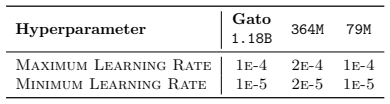
Table 6 :Learning rate schedule hyperparameters for the different model scales.
出典 · CC BY 4.0 · Scott Reed, Konrad Zolna, Emilio Parisotto, Sergio Gomez Colmenarejo, Alexander Novikov, Gabriel Barth-Maron, Mai Gimenez, Yury Sulsky, Jackie Kay, Jost Tobias Springenberg, Tom Eccles, Jake Bruce, Ali Razavi, Ashley Edwards, Nicolas Heess, Yutian Chen, Raia Hadsell, Oriol Vinyals, Mahyar Bordbar, Nando de Freitas · A Generalist Agent · 論文の図を引用 · 元のPDFの35ページ目から図の部分を抽出しています。学習データと専門家リターンによるフィルタリング
Gatoは、シミュレーション制御データ、実ロボットデータ、テキストデータ、視覚言語データを併用します。制御データには、Meta-World、Sokoban、BabyAI、DM Control Suite、DM Lab、ALE Atari、Procgen、Modular RL、DM Manipulation Playgroundなどが含まれます。テキストはMassiveTextから、視覚言語データはALIGN、LTIP、COCOキャプションなどから取得されます。
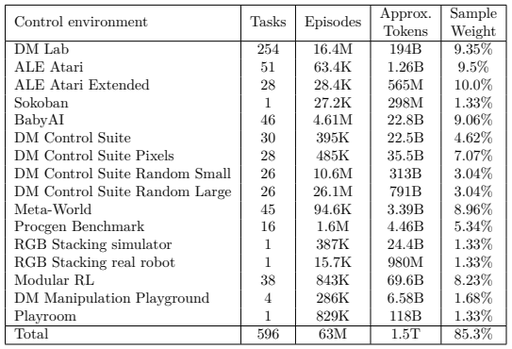
Table 1 :Datasets. Left: Control datasets used to train Gato. Right: Vision & language datasets. Sample weight means the proportion of each dataset, on average, in the training sequence batches.
出典 · CC BY 4.0 · Scott Reed, Konrad Zolna, Emilio Parisotto, Sergio Gomez Colmenarejo, Alexander Novikov, Gabriel Barth-Maron, Mai Gimenez, Yury Sulsky, Jackie Kay, Jost Tobias Springenberg, Tom Eccles, Jake Bruce, Ali Razavi, Ashley Edwards, Nicolas Heess, Yutian Chen, Raia Hadsell, Oriol Vinyals, Mahyar Bordbar, Nando de Freitas · A Generalist Agent · 論文の図を引用 · 元のPDFの6ページ目から図の部分を抽出しています。制御データは、専門家または準SoTAエージェントが記録した経験です。著者らは、タスクごとの専門家リターンの80%以上のエピソードだけを選んで学習したと述べています。専門家リターンは、複数のウィンドウにおける平均リターンの最大値として定義され、ウィンドウサイズは、全データの10%と最小1000エピソードのうち小さい方の値です。このフィルタリングはデータの品質を高める選択ですが、フィルタより下の実演がどのような影響を与えるかは、この論文の範囲には含まれません。
各バッチは、ドメイン全体にほぼ均一に混ぜられます。大規模なデータセットや、品質が高いと判断されたデータセットには、手動の重みが加えられます。この構成は学習時にサンプルの比率を決める方法であり、タスクごとの最適な性能を保証する方法ではありません。
シミュレーション制御タスクにおける専門家スコアの比較
シミュレーション評価では、Gatoは単一の事前学習モデルと同じ重みを保ったまま、604個のタスクで実行されます。各タスクでは、ポリシーを環境で50回ロールアウトし、定められたスコアを平均します。スコアは、タスクごとの専門家スコアを100%、ランダムポリシーを0%とした割合です。この方法で、Gatoは604個のタスクのうち450個以上で、専門家スコアの50%を超えることが示されています。
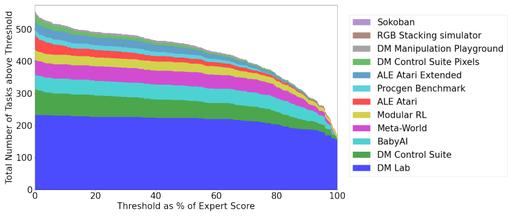
Figure 5 :Gato’s performance on simulated control tasks.Number of tasks where the performance of the pretrained model is above a percentage of expert score, grouped by domain. Here values on the x-axis represent a specific percentage of expert score, where 0 corresponds to random agent performance. The y-axis is the number of tasks where the pretrained model’s mean performance is equal to or above that percentage. That is, the width of each colour band indicates the number of tasks where Gato’s mean performance is above a percentage of the maximum score obtained by a task-specific expert.
出典 · CC BY 4.0 · Scott Reed, Konrad Zolna, Emilio Parisotto, Sergio Gomez Colmenarejo, Alexander Novikov, Gabriel Barth-Maron, Mai Gimenez, Yury Sulsky, Jackie Kay, Jost Tobias Springenberg, Tom Eccles, Jake Bruce, Ali Razavi, Ashley Edwards, Nicolas Heess, Yutian Chen, Raia Hadsell, Oriol Vinyals, Mahyar Bordbar, Nando de Freitas · A Generalist Agent · 論文の図を引用 · 元のPDFの8ページ目から図の部分を抽出しています。ドメインごとの結果は、同じ尺度で見ても差があります。ALE Atariでは、23個のゲームで平均的な人間以上のスコアを得て、11個のゲームでは人間のスコアの2倍以上を得ています。著者らは、この結果がオンラインの単一タスクエージェントより低いことを認めたうえで、容量増加やオフラインRL学習によって縮められると解釈しています。BabyAIでは、ほとんどのレベルで専門家スコアの80%以上を得ています。Meta-Worldでは、45個のタスクのうち44個で50%以上、35個のタスクで80%以上、3個のタスクで90%以上を得ています。DM Control Suiteの状態入力では、30個のタスクのうち21個で50%以上を得ています。
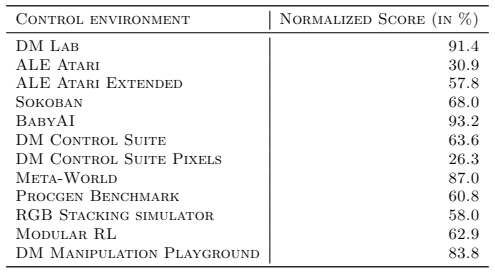
Table 8 :Normalized Gato per-domain scores.Averaged over 50 evaluations.
出典 · CC BY 4.0 · Scott Reed, Konrad Zolna, Emilio Parisotto, Sergio Gomez Colmenarejo, Alexander Novikov, Gabriel Barth-Maron, Mai Gimenez, Yury Sulsky, Jackie Kay, Jost Tobias Springenberg, Tom Eccles, Jake Bruce, Ali Razavi, Ashley Edwards, Nicolas Heess, Yutian Chen, Raia Hadsell, Oriol Vinyals, Mahyar Bordbar, Nando de Freitas · A Generalist Agent · 論文の図を引用 · 元のPDFの42ページ目から図の部分を抽出しています。これらの結果はすべて、1つの事前学習モデルによるシミュレーション評価です。実ロボットの結果とは区別して読む必要があり、別の専門家基準や別の環境設定で得られたスコアと、同じ条件で直接比較してはいけません。
RGB Stackingの実ロボット評価
ロボットの評価は、RGB Stackingベンチマークの2つのタスクに分かれます。Skill Generalizationは、学習データにない5物体の三つ組を積み上げるタスクです。Skill Masteryは、評価で使う物体形状のデータを学習に含めたタスクです。Skill Generalizationの実ロボット評価では、Gatoはテストの三つ組ごとに200エピソードを実行し、平均成功率は50.2%です。同じ表のBC-IMPベースラインは49%です。
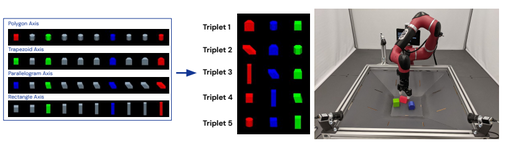
Figure 4 :RGB Stacking environment with the Sawyer robot arm.Blocks vary along several shape axes, with 5 held out test triplets. The goal is to stack red on blue, ignoring green.
出典 · CC BY 4.0 · Scott Reed, Konrad Zolna, Emilio Parisotto, Sergio Gomez Colmenarejo, Alexander Novikov, Gabriel Barth-Maron, Mai Gimenez, Yury Sulsky, Jackie Kay, Jost Tobias Springenberg, Tom Eccles, Jake Bruce, Ali Razavi, Ashley Edwards, Nicolas Heess, Yutian Chen, Raia Hadsell, Oriol Vinyals, Mahyar Bordbar, Nando de Freitas · A Generalist Agent · 論文の図を引用 · 元のPDFの7ページ目から図の部分を抽出しています。
Table 2 :Gato real robot Skill Generalization results.In addition to performing hundreds of other tasks, Gato also stacks competitively with the comparable published baseline.
出典 · CC BY 4.0 · Scott Reed, Konrad Zolna, Emilio Parisotto, Sergio Gomez Colmenarejo, Alexander Novikov, Gabriel Barth-Maron, Mai Gimenez, Yury Sulsky, Jackie Kay, Jost Tobias Springenberg, Tom Eccles, Jake Bruce, Ali Razavi, Ashley Edwards, Nicolas Heess, Yutian Chen, Raia Hadsell, Oriol Vinyals, Mahyar Bordbar, Nando de Freitas · A Generalist Agent · 論文の図を引用 · 元のPDFの10ページ目から図の部分を抽出しています。Skill Masteryの実ロボット結果は、Appendix Hにある以前のバージョンのGato構造を使い、ファインチューニングは行っていません。この結果では、Gatoの平均成功率は75.6%で、フィルタリングされたBC-IMPベースラインは74.6%です。2つの実ロボット結果は、いずれもベースラインとの差がわずかです。そのため、著者らはGatoがベースラインと同程度だと報告しており、大きな優位性は主張していません。

Table 3 :Real robot Skill Mastery results.Gato is competitive with the filtered BC baseline.
出典 · CC BY 4.0 · Scott Reed, Konrad Zolna, Emilio Parisotto, Sergio Gomez Colmenarejo, Alexander Novikov, Gabriel Barth-Maron, Mai Gimenez, Yury Sulsky, Jackie Kay, Jost Tobias Springenberg, Tom Eccles, Jake Bruce, Ali Razavi, Ashley Edwards, Nicolas Heess, Yutian Chen, Raia Hadsell, Oriol Vinyals, Mahyar Bordbar, Nando de Freitas · A Generalist Agent · 論文の図を引用 · 元のPDFの14ページ目から図の部分を抽出しています。少数デモのファインチューニングとモデル規模
事前学習の後は、新しいタスクへの適応を確認します。著者らは、長いプロンプトの文脈で適応する方法よりも、1つのタスクの少数のデモでパラメータをファインチューニングする方法を選びました。メモリ制約と、トークン化されたデモの長いシーケンスのため、文脈で十分な情報を与えるのは難しいからです。ファインチューニングは、学習率スケジュールを除けば事前学習とほぼ同じです。
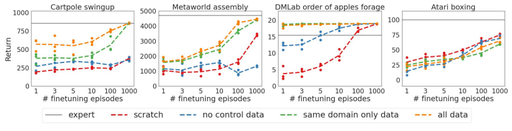
Figure 9 :Few-shot performance, ablating over various pretraining settings.Orange corresponds to the base Gato pretrained on all data. Red is trained from scratch only on the few-shot data.364M parameter variants of Gato were used for this experiment to save compute.
出典 · CC BY 4.0 · Scott Reed, Konrad Zolna, Emilio Parisotto, Sergio Gomez Colmenarejo, Alexander Novikov, Gabriel Barth-Maron, Mai Gimenez, Yury Sulsky, Jackie Kay, Jost Tobias Springenberg, Tom Eccles, Jake Bruce, Ali Razavi, Ashley Edwards, Nicolas Heess, Yutian Chen, Raia Hadsell, Oriol Vinyals, Mahyar Bordbar, Nando de Freitas · A Generalist Agent · 論文の図を引用 · 元のPDFの11ページ目から図の部分を抽出しています。モデル規模の比較では、79M、364M、1.18Bの3つのサイズを使いました。1.18Bモデルは、少数のファインチューニングデータが増えると、より少ないエピソードで適応する傾向があります。364Mモデルは、1つのエピソードで過学習し、性能が下がる区間があります。79Mモデルは、3つのサイズの中で最も低い性能にとどまります。著者らは、大きなモデルが事前学習データから得た表現を、テスト時により良く活用するという解釈を挙げています。
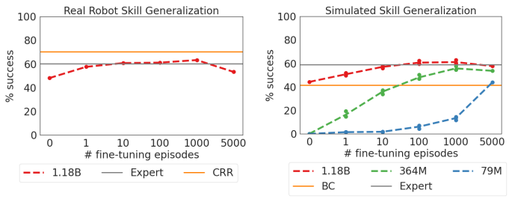
Figure 10 :Robotics fine-tuning results.Left: Comparison of real robot Skill Generalization success rate averaged across test triplets for Gato, expert, and CRR trained on 35k expert episodes (upper bound). Right: Comparison of simulated robot Skill Generalization success rate averaged across test triplets for a series of ablations on the number of parameters, including scores for expert and a BC baseline trained on 5k episodes.
出典 · CC BY 4.0 · Scott Reed, Konrad Zolna, Emilio Parisotto, Sergio Gomez Colmenarejo, Alexander Novikov, Gabriel Barth-Maron, Mai Gimenez, Yury Sulsky, Jackie Kay, Jost Tobias Springenberg, Tom Eccles, Jake Bruce, Ali Razavi, Ashley Edwards, Nicolas Heess, Yutian Chen, Raia Hadsell, Oriol Vinyals, Mahyar Bordbar, Nando de Freitas · A Generalist Agent · 論文の図を引用 · 元のPDFの12ページ目から図の部分を抽出しています。分布外タスクの実験では、Stack blue on greenのように、学習データにない目標の変化を扱います。このタスクでは、500個の実ロボットデモでファインチューニングしたGatoが60%の成功率を得ています。一方、ゼロから学習したBCベースラインは0.5%(200エピソード中1エピソード)を得ています。この結果は、このタスクとデータ構成の範囲に限って解釈すべきです。
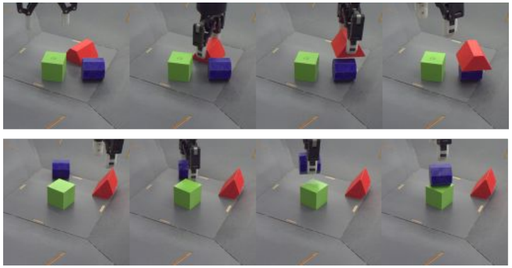
Figure 11 :Comparing training/test task goal variations.Top: the standard “stack red on blue” task tested in the Skill Generalization benchmark. Bottom: the novel “stack blue on green” task demonstrating Gato’s out of distribution adaptation to perceptual variations.
出典 · CC BY 4.0 · Scott Reed, Konrad Zolna, Emilio Parisotto, Sergio Gomez Colmenarejo, Alexander Novikov, Gabriel Barth-Maron, Mai Gimenez, Yury Sulsky, Jackie Kay, Jost Tobias Springenberg, Tom Eccles, Jake Bruce, Ali Razavi, Ashley Edwards, Nicolas Heess, Yutian Chen, Raia Hadsell, Oriol Vinyals, Mahyar Bordbar, Nando de Freitas · A Generalist Agent · 論文の図を引用 · 元のPDFの13ページ目から図の部分を抽出しています。単一ドメインの専門エージェントとGatoの違い
論文では、Gatoとは別に、単一ドメインの専門エージェントも学習しています。Meta-Worldの専門エージェントは79Mの構造を使い、50個のタスク全体で学習されます。タスクごとにMPO専門家を作り、その軌道を1つのエージェントに蒸留した結果です。このエージェントは、50個のタスクの平均で96.6%の成功率を報告しています。
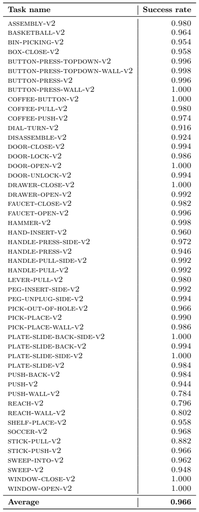
Table 7 :Success rates of specialist Meta-World agent.Averaged over 500 evaluations.
出典 · CC BY 4.0 · Scott Reed, Konrad Zolna, Emilio Parisotto, Sergio Gomez Colmenarejo, Alexander Novikov, Gabriel Barth-Maron, Mai Gimenez, Yury Sulsky, Jackie Kay, Jost Tobias Springenberg, Tom Eccles, Jake Bruce, Ali Razavi, Ashley Edwards, Nicolas Heess, Yutian Chen, Raia Hadsell, Oriol Vinyals, Mahyar Bordbar, Nando de Freitas · A Generalist Agent · 論文の図を引用 · 元のPDFの41ページ目から図の部分を抽出しています。ALE Atariの専門エージェントは、51個のタスク全体で学習され、1.18Bの構造を使います。このエージェントは、44個のゲームで平均的な人間以上の性能を得ています。著者らは、他の7個のゲームではオンラインの専門家も平均的な人間より低かったと説明しています。したがって、超人的なデータがあったゲームで、専門エージェントが超人的な性能を得たと解釈できます。この専門Atariエージェントは、Gatoの23個のゲームより多くのゲームで高い性能を得ています。ただし、専門エージェントは単一ドメインに特化した結果なので、Gatoの複数ドメインの性能と同じ対象として扱ってはいけません。
文脈長とデータ確保の限界
Gatoの文脈長は1024トークンです。この制限のため、画像の観測が多い環境では、デモエピソードの一部しか入力に入らない場合があります。著者らは、さまざまなプロンプト構造を試したところ性能は似ており、プロンプトによる文脈内学習も、プロンプトなしの評価に比べて明確には改善しなかったと報告しています。この限界は、自己注意の二乗的な規模の増加と関係すると説明されています。
データの面でも限界があります。Gatoは模倣学習で学習されるため、Webスケールの制御データは現在のところ容易に得られません。著者らは、オフラインRLデータセット、シミュレーション、実データ、観測のみのデータが代替になりうると論じています。ただし、これらの代替案はこの論文の実験で検証された結果ではありません。また、ロボット実験は特定のSawyerロボットとRGB Stackingタスクに限られており、他の実装体への汎化はこの論文では確認していません。
論文情報
- 著者
- Scott Reed, Konrad Zolna, Emilio Parisotto, Sergio Gomez Colmenarejo, Alexander Novikov, Gabriel Barth-Maron, Mai Gimenez, Yury Sulsky, Jackie Kay, Jost Tobias Springenberg, Tom Eccles, Jake Bruce, Ali Razavi, Ashley Edwards, Nicolas Heess, Yutian Chen, Raia Hadsell, Oriol Vinyals, Mahyar Bordbar, Nando de Freitas
- 学会・ジャーナル
- arXiv · プレプリント
- 公開日
- 2022年5月12日
- 登録日
- 2026年10月20日
- 更新日
- 2022年11月11日
- バージョン
- v3
- arXiv
- 2205.06175
- カテゴリ
- cs.AI · cs.CL · cs.LG · cs.RO
- ライセンス
- CC BY 4.0
- 掲載内容
- 論文情報・解説・論文の図
この解説は、Refivuの韓国語解説をAIで翻訳したものです。不正確な翻訳や誤りが含まれる可能性があります。論文と図の利用条件は各出典に従います。
アブストラクト
Inspired by progress in large-scale language modeling, we apply a similar approach towards building a single generalist agent beyond the realm of text outputs. The agent, which we refer to as Gato, works as a multi-modal, multi-task, multi-embodiment generalist policy. The same network with the same weights can play Atari, caption images, chat, stack blocks with a real robot arm and much more, deciding based on its context whether to output text, joint torques, button presses, or other tokens. In this report we describe the model and the data, and document the current capabilities of Gato.
この論文を引用
Scott Reed, Konrad Zolna, Emilio Parisotto, Sergio Gomez Colmenarejo, Alexander Novikov, Gabriel Barth-Maron, Mai Gimenez, Yury Sulsky, Jackie Kay, Jost Tobias Springenberg, Tom Eccles, Jake Bruce, Ali Razavi, Ashley Edwards, Nicolas Heess, Yutian Chen, Raia Hadsell, Oriol Vinyals, Mahyar Bordbar, Nando de Freitas (2022). A Generalist Agent. arXiv:2205.06175v3. https://arxiv.org/abs/2205.06175v3
BibTeX
@misc{reed2022generalist,
  title = {{A Generalist Agent}},
  author = {Scott Reed and Konrad Zolna and Emilio Parisotto and Sergio Gomez Colmenarejo and Alexander Novikov and Gabriel Barth-Maron and Mai Gimenez and Yury Sulsky and Jackie Kay and Jost Tobias Springenberg and Tom Eccles and Jake Bruce and Ali Razavi and Ashley Edwards and Nicolas Heess and Yutian Chen and Raia Hadsell and Oriol Vinyals and Mahyar Bordbar and Nando de Freitas},
  year = {2022},
  eprint = {2205.06175},
  archivePrefix = {arXiv},
  url = {https://arxiv.org/abs/2205.06175v3}
}