논문 해설
ARMBench: An Object-centric Benchmark Dataset for Robotic Manipulation
ARMBench: 로봇 조작을 위한 객체 중심 벤치마크 데이터셋
- 연구 문제 창고의 다양한 물체와 상호작용을 담은 대규모 로봇 조작 데이터셋이 부족하여, ARMBench는 실제 창고 pick-and-place 데이터로 이를 보완합니다.
- 연구 방법 아마존 창고 작업셀에서 수집한 이미지·비디오·메타데이터로 분할, 식별, 결함 검출 과제의 기준선을 구성합니다.
- 주요 결과 mix-object-tote에서 Mask R-CNN은 mAP50 0.72였고, 전이 세트에서는 0.25와 0.11로 떨어졌습니다. 결함 검출 recall은 기준선별로 크게 달라 웨어하우스 요구 수준에는 미치지 못했습니다.
창고 로봇 조작에 필요한 데이터의 공백
창고에서는 다양한 물체가 정해진 배치 없이 용기에 담겨 있고, 로봇 팔은 그중 한 번에 한 물체를 집어 옮겨야 합니다. 이때 시스템은 물체를 분할하고, 식별하고, 집기 과정의 결함을 찾아야 합니다. 기존 데이터셋은 물체 종류가 적거나 3D 모델로 합성한 장면에 치우쳐 있어 창고 환경의 다양성과 상호작용을 충분히 담지 못합니다. ARMBench는 이 공백을 메우기 위해 아마존 창고의 실제 pick-and-place 작업에서 수집한 대규모 객체 중심 데이터셋으로 제시됩니다. 논문은 객체 분할, 객체 식별, 결함 검출의 세 과제에 대해 기준선 성능을 함께 보고합니다.
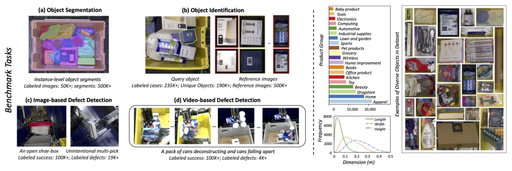
Fig. 2 . (left) Benchmark tasks and annotation statistics on the ARMBench dataset. (right) Distribution of product-groups and object dimensions for 190,00+ unique objects in the dataset.
원문 · CC BY 4.0 · Chaitanya Mitash, Fan Wang, Shiyang Lu, Vikedo Terhuja, Tyler Garaas, Felipe Polido, Manikantan Nambi · ARMBench: An Object-centric Benchmark Dataset for Robotic Manipulation · 원문 그림 인용 · 원본 PDF 3쪽에서 그림 영역을 추출했습니다.데이터 수집 구성과 주석
ARMBench는 진공 흡착식 末端 장치를 단 로봇 팔이 용기 안의 물체를 한 개씩 옮기는 작업셀에서 수집됩니다. 각 pick 활동에는 상단 카메라의 pick 이미지, 여러 측면 카메라의 전달 이미지, 배치 후 place 이미지와 720p 비디오가 연결됩니다. 메타데이터로는 창고 추적 시스템의 컨테이너 매니페스트와 이전 작업에서 얻은 참조 이미지가 제공됩니다. 물체 ID는 작업셀의 바코드 스캐너로 자동 획득되며, 스캔되지 않은 경우 작업자가 수동으로 스캔합니다.
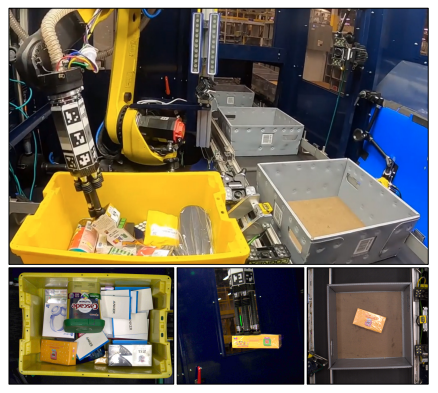
Fig. 1 . A large-scale object dataset is collected using a robotic manipulation system operating in an Amazon warehouse. The robotic arm picks one object at a time from the yellow container and places it in a gray tray (top). The dataset contains images for different phases of manipulation i.e., image of objects in the yellow container before picking (bottom-left), during transfer (bottom-mid) and after placement (bottom-right). In addition to sensor data, the dataset also provides high-quality annotations for tasks such as object segmentation, object identification, and defect detection.
원문 · CC BY 4.0 · Chaitanya Mitash, Fan Wang, Shiyang Lu, Vikedo Terhuja, Tyler Garaas, Felipe Polido, Manikantan Nambi · ARMBench: An Object-centric Benchmark Dataset for Robotic Manipulation · 원문 그림 인용 · 원본 PDF 1쪽에서 그림 영역을 추출했습니다.객체 분할 기준선과 장면 변화
객체 분할 과제는 용기 안에 저장된 개별 물체를 식별하고 경계를 구분하는 인스턴스 분할입니다. 주 데이터셋인 mix-object-tote는 44,253개 이미지와 467,225개 주석으로 구성되며, 이미지당 평균 10.5개의 물체 분할이 있습니다. 기준선은 ResNet-50 백본을 쓰는 Mask R-CNN을 mix-object-tote에서 학습한 것이며, 학습 스케줄과 하이퍼파라미터는 MS-COCO 기본 설정을 따르고 train-valid-test 비율은 0.7:0.15:0.15입니다. 같은 모델은 mix-object-tote에서 mAP50 0.72, mAP75 0.61을 보였습니다. 다른 창고에서 촬영한 zoomed-out-tote-transfer-set에서는 mAP50 0.25, mAP75 0.19로 떨어졌고, 같은 물체가 촘촘히 쌓인 same-object-transfer-set에서는 mAP50 0.11, mAP75 0.10이었습니다.
이 두 전이 결과는 mix-object-tote로 학습한 모델을 그대로 적용했을 때의 값입니다. 논문은 물체 수가 늘수록 성능이 낮아지며, 1~5개 인스턴스에서 mAP50이 0.95였던 것이 26개를 넘으면 0.38 수준으로 떨어진다고 보고합니다.
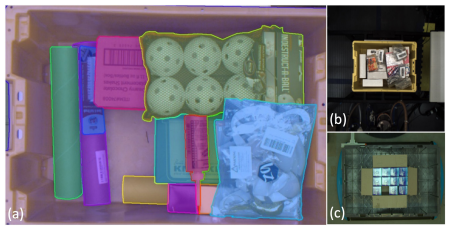
Fig. 3 . (a) Segmentation annotation overlaid on an image from mix- object-tote. Each identifiable item is segmented regardless of its size and occlusion. Multiple objects in the same package are considered as one object and is delineated by the boundary of the package. In particular, items wrapped in transparent packaging are segmented by the peripheral of the package, although other products may be seen through them. (b- c) Example images from zoomed-out-tote-transfer-set and same-object- transfer-set subsets representing variations in background, scale, and clutter.
원문 · CC BY 4.0 · Chaitanya Mitash, Fan Wang, Shiyang Lu, Vikedo Terhuja, Tyler Garaas, Felipe Polido, Manikantan Nambi · ARMBench: An Object-centric Benchmark Dataset for Robotic Manipulation · 원문 그림 인용 · 원본 PDF 4쪽에서 그림 영역을 추출했습니다.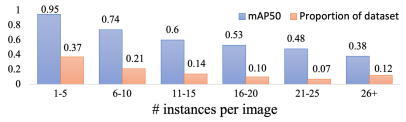
Fig. 4 . Performance on mix-object-tote with varying degree of clutter.
원문 · CC BY 4.0 · Chaitanya Mitash, Fan Wang, Shiyang Lu, Vikedo Terhuja, Tyler Garaas, Felipe Polido, Manikantan Nambi · ARMBench: An Object-centric Benchmark Dataset for Robotic Manipulation · 원문 그림 인용 · 원본 PDF 4쪽에서 그림 영역을 추출했습니다.객체 식별을 이미지 검색으로 보는 기준선
객체 식별은 분할된 질의 이미지가 데이터베이스의 어떤 물체인지 찾는 과제이며, 논문은 이를 이미지 검색 문제로 정의합니다. 질의 이미지는 pick 및 전달 단계의 분할 결과이고, 갱신 대상이 아닌 컨테이너 매니페스트의 참조 이미지가 갤러리가 됩니다. 기준선으로는 ImageNet 분류로 사전 학습된 ResNet50-RMAC의 512차원 디스크립터와, 자기지도 학습된 DINO-ViTS의 384차원 특징이 쓰이며, 두 임베딩 사이의 코사인 유사도로 가장 가까운 후보를 고릅니다. 기본 테스트 세트는 참조 이미지가 있는 50,000개 pick 활동으로 구성되고, test-uncertainty 세트는 집은 물체의 참조 이미지를 20%의 사례에서 제외해 새 물체 상황을 모사합니다.
상위 1개 기준 recall@1은 pre-pick에서 ResNet50-RMAC 71.7, DINO-ViTS 77.2이며, test-uncertainty에서는 각각 57.7과 61.9입니다. 두 값 모두 원문 표의 pre-pick/post-pick 쌍 중 pre-pick 값입니다. 전달 이미지를 더한 post-pick 시나리오에서는 여러 시점이 더해져 검색률이 조금 높아집니다.
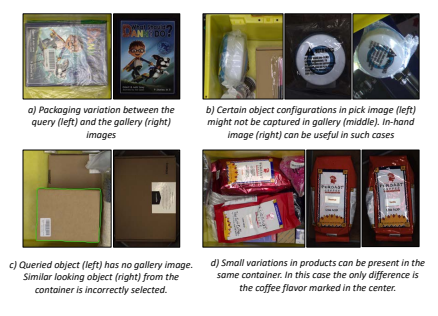
Fig. 5 . Challenging cases for Object Identification
원문 · CC BY 4.0 · Chaitanya Mitash, Fan Wang, Shiyang Lu, Vikedo Terhuja, Tyler Garaas, Felipe Polido, Manikantan Nambi · ARMBench: An Object-centric Benchmark Dataset for Robotic Manipulation · 원문 그림 인용 · 원본 PDF 5쪽에서 그림 영역을 추출했습니다.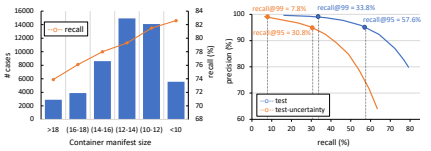
Fig. 6 . Container manifest size (left) is indicative of the number of images that the algorithm needs to select from. The precision-recall curve (right) shows the need for a confidence model to prevent false-positive predictions.
원문 · CC BY 4.0 · Chaitanya Mitash, Fan Wang, Shiyang Lu, Vikedo Terhuja, Tyler Garaas, Felipe Polido, Manikantan Nambi · ARMBench: An Object-centric Benchmark Dataset for Robotic Manipulation · 원문 그림 인용 · 원본 PDF 5쪽에서 그림 영역을 추출했습니다.결함 검출 기준선과 남은 격차
결함 검출은 로봇 조작 활동이 결함을 일으켰는지 판단하는 과제이며, 결함은 여러 물체가 함께 집히는 multi-pick과 포장이 열리거나 물체가 분리되는 package-defect로 나뉩니다. package-defect는 open과 deconstruction 하위 유형으로 정의됩니다. 단일 뷰 이미지 실험에서는 ResNet-50 분류기를 global average pooling과 focal loss로 학습했고, 이미지 19,303개를 대상으로 했습니다. 이 결과에서 multi-pick의 recall은 0.34, package-defect의 recall은 0.73, combined의 recall은 0.57이며 fpr은 세 열 모두 0.05입니다.
비디오 실험에서는 MViT-B를 각 비디오의 32개 프레임(약 5 FPS 샘플링)으로 학습했고, open의 recall은 0.69, deconstruction의 recall은 0.79, combined의 recall은 0.73입니다. 같은 비디오 결과에서 fpr은 open 0.23, deconstruction 0.03, combined 0.13입니다. 저자들은 웨어하우스 운영에 필요한 recall이 0.95를 넘고 fpr이 0.01 미만이어야 한다고 보며, 현재 기준선은 이 수준에 미치지 못한다고 해석합니다.
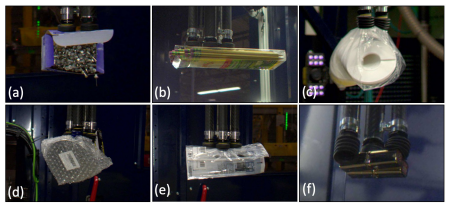
Fig. 7 . Multi-view images in the defect detection dataset showing (a)–(c) package-defect and (d)–(f) multi-pick defect for different types of objects.
원문 · CC BY 4.0 · Chaitanya Mitash, Fan Wang, Shiyang Lu, Vikedo Terhuja, Tyler Garaas, Felipe Polido, Manikantan Nambi · ARMBench: An Object-centric Benchmark Dataset for Robotic Manipulation · 원문 그림 인용 · 원본 PDF 6쪽에서 그림 영역을 추출했습니다.적용 범위와 한계
이 결과는 ARMBench의 특정 작업셀과 창고 데이터, 그리고 명시된 기준선 모델에서 얻은 것입니다. 분할 결과는 mix-object-tote에서 학습한 Mask R-CNN과 ResNet-50 백본에 해당하며, 다른 백본이나 다른 학습 데이터에서 같은 수치가 나온다고 보장하지 않습니다. 식별 결과는 사전 학습된 특징과 코사인 유사도를 쓴 기준선이며, 불확실성 추정이나 텍스트·치수 같은 추가 모달리티는 평가되지 않았습니다. 결함 검출은 저자들이 제시한 recall과 fpr 목표에 아직 도달하지 못했습니다. 논문은 향후 데이터 확장과 3D 데이터 추가를 계획으로 밝힙니다.
논문 정보
- 저자
- Chaitanya Mitash, Fan Wang, Shiyang Lu, Vikedo Terhuja, Tyler Garaas, Felipe Polido, Manikantan Nambi
- 학회·저널
- arXiv · 프리프린트
- 최초 공개일
- 2023년 3월 29일
- 등록일
- 2026년 11월 4일
- 수정일
- 2023년 3월 29일
- 버전
- v1
- arXiv
- 2303.16382
- 분류
- cs.RO · cs.CV
- 원문 이용 조건
- CC BY 4.0
- 제공 범위
- 논문 정보, 해설, 허용된 원문 그림
AI 해설은 논문 원문과 별개의 설명이며 오류가 있을 수 있습니다. 원문과 그림은 각 출처의 이용 조건과 따로 표시된 권리를 따릅니다.
초록
This paper introduces Amazon Robotic Manipulation Benchmark (ARMBench), a large-scale, object-centric benchmark dataset for robotic manipulation in the context of a warehouse. Automation of operations in modern warehouses requires a robotic manipulator to deal with a wide variety of objects, unstructured storage, and dynamically changing inventory. Such settings pose challenges in perceiving the identity, physical characteristics, and state of objects during manipulation. Existing datasets for robotic manipulation consider a limited set of objects or utilize 3D models to generate synthetic scenes with limitation in capturing the variety of object properties, clutter, and interactions. We present a large-scale dataset collected in an Amazon warehouse using a robotic manipulator performing object singulation from containers with heterogeneous contents. ARMBench contains images, videos, and metadata that corresponds to 235K+ pick-and-place activities on 190K+ unique objects. The data is captured at different stages of manipulation, i.e., pre-pick, during transfer, and after placement. Benchmark tasks are proposed by virtue of high-quality annotations and baseline performance evaluation are presented on three visual perception challenges, namely 1) object segmentation in clutter, 2) object identification, and 3) defect detection. ARMBench can be accessed at http://armbench.com
원문 인용
Chaitanya Mitash, Fan Wang, Shiyang Lu, Vikedo Terhuja, Tyler Garaas, Felipe Polido, Manikantan Nambi (2023). ARMBench: An Object-centric Benchmark Dataset for Robotic Manipulation. arXiv:2303.16382v1. https://arxiv.org/abs/2303.16382v1
BibTeX
@misc{mitash2023armbench,
  title = {{ARMBench: An Object-centric Benchmark Dataset for Robotic Manipulation}},
  author = {Chaitanya Mitash and Fan Wang and Shiyang Lu and Vikedo Terhuja and Tyler Garaas and Felipe Polido and Manikantan Nambi},
  year = {2023},
  eprint = {2303.16382},
  archivePrefix = {arXiv},
  url = {https://arxiv.org/abs/2303.16382v1}
}