논문 해설
Dynamic Relational Priming Improves Transformer in Multivariate Time Series
동적 관계 프라이밍이 다변량 시계열에서 트랜스포머를 향상시킨다
- 연구 문제 표준 어텐션은 토큰 표현을 모든 쌍별 계산에 고정하므로 이질적인 채널 간 의존성을 충분히 포착하기 어렵습니다.
- 연구 방법 프라임 어텐션은 키와 밸류를 토큰 쌍마다 학습 가능한 primer로 원소별 변조하여 쌍별 동적 관계 학습을 수행합니다.
- 주요 결과 백본 교체 실험에서 Weather 데이터셋의 Timer-XL 기준 최대 6.5%의 예측 정확도 향상이 보고되었고, L=48과 L=64에서 L=96 표준 어텐션 기준선을 넘었습니다.
정적 관계 학습의 한계
다변량 시계열 데이터에서는 채널 쌍마다 서로 다른 물리 법칙이나 시간적 동역학이 나타날 수 있습니다. 표준 어텐션은 각 층에서 토큰 표현을 모든 쌍별 계산에 동일하게 사용하므로, 한 토큰이 상대 토큰과 무관하게 같은 표현으로 참여합니다. 저자들은 이를 정적 관계 학습(static relational learning)이라고 부릅니다. 이 논문은 이러한 정적 관계 학습의 한계를 다루며, 쌍마다 표현을 다르게 조정하는 동적 관계 학습으로의 전환을 목표로 합니다.
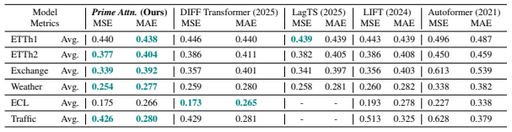
Table 2 .Performance comparison between prime attention and existing works in MTS that enhance and leverage relational information (abridged). Lower values indicate better performance. Full table is available in Section F, Table 8.
원문 · CC BY 4.0 · Hunjae Lee, Corey Clark · Dynamic Relational Priming Improves Transformer in Multivariate Time Series · 원문 그림 인용 · 원본 PDF 7쪽에서 그림 영역을 추출했습니다.프라임 어텐션의 쌍별 변조
프라임 어텐션은 키와 밸류를 토큰 쌍마다 학습 가능한 primer F_ij로 원소별 곱하여 변조합니다. 원문은 키와 밸류를 각각 ekj = kj ⊙ Fij, evj = vj ⊙ Fij로 정의합니다. primer는 무작위 초기화를 항등 근처에서 시작하거나, 선행-후행 계수와 순간 상관으로 편향된 초기화 값을 MLP로 학습 가능하게 만듭니다. 이 설정에서 primer는 쌍별 관계 맥락을 담으므로, 같은 토큰이라도 상대에 따라 다른 표현으로 상호작용합니다.
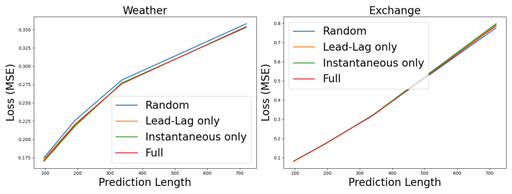
Figure 5 .Effect that different initialization strategies for pair-wise modulation primer F has on performance (y-axis, lower is better) across prediction lengths (x-axis).
원문 · CC BY 4.0 · Hunjae Lee, Corey Clark · Dynamic Relational Priming Improves Transformer in Multivariate Time Series · 원문 그림 인용 · 원본 PDF 19쪽에서 그림 영역을 추출했습니다.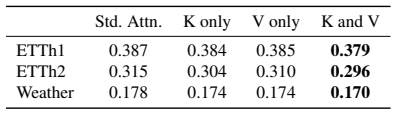
Table 7 .Effect of applying filter modulation to the keys (K), values (V), or both, compared to standard attention. Values are MSE (lower is better); the best result per dataset is inbold.
원문 · CC BY 4.0 · Hunjae Lee, Corey Clark · Dynamic Relational Priming Improves Transformer in Multivariate Time Series · 원문 그림 인용 · 원본 PDF 23쪽에서 그림 영역을 추출했습니다.쌍별 동적 학습의 논증
명제 4.1의 논증에서 프라임 어텐션은 h_j→i에 F_ji를 곱하고 h_j→v에 F_jv를 곱합니다. 학습 후 F_ji와 F_jv가 서로 같지 않다는 가정이 성립하면, 같은 토큰 j의 표현이 상대 i와 v에 따라 달라집니다. 이 논증은 조건부 결론이며, primer가 항상 서로 달라진다는 전체 공간의 성질로 읽지 않아야 합니다.
백본별 예측 정확도 비교
백본 Timer-XL, FreDF, iTransformer에서 표준 어텐션과 프라임 어텐션을 비교했습니다. 룩백 윈도우 L은 96으로 고정했고 예측 호라이즌은 96, 192, 336, 720입니다. 프라임 어텐션 버전은 주 어텐션 블록만 교체하고 드롭아웃만 재조정했습니다. 이질적인 채널을 가진 Weather에서는 Timer-XL 기준 최대 6.5%의 개선이 보고되었고, ECL과 Traffic에서는 이득이 작았습니다.
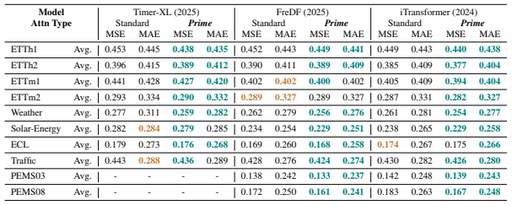
Table 1 .Comparison between standard attention and prime attention on recent state-of-the-art transformer models (abridged). Lower values indicate better performance. Full table is available in Section F, Table 9.
원문 · CC BY 4.0 · Hunjae Lee, Corey Clark · Dynamic Relational Priming Improves Transformer in Multivariate Time Series · 원문 그림 인용 · 원본 PDF 6쪽에서 그림 영역을 추출했습니다.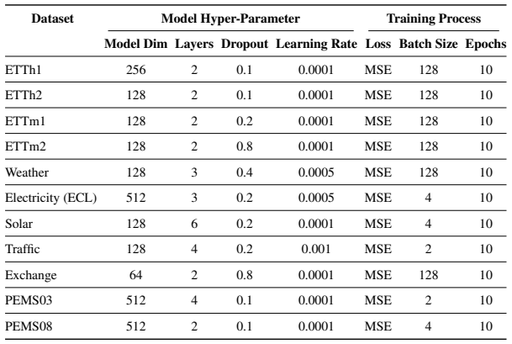
Table 5 .Model configurations across different datasets with iTransformer (Liu et al., 2024) backbone. We keep the hyperparameters used with standard attention (with dropout being the only exception) in prime attention to ensure fair comparison.
원문 · CC BY 4.0 · Hunjae Lee, Corey Clark · Dynamic Relational Priming Improves Transformer in Multivariate Time Series · 원문 그림 인용 · 원본 PDF 14쪽에서 그림 영역을 추출했습니다.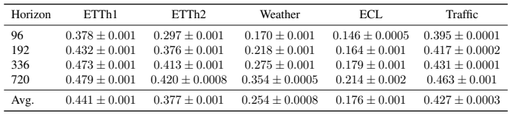
Table 6 .Averaged forecasting results from 5 independent runs with standard deviation.
원문 · CC BY 4.0 · Hunjae Lee, Corey Clark · Dynamic Relational Priming Improves Transformer in Multivariate Time Series · 원문 그림 인용 · 원본 PDF 15쪽에서 그림 영역을 추출했습니다.입력 길이 효율과 분석의 범위
입력 길이 분석에서는 L을 16부터 96까지 바꾸고 호라이즌을 96으로 고정했으며, 백본은 iTransformer입니다. 프라임 어텐션은 L이 48과 64일 때 L=96의 표준 어텐션 기준선을 넘었다고 보고되며, 이는 각각 40%와 33% 적은 입력에 해당합니다. 어텐션 맵 분석은 Solar 데이터셋에서 표준 어텐션이 한 채널에 과도하게 의존하는 현상을 보여 주지만, 저자들은 이를 상관적 증거로 해석합니다.
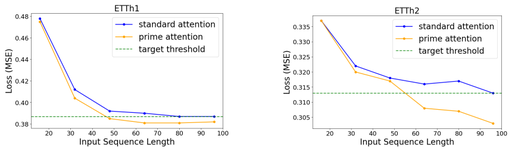
Figure 1 .Comparing performance between standard (blue) and prime (yellow) attention at various input sequence length (or look-back window L). The horizontal target threshold line (green, dotted) represents standard attention’s performance at L= 96 . Lower values indicate better performance.
원문 · CC BY 4.0 · Hunjae Lee, Corey Clark · Dynamic Relational Priming Improves Transformer in Multivariate Time Series · 원문 그림 인용 · 원본 PDF 8쪽에서 그림 영역을 추출했습니다.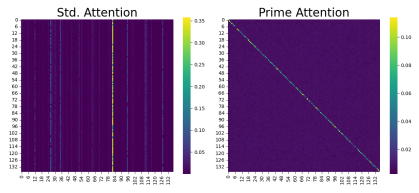
Figure 2 .Attention map comparison between standard and prime attention on the Solar dataset. Standard attention (left) shows an over-reliance on a single channel (displayed as a yellow vertical line) which may indicate that the model is prematurely converging to an easy solution, unable to capture more diverse and complex patterns. Prime attention (right) on the other hand shows its ability to act as asoftCI model, learning to prioritize self-signals along the diagonal instead of developing an over-reliance on a single channel.
원문 · CC BY 4.0 · Hunjae Lee, Corey Clark · Dynamic Relational Priming Improves Transformer in Multivariate Time Series · 원문 그림 인용 · 원본 PDF 8쪽에서 그림 영역을 추출했습니다.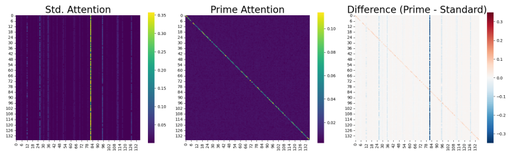
Figure 8 .Attention maps of standard attention (left), prime attention (middle), and their difference (right) on the Solar dataset. Warmer colors (yellow/green) reflect higher attention coefficient and colder colors (blue/purple) reflect lower attention coefficient.
원문 · CC BY 4.0 · Hunjae Lee, Corey Clark · Dynamic Relational Priming Improves Transformer in Multivariate Time Series · 원문 그림 인용 · 원본 PDF 20쪽에서 그림 영역을 추출했습니다.논문 정보
- 저자
- Hunjae Lee, Corey Clark
- 학회·저널
- arXiv · 프리프린트
- 최초 공개일
- 2025년 9월 15일
- 등록일
- 2026년 10월 29일
- 수정일
- 2026년 10월 22일
- 버전
- v3
- arXiv
- 2509.12196
- 분류
- cs.LG · cs.AI
- 원문 이용 조건
- CC BY 4.0
- 제공 범위
- 논문 정보, 해설, 허용된 원문 그림
AI 해설은 논문 원문과 별개의 설명이며 오류가 있을 수 있습니다. 원문과 그림은 각 출처의 이용 조건과 따로 표시된 권리를 따릅니다.
초록
Standard attention mechanisms in transformers employ static token representations that remain unchanged across all pair-wise computations in each layer. This limits their representational alignment with the potentially diverse relational dynamics of each token-pair interaction. While they excel in domains with relatively homogeneous relationships, standard attention's static relational learning struggles to capture the diverse, heterogeneous inter-channel dependencies of multivariate time series (MTS) data--where different channel-pair interactions within a single system may be governed by entirely different physical laws or temporal dynamics. To better align the attention mechanism for such domain phenomena, we propose attention with dynamic relational priming (prime attention). Unlike standard attention where each token presents an identical representation across all of its pair-wise interactions, prime attention tailors each token dynamically (or per interaction) through learnable modulations to best capture the unique relational dynamics of each token pair, optimizing each pair-wise interaction for that specific relationship. This representational plasticity of prime attention enables effective extraction of relationship-specific information in MTS while maintaining the same asymptotic computational complexity as standard attention. Our results demonstrate that prime attention consistently outperforms standard attention across benchmarks, achieving up to 6.5\% improvement in forecasting accuracy. In addition, we find that prime attention achieves comparable or superior performance using up to 40\% less sequence length compared to standard attention, further demonstrating its superior relational modeling capabilities.
원문 인용
Hunjae Lee, Corey Clark (2025). Dynamic Relational Priming Improves Transformer in Multivariate Time Series. arXiv:2509.12196v3. https://arxiv.org/abs/2509.12196v3
BibTeX
@misc{lee2025dynamic,
  title = {{Dynamic Relational Priming Improves Transformer in Multivariate Time Series}},
  author = {Hunjae Lee and Corey Clark},
  year = {2025},
  eprint = {2509.12196},
  archivePrefix = {arXiv},
  url = {https://arxiv.org/abs/2509.12196v3}
}