논문 해설
Opening the Black Box of Neural Auction Mechanisms
신경 경매 메커니즘의 블랙박스 열기
- 연구 문제 신경 경매는 학습된 할당·지불 규칙이 내부에서 어떻게 작동하는지 드러나지 않아 감사와 신뢰에 한계가 있습니다. 이 논문은 구조를 바꾸지 않고 CITransNet을 사후에 감사하는 프레임워크를 제안합니다.
- 연구 방법 CITransNet의 은닉 표현을 TopK 희소 자동인코더로 분해하고, 특징 설명의 활성 예측과 용량 개입에 따른 경제 목표 변화를 검증합니다.
- 주요 결과 2×5c 설정에서 SAE 재구성은 할당 L1 차이 0.003013과 지불 L1 차이 0.000534를 보였으며, 512개 특징 중 165개가 단조 반응을 보인 강한 반응 특징으로 선택되었습니다.
신경 경매의 불투명성 문제
신경 경매는 할당과 지불 규칙을 심층 신경망으로 학습하므로, 학습된 메커니즘이 어떤 내부 상태로 경제적 결과를 만드는지 직접 확인하기 어렵습니다. 논문은 이 불투명성이 감사 가능성과 신뢰의 문제로 이어진다고 봅니다. 기존 접근은 설계 단계의 구조 제약이나 형식 검증으로 신뢰를 확보하려 했지만, 이는 표현력과 수익을 희생하거나 확장성에 한계가 있다고 논문은 지적합니다. 이 연구는 이미 학습된 신경 경매를 구조 변경 없이 사후에 감사하는 방향을 택합니다.
핵심 난점은 두 가지입니다. 첫째, 활성화 문맥은 의미 구조가 드러나지 않는 조밀하고 상관된 수치 프로파일입니다. 둘째, 특징 해석은 측정 가능한 경매 상태나 결과에 대응될 때에만 반증 가능하게 검사할 수 있습니다. 따라서 논문은 특징을 자유로운 의미 발견이 아니라 메커니즘의 기본 경제 목표에 연결하는 방식을 제안합니다.
희소 분해와 경제 목표 정의
감사 대상은 CITransNet의 고정된 체크포인트입니다. 논문은 경매 인스턴스를 x=(v,b,c)로 두고, 입찰자 i와 물품 j의 할당 확률 A_ij와 지불 p_i를 모델 출력으로 정의합니다. 할당과 지불 규칙의 파라미터 θ는 감사 중 고정됩니다.
은닉 표현 h_t는 입찰자–물품 쌍 t=(x,i,j)에서 얻으며, 학습 분할 통계량으로 표준화한 뒤 TopK SAE에 입력합니다. 인코더 출력에 ReLU를 적용하고 상위 s개의 양수 활성만 남기므로, 512개 특징 사전에서 쌍마다 최대 32개 특징만 활성화됩니다. 디코더는 표준화된 표현을 재구성하고, 재구성 상태는 원래 스케일로 되돌린 뒤 동결된 CITransNet의 해당 은닉 상태를 대체합니다.
특징을 해석하기 위해 논문은 일곱 가지 경제 목표를 정의합니다. 수익 R(x), 사회적 후생 W(x), 입찰자 효용 U_i(x), 지불 비율 P_i(x), 할당 엔트로피 H(x), 승자 여유 L(x)는 순전파 결과입니다. 반면 인센티브 점수 I(x)=−Reg^d_θ(x)는 탐색으로 구한 허위보고 이득을 반영하는 반사실 지표입니다.
재구성 충실도와 설명 예측
SAE 재구성이 원래 메커니즘의 동작을 보존하는지 확인하기 위해, 논문은 재구성 상태로 대체한 메커니즘과 원래 메커니즘의 할당·지불 L1 차이를 측정합니다. 2×5c 설정에서 표준화 재구성 MSE는 4.44×10^−5이며, 평균 할당 L1 차이는 0.003013, 평균 지불 L1 차이는 0.000534로 보고됩니다. 이 값은 2입찰자 5물품 연속 문맥 설정의 주 평가에 대한 결과입니다.
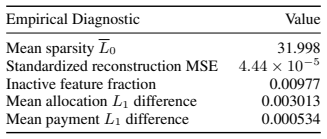
Table 1 : Representational and downstream output fidelity of the SAE in2×5c.
원문 · CC BY 4.0 · Li Kong, Zilong Liu, Haoyang Zhou, Hanbing Liu, Qi Qi · Opening the Black Box of Neural Auction Mechanisms · 원문 그림 인용 · 원본 PDF 7쪽에서 그림 영역을 추출했습니다.특징 설명의 검증은 생성 분할과 예측 분할을 분리하여 수행합니다. 생성 단계에서 특징과 경제 목표의 Spearman 순위 상관으로 목표와 방향 d_f를 정하고, 예측 단계에서 설명만 보고 활성 여부를 판단하는 블라인드 예측을 수행합니다. 균형 잡힌 벤치마크에서 전체 설명은 pooled precision 0.630, recall 0.672를 얻었습니다. 설명만 제공한 설정과 목표만 제공한 설정의 비교는 두 입력이 상보적임을 보여 주며, 셔플 설명과 빈도 일치 설명은 설명 내용의 의미가 예측에 기여함을 확인하는 대조군입니다.
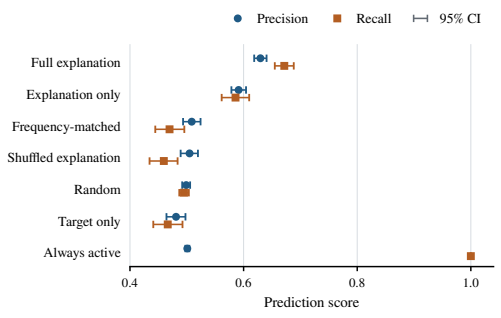
Figure 1 : Activation-prediction fidelity across all 512 features. Points display pooled precision and recall with 95% feature-bootstrap confidence intervals.
원문 · CC BY 4.0 · Li Kong, Zilong Liu, Haoyang Zhou, Hanbing Liu, Qi Qi · Opening the Black Box of Neural Auction Mechanisms · 원문 그림 인용 · 원본 PDF 7쪽에서 그림 영역을 추출했습니다.용량 개입과 강한 반응 특징
활성 예측은 특징이 언제 켜지는지를 설명하지만, 인과적 영향을 보여 주지는 않습니다. 그래서 논문은 특징 f의 활성을 용량 계수 γ로 곱한 뒤 재구성 상태를 다시 디코딩하여 메커니즘을 편집합니다. 용량 grid는 {0, 0.5, 1, 2}이며 γ=1은 재구성 기준선입니다. 각 경매에서 OLS 기울기 β_xf를 계산하고, 활성 경매에서 방향 가설을 단측 t검정으로 검사합니다.
강한 반응 특징 집합은 BH 보정 q값이 0.05 이하이고, 각 용량 구간에서 방향 d_f에 맞는 단조 증가가 함께 성립할 때 정의됩니다. 이 기준으로 512개 특징 중 165개가 선택되었습니다. 추가 용량 grid γ=8까지 확장하면 165개 중 158개가 유지되며, 이는 부록 확장 실험에서 보고된 결과입니다. 선택된 특징 중 163개는 평균 반응이 용량에 대해 거의 선형에 가까우며 R²≥0.95를 보였습니다.
허위보고 후회 감사와 Myerson 정렬
검증된 특징은 메커니즘 분석 도구로 쓰일 수 있습니다. 첫 번째 분석은 특징 개입 후 재최적화된 허위보고 아래의 경험적 후회 변화입니다. 논문은 경험적 후회를 진실 보고를 포함한 수치 탐색으로 근사하며, 165개 강한 반응 특징 중 88개는 평균 기울기가 양수이고 77개는 음수라고 보고합니다. BH 기준 q≤0.05에서는 26개가 후회를 높이고 17개가 낮추는 특징으로 나타납니다. 지불 비율 관련 특징 집합에서는 두 방향이 모두 관찰되었습니다.
두 번째 분석은 2입찰자 단일 물품 설정의 Myerson 오라클과의 정렬입니다. 가상 가치 φ_i(v_i)=2v_i−v̄_i에 따라 세 영역, 즉 판매 없음, 입찰자 0 낙찰, 입찰자 1 낙찰을 구분합니다. 특징 F62는 판매 없음 영역에서 AUC 0.9636을 보이며, F73과 F421은 입찰자별 낙찰 영역에서 AUC 0.9129와 0.9277을 보고합니다. F62를 제거하면 할당 MAE가 증가하고 두 배로 증폭하면 MAE가 감소하여, 이 설정에서는 오라클 방향과의 정렬이 개입으로 달라진다고 볼 수 있습니다.
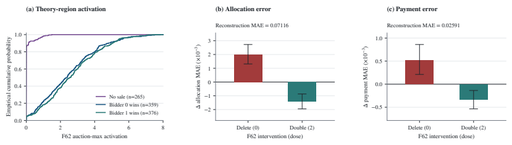
Figure 4 : Alignment with optimal-auction theory for feature F62 in the 2×1 c setting. (a) Empirical cumulative distribution of F62 auction-maximum activation across the three Myerson oracle regions on 1,000 evaluation auctions. (b, c) Paired changes in allocation and payment MAE relative to theγ= 1 reconstruction baseline when ablating at dose 0 or doubling at dose 2, with 95% auction-bootstrap confidence intervals. Negative values indicate closer agreement with the Myerson oracle.
원문 · CC BY 4.0 · Li Kong, Zilong Liu, Haoyang Zhou, Hanbing Liu, Qi Qi · Opening the Black Box of Neural Auction Mechanisms · 원문 그림 인용 · 원본 PDF 10쪽에서 그림 영역을 추출했습니다.적용 범위와 남은 질문
논문의 주요 결과는 2입찰자 5물품 연속 문맥 설정의 CITransNet 체크포인트에서 얻은 것입니다. 2×1c와 2×5d 설정은 독립적으로 학습한 메커니즘과 SAE 사전에서 같은 4용량 절차를 적용한 보조 감사이며, 강한 반응 특징은 각각 106개와 142개로 보고됩니다. 따라서 이 결과를 모든 신경 경매 아키텍처나 임의의 입찰자 수로 일반화할 수는 없습니다.
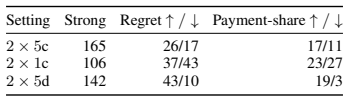
Table 7 : Cross-setting causal-response and empirical-regret audits under the four-dose protocol. Strong counts monotonic strong-response features, Regret ↑/↓ reports significantly increasing/decreasing regret-sensitive features within each strong-response set, and Payment-share ↑/↓ reports the corresponding counts within the payment-share target.
원문 · CC BY 4.0 · Li Kong, Zilong Liu, Haoyang Zhou, Hanbing Liu, Qi Qi · Opening the Black Box of Neural Auction Mechanisms · 원문 그림 인용 · 원본 PDF 17쪽에서 그림 영역을 추출했습니다.또한 설명 예측의 정밀도는 전체 512개 특징에 대한 균형 벤치마크 결과입니다. 낮은 정밀도를 보인 특징 F1의 사례는 설명이 과도하게 넓을 때 예측이 실패할 수 있음을 보여 줍니다. 사례 연구는 상위 활성 특징을 중심으로 한 진단이며, 원문에 보고되지 않은 다른 경매 전체의 원인 관계를 증명하지는 않습니다.
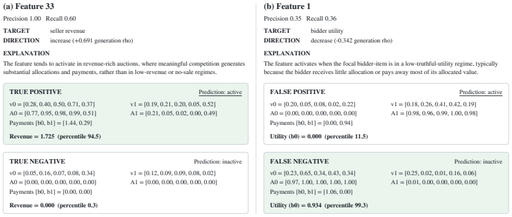
Figure 2 : Contrasting explanations: F33’s predictive revenue description and F1’s overbroad low-utility description. Each column shows the original text, selected target, preassigned direction, and two auctions in the prediction set with values, allocations, payments, and outcomes. Green marks actual positive SAE activation, and underlining marks predicted activation.
원문 · CC BY 4.0 · Li Kong, Zilong Liu, Haoyang Zhou, Hanbing Liu, Qi Qi · Opening the Black Box of Neural Auction Mechanisms · 원문 그림 인용 · 원본 PDF 8쪽에서 그림 영역을 추출했습니다.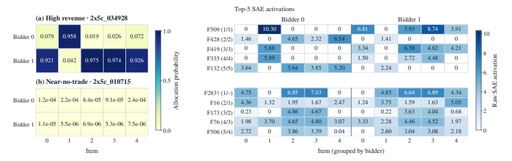
Figure 5 : Diagnostic case studies in the 2×5 c setting.Left:Bidder–item allocation probabilities on a shared scale, with scientific notation preserving tiny nonzero allocations.Right:Activation matrices for the top five SAE features in each auction grouped by bidder, where labels ranks as (whole dictionary / strong-response subset) and the dagger † marks F283 outsideS strong.
원문 · CC BY 4.0 · Li Kong, Zilong Liu, Haoyang Zhou, Hanbing Liu, Qi Qi · Opening the Black Box of Neural Auction Mechanisms · 원문 그림 인용 · 원본 PDF 17쪽에서 그림 영역을 추출했습니다.논문 정보
- 저자
- Li Kong, Zilong Liu, Haoyang Zhou, Hanbing Liu, Qi Qi
- 학회·저널
- arXiv · 프리프린트
- 최초 공개일
- 2026년 11월 1일
- 등록일
- 2026년 11월 6일
- 수정일
- 2026년 11월 1일
- 버전
- v1
- arXiv
- 2611.01981
- 분류
- cs.AI
- 원문 이용 조건
- CC BY 4.0
- 제공 범위
- 논문 정보, 해설, 허용된 원문 그림
AI 해설은 논문 원문과 별개의 설명이며 오류가 있을 수 있습니다. 원문과 그림은 각 출처의 이용 조건과 따로 표시된 권리를 따릅니다.
초록
Neural auction design has emerged as a powerful paradigm within automated mechanism design for modern Web platforms. Because these learned mechanisms directly dictate critical economic outcomes, their lack of internal transparency raises significant auditability and trust concerns. Opening this black box \textit{post-hoc} is therefore essential, yet presents two distinctive challenges: (1) activation contexts are dense, correlated numerical profiles devoid of explicit semantic structure, and (2) feature interpretations can only be falsifiably audited if they map to measurable auction states or outcomes. In this paper, we propose a post-hoc white-box auditing framework for unpacking trained neural auctions. Using CITransNet as a representative testbed, we first employ sparse autoencoders to decompose hidden representations while faithfully preserving downstream auction behavior. Anchoring feature interpretations to native economic targets, we validate them through activation prediction and causal interventions to isolate verified features from the reconstruction dictionary. Finally, applying this pipeline across varied auction settings, we show that the verified features can serve as analytical instruments to examine how internal representations modulate strategic misreporting incentives, align with Myerson's optimal auction, and support the diagnosis of individual auctions. Our work highlights the potential of white-box mechanism auditing to build the foundational trust necessary for neural auctions to be deployed as widely adopted Web technologies. To enhance research transparency and facilitate independent inspection, we publicly release the experimental results supporting our findings at https://github.com/Li-Beverly-Kong/opening-neural-auctions.git
원문 인용
Li Kong, Zilong Liu, Haoyang Zhou, Hanbing Liu, Qi Qi (2026). Opening the Black Box of Neural Auction Mechanisms. arXiv:2611.01981v1. https://arxiv.org/abs/2611.01981v1
BibTeX
@misc{kong2026opening,
  title = {{Opening the Black Box of Neural Auction Mechanisms}},
  author = {Li Kong and Zilong Liu and Haoyang Zhou and Hanbing Liu and Qi Qi},
  year = {2026},
  eprint = {2611.01981},
  archivePrefix = {arXiv},
  url = {https://arxiv.org/abs/2611.01981v1}
}