논문 해설
To Each Metric Its Decoding: Post-Hoc Optimal Decision Rules of Probabilistic Hierarchical Classifiers
각 지표에 맞는 디코딩: 확률적 계층 분류기의 사후 최적 결정 규칙
- 연구 문제 계층 분류에서 사후 확률 분포를 주어진 계층 평가 지표에 맞게 최적으로 디코딩하는 규칙이 필요하며, 기존 휴리스틱은 지표와 맞지 않을 수 있습니다.
- 연구 방법 계층적으로 합리적인 지표에는 노드 확률 임계값으로 후보를 줄이는 O(dmax·|L|+|N|) 알고리즘을, hFβ 점수에는 크기별 상위 k 선택으로 O(dmax²·|N|) 알고리즘을 제시합니다.
- 주요 결과 두 데이터셋의 여러 모델과 지표에서 최적 디코딩은 휴리스틱보다 일관되게 우세하며, 흐림으로 불확실성이 커질수록 휴리스틱의 상대 성능 저하가 커집니다.
계층 분류에서 디코딩이 필요한 이유
계층 분류에서는 클래스가 트리 구조로 묶이며, 오분류의 심각도가 트리 위의 거리로 반영됩니다. 모델은 리프 클래스에 대한 사후 확률 분포를 출력하지만, 그 분포에서 최종 예측을 고르는 규칙은 흔히 argmax나 임계값 기반 휴리스틱으로 정해집니다. 이러한 휴리스틱은 실제 평가 지표와 맞지 않을 수 있습니다. 이 논문은 학습된 모델을 바꾸지 않고, 사후 확률 분포를 입력받아 주어진 계층 지표의 기대 비용을 최소화하는 디코딩 규칙을 도출합니다. 저자들은 이 문제를 사후 처리(post-hoc) 디코딩으로 한정하며, 확률 추정 자체는 다루지 않습니다.
베이즈 최적 디코딩과 노드 후보 축소
결정 규칙 ξ는 확률 분포 p를 예측 집합 H의 원소로 보내는 함수이며, 최적 규칙은 p(l)과 C(h,l)의 합 Σ p(l)C(h,l)을 최소화하는 h를 고릅니다. 후보가 리프 집합이면 이 계산은 기존 비용 민감 분류와 비슷하지만, 노드 집합이면 후보 수가 커집니다. 이 논문은 계층적으로 합리적인 지표에 대해 노드 n의 확률 p(n)과 임계값 qCmin(n), qCmax(n)을 비교합니다. p(n)이 qCmax(n)보다 크면 부모 π(n)은 최적이 아니고, p(n)이 qCmin(n)보다 작으면 n은 최적이 아닙니다. 이 조건으로 후보를 크기 O(dmax) 수준으로 줄인 뒤 전수 탐색하여 O(dmax·|L|+|N|) 시간의 알고리즘을 얻습니다.
hFβ 점수의 노드 집합 디코딩
hFβ 점수는 예측 노드 집합 h를 조상으로 확장한 집합과 정답의 조상 집합 사이의 겹침으로 정밀도와 재현율을 정의하고, 이를 β로 가중하여 결합합니다. 이 경우 최적화 대상은 기대 효용의 최대화이며, 최적 규칙은 MT(N) 위의 argmax로 표현됩니다. 저자들은 노드 확률 p(n)이 1/(1+β²(dmax(n)+1)) 미만이면 n이 최적 집합에 포함되지 않는다는 보조 결과를 사용하여 후보를 Q(p)로 제한합니다. 이후 예측 크기 k별로 상위 k개의 노드를 선택하는 방식으로 O(dmax²·|N|) 알고리즘을 제시합니다.
실험 설정과 디코딩 비교
실험은 tieredImageNet-H와 iNat19 데이터셋에서 pre-training 모델과 미세조정 모델의 테스트 집합 확률 출력에 디코딩 규칙을 적용하여 수행됩니다. 비교 대상은 Majority, Plurality, Darts, Expected Information, argmax 등의 휴리스틱입니다. 이 결과는 해당 데이터셋과 모델 조건에서 얻은 것이며, 저자들은 최적 전략이 평가한 지표 전반에서 일관되게 우세하다고 보고합니다. 상대 이득은 최적 전략과 다른 전략들의 평균 사이 차이를 백분율로 나타낸 값입니다. 변형 Mistake Severity는 상대 이득이 10%로 보고되었고, 나머지 지표는 1%에서 5% 범위입니다.
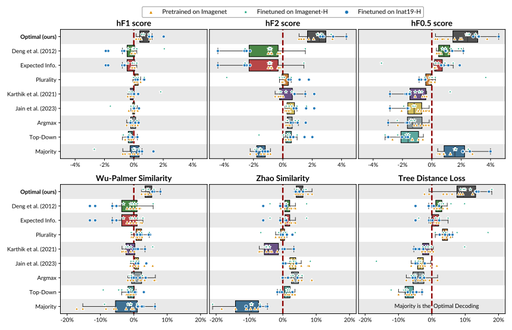
Figure 2 : Relative Gain (in %) of Decoding Strategies. Each dot represents the relative gain of the optimal strategy vs. the average over all other strategies for a specific metric and model on the test set of a given dataset, with symbols indicating the dataset: ▲ for models pretrained on ImageNet, ⋆ for models fine-tuned on ImageNet-H, and • for models fine-tuned on iNat19. Boxplots summarize the distribution of relative gains for each decoding strategy. The higher the gain, the better the decoding strategy. Results are reported for six metrics across various model architectures trained on three datasets.
원문 · CC0 1.0 · Roman Plaud, Alexandre Perez-Lebel, Matthieu Labeau, Antoine Saillenfest, Thomas Bonald · To Each Metric Its Decoding: Post-Hoc Optimal Decision Rules of Probabilistic Hierarchical Classifiers · 원문 그림 인용 · 원본 PDF 7쪽에서 그림 영역을 추출했습니다.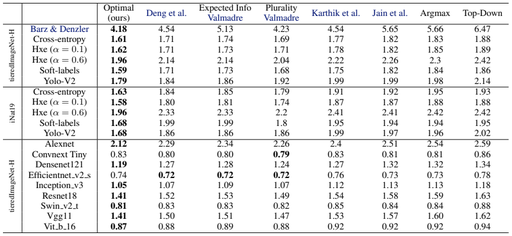
Table D.1 : Performance on Mistake Severity metric of different decoding strategy for various models trained on various datasets
원문 · CC0 1.0 · Roman Plaud, Alexandre Perez-Lebel, Matthieu Labeau, Antoine Saillenfest, Thomas Bonald · To Each Metric Its Decoding: Post-Hoc Optimal Decision Rules of Probabilistic Hierarchical Classifiers · 원문 그림 인용 · 원본 PDF 19쪽에서 그림 영역을 추출했습니다.불확실성 증가와 휴리스틱 성능 저하
저자들은 입력 이미지에 Gaussian blur를 점진적으로 가해 특징의 예측력을 낮추고, 사후 확률 분포가 심플렉스의 중심 쪽으로 이동하도록 설계합니다. 이 조건에서 hFβ 점수에 대해 휴리스틱의 상대 성능 저하를 흐림 수준별로 측정하며, 흐림이 커질수록 저하가 커진다고 보고합니다. 그림 1은 VGG11 확률을 이용한 세 디코딩 전략의 예측이 흐림 수준에 따라 달라지는 예시를 보여 주는 캡션 정보입니다. 이 설명은 흐림이라는 한 종류의 불확실성 증가에 대한 결과이며, 다른 불확실성 원인에 그대로 일반화된다고 볼 수는 없습니다.
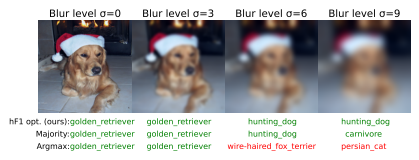
Figure 1 : Underdetermination amplifies decision-making dis- parities between decoding strategies. Predictions of three decod- ing strategies based on the probability estimates of a pretrained VGG11 model, for images with blur levels σ ∈ {0, 3, 6, 9}. Cor- rect predictions are highlighted in green, incorrect in red.
원문 · CC0 1.0 · Roman Plaud, Alexandre Perez-Lebel, Matthieu Labeau, Antoine Saillenfest, Thomas Bonald · To Each Metric Its Decoding: Post-Hoc Optimal Decision Rules of Probabilistic Hierarchical Classifiers · 원문 그림 인용 · 원본 PDF 1쪽에서 그림 영역을 추출했습니다.적용 범위와 남은 한계
이 연구는 실험을 이미지 데이터셋에 한정하며 텍스트 등 다른 양식은 다루지 않습니다. 또한 사후 확률 분포를 정확히 추정하는 문제는 다루지 않고, 이론 결과는 오라클 분포를 가정합니다. 실제 모델의 확률 추정 오차가 디코딩 이득을 어떻게 바꾸는지는 이 논문의 범위 밖입니다. 제안된 확장 방향인 비트리 계층이나 비용 민감 학습은 아직 검증되지 않았습니다.
논문 정보
- 저자
- Roman Plaud, Alexandre Perez-Lebel, Matthieu Labeau, Antoine Saillenfest, Thomas Bonald
- 학회·저널
- arXiv · 프리프린트
- 최초 공개일
- 2025년 6월 2일
- 등록일
- 2026년 10월 29일
- 수정일
- 2025년 6월 2일
- 버전
- v1
- arXiv
- 2506.01552
- 분류
- cs.LG · stat.ML
- 원문 이용 조건
- CC0 1.0
- 제공 범위
- 논문 정보, 해설, 허용된 원문 그림
AI 해설은 논문 원문과 별개의 설명이며 오류가 있을 수 있습니다. 원문과 그림은 각 출처의 이용 조건과 따로 표시된 권리를 따릅니다.
초록
Hierarchical classification offers an approach to incorporate the concept of mistake severity by leveraging a structured, labeled hierarchy. However, decoding in such settings frequently relies on heuristic decision rules, which may not align with task-specific evaluation metrics. In this work, we propose a framework for the optimal decoding of an output probability distribution with respect to a target metric. We derive optimal decision rules for increasingly complex prediction settings, providing universal algorithms when candidates are limited to the set of nodes. In the most general case of predicting a subset of nodes, we focus on rules dedicated to the hierarchical $hF_β$ scores, tailored to hierarchical settings. To demonstrate the practical utility of our approach, we conduct extensive empirical evaluations, showcasing the superiority of our proposed optimal strategies, particularly in underdetermined scenarios. These results highlight the potential of our methods to enhance the performance and reliability of hierarchical classifiers in real-world applications. The code is available at https://github.com/RomanPlaud/hierarchical_decision_rules
원문 인용
Roman Plaud, Alexandre Perez-Lebel, Matthieu Labeau, Antoine Saillenfest, Thomas Bonald (2025). To Each Metric Its Decoding: Post-Hoc Optimal Decision Rules of Probabilistic Hierarchical Classifiers. arXiv:2506.01552v1. https://arxiv.org/abs/2506.01552v1
BibTeX
@misc{plaud2025each,
  title = {{To Each Metric Its Decoding: Post-Hoc Optimal Decision Rules of Probabilistic Hierarchical Classifiers}},
  author = {Roman Plaud and Alexandre Perez-Lebel and Matthieu Labeau and Antoine Saillenfest and Thomas Bonald},
  year = {2025},
  eprint = {2506.01552},
  archivePrefix = {arXiv},
  url = {https://arxiv.org/abs/2506.01552v1}
}