논문 해설
Subjective and Objective Quality Assessment for in-the-Wild Computer Graphics Images
야생 환경의 컴퓨터 그래픽 이미지를 위한 주관적 및 객관적 품질 평가
- 연구 문제 기존 NR IQA 모델은 자연 장면 이미지 중심으로 개발·검증되어 in-the-wild CGI의 품질을 평가하기 어렵고, 관련 데이터베이스도 작고 오래되었습니다.
- 연구 방법 논문은 6,000개 CGI의 주관 품질 데이터베이스 CGIQA-6k를 구축하고, 왜곡 스트림(MFF·MCA)과 사전 학습된 미적 스트림을 결합한 무참조 IQA 모델을 제안합니다.
- 주요 결과 제안 모델은 CGIQA-6k 전체에서 SRCC 0.8552와 PLCC 0.8531을 보고했으며, 두 스트림을 함께 사용한 설정이 각 단독 설정보다 높은 성능을 보였습니다.
기존 IQA 모델이 CGI에 맞지 않는 이유
컴퓨터 그래픽 이미지(CGI)는 게임이나 영상 스트리밍에서 널리 보이지만, 기존 화질 평가(IQA) 모델은 주로 자연 장면 이미지(NSI)와 인위적 왜곡 데이터베이스로 검증되었습니다. 논문은 CGI가 자연 장면과 다른 통계 분포를 가진다는 점을 짚습니다. KonIQ-10k의 NSI와 LSCGB의 CGI를 비교하면 CGI는 조도가 낮고 색채감이 부족한 경향을 보이며, 이는 NSI 기반 모델을 CGI에 그대로 옮기기 어렵다는 근거로 제시됩니다.
또한 기존 CGIQA 데이터베이스는 오래된 콘텐츠를 담고 규모가 작으며, 대부분 기준 영상이 있는 전체 참조(FR) 방식에 치우쳐 있었습니다. 실제 in-the-wild CGI에서는 원본 기준 영상을 얻기 어려우므로 무참조(NR) 평가가 필요합니다. 이 논문은 이러한 공백을 채우기 위해 대규모 CGIQA-6k 데이터베이스와 무참조 평가 모델을 함께 제시합니다.
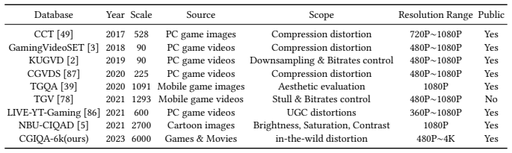
Table 1 . The comparison of previous CGIQA-related databases and our database. The scale indicates the number of stimuli with mean opinion scores (MOSs).
원문 · CC BY 4.0 · Zicheng Zhang, Wei Sun, Yingjie Zhou, Jun Jia, Zhichao Zhang, Jing Liu, Xiongkuo Min, Guangtao Zhai · Subjective and Objective Quality Assessment for in-the-Wild Computer Graphics Images · 원문 그림 인용 · 원본 PDF 5쪽에서 그림 영역을 추출했습니다.CGIQA-6k 데이터베이스의 구축과 주관 평가
CGIQA-6k는 게임과 영화에서 수집한 6,000개의 CGI로 구성됩니다. 수집 단계에서는 스트리밍 영상 프레임과 게임 데모 화면을 사용했고, 생명바와 미니맵, 자막을 제거했습니다. 시점도 1인칭과 3인칭을 모두 포함했으며, 최종 표본은 분포를 보존하도록 무작위로 추출하여 게임 CGI 3,000개와 영화 CGI 3,000개로 맞추었습니다.
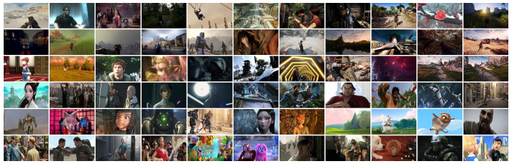
Fig. 2 . Sample images from the CGIQA-6k database. Top three rows: CGIs from games. Bottom three rows: CGIs from movies.
원문 · CC BY 4.0 · Zicheng Zhang, Wei Sun, Yingjie Zhou, Jun Jia, Zhichao Zhang, Jing Liu, Xiongkuo Min, Guangtao Zhai · Subjective and Objective Quality Assessment for in-the-Wild Computer Graphics Images · 원문 그림 인용 · 원본 PDF 5쪽에서 그림 영역을 추출했습니다.주관 실험은 ITU-R BT.500-13 권고를 따르고 실험실 환경에서 60명의 참가자가 수행했습니다. 실험은 20개 세션으로 나뉘었으며 각 CGI는 최소 20명에게 평가받았습니다. 원점수는 피험자별 z-score로 바꾼 뒤 피험자 거부 절차를 거쳐 평균하여 MOS를 계산합니다. MOS 분포는 대체로 가우시안 형태를 보였고, 영화 CGI가 게임 CGI보다 높은 점수를 받는 경향이 관찰되었습니다.
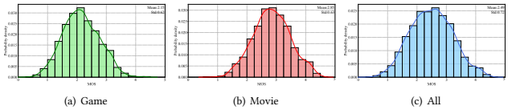
Fig. 3 . The distribution of the MOSs of the CGIQA-6k database. (a) represents the MOS distribution for game CGIs while (b) indicates the MOS distribution for movie CGIs. (c) exhibits the MOS distribution for all CGIs. Additionally, the mean and standard deviation values of the MOSs are marked on the top right as well.
원문 · CC BY 4.0 · Zicheng Zhang, Wei Sun, Yingjie Zhou, Jun Jia, Zhichao Zhang, Jing Liu, Xiongkuo Min, Guangtao Zhai · Subjective and Objective Quality Assessment for in-the-Wild Computer Graphics Images · 원문 그림 인용 · 원본 PDF 6쪽에서 그림 영역을 추출했습니다.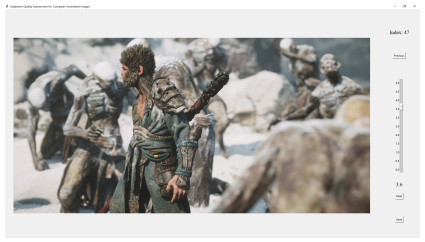
Fig. 6 . Screenshot of the interface for subjective experiments.
원문 · CC BY 4.0 · Zicheng Zhang, Wei Sun, Yingjie Zhou, Jun Jia, Zhichao Zhang, Jing Liu, Xiongkuo Min, Guangtao Zhai · Subjective and Objective Quality Assessment for in-the-Wild Computer Graphics Images · 원문 그림 인용 · 원본 PDF 8쪽에서 그림 영역을 추출했습니다.왜곡 스트림과 미적 스트림을 결합한 모델
제안 모델은 왜곡 스트림과 미적 스트림의 두 갈래로 구성됩니다. 왜곡 스트림에서는 백본의 여러 단계 특징맵을 적응 평균 풀링으로 7×7 해상도에 맞춘 뒤 연결하고, 1×1, 3×3, 1×1 합성곱 블록으로 융합하는 다단계 특징 융합(MFF) 모듈을 사용합니다. 이어서 평균 풀링과 최대 풀링으로 채널 기술자를 만들고, 공유 MLP와 시그모이드를 거쳐 채널 주의를 계산하는 다단계 채널 주의(MCA) 모듈을 적용합니다. 최종 왜곡 특징은 채널 주의 결과와 융합 특징의 원소별 곱을 평균 풀링해 얻습니다.
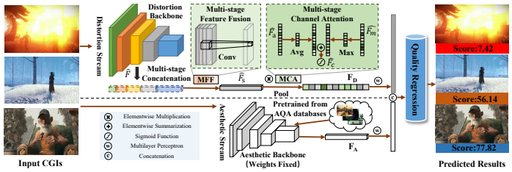
Fig. 7 . The framework of the proposed method, where the proposed MFF and MCA modules are arranged in a series manner and the aesthetic stream backbone’s weights are fixed during the training.
원문 · CC BY 4.0 · Zicheng Zhang, Wei Sun, Yingjie Zhou, Jun Jia, Zhichao Zhang, Jing Liu, Xiongkuo Min, Guangtao Zhai · Subjective and Objective Quality Assessment for in-the-Wild Computer Graphics Images · 원문 그림 인용 · 원본 PDF 9쪽에서 그림 영역을 추출했습니다.미적 스트림은 AVA로 먼저 학습한 뒤 TGQA로 추가 학습한 백본을 사용하며, 마지막 단계 특징을 평균 풀링해 미적 특징을 만듭니다. 이 미적 백본의 pre-training 가중치는 결합 학습 중 왜곡 학습의 영향을 피하기 위해 고정됩니다. 두 특징은 MLP로 채널을 맞춘 뒤 연결되고, 1024와 128 뉴런의 두 FC 층으로 품질 점수를 회귀합니다. 손실은 예측 점수와 정답 MOS 사이의 평균제곱오차입니다.
CGIQA-6k 전체 및 하위 집합에서의 비교
평가에서는 학습과 테스트 세트를 8:2로 무작위 분할했고, 각 결과는 10회 반복의 평균으로 기록되었습니다. 점수 비교에는 SRCC, PLCC, KRCC, RMSE가 사용되었으며, 예측 점수는 평가 전에 five-parameter logistic 함수로 MOS 척도에 매핑되었습니다.
CGIQA-6k 전체 집합에서 제안 모델은 SRCC 0.8552와 PLCC 0.8531을 기록했습니다. 같은 표에서 MGQA와 StairIQA도 높은 점수를 보였지만 제안 모델이 가장 높은 값을 보고했습니다. 게임과 영화 하위 집합에서도 제안 모델이 높은 SRCC를 보고했습니다. 깊이 학습 기반 방법은 전통적 방법보다 대체로 높은 성능을 보였습니다.
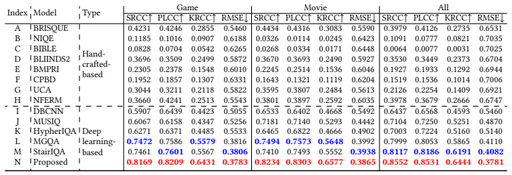
Table 2 . Performance comparison on the CGIQA-6k database and the corresponding subsets. The best performance results are marked in RED and the second performance results are marked in BLUE.
원문 · CC BY 4.0 · Zicheng Zhang, Wei Sun, Yingjie Zhou, Jun Jia, Zhichao Zhang, Jing Liu, Xiongkuo Min, Guangtao Zhai · Subjective and Objective Quality Assessment for in-the-Wild Computer Graphics Images · 원문 그림 인용 · 원본 PDF 12쪽에서 그림 영역을 추출했습니다.두 스트림의 기여와 대조 결과
절제 실험에서 두 스트림을 함께 사용한 모델은 CGIQA-6k에서 SRCC 0.8552, PLCC 0.8531을 기록했습니다. 왜곡 스트림만 사용하면 SRCC 0.8288, PLCC 0.8353이었고, 미적 스트림만 사용하면 SRCC 0.3002, PLCC 0.3091이었습니다. 이 단일 미적 스트림 설정에서는 백본 가중치를 고정하고 선형 회귀만 사용했습니다.

Table 4 . Performance Results of the ablation study on the two streams. The mark ✓indicates that the referred stream is applied while× indicates that the referred stream is not applied. The aesthetic stream backbone weights are fixed and only linear regression is employed for the single aesthetic stream.
원문 · CC BY 4.0 · Zicheng Zhang, Wei Sun, Yingjie Zhou, Jun Jia, Zhichao Zhang, Jing Liu, Xiongkuo Min, Guangtao Zhai · Subjective and Objective Quality Assessment for in-the-Wild Computer Graphics Images · 원문 그림 인용 · 원본 PDF 15쪽에서 그림 영역을 추출했습니다.이 결과는 두 스트림을 함께 쓰는 설정이 각 단독 설정보다 높았다는 관찰입니다. 미적 스트림 단독 성능이 낮다는 점은 왜곡 정보가 CGI 품질 예측에서 더 큰 비중을 차지한다는 저자의 해석과 연결됩니다. 같은 실험에서 MFF와 MCA를 각각 제거한 설정도 비교되었으며, 두 모듈을 모두 사용한 설정이 가장 높은 SRCC를 보고했습니다.

Table 5 . Performance Results of the ablation study on the attention modules. The mark ✓indicates that the referred module is applied while× indicates that the referred module is not applied.
원문 · CC BY 4.0 · Zicheng Zhang, Wei Sun, Yingjie Zhou, Jun Jia, Zhichao Zhang, Jing Liu, Xiongkuo Min, Guangtao Zhai · Subjective and Objective Quality Assessment for in-the-Wild Computer Graphics Images · 원문 그림 인용 · 원본 PDF 15쪽에서 그림 영역을 추출했습니다.교차 데이터베이스 검증과 적용 범위
교차 데이터베이스 검증에서 제안 모델은 CGIQA-6k로 학습한 뒤 CCT-CGI와 NBU-CIQAD에서 평가되었습니다. CCT-CGI에서는 제안 모델이 비교 모델보다 높은 값을 보였으나, NBU-CIQAD에서는 전체 결과가 만족스럽지 않았습니다. 저자들은 NBU-CIQAD가 만화 이미지와 색 왜곡 중심이라 CGIQA-6k와 콘텐츠 및 왜곡 차이가 크다고 해석합니다.
Table 7 . Experimental results for the cross-database validation. The NR IQA models are trained on the CGIQA-6K database. The default experimental setup is maintained.
원문 · CC BY 4.0 · Zicheng Zhang, Wei Sun, Yingjie Zhou, Jun Jia, Zhichao Zhang, Jing Liu, Xiongkuo Min, Guangtao Zhai · Subjective and Objective Quality Assessment for in-the-Wild Computer Graphics Images · 원문 그림 인용 · 원본 PDF 16쪽에서 그림 영역을 추출했습니다.LIVE-YT-Gaming처럼 실제 왜곡이 있는 데이터베이스에서는 모든 IQA 모델의 성능이 낮아졌습니다. 따라서 이 결과는 사용된 세 가지 평가 데이터와 제안 설정에서 얻은 것이며, 모든 실제 왜곡이나 모든 CGI 유형에 대한 일반화를 직접 보여 주지는 않습니다.
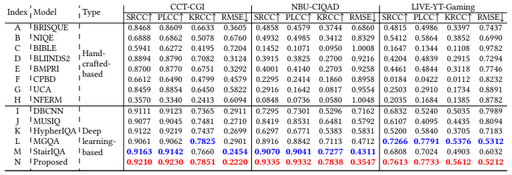
Table 3 . Performance results on the CCT-CGI, NBU-CIQAD, and LIVE-YT-Gaming databases. The best performance results are marked in RED and the second performance results are marked in BLUE.
원문 · CC BY 4.0 · Zicheng Zhang, Wei Sun, Yingjie Zhou, Jun Jia, Zhichao Zhang, Jing Liu, Xiongkuo Min, Guangtao Zhai · Subjective and Objective Quality Assessment for in-the-Wild Computer Graphics Images · 원문 그림 인용 · 원본 PDF 14쪽에서 그림 영역을 추출했습니다.논문 정보
- 저자
- Zicheng Zhang, Wei Sun, Yingjie Zhou, Jun Jia, Zhichao Zhang, Jing Liu, Xiongkuo Min, Guangtao Zhai
- 학회·저널
- arXiv · 프리프린트
- 최초 공개일
- 2023년 3월 14일
- 등록일
- 2026년 11월 5일
- 수정일
- 2023년 11월 1일
- 버전
- v4
- arXiv
- 2303.08050
- 분류
- cs.CV · eess.IV
- 원문 이용 조건
- CC BY 4.0
- 제공 범위
- 논문 정보, 해설, 허용된 원문 그림
AI 해설은 논문 원문과 별개의 설명이며 오류가 있을 수 있습니다. 원문과 그림은 각 출처의 이용 조건과 따로 표시된 권리를 따릅니다.
초록
Computer graphics images (CGIs) are artificially generated by means of computer programs and are widely perceived under various scenarios, such as games, streaming media, etc. In practice, the quality of CGIs consistently suffers from poor rendering during production, inevitable compression artifacts during the transmission of multimedia applications, and low aesthetic quality resulting from poor composition and design. However, few works have been dedicated to dealing with the challenge of computer graphics image quality assessment (CGIQA). Most image quality assessment (IQA) metrics are developed for natural scene images (NSIs) and validated on databases consisting of NSIs with synthetic distortions, which are not suitable for in-the-wild CGIs. To bridge the gap between evaluating the quality of NSIs and CGIs, we construct a large-scale in-the-wild CGIQA database consisting of 6,000 CGIs (CGIQA-6k) and carry out the subjective experiment in a well-controlled laboratory environment to obtain the accurate perceptual ratings of the CGIs. Then, we propose an effective deep learning-based no-reference (NR) IQA model by utilizing both distortion and aesthetic quality representation. Experimental results show that the proposed method outperforms all other state-of-the-art NR IQA methods on the constructed CGIQA-6k database and other CGIQA-related databases. The database is released at https://github.com/zzc-1998/CGIQA6K.
원문 인용
Zicheng Zhang, Wei Sun, Yingjie Zhou, Jun Jia, Zhichao Zhang, Jing Liu, Xiongkuo Min, Guangtao Zhai (2023). Subjective and Objective Quality Assessment for in-the-Wild Computer Graphics Images. arXiv:2303.08050v4. https://arxiv.org/abs/2303.08050v4
BibTeX
@misc{zhang2023subjective,
  title = {{Subjective and Objective Quality Assessment for in-the-Wild Computer Graphics Images}},
  author = {Zicheng Zhang and Wei Sun and Yingjie Zhou and Jun Jia and Zhichao Zhang and Jing Liu and Xiongkuo Min and Guangtao Zhai},
  year = {2023},
  eprint = {2303.08050},
  archivePrefix = {arXiv},
  url = {https://arxiv.org/abs/2303.08050v4}
}