논문 해설
Spatiotemporal Attention Enhances Lidar-Based Robot Navigation in Dynamic Environments
공간-시간 어텐션이 동적 환경에서 라이다 기반 로봇 내비게이션을 향상시킨다
- 연구 문제 2D 라이다만으로 실내 보행자 같은 동적 장애물을 추적 없이 피하는 내비게이션 제어기를 학습하는 문제를 다룹니다.
- 연구 방법 연속 라이다 스캔을 ICP로 정렬해 TAGD를 만들고, 공간·시간 어텐션 두 스트림을 가진 DDPG 제어기로 속도 명령을 학습합니다.
- 주요 결과 Pybullet 아블레이션에서 OUR의 성공률은 86.2%였고 제거 변형과 기준선은 이보다 낮았으며, iGibson sim-to-sim 평가에서도 비교 접근법 가운데 가장 좋은 일반화를 보였다고 보고됩니다.
2D 라이다로 동적 장애물을 추적 없이 피하는 문제
이 논문은 가볍고 저렴한 2D 라이다만으로 실내에서 보행자 같은 동적 장애물을 피하며 목표로 이동하는 내비게이션 제어기를 다룹니다. 보행자를 명시적으로 추적하면 정보가 풍부한 표현을 얻을 수 있지만, 2D 라이다에서는 다리 형태만으로 보행자를 추적하기 어렵고 로봇 자신의 움직임 때문에 정적 물체도 스캔 사이에서 움직이는 것처럼 보입니다. 따라서 이 연구는 동적 장애물의 움직임 단서를 명시적 추적 없이 라이다 관측에서 추출하는 문제에 초점을 둡니다. 저자들은 이를 위해 공간 어텐션과 시간 어텐션을 결합한 구조를 제안합니다.
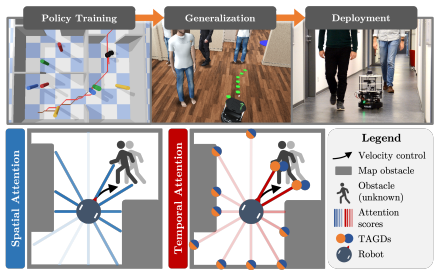
Fig. 1 : Our pipeline for learning a robot navigation controller based on lidar. Two attention mechanisms reason about the importance of individual lidar sectors with respect to known and unknown dynamic obstacles. Our Temporal Accumulation Group Descriptors (TAGD) reveal moving obstacles from subsequent lidar scans affected by robot self-motion.
원문 · CC BY 4.0 · Jorge de Heuvel, Xiangyu Zeng, Weixian Shi, Tharun Sethuraman, Maren Bennewitz · Spatiotemporal Attention Enhances Lidar-Based Robot Navigation in Dynamic Environments · 원문 그림 인용 · 원본 PDF 1쪽에서 그림 영역을 추출했습니다.TAGD: 연속 스캔에서 움직임 단서를 만드는 방법
TAGD는 연속한 두 라이다 스캔에서 동적 장애물의 위치 변화를 드러내는 표현입니다. 먼저 ICP로 이전 스캔을 현재 스캔에 정렬하여 로봇의 회전과 이동 효과를 줄입니다. 정렬 후 정적 장애물의 점들은 맞춰지고 동적 장애물의 점들은 어긋나게 됩니다. 이후 Nc개의 균등한 레이 방향마다 로봇에 가장 가까운 점을 그룹 중심으로 정하고, 그 주변에서 거리 dthresh=0.25m 이내의 점들을 두 시점의 그룹으로 나눕니다. 각 그룹의 중심을 계산하면 (cit, cit-1) 형태의 TAGD 쌍이 되며, 두 중심의 위치 차이가 장애물의 움직임을 나타냅니다. 저자들은 dthresh를 최대 장애물 속도와 추론 시간 간격의 곱보다 크게 잡는 안전 여유 기준을 사용했다고 설명합니다.
이 과정은 ICP가 정적 장애물에만 의존하며 오도메트리나 IMU를 쓰지 않는다는 가정 위에 있습니다.
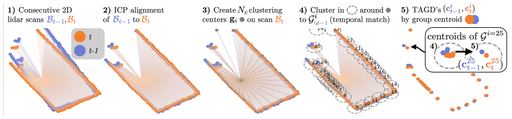
Fig. 2 : Schematic of the TAGD generation process. The ICP alignment of two subsequent lidar scans (1) in 2D Cartesian coordinates reduces the effect of robot self-movement (2). This allows better differentiation between dynamic obstacles and static obstacles. The aligned scan is grouped and clustered around ray-cast centers (3). From the clustered points (4), the position difference of the centroid from both time steps reveals a moving obstacle (5).
원문 · CC BY 4.0 · Jorge de Heuvel, Xiangyu Zeng, Weixian Shi, Tharun Sethuraman, Maren Bennewitz · Spatiotemporal Attention Enhances Lidar-Based Robot Navigation in Dynamic Environments · 원문 그림 인용 · 원본 PDF 3쪽에서 그림 영역을 추출했습니다.공간·시간 어텐션 구조와 DDPG 학습
제어기는 DDPG 액터-크리틱 구조로 학습됩니다. 상태는 라이다 점 집합, TAGD, 다음 웨이포인트로 구성되며 행동은 선형 속도와 각속도입니다. 공간 스트림에서는 라이다 scan을 Nb개의 각도 섹터로 나누고 각 섹터 벡터를 웨이포인트와 이어 붙여 공간 어텐션 모듈에 넣습니다. 시간 스트림에서는 각 TAGD 쌍과 웨이포인트를 묶은 벡터를 시간 어텐션 모듈에 넣습니다. 어텐션 모듈은 임베딩, 점수, 특징 네트워크로 구성되며, 점수에 Softmax를 적용한 가중치로 특징을 가중합합니다. 입력 벡터끼리 서로 주의를 주고받는 구조가 아니라 위치 기반 가중치로 각 벡터의 영향력을 조절하는 방식입니다. 두 스트림의 출력은 결합되어 액터와 크리틱의 출력 모듈로 전달됩니다.
보상은 충돌 페널티, 경로 안내 페널티, 장애물 근접 페널티의 가중합으로 정의됩니다.
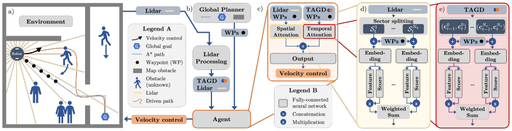
Fig. 3 : Illustration of our architecture. a) The indoor environment provides lidar readings to the deep reinforcement learning agent that drives a differential- wheeled robot via linear and angular velocity commands. b) From subsequent lidar readings, the TAGDs are computed. Merged with the five upcoming waypoints of the global path and the raw lidar readings as observations, they are c) processed by the agent in a separate spatial and temporal stream. Both streams feature an attention block to weigh the importance of d) individual lidar sectors (spatial) or e) the TAGDs (temporal), with respect to the upcoming waypoints. After feature extraction, both streams are concatenated for further processing in the final output network of the actor-critic agent.
원문 · CC BY 4.0 · Jorge de Heuvel, Xiangyu Zeng, Weixian Shi, Tharun Sethuraman, Maren Bennewitz · Spatiotemporal Attention Enhances Lidar-Based Robot Navigation in Dynamic Environments · 원문 그림 인용 · 원본 PDF 4쪽에서 그림 영역을 추출했습니다.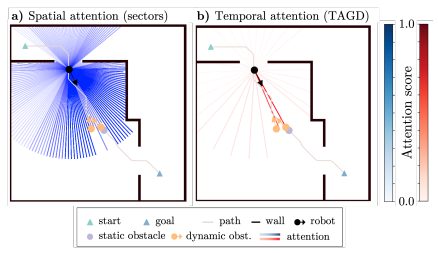
Fig. 6 : Exemplary visualization of the a) spatial (blue) and b) temporal attention (red) for a given navigation scene. The attention scores were color- mapped onto the lidar beam sectors for the spatial and on the beams pointing towards the TAGDs for the temporal attention, respectively. Increased spatial attention towards the forward-facing lidar sectors, as well as increased temporal attention towards the oncoming dynamic obstacle can be observed.
원문 · CC BY 4.0 · Jorge de Heuvel, Xiangyu Zeng, Weixian Shi, Tharun Sethuraman, Maren Bennewitz · Spatiotemporal Attention Enhances Lidar-Based Robot Navigation in Dynamic Environments · 원문 그림 인용 · 원본 PDF 6쪽에서 그림 영역을 추출했습니다.Pybullet 학습 환경과 제거 변형의 비교
학습과 평가는 Pybullet 기반의 복도, 교차로, 사무실 환경에서 수행됩니다. 장애물은 A* 경로를 따라 움직이는 직육면체로 표현되며 일부는 정적으로 설정됩니다. 1,000개 에피소드를 모든 접근법에 동일한 장면 설정으로 적용하고 성공률, 충돌률, 타임아웃률, 항행 시간을 측정합니다. 아블레이션에서 OUR의 성공률은 86.2%이며, 공간 스트림을 제거한 A1은 74.7%, 시간 스트림을 제거한 A2는 80.5%, TAGD 전처리를 제거한 A3는 85.0%입니다. 이 결과는 해당 제거 변형이 OUR보다 낮은 성공률을 보였다는 관찰이며, 각 요소가 유익하다는 결론은 이 세 비교의 범위 안에서 읽어야 합니다.
기준선 B1은 78.4%, B2는 77.4%, B3는 79.9%였습니다. 저자들은 CNN 기반 기준선이 장애물 수가 늘 때 더 크게 흔들린다고 보고합니다.
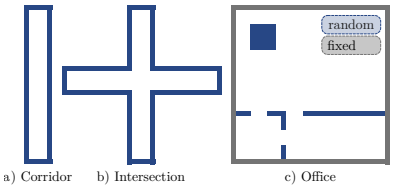
Fig. 4 : The Pybullet-based environments of [17] are used for training. a) In the corridor and b) intersection environment, the wall distances are randomized (blue). c) In the office environment, the outer walls are fixed with randomized inner wall placement for diverse room setups.
원문 · CC BY 4.0 · Jorge de Heuvel, Xiangyu Zeng, Weixian Shi, Tharun Sethuraman, Maren Bennewitz · Spatiotemporal Attention Enhances Lidar-Based Robot Navigation in Dynamic Environments · 원문 그림 인용 · 원본 PDF 4쪽에서 그림 영역을 추출했습니다.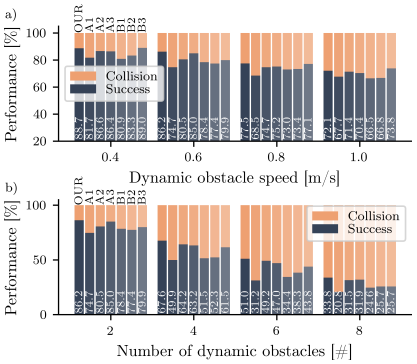
Fig. 5 : Performance overview for all approaches averaged over 1,000 episodes with identical scene setups in all three Pybullet environ- ments for a) increasing obstacle speeds, with two dynamic and one static pedestrians, and b) increasing number of obstacles, with a fixed pedestrian speed 0.6m s−1.
원문 · CC BY 4.0 · Jorge de Heuvel, Xiangyu Zeng, Weixian Shi, Tharun Sethuraman, Maren Bennewitz · Spatiotemporal Attention Enhances Lidar-Based Robot Navigation in Dynamic Environments · 원문 그림 인용 · 원본 PDF 5쪽에서 그림 영역을 추출했습니다.iGibson 전이와 ICP 강건성
Pybullet에서 학습한 에이전트는 iGibson 8개 장면에서 장면당 125 에피소드로 sim-to-sim 전이를 평가받았습니다. 이 평가에서 보행자는 실제 3D 메시로 표현되고 ORCA가 아니라 경로 기반 동작으로 움직이며, 최대 보행자 속도는 0.5m/s, 보행자 1명당 8m2 기준의 밀도가 사용되었습니다. 저자들은 OUR 컨트롤러가 비교한 접근법 가운데 가장 좋은 일반화 성능을 보였다고 보고합니다. 다만 장면별 난이도 차이가 있고 벽과 테이블·의자가 주요 충돌 대상이었습니다. ICP 강건성 실험에서는 정적 장애물이 없는 개방 공간에서 성능이 3.6% 감소했고, ICP 정렬을 끈 경우에는 4.8% 감소했습니다.
두 경우 모두 NO-TEMPORAL 변형보다는 여전히 높았다고 원문이 보고합니다.
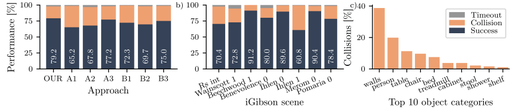
Fig. 7 : Results of the generalization study using the iGibson simulator over eight scenes witch 125 episodes each. a) OUR controller demonstrates the best generalization capabilities in the sim-to-sim transfer of all approaches. b) Breakdown into the different scenes shows a scene-dependency of the controller performance for OUR controller. c) Collision object category analysis within iGibson: The most collided-with objects are the walls.
원문 · CC BY 4.0 · Jorge de Heuvel, Xiangyu Zeng, Weixian Shi, Tharun Sethuraman, Maren Bennewitz · Spatiotemporal Attention Enhances Lidar-Based Robot Navigation in Dynamic Environments · 원문 그림 인용 · 원본 PDF 7쪽에서 그림 영역을 추출했습니다.실제 로봇 시험과 적용 범위
실제 로봇 실험은 Kobuki Turtlebot 2와 2D 라이다로 수행되었으며, ROS와 Gmapping으로 사전 지도를 만들고 AMCL로 위치를 추정했습니다. 복도, 교차로, 사무실에서 보행자가 로봇을 추월하거나 정면으로 접근하는 상황을 정성적으로 시험했고, 원문은 모든 상황이 처리되었다고 보고합니다. 이 결과는 정성적 시험이므로 정량적 실세계 성능으로 확대할 수는 없습니다. 또한 시뮬레이터의 보행자 동작은 경로 기반이어서 메시 겹침과 통행 불가능 상황이 가끔 발생한다고 저자들이 밝힙니다. TAGD의 정확도는 ICP 정렬과 정적 장애물에 의존하며, 원문은 이 의존성이 개방 공간과 ICP 해제 실험에서 부분적으로 드러난다고 설명합니다.
논문 정보
- 저자
- Jorge de Heuvel, Xiangyu Zeng, Weixian Shi, Tharun Sethuraman, Maren Bennewitz
- 학회·저널
- arXiv · 프리프린트
- 최초 공개일
- 2023년 10월 30일
- 등록일
- 2026년 11월 6일
- 수정일
- 2024년 2월 28일
- 버전
- v2
- arXiv
- 2310.19670
- 분류
- cs.RO
- 원문 이용 조건
- CC BY 4.0
- 제공 범위
- 논문 정보, 해설, 허용된 원문 그림
AI 해설은 논문 원문과 별개의 설명이며 오류가 있을 수 있습니다. 원문과 그림은 각 출처의 이용 조건과 따로 표시된 권리를 따릅니다.
초록
Foresighted robot navigation in dynamic indoor environments with cost-efficient hardware necessitates the use of a lightweight yet dependable controller. So inferring the scene dynamics from sensor readings without explicit object tracking is a pivotal aspect of foresighted navigation among pedestrians. In this paper, we introduce a spatiotemporal attention pipeline for enhanced navigation based on 2D~lidar sensor readings. This pipeline is complemented by a novel lidar-state representation that emphasizes dynamic obstacles over static ones. Subsequently, the attention mechanism enables selective scene perception across both space and time, resulting in improved overall navigation performance within dynamic scenarios. We thoroughly evaluated the approach in different scenarios and simulators, finding excellent generalization to unseen environments. The results demonstrate outstanding performance compared to state-of-the-art methods, thereby enabling the seamless deployment of the learned controller on a real robot.
원문 인용
Jorge de Heuvel, Xiangyu Zeng, Weixian Shi, Tharun Sethuraman, Maren Bennewitz (2023). Spatiotemporal Attention Enhances Lidar-Based Robot Navigation in Dynamic Environments. arXiv:2310.19670v2. https://arxiv.org/abs/2310.19670v2
BibTeX
@misc{heuvel2023spatiotemporal,
  title = {{Spatiotemporal Attention Enhances Lidar-Based Robot Navigation in Dynamic Environments}},
  author = {Jorge de Heuvel and Xiangyu Zeng and Weixian Shi and Tharun Sethuraman and Maren Bennewitz},
  year = {2023},
  eprint = {2310.19670},
  archivePrefix = {arXiv},
  url = {https://arxiv.org/abs/2310.19670v2}
}