논문 해설
Where Should the Code Go? Locating Foundation-Model Errors in Bitemporal Inventory Simulation
코드는 어디에 두어야 하는가? 이중 시간축 재고 시뮬레이션에서 파운데이션 모델의 오류 위치 찾기
- 연구 문제 보고서 도착 시각과 수정 때문에 재고 상태를 재구성하는 일이 어렵고, 기반 모델은 이 과정에서 선택·재생·롤아웃 오류를 함께 냅니다.
- 연구 방법 정확한 코드를 모델 앞, 뒤, 호출 내부에 두는 배치를 비교해 각 배치가 제거하는 오류를 측정했습니다.
- 주요 결과 GPT-5.4 mini에서 canonical 입력은 미래 결합 정확도를 원시 입력 대비 +29.7 [+20.8, +38.5] 퍼센트포인트 높였고, 호출 내부 코드 도구는 원시 입력에서 +54.2 [+45.3, +62.5] 퍼센트포인트를 더했습니다.
보고서 이력에서 상태를 재구성하는 문제
재고 관리 에이전트는 주문과 입고 이력을 문맥에서 읽어 현재 재고 상태를 추정합니다. 그런데 운영 보고서에는 사건이 일어난 시각과 보고서가 도착한 시각이 따로 있고, 나중에 도착한 보고서가 앞선 보고서를 수정하기도 합니다. 따라서 특정 지식 시점 K까지 보이는 보고서만으로 목표 시점 T의 재고를 복원하려면 도착 시각 기준의 선택, 수정 버전 정리, 사건 시각 순서의 재생이 모두 필요합니다. 이 논문은 이 상태 재구성 단계와 공지된 미래 일정을 굴리는 롤아웃 단계를 나누고, 어느 단계에서 어떤 오류가 생기는지 측정합니다. 실험 환경은 정확히 풀 수 있는 손실판매 재고 모델이므로 중간 결과의 정답을 코드로 계산할 수 있습니다.
코드를 배치하는 세 가지 위치
연구는 정확한 코드를 모델 앞, 모델 뒤, 모델 호출 내부에 두는 배치를 비교합니다. raw 입력은 수신 시각 순서로 모든 보고서 버전을 주며 K 이후 보고서도 포함하므로 모델이 직접 무시해야 합니다. canonical 입력은 코드가 보이는 보고서를 골라 버전을 정리하고 사건 시각 순서로 제공합니다. snapshot 입력은 여기에 정확히 재생된 과거 상태까지 주므로 모델에는 롤아웃만 남습니다. 모델 뒤에 두는 hybrid 방식은 모델이 과거 재고와 과거 손실 두 정수만 답하고, 코드가 공지된 일정을 적용합니다. 호스팅 코드 도구는 OpenAI 구성에서만 쓰였고 모델이 실행 여부를 선택합니다. 보존 법칙에 따라 같은 재고에서 코드가 미래를 계산하면 hybrid의 미래 정확도는 재구성 정확도와 같습니다.
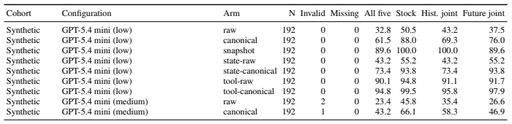
Table 6 : All cells of the original grid and the extension studies (%). State-only arms report the hybrid answer (model historical fields plus executable continuation); their future-joint accuracy equals their stock accuracy by conservation. Tool arms had a code-execution tool available. Invalid answers (missing, malformed or negative) fail every endpoint and remain in denominators.
원문 · CC BY 4.0 · Durga Sandeep Saluru, Lanchen Song, Aditya Kumaran · Where Should the Code Go? Locating Foundation-Model Errors in Bitemporal Inventory Simulation · 원문 그림 인용 · 원본 PDF 8쪽에서 그림 영역을 추출했습니다.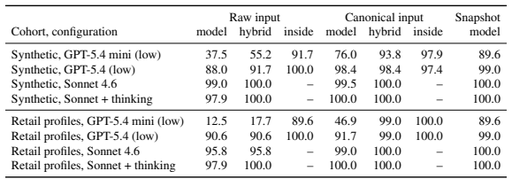
Table 16 : Future-joint accuracy (%, all three scenario outputs exact) by input and code placement; 192 synthetic and 96 profile calls per cell; invalid answers fail.model: all five fields from the model; hybrid: model returns the two historical fields, code applies the schedule (equals reconstruction accuracy by conservation);inside: code-execution tool available during the call (OpenAI only); snapshot: exact state supplied, model rolls out; dashes mark arms not run. All-five accuracy: Appendix B.
원문 · CC BY 4.0 · Durga Sandeep Saluru, Lanchen Song, Aditya Kumaran · Where Should the Code Go? Locating Foundation-Model Errors in Bitemporal Inventory Simulation · 원문 그림 인용 · 원본 PDF 22쪽에서 그림 영역을 추출했습니다.입력 방식과 코드 배치의 효과
합성 코호트에서 canonical 입력은 GPT-5.4 mini의 미래 결합 정확도를 원시 입력 대비 +29.7 [+20.8, +38.5] 퍼센트포인트 높였습니다. GLM-5.3 Flash에서는 canonical 입력의 이득이 +8.3 [+0.0, +16.7]에 그쳤고 정확한 상태를 더해도 추가 이득이 없었습니다. 반면 같은 canonical 답 위에 코드를 뒤에 두면 +22.9 [+15.1, +30.7] 개선되어, 이 모델의 오류는 주로 롤아웃에 있었습니다. 저자들은 이 차이를 모델마다 재구성 오류와 롤아웃 오류의 비중이 다르다는 근거로 해석합니다. 원시 입력에서는 hybrid가 약한 모델에서 78%를 넘지 않았는데, 이는 잘못 선택된 보고서로 만든 상태를 뒤 코드가 고칠 수 없기 때문입니다.
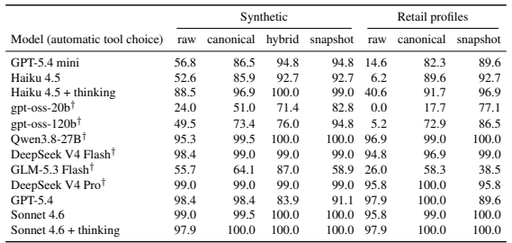
Table 1 : Future-joint accuracy (%, all three scenario outputs exact) by input and code placement, every configuration under automatic tool choice at its lowest requested effort (OpenAI and open-weight models: requested effort low; Anthropic models: no or 4,096-token thinking); 192 synthetic and 96 profile calls per cell; invalid and missing answers fail.raw: model selects, replays and rolls out; canonical: code selects and orders eligible events;hybrid: model returns the two historical fields from canonical input and code applies the schedule (equals reconstruction accuracy by conservation); snapshot: exact state supplied, model rolls out. †Open-weight models through OpenRouter, each pinned to one upstream provider (Appendix F). Forced-call cells and all-five accuracy: Appendix B.
원문 · CC BY 4.0 · Durga Sandeep Saluru, Lanchen Song, Aditya Kumaran · Where Should the Code Go? Locating Foundation-Model Errors in Bitemporal Inventory Simulation · 원문 그림 인용 · 원본 PDF 3쪽에서 그림 영역을 추출했습니다.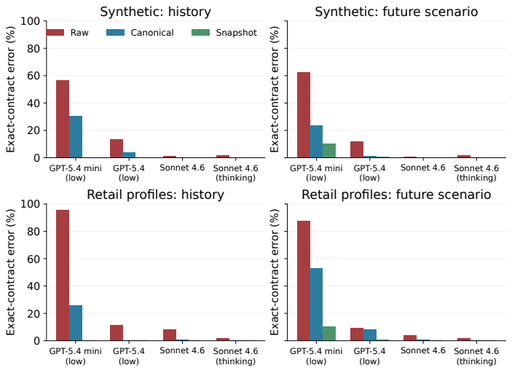
Figure 2 : Historical and future-stage errors under the three representations in the original grid. Snapshot historical answers are supplied by code; their accuracy measures faithful copying. Future- stage errors remain the substantive endpoint for that representation.
원문 · CC BY 4.0 · Durga Sandeep Saluru, Lanchen Song, Aditya Kumaran · Where Should the Code Go? Locating Foundation-Model Errors in Bitemporal Inventory Simulation · 원문 그림 인용 · 원본 PDF 15쪽에서 그림 영역을 추출했습니다.호출 내부 코드 도구와 추론 강도
호스팅 코드 도구를 쓸 수 있는 GPT-5.4 mini는 합성 이력의 원시 입력에서 미래 결합 정확도가 +54.2 [+45.3, +62.5] 퍼센트포인트 올랐습니다. 이때 모델은 576개 호출 중 469개에서 코드를 실행했고, 실행한 호출 가운데 453개가 정확했습니다. 같은 자동 선택 기준선과 비교한 도구 자체의 기여는 원시 입력에서 +34.9 [+26.0, +43.8]이었습니다. 추론 강도를 높이는 효과는 도구 호출 인터페이스에 따라 달랐습니다. 같은 모델을 자동 선택으로 실행하면 이 하락이 나타나지 않았으므로, 이 결과는 인터페이스와 모델-제공자 쌍의 조합으로 읽어야 합니다.
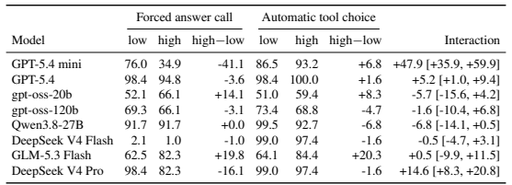
Table 2 : Requested reasoning effort × tool-choice interface, synthetic cohort, canonical input, future- joint accuracy (%; 192 calls per cell). high−low: paired effort effect within an interface. Interaction: automatic-choice effort effect minus forced-call effort effect, paired by history, with a descriptive 95% history-bootstrap interval (10,000 draws); a positive interaction means the forced call turns extra effort into a liability. Requested effort is a family-specific provider setting, not a compute match (observed reasoning tokens: Appendix F).
원문 · CC BY 4.0 · Durga Sandeep Saluru, Lanchen Song, Aditya Kumaran · Where Should the Code Go? Locating Foundation-Model Errors in Bitemporal Inventory Simulation · 원문 그림 인용 · 원본 PDF 4쪽에서 그림 영역을 추출했습니다.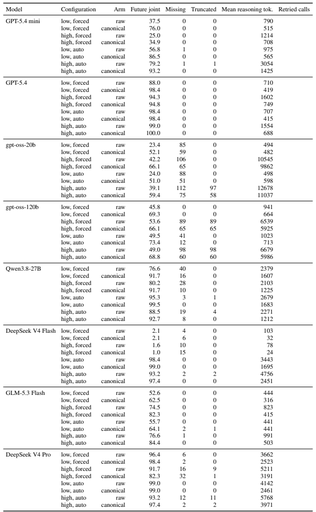
Table 12 : Effort × interface cells on the synthetic cohort (192 calls each): future-joint accuracy (%), calls with no answer (including refusals), calls truncated at the 16,384-token output limit, and mean provider-reported reasoning tokens. Each upstream maps the unified effort parameter onto its own control, so effort levels are comparable within a model family only.
원문 · CC BY 4.0 · Durga Sandeep Saluru, Lanchen Song, Aditya Kumaran · Where Should the Code Go? Locating Foundation-Model Errors in Bitemporal Inventory Simulation · 원문 그림 인용 · 원본 PDF 19쪽에서 그림 영역을 추출했습니다.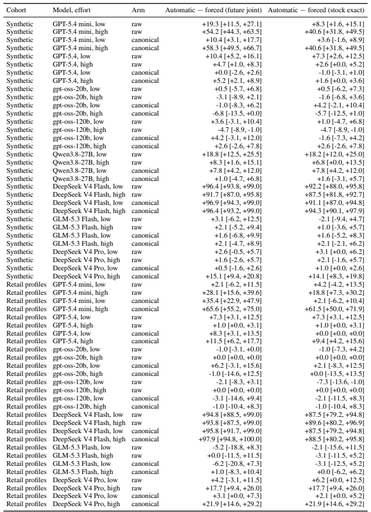
Table 14 : Interface effect: automatic tool choice minus forced answer call at fixed model, effort, input and history; paired differences in percentage points with descriptive 95% history-bootstrap intervals.
원문 · CC BY 4.0 · Durga Sandeep Saluru, Lanchen Song, Aditya Kumaran · Where Should the Code Go? Locating Foundation-Model Errors in Bitemporal Inventory Simulation · 원문 그림 인용 · 원본 PDF 21쪽에서 그림 영역을 추출했습니다.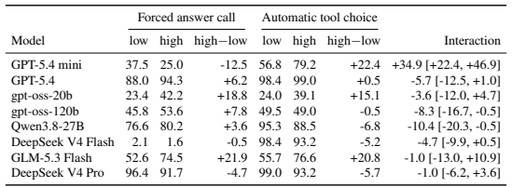
Table 15 : Requested reasoning effort × tool-choice interface, synthetic cohort, raw input, future-joint accuracy (%; 192 calls per cell). high −low: paired effort effect within an interface. Interaction: automatic-choice effort effect minus forced-call effort effect, paired by history, with a descriptive 95% history-bootstrap interval (10,000 draws); a positive interaction means the forced call turns extra effort into a liability. Requested effort is a family-specific provider setting, not a compute match (observed reasoning tokens: Appendix F).
원문 · CC BY 4.0 · Durga Sandeep Saluru, Lanchen Song, Aditya Kumaran · Where Should the Code Go? Locating Foundation-Model Errors in Bitemporal Inventory Simulation · 원문 그림 인용 · 원본 PDF 22쪽에서 그림 영역을 추출했습니다.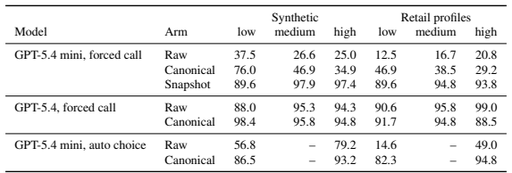
Table 17 : Future-joint accuracy (%) by requested reasoning effort, identical prompts and tasks; 192 synthetic and 96 profile calls per cell; the forced-call low columns are the original cohorts. Forced call: the answer function is the only permitted action; auto choice: the model may respond freely and a missing answer fails. Dashes: not run.
원문 · CC BY 4.0 · Durga Sandeep Saluru, Lanchen Song, Aditya Kumaran · Where Should the Code Go? Locating Foundation-Model Errors in Bitemporal Inventory Simulation · 원문 그림 인용 · 원본 PDF 22쪽에서 그림 영역을 추출했습니다.적용 범위와 해석의 한계
9포인트보다 작은 차이는 해결되지 않은 것으로 다뤘습니다. 오픈웨이트 모델은 각각 하나의 상류 제공자로 실행되었으므로 도구 호출과 추론 강도의 효과는 모델 자체가 아니라 모델과 제공자 쌍에 대한 결론입니다. gpt-oss-20b는 출력 예산을 소진하거나 답을 거부한 경우가 많아 그 셀은 정확도와 완료율을 함께 측정합니다. 또한 TSFM은 평가하지 않았고, 예측 단계를 제거해 상태 오류를 정확히 측정했습니다.
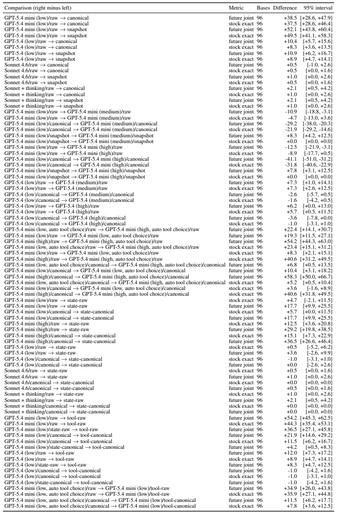
Table 10 : Paired differences in percentage points, synthetic cohort: matched by history and repetition index, averaged within history; descriptive 95% history-bootstrap percentile intervals (10,000 draws), not multiplicity adjusted. The same-period replication moved one identical cell by −8.9 points, so differences of that size are within run-to-run variation. Cells at or near 100% give degenerate intervals. Identical rows arise when two comparisons have identical per-history differences.
원문 · CC BY 4.0 · Durga Sandeep Saluru, Lanchen Song, Aditya Kumaran · Where Should the Code Go? Locating Foundation-Model Errors in Bitemporal Inventory Simulation · 원문 그림 인용 · 원본 PDF 16쪽에서 그림 영역을 추출했습니다.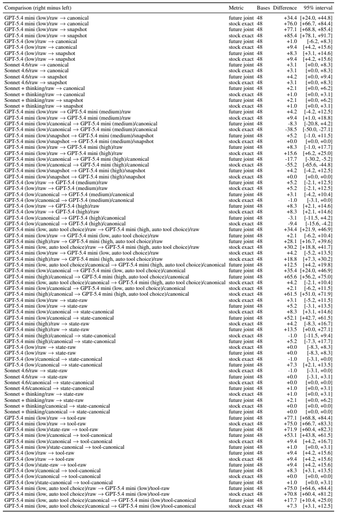
Table 11 : Paired differences in percentage points, retail profiles cohort: matched by history and repetition index, averaged within history; descriptive 95% history-bootstrap percentile intervals (10,000 draws), not multiplicity adjusted. The same-period replication moved one identical cell by −8.9 points, so differences of that size are within run-to-run variation. Cells at or near 100% give degenerate intervals. Identical rows arise when two comparisons have identical per-history differences.
원문 · CC BY 4.0 · Durga Sandeep Saluru, Lanchen Song, Aditya Kumaran · Where Should the Code Go? Locating Foundation-Model Errors in Bitemporal Inventory Simulation · 원문 그림 인용 · 원본 PDF 17쪽에서 그림 영역을 추출했습니다.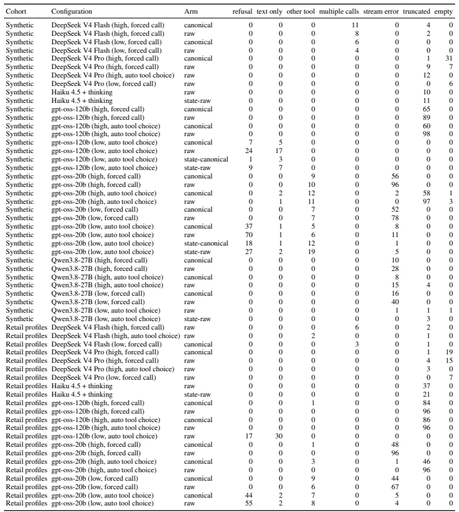
Table 13 : Missing answers by kind for every cell with at least three (all counted as failures in every accuracy):refusal, a text reply declining the task;text only, an answer written in the message instead of the tool call;other toolandmultiple calls, calls to a non-existent tool or more than one call;stream error, a provider-side error after the request was accepted;truncated, the 16,384-token output limit reached (for Anthropic thinking runs, entirely in thinking);empty, no content.
원문 · CC BY 4.0 · Durga Sandeep Saluru, Lanchen Song, Aditya Kumaran · Where Should the Code Go? Locating Foundation-Model Errors in Bitemporal Inventory Simulation · 원문 그림 인용 · 원본 PDF 20쪽에서 그림 영역을 추출했습니다.논문 정보
- 저자
- Durga Sandeep Saluru, Lanchen Song, Aditya Kumaran
- 학회·저널
- arXiv · 프리프린트
- 최초 공개일
- 2026년 11월 10일
- 등록일
- 2026년 11월 13일
- 수정일
- 2026년 11월 10일
- 버전
- v1
- arXiv
- 2611.14671
- 분류
- cs.SE · cs.AI · cs.LG
- 원문 이용 조건
- CC BY 4.0
- 제공 범위
- 논문 정보, 해설, 허용된 원문 그림
AI 해설은 논문 원문과 별개의 설명이며 오류가 있을 수 있습니다. 원문과 그림은 각 출처의 이용 조건과 따로 표시된 권리를 따릅니다.
초록
Operational reports carry two clocks: when an event happened and when its report arrived; later reports can revise earlier ones. A foundation-model component that maintains the state supported by the reports visible at a cutoff, then rolls a supplied scenario forward, can be helped by exact code before it, after it or inside the call, or asked to reason harder. We ask which remedy removes which error, for which models, on an exactly solvable lost-sales inventory environment: 36,672 independently rescored requests over twelve configurations of closed and open-weight models, with a forced-answer-call interface as a control and protocols frozen before the calls. Weak models fail in separable ways. Canonical input removes report-selection error, exact continuation removes rollout error, neither repairs the other, and which error dominates differs by model; strong models are at ceiling on raw reports. Asking for more reasoning is no substitute and can depend on the interface: under a forced answer call high effort collapses GPT-5.4 mini and DeepSeek V4 Pro, which gain or hold under automatic choice; on its provider the forced call disables reasoning for DeepSeek V4 Flash; and at high effort gpt-oss exhausts its output budget. The contribution is a controlled component diagnostic, released with every request, and evidence that for some model and provider pairs the tool-calling interface confounds reasoning evaluation.
원문 인용
Durga Sandeep Saluru, Lanchen Song, Aditya Kumaran (2026). Where Should the Code Go? Locating Foundation-Model Errors in Bitemporal Inventory Simulation. arXiv:2611.14671v1. https://arxiv.org/abs/2611.14671v1
BibTeX
@misc{saluru2026where,
  title = {{Where Should the Code Go? Locating Foundation-Model Errors in Bitemporal Inventory Simulation}},
  author = {Durga Sandeep Saluru and Lanchen Song and Aditya Kumaran},
  year = {2026},
  eprint = {2611.14671},
  archivePrefix = {arXiv},
  url = {https://arxiv.org/abs/2611.14671v1}
}