논문 해설
Deep Episodic Memory: Encoding, Recalling, and Predicting Episodic Experiences for Robot Action Execution
딥 에피소드 메모리: 로봇 행동 실행을 위한 에피소드 경험의 인코딩, 회상, 예측
- 연구 문제 로봇이 관찰한 행동 영상을 에피소드 기억처럼 저장하고 회상하며 미래 프레임까지 예측하는 방법이 필요합니다.
- 연구 방법 하나의 인코더가 프레임 시퀀스를 잠재 벡터로 압축하고, 재구성 디코더와 예측 디코더가 그 벡터만으로 과거 프레임과 미래 프레임을 생성합니다. 검색은 잠재 벡터 사이의 코사인 유사도로 수행합니다.
- 주요 결과 잠재 공간에서 같은 클래스의 비디오가 더 가깝게 배치되었고, 검색 정밀도는 제시된 기준선보다 높았습니다. 예측 프레임의 품질은 시간이 지날수록 낮아졌습니다.
연구 문제: 에피소드 기억을 로봇에 두기
이 논문은 로봇이 관찰한 행동 영상을 에피소드 기억처럼 저장하고, 필요할 때 떠올리며, 다음 프레임을 예측할 수 있는지 묻습니다. 기존 에피소드 기억 연구는 기호적 고수준 표현이나 사전에 정의된 문제별 표현에 많이 의존하여, 복잡한 실제 환경에서 지식을 일반화하기 어렵다고 지적됩니다. 반면 비디오 행동 이해 연구는 분류, 프레임 예측, 표현 예측 등으로 나뉘며, 프레임 예측 계열 중 일부 모델은 잠재 표현에서 원래 프레임을 복원하지 못합니다. 이 논문은 원시 프레임을 끝단 간(end-to-end)으로 인코딩하고 같은 잠재 표현에서 재구성과 미래 프레임 예측을 모두 수행하는 구조를 다룹니다.
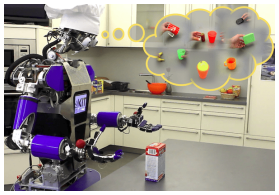
Fig. 1 : The ARMAR-IIIa humanoid robot, see [1], recalling previous visual episodes in a kitchen scene.
원문 · CC BY 4.0 · Jonas Rothfuss, Fabio Ferreira, Eren Erdal Aksoy, You Zhou, Tamim Asfour · Deep Episodic Memory: Encoding, Recalling, and Predicting Episodic Experiences for Robot Action Execution · 원문 그림 인용 · 원본 PDF 1쪽에서 그림 영역을 추출했습니다.심층 에피소드 메모리 모델의 구조
제안 모델은 하나의 인코더 E와 두 개의 디코더로 구성됩니다. 프레임 시퀀스 Xr = x1,...,xk를 인코더가 처리하여 하나의 잠재 벡터 V = E(Xr)로 투영하며, 이 V가 재구성 디코더 Dr과 예측 디코더 Dp의 유일한 입력입니다. Dr은 입력 프레임을 복원하고 Dp는 이후 프레임을 예측합니다. 인코더는 합성곱 계층과 convolutional LSTM 계층을 번갈아 쌓고, 그 위에 완전 연결 계층과 fc LSTM 계층을 둡니다. 최종 잠재 벡터는 fc LSTM의 마지막 은닉 상태 hk와 셀 상태 ck를 이어 붙인 V = hk‖ck이며, 차원은 2000입니다. 두 디코더는 인코더의 역구조이며 전치 합성곱으로 128×128 해상도를 복원합니다.
학습 시에는 V에 σ = 0.1의 가우시안 잡음을 더해 잠재 공간을 고르게 쓰도록 유도합니다.
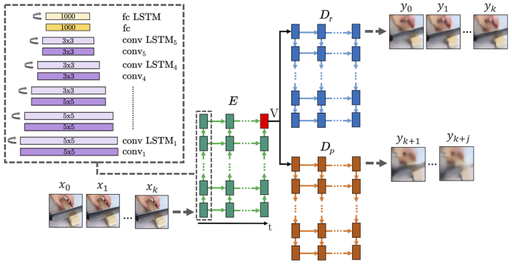
Fig. 2 : Structure of the proposed composite encoder-decoder network. It represents the shape of an unrolled network over multiple time steps. The encoder E receives multiple video frames as input and maps them into a latent vector space. The resulting vector representation V (highlighted in red) is forwarded to the two decoder networks. The first decoder ( Dr) is trained to reconstruct the video frames that were provided to the encoder while the second decoder ( Dp) attempts to predict the future frames. The dashed box on the left depicts the layers of the encoder network. The label inside each layer denotes the kernel size of the convolutional layer or the number of hidden units of the fully connected (fc) layer, respectively.
원문 · CC BY 4.0 · Jonas Rothfuss, Fabio Ferreira, Eren Erdal Aksoy, You Zhou, Tamim Asfour · Deep Episodic Memory: Encoding, Recalling, and Predicting Episodic Experiences for Robot Action Execution · 원문 그림 인용 · 원본 PDF 3쪽에서 그림 영역을 추출했습니다.학습 목표와 최적화
학습 오차는 재구성 손실 Lmse와 gradient difference loss Lgd의 선형 결합 L = (1−η)Lmse + ηLgd로 계산되며, 저자들은 η = 0.4를 사용합니다. Lmse는 생성 프레임 yi와 정답 프레임 xi의 픽셀 차이 제곱을 평균한 값입니다. Lgd는 정답과 생성 프레임의 수평·수직 image gradient 차이를 비교하여 흐림을 벌하고 경계를 선명하게 합니다. 손실은 입력 프레임과 예측 프레임 전체 X = Xr‖Xp와 Y = Yr‖Yp에 대해 계산되며, 테스트 시에는 Xr만 인코더에 입력됩니다. 최적화는 mini-batch 경사하강법과 ADAM을 사용하고 학습률은 지수적으로 감쇠합니다.
각 층에는 layer normalization과 10%에서 20% 사이의 dropout이 적용됩니다.
잠재 공간에서의 에피소드 검색
검색 단계에서는 질의 에피소드의 잠재 벡터 Vq와 메모리에 저장된 각 Vi 사이의 코사인 유사도를 계산합니다. 유사도가 가장 큰 n개의 메모리 항목을 검색 결과로 반환합니다. 이 방식은 잠재 벡터가 개념적 유사성을 공간상의 근접성으로 드러낸다는 전제에 의존합니다. 원문은 이 전제를 클래스 레이블을 쓰지 않은 비지도 학습 결과에서 확인하고, 이를 바탕으로 검색 메커니즘을 도입했다고 설명합니다.
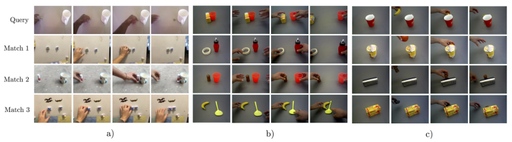
Fig. 6 : The proposed matching and retrieval mechanism evaluated on different visual episodes of object manipulations. The figure depicts three exemplary query episodes and the corresponding 3 closest matches in the latent space of our proposed network. The latent representations are generated by the 20BN model. While (a) shows a query on the 20BN dataset, (b) and (c) comprise human demonstrations for the ARMAR-IIIa robot (see section IV-F ).
원문 · CC BY 4.0 · Jonas Rothfuss, Fabio Ferreira, Eren Erdal Aksoy, You Zhou, Tamim Asfour · Deep Episodic Memory: Encoding, Recalling, and Predicting Episodic Experiences for Robot Action Execution · 원문 그림 인용 · 원본 PDF 7쪽에서 그림 영역을 추출했습니다.잠재 공간의 클래스 근접성
ActivityNet과 20BN의 검증 분할에서 비디오마다 잠재 벡터를 만들고 쌍별 코사인 유사도를 계산했습니다. Fig. 3의 행렬에서 대각 원소는 같은 클래스 사이의 평균 유사도, 비대각 원소는 다른 클래스 사이의 평균 유사도를 뜻합니다. 두 데이터셋 모두에서 대각 원소가 비대각 원소보다 상당히 높게 나타났습니다. 이 관찰은 클래스 레이블을 학습에 쓰지 않은 상태에서 개념적 유사성이 잠재 공간 근접성으로 반영됨을 보여 줍니다. 클래스 평균 벡터에 PCA를 적용하면 같은 클래스는 더 가까워지고 다른 클래스는 더 멀어지는 분포가 보고되며, 이는 배경 세부 정보의 영향을 줄이기 위한 후처리로 설명됩니다.
재구성과 미래 프레임 예측의 품질
재구성과 예측 품질은 원본 프레임과 생성 프레임 사이의 PSNR로 측정되었습니다. 5개의 재구성 프레임과 5개의 예측 프레임에 대해 검증 샘플 전체의 프레임별 평균을 보고하며, 채널별 입력 프레임 평균을 단순 기준선으로 함께 제시했습니다. 재구성 PSNR은 시간에 따라 대체로 일정했지만 예측 PSNR은 시간이 지날수록 감소했습니다. 저자들은 이 감소가 미래에 대한 불확실성 증가와 흐림 증가에서 주로 비롯되며, 객체의 움직임은 비교적 잘 외삽된다고 해석합니다. 따라서 이 감소는 픽셀 공간 회귀의 일반적 한계로 제시되며, 잠재 표현의 의미적 풍부함에 대한 직접 지표는 아닙니다.
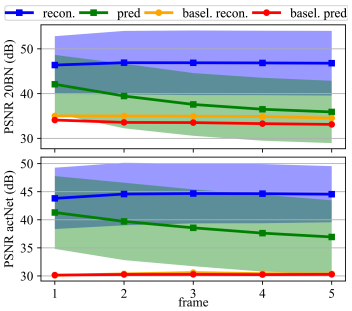
Fig. 5 : Peak-Signal-to-Noise-Ratio (PSNR) for each of the 5 reconstructed (blue) and predicted (green) frames generated by the 20BN and actNet model averaged over the entire validation dataset. The shaded regions depict the correspond- ing standard deviation. Additionally using the channel-wise mean of input frames as reconstruction/prediction is reported as simple baseline (red/orange). baselines, we phrase the matching and retrieval of memo- rized episodes as a document retrieval problem. Thereby, we assume that a retrieved episode is only relevant if it originates from the same action category as the query episode. For evaluating the performance of retrieving relevant visual episodes, we report the precision of the first match and the mean average precision (mAP). Since the setting is purely unsupervised, the precisions reported in this context are not to be confused with precisions for a classification task. Overall, we use the ActivityNet and the 20BN dataset to train and evaluate the different methods. For computing the performance metrics, we split the validation set of the respective dataset into 5 shuffled folds. In each fold, 80% of the videos are used as memory whereas the remaining 20% are used to query the memory. The results illustrated in Table I are averaged over the 5 folds. The evaluations were conducted with various numbers of GMM components and two different distance metrics (i.e. Euclidean and cosine) for matching the video encodings. We want to emphasize that we always report the best results out
원문 · CC BY 4.0 · Jonas Rothfuss, Fabio Ferreira, Eren Erdal Aksoy, You Zhou, Tamim Asfour · Deep Episodic Memory: Encoding, Recalling, and Predicting Episodic Experiences for Robot Action Execution · 원문 그림 인용 · 원본 PDF 6쪽에서 그림 영역을 추출했습니다.검색 성능 비교
검색은 같은 행동 범주에서 나온 에피소드를 관련 결과로 보는 문서 검색 문제로 정식화되었습니다. 검증 세트를 5개의 섞인 폴드로 나누어 80%를 메모리, 20%를 질의로 사용했고, 결과는 5개 폴드 평균입니다. 평가 지표는 첫 번째 일치의 정밀도와 상위 3개 결과의 mAP입니다. 비교 기준으로 SIFT와 STIP의 Fisher Vector, ResNet-50과 VGG-16 특징의 Fisher Vector, 같은 특징의 LSTM 인코딩이 포함되었으며, GMM 구성요소 수와 Euclidean·cosine 거리 중 최선의 결과가 보고되었습니다. ActivityNet에서 제안 방법은 PCA 없이 정밀도 44.31, PCA 200 성분에서 45.55를 기록하여 ResNet-50 LSTM의 36.29보다 높았습니다.
20BN에서는 PCA 200 성분에서 정밀도 11.81을 기록했고 ResNet-50 LSTM은 10.08이었습니다. 이 수치들은 논문에서 같은 표 안의 조건으로 보고된 결과입니다.
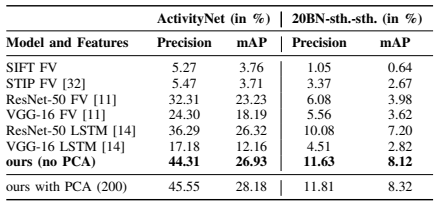
원문 그림 TABLE I: Benchmark results showing the matching and retrieving performance of our approach against the baselines. We report the precision for the first match and the mean average precision (mAP) for retrieving the 3 closest matches. Fisher Vectors are abbreviated to FV .
원문 · CC BY 4.0 · Jonas Rothfuss, Fabio Ferreira, Eren Erdal Aksoy, You Zhou, Tamim Asfour · Deep Episodic Memory: Encoding, Recalling, and Predicting Episodic Experiences for Robot Action Execution · 원문 그림 인용 · 원본 PDF 7쪽에서 그림 영역을 추출했습니다.정적 장면 질의에 기반한 로봇 파일럿
로봇 파일럿 연구에서는 사람이 ARMAR-IIIa에게 10개의 조작 행동을 보여 주는 120개 에피소드를 기록했습니다. 이 중 100개는 메모리로, 20개는 질의로 사용되었습니다. 정적 장면 하나를 질의로 넣으면 시스템이 밀기 시연 에피소드를 검색하고, 그 에피소드에서 객체 검출기로 추적한 궤적을 dynamic movement primitives로 학습하여 로봇이 인지된 스펀지에 같은 밀기 동작을 실행하도록 했습니다. 이 결과는 하나의 기억 사례가 유사한 행동의 전달에 쓰일 수 있음을 보이는 파일럿 연구입니다. 원문은 이 과정이 보조 객체 검출기에 의존하며, 학습된 행동 정보를 잠재 표현에서 직접 실행하는 것은 향후 과제라고 밝힙니다.
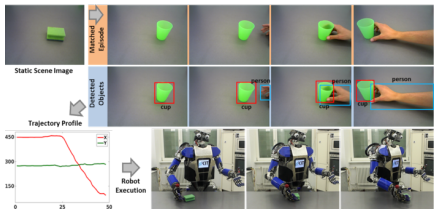
Fig. 7 : Robot execution of a matched pushing action.
원문 · CC BY 4.0 · Jonas Rothfuss, Fabio Ferreira, Eren Erdal Aksoy, You Zhou, Tamim Asfour · Deep Episodic Memory: Encoding, Recalling, and Predicting Episodic Experiences for Robot Action Execution · 원문 그림 인용 · 원본 PDF 7쪽에서 그림 영역을 추출했습니다.배경 편향과 적용 범위
저자들은 배경 색이 검색 결과에 영향을 준다고 보고합니다. 어두운 배경의 영상은 같은 종류의 어두운 배경 영상과 더 자주 매칭되는 경향이 있으며, 밝은 영상도 같은 방식으로 나타납니다. 또한 원문은 pixel 수준 예측에 의존한다는 점을 한계로 보고하고, 분할 마스크를 재구성 목표로 쓰는 방법을 향후 과제로 제시합니다. 로봇 적용에서도 메모리 항목이 순수한 시각 정보이므로 새 장면에 행동을 옮기는 일은 직접적이지 않습니다. 이 결과는 본문에 보고된 두 데이터셋과 로봇 파일럿 설정에서 얻은 것이며, 다른 로봇 과제나 실제 실행 성공률까지 일반화되지는 않습니다.
논문 정보
- 저자
- Jonas Rothfuss, Fabio Ferreira, Eren Erdal Aksoy, You Zhou, Tamim Asfour
- 학회·저널
- arXiv · 프리프린트
- 최초 공개일
- 2018년 1월 12일
- 등록일
- 2026년 11월 6일
- 수정일
- 2018년 7월 14일
- 버전
- v3
- arXiv
- 1801.04134
- 분류
- cs.AI · cs.CV · cs.RO
- 원문 이용 조건
- CC BY 4.0
- 제공 범위
- 논문 정보, 해설, 허용된 원문 그림
AI 해설은 논문 원문과 별개의 설명이며 오류가 있을 수 있습니다. 원문과 그림은 각 출처의 이용 조건과 따로 표시된 권리를 따릅니다.
초록
We present a novel deep neural network architecture for representing robot experiences in an episodic-like memory which facilitates encoding, recalling, and predicting action experiences. Our proposed unsupervised deep episodic memory model 1) encodes observed actions in a latent vector space and, based on this latent encoding, 2) infers most similar episodes previously experienced, 3) reconstructs original episodes, and 4) predicts future frames in an end-to-end fashion. Results show that conceptually similar actions are mapped into the same region of the latent vector space. Based on these results, we introduce an action matching and retrieval mechanism, benchmark its performance on two large-scale action datasets, 20BN-something-something and ActivityNet and evaluate its generalization capability in a real-world scenario on a humanoid robot.
원문 인용
Jonas Rothfuss, Fabio Ferreira, Eren Erdal Aksoy, You Zhou, Tamim Asfour (2018). Deep Episodic Memory: Encoding, Recalling, and Predicting Episodic Experiences for Robot Action Execution. arXiv:1801.04134v3. https://arxiv.org/abs/1801.04134v3
BibTeX
@misc{rothfuss2018deep,
  title = {{Deep Episodic Memory: Encoding, Recalling, and Predicting Episodic Experiences for Robot Action Execution}},
  author = {Jonas Rothfuss and Fabio Ferreira and Eren Erdal Aksoy and You Zhou and Tamim Asfour},
  year = {2018},
  eprint = {1801.04134},
  archivePrefix = {arXiv},
  url = {https://arxiv.org/abs/1801.04134v3}
}