논문 해설
Trust-based Multi-Robot Symbolic Motion Planning with a Human-in-the-Loop
사람이 개입하는 신뢰 기반 다중 로봇 기호 모션 플래닝
- 연구 문제 다중 로봇 심볼릭 동작 계획은 로봇 수가 늘면 상태 공간이 커지고, 인간의 로봇에 대한 신뢰를 계획에 반영하는 방법이 부족합니다.
- 연구 방법 인간의 로봇에 대한 신뢰를 DBN 기반으로 추정하고, 그 신뢰로 목표 배정과 수동·자율 계획 전환을 결정합니다.
- 주요 결과 시뮬레이션에서 신뢰 값이 높아진 로봇에게 수동 계획이 요청되고, 결함 발생 후 신뢰 하락에 따라 목표가 재배정되는 과정이 관찰되었습니다.
다중 로봇 심볼릭 계획의 확장성과 인간 신뢰
이 논문은 한 명의 인간 운용자가 여러 자율 로봇을 감독하는 상황에서, 이산 공간의 작업 명세를 연속 공간에서 실행하는 심볼릭 동작 계획을 확장하는 문제를 다룹니다. 심볼릭 동작 계획은 작업을 이산 영역의 명세로 쓰고 그 명세를 보존하는 실행 경로를 얻는 방법이지만, 다중 로봇으로 확장하면 전체 상태 공간이 로봇 수에 따라 급격히 커지는 상태 공간 폭발 문제가 생깁니다. 따라서 저자들은 전역 명세를 로봇별 로컬 명세로 나누는 구성적 추론이 필요하다고 설명합니다. 또한 로봇의 감지와 인식이 완전하지 않은 환경에서는 인간의 고수준 판단이 도움이 될 수 있지만, 인간이 로봇을 얼마나 신뢰하는지에 따라 자율 계획과 수동 계획을 어떻게 나눌지가 달라집니다.
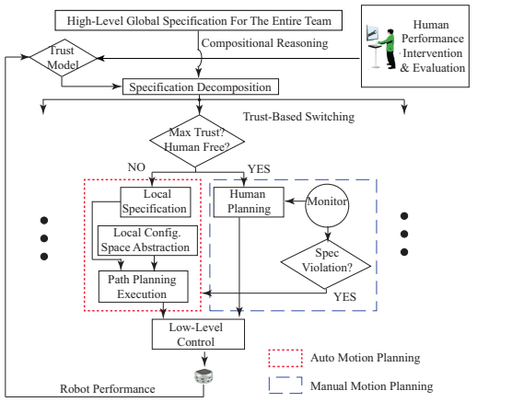
Fig. 2 . Schematic diagram of trust-based symbolic motion planning for human and multi-robot collaboration systems.
원문 · CC BY 4.0 · Yue Wang, Laura R. Humphrey, Zhanrui Liao, Huanfei Zheng · Trust-based Multi-Robot Symbolic Motion Planning with a Human-in-the-Loop · 원문 그림 인용 · 원본 PDF 7쪽에서 그림 영역을 추출했습니다.이 연구는 인간의 로봇에 대한 신뢰를 동적, 정량적, 확률적으로 추정하고, 그 추정값을 명세 분해와 수동·자율 계획 전환에 사용하는 것을 목표로 합니다. 다만 본 논문의 주요 검증은 설정된 ISR 시뮬레이션과 제한된 인간 입력에 기반합니다.
신뢰 모델의 동적 베이지안 네트워크 구성
신뢰 모델은 인간의 로봇에 대한 신뢰 T_i(t)를 실시간으로 진화하는 은닉 상태로 둡니다. 이 신뢰는 로봇 성능 P_R,i, 인간 성능 P_H,i, 공동 인간-로봇 결함 F_i의 세 요인에 의해 영향을 받으며, 인간의 개입 m_i, 신뢰 변화 보고 c_i, 주관적 신뢰 피드백 f_i는 관측값으로 사용됩니다. 저자들은 m_i가 실시간으로 측정될 수 있는 반면 c_i와 f_i는 주기적으로만 관측된다고 설명합니다.
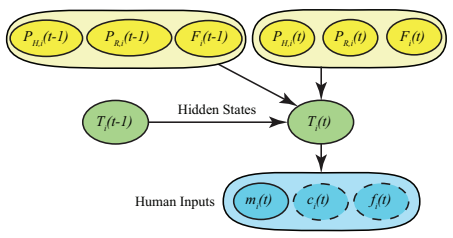
Fig. 3 . A dynamic Bayesian network (DBN) based model for dynamic, quantitative, and probabilistic trust estimates.
원문 · CC BY 4.0 · Yue Wang, Laura R. Humphrey, Zhanrui Liao, Huanfei Zheng · Trust-based Multi-Robot Symbolic Motion Planning with a Human-in-the-Loop · 원문 그림 인용 · 원본 PDF 10쪽에서 그림 영역을 추출했습니다.평균 신뢰는 이전 신뢰와 현재 및 이전 성능·결함 항의 선형 결합으로 정의됩니다. 신뢰의 조건부 분포는 이 평균과 분산을 갖는 가우시안으로 주어지며, 계수는 인간 실험 데이터로 정해진 뒤 평균 신뢰가 정규화되도록 조정된다고 밝힙니다. 개입 확률은 신뢰가 높을수록 인간이 협업을 선택하는 경향을 반영하는 시그모이드 형태로 모델링됩니다.
신뢰 믿음 갱신과 EM 학습
신뢰 믿음은 DBN의 전방 알고리즘으로 갱신됩니다. 전방 계산은 이전 신뢰 믿음을 전이 분포로 전파하고, 개입 확률, 신뢰 변화 확률, 주관적 피드백 확률을 곱하여 새 믿음을 얻는 구조입니다. 저자들은 이 계산이 시간에 따라 지수적으로 늘어나는 비용을 피하기 위해 동적 계획법을 사용한다고 설명합니다.
DBN의 매개변수 ω1, ω2는 기대값 최대화 알고리즘으로 학습됩니다. 기대 단계에서 전방 및 후방 평활화로 신뢰 상태 열을 추정하고, 최대화 단계에서 각 조건부 분포의 매개변수를 갱신합니다. 이 학습은 훈련 세션에서 오프라인으로 수행되며, 학습 후 실시간 운용에서는 학습된 파라미터를 사용합니다. 시뮬레이션에서는 네 번의 EM 반복을 수행했다고 보고합니다.
신뢰 기반 명세 분해와 충돌 회피
명세 분해 단계에서는 글로벌 명세의 도달성 항과 장애물 회피 항을 로봇별 로컬 명세로 나눕니다. 더 높은 신뢰를 받는 로봇에는 더 많은 목표가 배정됩니다. 원문은 이 배정이 신뢰 믿음 추정에 따라 시간에 따라 갱신된다고 설명합니다.
로봇은 관측, 통신, 제어 명제를 사용해 장애물과 상호 충돌을 처리합니다. 로봇이 장애물을 감지하면 작업 공간 표현을 갱신하고 계획을 다시 합성합니다. 통신 범위 안에서 다른 로봇을 만나면 목표와 경로 정보를 교환하고 필요하면 정지 또는 재계획을 수행합니다. 저자들은 이 단순한 충돌 프로토콜만으로는 좁은 통로에서 교착이 생길 수 있으므로 목표 재할당을 포함한 알고리즘이 필요하다고 설명합니다.
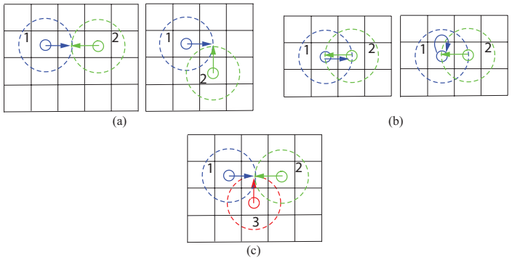
Fig. 5 . Collision avoidance scenarios.
원문 · CC BY 4.0 · Yue Wang, Laura R. Humphrey, Zhanrui Liao, Huanfei Zheng · Trust-based Multi-Robot Symbolic Motion Planning with a Human-in-the-Loop · 원문 그림 인용 · 원본 PDF 15쪽에서 그림 영역을 추출했습니다.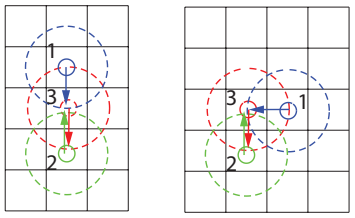
Fig. 8 . Example collision scenarios among 3 robots: Robot 1 and 2 will run into a same cell at the next move; Robot 2 and 3 are at adjacent cells and will run into each other at the next move.
원문 · CC BY 4.0 · Yue Wang, Laura R. Humphrey, Zhanrui Liao, Huanfei Zheng · Trust-based Multi-Robot Symbolic Motion Planning with a Human-in-the-Loop · 원문 그림 인용 · 원본 PDF 21쪽에서 그림 영역을 추출했습니다.수동·자율 계획 전환 구조
자율 계획은 로봇이 이산 추상화를 따라 안전하게 이동하도록 보장하지만, 과도한 근사 때문에 장애물 사이의 더 효율적인 경로를 놓칠 수 있습니다. 이 논문은 인간이 신뢰하고 과부하가 없을 때 수동 계획을 요청하여 이런 위험하지만 효율적인 경로를 선택할 수 있게 합니다. 전환 판단은 신뢰 믿음 분포에서 얻은 최대 우도 신뢰 값과 이전 시점과의 변화량을 비교하는 방식입니다.
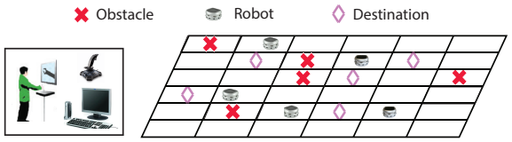
Fig. 1 . Multiple robots must reach a set of destinations while avoiding obstacles and collisions with other robots, taking shorter but riskier paths between obstacles with human oversight when trusted to do so. That is, when the human operator trusts a robot, he/she plans for robot motion through visual feedback from a robot’s onboard camera using HMI such as keyboard, mouse, or joystick.
원문 · CC BY 4.0 · Yue Wang, Laura R. Humphrey, Zhanrui Liao, Huanfei Zheng · Trust-based Multi-Robot Symbolic Motion Planning with a Human-in-the-Loop · 원문 그림 인용 · 원본 PDF 5쪽에서 그림 영역을 추출했습니다.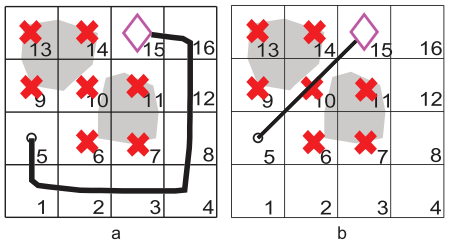
Fig. 6 . (a) Safe autonomous motion planning in low trust scenario, and (b) advanced manual motion planning in high trust scenario.
원문 · CC BY 4.0 · Yue Wang, Laura R. Humphrey, Zhanrui Liao, Huanfei Zheng · Trust-based Multi-Robot Symbolic Motion Planning with a Human-in-the-Loop · 원문 그림 인용 · 원본 PDF 16쪽에서 그림 영역을 추출했습니다.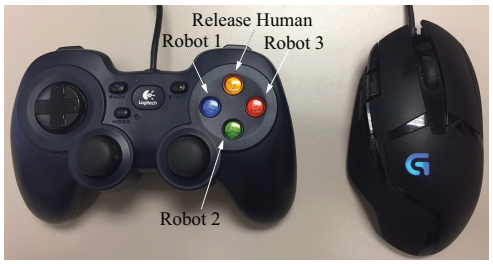
Fig. 14 . Human input devices: gamepad and mouse. The gamepad buttons are used to select and confirm a robot to collaborate with, e.g., “blue” button for Robot 1, “green” button for Robot 2, “red” button for Robot 3, and “yellow” button for releasing the human. The mouse is used to give waypoints to a robot manually.
원문 · CC BY 4.0 · Yue Wang, Laura R. Humphrey, Zhanrui Liao, Huanfei Zheng · Trust-based Multi-Robot Symbolic Motion Planning with a Human-in-the-Loop · 원문 그림 인용 · 원본 PDF 25쪽에서 그림 영역을 추출했습니다.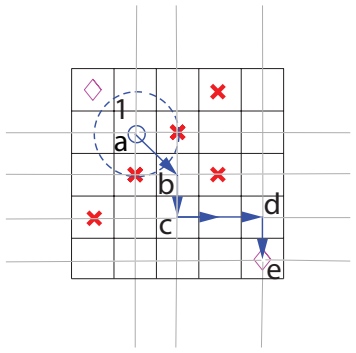
Fig. 15 . Illustration of manual motion planning using a mouse. The human assigns waypoints starting from a, passing between two obstacles to point b, and then point c, d, and eventually reaching the goal e.
원문 · CC BY 4.0 · Yue Wang, Laura R. Humphrey, Zhanrui Liao, Huanfei Zheng · Trust-based Multi-Robot Symbolic Motion Planning with a Human-in-the-Loop · 원문 그림 인용 · 원본 PDF 25쪽에서 그림 영역을 추출했습니다.수동 계획 중에도 모니터와 체커가 로봇 상태와 장애물 이벤트를 감시합니다. 이벤트가 명세 위반을 나타내면 자율 안전 계획이 다시 활성화됩니다. 저자들의 설계는 Simplex 구조와 MaC 프레임워크를 바탕으로 하며, 이는 안전 감시의 선행 설계에 대한 참조입니다.
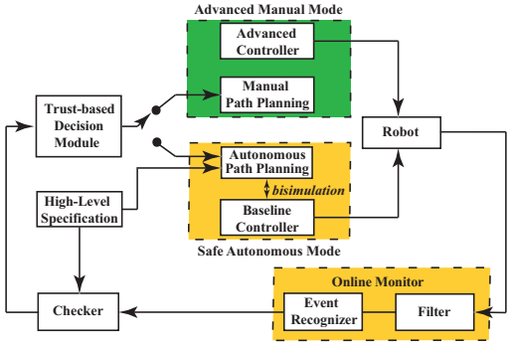
Fig. 7 . The overall structure of the monitoring and trust-based switching framework
원문 · CC BY 4.0 · Yue Wang, Laura R. Humphrey, Zhanrui Liao, Huanfei Zheng · Trust-based Multi-Robot Symbolic Motion Planning with a Human-in-the-Loop · 원문 그림 인용 · 원본 PDF 18쪽에서 그림 영역을 추출했습니다.교착과 생존성 실패를 막는 알고리즘
교착과 생존성 실패를 막기 위해 저자들은 현재 목표와 다음 목표의 집합을 로봇별로 유지하는 알고리즘을 제시합니다. 로봇이 통신 범위 안에 있는 경우 목표를 재할당하며, 가장 가까운 목표에 대해 경로 길이가 줄어드는 로봇에게 목표를 넘기는 규칙을 사용합니다.
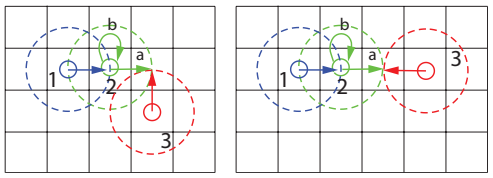
Fig. 9 . Example collision scenarios among 3 robots: Robot 2 and 3 will run into a same cell at the next move and hence Robot 2 waits, however under this policy Robot 1 and 2 will collide at the next move.
원문 · CC BY 4.0 · Yue Wang, Laura R. Humphrey, Zhanrui Liao, Huanfei Zheng · Trust-based Multi-Robot Symbolic Motion Planning with a Human-in-the-Loop · 원문 그림 인용 · 원본 PDF 21쪽에서 그림 영역을 추출했습니다.원문은 장애물 없는 유한 경로, 통신 범위가 셀 크기보다 크다는 조건, 인간 제어가 유한 시간에 끝난다는 가정 아래에서 도달성 정리를 증명합니다. 이 증명은 이러한 가정을 전제로 하며, 가정을 벗어난 환경 전체에 대한 보장으로 확장되지 않습니다.
시뮬레이션 결과와 신뢰 변화
시뮬레이션은 Matlab과 NuSMV를 결합한 ISR 환경에서 수행되었습니다. 세 로봇이 여섯 목표를 향하는 설정에서 로봇 1은 장애물을 통과하는 수동 경로를 사용했고, 로봇 3은 신뢰 증가가 임계값 0.05를 넘어 수동 계획을 요청했습니다. 로봇 3은 수동 계획 중 미지의 장애물과 충돌하여 결함이 발생했고, 신뢰가 떨어진 뒤 목표 일부를 로봇 1에 넘겼습니다.
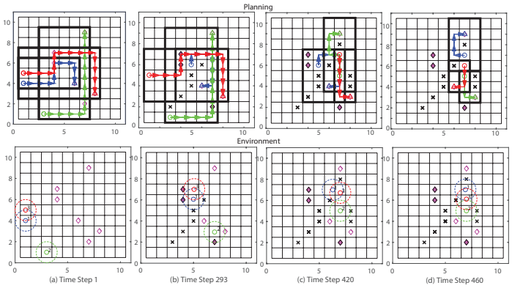
Fig. 10 . Progression of simulation of the inter-robot collision scenario in Fig. 8 (a) at time step t = 1 (initial plan and robot position), (b) t = 293 (new obstacle at (6,6) detected in the path and Robot 1 replans), (c) t = 420 (Robots 2 and 3 communicate each other’s obstacle information and replan), and (d) t = 450 (Robots 1,2, and 3 enter into the collision scenario in Fig. 8 and hence reassign goals and replan.)
원문 · CC BY 4.0 · Yue Wang, Laura R. Humphrey, Zhanrui Liao, Huanfei Zheng · Trust-based Multi-Robot Symbolic Motion Planning with a Human-in-the-Loop · 원문 그림 인용 · 원본 PDF 23쪽에서 그림 영역을 추출했습니다.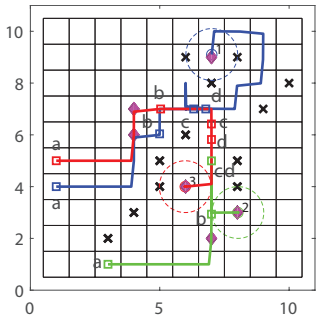
Fig. 11 . Final paths and key moments (marked by rectangles from step (a)-(d)) of each robot under the simulation scenario shown in Fig. 10.
원문 · CC BY 4.0 · Yue Wang, Laura R. Humphrey, Zhanrui Liao, Huanfei Zheng · Trust-based Multi-Robot Symbolic Motion Planning with a Human-in-the-Loop · 원문 그림 인용 · 원본 PDF 23쪽에서 그림 영역을 추출했습니다.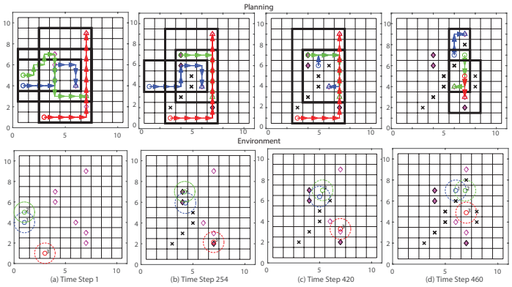
Fig. 12 . Progression of simulation of the inter-robot collision scenario in Fig. 9 (a) at time step t = 1 (initial plan and robot position), (b) t = 250 (Robots 1 and 2 are within each other’s communication ranges; Robot 2 finds new obstacles in the path and hence replans), t = 310 (new obstacle at (6,6) detected in the path and Robot 1 replans), and (d) t = 391 (Robots 1,2, and 3 enter into the collision scenario in Fig. 9 and hence reassign goals and replan.)
원문 · CC BY 4.0 · Yue Wang, Laura R. Humphrey, Zhanrui Liao, Huanfei Zheng · Trust-based Multi-Robot Symbolic Motion Planning with a Human-in-the-Loop · 원문 그림 인용 · 원본 PDF 24쪽에서 그림 영역을 추출했습니다.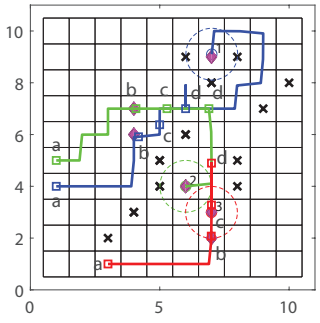
Fig. 13 . Final paths and key moments (marked by rectangles from step (a)-(d)) of each robot under the simulation scenario shown in Fig. 12.
원문 · CC BY 4.0 · Yue Wang, Laura R. Humphrey, Zhanrui Liao, Huanfei Zheng · Trust-based Multi-Robot Symbolic Motion Planning with a Human-in-the-Loop · 원문 그림 인용 · 원본 PDF 24쪽에서 그림 영역을 추출했습니다.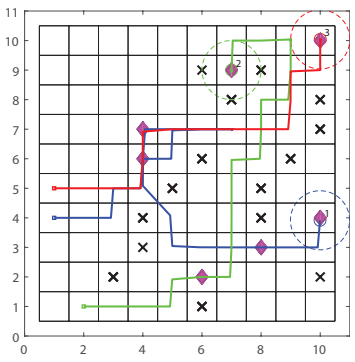
Fig. 17 . Final paths for 3-robot symbolic motion planning switching between manual and autonomous motion planning mode.
원문 · CC BY 4.0 · Yue Wang, Laura R. Humphrey, Zhanrui Liao, Huanfei Zheng · Trust-based Multi-Robot Symbolic Motion Planning with a Human-in-the-Loop · 원문 그림 인용 · 원본 PDF 28쪽에서 그림 영역을 추출했습니다.이 결과는 특정 시나리오와 인간 입력에서 관찰된 것입니다. 신뢰 모델의 계수와 EM 학습은 훈련 세션 데이터에 기반하므로, 다른 사용자와 환경으로 일반화하는 근거는 본 논문에서 직접 제시되지 않습니다.
범위와 한계
저자들은 신뢰가 로봇마다 독립적으로 진화한다고 가정하며, 실제로는 로봇 간 신뢰가 서로 영향을 줄 수 있다고 밝힙니다. 또한 모든 목표가 모든 로봇에게 도달 가능하다고 가정했으며, 대규모 실제 환경에서는 작업 부하와 명세 수정이 필요할 수 있습니다.
검증은 주로 시뮬레이션에 기반하며, 인간 신뢰 모델은 설정된 간단한 환경에서 검증되었습니다. 현재 근거만으로는 실제 로봇 하드웨어나 다른 인간 집단에서의 성능은 확인되지 않습니다.
논문 정보
- 저자
- Yue Wang, Laura R. Humphrey, Zhanrui Liao, Huanfei Zheng
- 학회·저널
- arXiv · 프리프린트
- 최초 공개일
- 2018년 8월 15일
- 등록일
- 2026년 11월 6일
- 수정일
- 2018년 8월 15일
- 버전
- v1
- arXiv
- 1808.05120
- DOI
- 10.1145/3213013
- 분류
- cs.RO
- 원문 이용 조건
- CC BY 4.0
- 제공 범위
- 논문 정보, 해설, 허용된 원문 그림
AI 해설은 논문 원문과 별개의 설명이며 오류가 있을 수 있습니다. 원문과 그림은 각 출처의 이용 조건과 따로 표시된 권리를 따릅니다.
초록
Symbolic motion planning for robots is the process of specifying and planning robot tasks in a discrete space, then carrying them out in a continuous space in a manner that preserves the discrete-level task specifications. Despite progress in symbolic motion planning, many challenges remain, including addressing scalability for multi-robot systems and improving solutions by incorporating human intelligence. In this paper, distributed symbolic motion planning for multi-robot systems is developed to address scalability. More specifically, compositional reasoning approaches are developed to decompose the global planning problem, and atomic propositions for observation, communication, and control are proposed to address inter-robot collision avoidance. To improve solution quality and adaptability, a dynamic, quantitative, and probabilistic human-to-robot trust model is developed to aid this decomposition. Furthermore, a trust-based real-time switching framework is proposed to switch between autonomous and manual motion planning for tradeoffs between task safety and efficiency. Deadlock- and livelock-free algorithms are designed to guarantee reachability of goals with a human-in-the-loop. A set of non-trivial multi-robot simulations with direct human input and trust evaluation are provided demonstrating the successful implementation of the trust-based multi-robot symbolic motion planning methods.
원문 인용
Yue Wang, Laura R. Humphrey, Zhanrui Liao, Huanfei Zheng (2018). Trust-based Multi-Robot Symbolic Motion Planning with a Human-in-the-Loop. arXiv:1808.05120v1. https://doi.org/10.1145/3213013
BibTeX
@article{wang2018trust,
  title = {{Trust-based Multi-Robot Symbolic Motion Planning with a Human-in-the-Loop}},
  author = {Yue Wang and Laura R. Humphrey and Zhanrui Liao and Huanfei Zheng},
  year = {2018},
  eprint = {1808.05120},
  archivePrefix = {arXiv},
  doi = {10.1145/3213013},
  url = {https://arxiv.org/abs/1808.05120v1}
}