논문 해설
Self-reconfigurable Multifunctional Memristive Nociceptor for Intelligent Robotics
지능형 로봇을 위한 자기 재구성 다기능 멤리스티브 통각 수용기
- 연구 문제 고정된 응답 특성을 가진 인공 통각수용체는 온도처럼 환경이 바뀌면 위험 자극을 정확히 판단하기 어렵습니다.
- 연구 방법 SDC 멤리스터를 VTEAM model로 기술하고, 압력과 온도 정보를 변조 방식 선택에 사용하는 자가 조절형 통각수용체 회로를 구성합니다.
- 주요 결과 295 K 조건의 시연에서 증폭은 memristor change ratio 기준 1000%로 보고되며, 온도 비교에서 difference ratio는 283 K와 307 K 사이에서 최대 500%입니다.
고정된 응답 특성의 한계와 자가 조절형 설계
인공 통각수용체는 위험한 자극을 감지해야 하지만, 기존에 보고된 인공 통각수용체의 응답 특성은 고정되어 있습니다. 생체 통각수용체는 환경 조건에 따라 반응 특성을 조절하는데, 고정된 특성은 온도처럼 환경이 바뀌는 상황에서 위험을 정확히 구분하기 어렵게 만듭니다.
이 논문은 SDC 멤리스터를 이용해 온도에 따라 위험 자극의 임계값과 증폭 정도가 자동으로 바뀌는 memristor-based nociceptor를 제시합니다. 기술적 변경점은 온도 정보에 따라 감작 임계값과 회복 전압을 아날로그 스위치와 전압원으로 바꾸는 설계이며, 압력과 온도를 함께 감지하는 시스템으로 구현됩니다. 응답은 온도가 높을수록 강화되고 낮을수록 억제되도록 설계되었습니다.
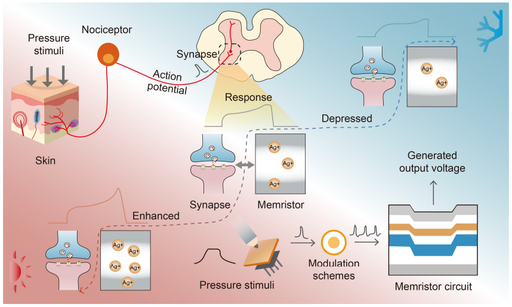
FIG.1 . Schematic illustrations of a memristive nociceptor with adjustable response characteristics. The response of this memristive nociceptor to dangerous pressure stimuli is enhanced with rising temperat ures and depressed with decreasi ng temperatures, respectively, cl osely mirroring that of biological tactile nociceptors.
원문 · CC BY 4.0 · Shengbo Wang, Mingchao Fang, Lekai Song, Cong Li, Jian Zhang, Arokia Nathan, Guohua Hu, Shuo Gao · Self-reconfigurable Multifunctional Memristive Nociceptor for Intelligent Robotics · 원문 그림 인용 · 원본 PDF 3쪽에서 그림 영역을 추출했습니다.SDC 멤리스터의 스위칭과 모델링
SDC 멤리스터는 KNOWM Inc.에서 구입한 다층 구조 소자입니다. Ag 이온이 Ge2Se3 활성층 안의 개구부를 따라 이동하면서 전도 채널이 형성되고 소멸하며, 이 과정에서 저항이 바뀝니다. Sn 이온은 Ag가 Ge-Ge 결합 자리를 치환하도록 도와 이러한 개구부를 만듭니다.
저자들은 구입한 소자의 전압-전류 이력 곡선과 펄스 측정을 바탕으로 VTEAM model을 세웠습니다. 이 모델은 저항 M과 상태 변수 w 사이의 지수적 의존성을 포함하며, 파라미터 kon과 koff는 quasi-newton 최적화 방법으로 맞추었습니다. 이렇게 얻은 행동 모델은 이후 SPICE 시뮬레이션에 쓰이고, 같은 입력 전압에서 실제 소자와 시뮬레이션 결과를 비교합니다.
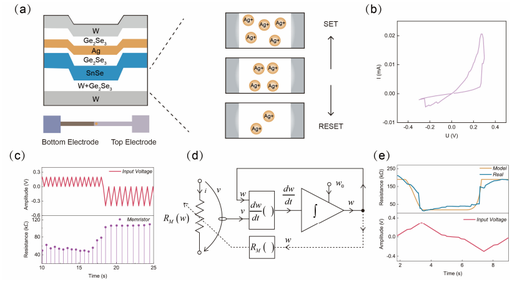
FIG.2 . The self-directed channel (SDC) memristor and its electrical model. (a) The mixed structure of the SDC memristor along its switching mechanisms. (b) The U-I (voltage-current) hysteresis curve of the purchased SDC memristor. (c) The electrical characteristics test conducted on the purchased memristor. (d) The block diagram used to simulate the switching behaviour of the memristor. (e) Comparison of the actual SDC memristor and its simulation model under the same input voltage.
원문 · CC BY 4.0 · Shengbo Wang, Mingchao Fang, Lekai Song, Cong Li, Jian Zhang, Arokia Nathan, Guohua Hu, Shuo Gao · Self-reconfigurable Multifunctional Memristive Nociceptor for Intelligent Robotics · 원문 그림 인용 · 원본 PDF 4쪽에서 그림 영역을 추출했습니다.감각 입력에서 응답 전압까지의 처리 흐름
시스템은 감각 모듈, 신호 생성 모듈, memristor-based nociceptor module의 세 부분으로 구성됩니다. 감각 모듈에서 piezoresistive film은 압력 자극을 전압 변화 Vs로 바꾸고, thermistor는 온도 정보를 직렬 저항 양단의 전압 변화 VT로 전달합니다. piezoresistive film은 정전압원과 직렬 저항에 직렬로 연결되어 있습니다.
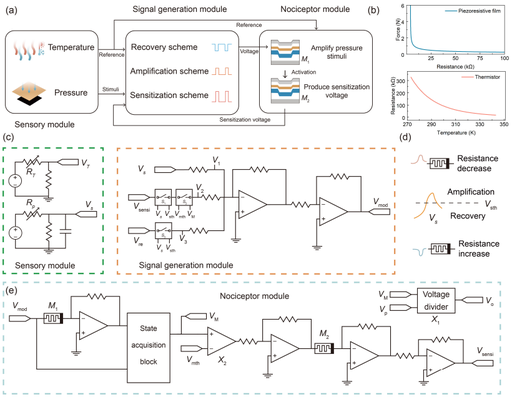
FIG.3 . The memristor-based adjustable nociceptor. (a) The schematic diagram of the memristor-based adjustable nociceptor, compromising three modules: the sensory module, the signal generation module, and the memristor-based nociceptor module. (b) Response characteristics of the piezoresistive film and thermistor, which detects pressure stimuli and temperature conditions, respectively. (c) Detailed circuit design of the sensory module and signal generation module. (d) The modul ation schemes. (e) Detailed circuit design of the memristor-ba sed nociceptor module.
원문 · CC BY 4.0 · Shengbo Wang, Mingchao Fang, Lekai Song, Cong Li, Jian Zhang, Arokia Nathan, Guohua Hu, Shuo Gao · Self-reconfigurable Multifunctional Memristive Nociceptor for Intelligent Robotics · 원문 그림 인용 · 원본 PDF 6쪽에서 그림 영역을 추출했습니다.신호 생성 모듈은 V1, V2, V3을 연산 증폭기 기반 가산 회로로 더해 변조 전압 Vmod를 만듭니다. 식으로는 \(V_{mod}=V_1+V_2+V_3\)이며 V1은 Vs로 설정됩니다. 메모리스터 M1의 양의 전압 VM이 감작 임계값보다 낮고 Vs가 자극 임계값 Vsth를 넘으면 V2에 감작 전압 Vsensi가 할당됩니다. Vs가 Vsth보다 작을 때에는 회복 전압이 V3으로 전달되고, 두 경우가 아니면 증폭 방식이 선택됩니다.
memristor-based nociceptor module에서는 M1이 Vmod로 변조되어 자극을 증폭하고, 상태 획득 블록이 M1의 저항을 전압 VM으로 바꿉니다. VM이 감작 임계값 Vmth보다 낮아지면 비교 회로 X2가 M2를 저저항 상태로 만들어 Vsensi를 생성하고, 이 전압은 신호 생성 모듈로 보내집니다. 전압 분배 블록 X1은 Vp와 VM의 비율을 계산해 응답 전압 Vo를 출력합니다.
온도별 임계값 조정
온도 적응은 감작 임계값 Vmth, Vsth, 회복 전압 Vre를 온도별 값으로 바꾸는 방식으로 구현됩니다. 표 II에서 감작 상태의 Vsth는 283 K에서 0.46 V, 307 K에서 0.14 V로 낮아지고, 그 밖의 상태의 Vsth는 0.56 V에서 0.24 V로 낮아집니다. 같은 구간에서 Vmth는 0.6 V에서 3.4 V로 높아지고, 회복 전압 Vre는 -0.51 V에서 -0.19 V로 바뀝니다.
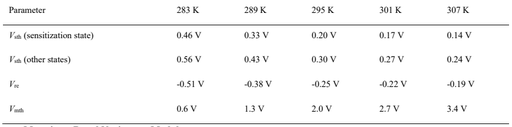
원문 그림 TABLE II. Adjustment of threshold parameters at different temperatures.
원문 · CC BY 4.0 · Shengbo Wang, Mingchao Fang, Lekai Song, Cong Li, Jian Zhang, Arokia Nathan, Guohua Hu, Shuo Gao · Self-reconfigurable Multifunctional Memristive Nociceptor for Intelligent Robotics · 원문 그림 인용 · 원본 PDF 7쪽에서 그림 영역을 추출했습니다.이 조정으로 온도가 높을수록 같은 힘 자극에서 M1이 더 쉽게 활성화되고 감작 상태에 더 빨리 들어갑니다. 예를 들어 301 K에서는 295 K보다 Vsth가 낮아져 M1이 더 쉽게 활성화되며, 289 K에서는 반대 방향으로 변합니다. 저자들은 이 방향이 생체 통각수용체의 민감도 변화와 대응한다고 해석합니다.
힘 자극 시나리오와 온도별 응답 비교
기능 검증은 힘 자극의 크기와 순서를 바꾸어 수행되었습니다. 295 K에서 첫 번째 힘 자극은 약해서 회복 상태가 유지되고 M1은 고저항 상태를 유지합니다. 두 번째 자극에서 Vs가 Vsth를 넘으면 M1의 저항이 줄어들며, 이는 threshold와 no-adaptation 특성으로 제시됩니다.
강한 자극이 이어지면 M1이 저저항 상태로 떨어져 VM이 Vmth 아래로 내려가고, M2가 Vsensi를 더해 감작 응답이 나타납니다. 이 295 K 실험 조건에서 memristor change ratio 기준 위험 자극의 증폭은 1000%로 보고됩니다.
온도 비교에서는 같은 힘 자극에서 301 K와 289 K의 응답을 295 K와 비교했습니다. difference ratio는 283 K와 307 K 사이에서 최대 500%이며, 이는 서로 다른 온도에서 멤리스터 응답이 얼마나 달라지는지를 보여 줍니다. 289 K 조건에서는 임계값이 올라가 세 번째 자극이 활성화되지 않는다고 보고됩니다.
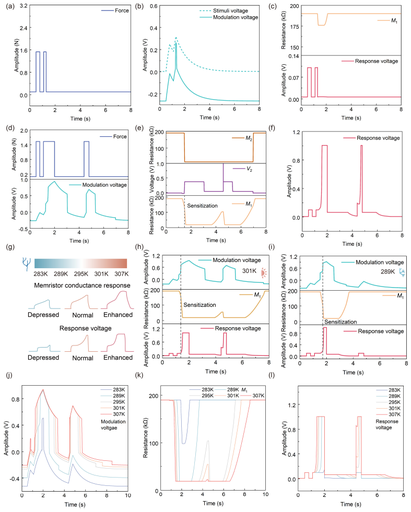
FIG.4 . Functional demonstration of the adjustable memristor-based nociceptor. (a) Force stimuli applied to demonstrate the ‘thr eshold’ and ‘no-adaptation’ characteristics. (b) Comparison of stimuli voltage and modulation voltage under the force stimuli shown in (a). (c) Memristor response and corresponding response voltage. Upon the second force stimulus, the decrease in M1 resistance is indicative of the ‘no-adaptation’ feature. (d) Force stimuli applied to exhibit the ‘sensitization’ characteristics and adaptive response at varying temperatures . (e) Memristor response and voltage at port 2. When M1 falls below the threshold, M2 is set to a low-resistance state, sending sensitization voltage to port 2. The increased voltage makes M1 drop dramatically, observable in the changing resistance rate. (f) Response voltage of the nociceptor to the force stimuli in (d). (g) Schematic illustrations of the adaptive response of the memristor-based nociceptor at varying temperatures, showing increased sensitivity to external pressure stimuli at higher temperatures. (h) Modulation voltage, memristor response, and resp onse voltage under the same force stimuli as in (d) at 301 K. (i) Modulation voltage, memristor response, and response voltage under the sam e force
원문 · CC BY 4.0 · Shengbo Wang, Mingchao Fang, Lekai Song, Cong Li, Jian Zhang, Arokia Nathan, Guohua Hu, Shuo Gao · Self-reconfigurable Multifunctional Memristive Nociceptor for Intelligent Robotics · 원문 그림 인용 · 원본 PDF 9쪽에서 그림 영역을 추출했습니다.적용 범위와 한계
이 결과는 신호 생성 절차가 일정한 온도를 가정한다는 전제에서 나온 것입니다. 저자들은 온도 적응을 임계값과 회복 전압의 조정으로 구현했다고 설명하지만, 보고된 온도 조건은 283 K부터 307 K까지의 다섯 점입니다. 이 범위 밖의 온도나 연속적인 온도 변화에서의 응답은 이 결과에 포함되지 않습니다.
또한 시연과 모델은 상업용 SDC 멤리스터 하나를 기준으로 합니다. 결론부는 이 설계가 멤리스터의 스위칭 메커니즘과 무관하게 적용될 수 있다고 주장하지만, 제시된 구현과 검증은 SDC 멤리스터에서 이루어졌습니다. 표 III은 기능 항목을 정리한 비교이므로, 선행 연구와의 차이를 같은 자극 조건에서 수행된 대조 실험의 결과로 읽어서는 안 됩니다.

원문 그림 TABLE III. Comparison with other works.
원문 · CC BY 4.0 · Shengbo Wang, Mingchao Fang, Lekai Song, Cong Li, Jian Zhang, Arokia Nathan, Guohua Hu, Shuo Gao · Self-reconfigurable Multifunctional Memristive Nociceptor for Intelligent Robotics · 원문 그림 인용 · 원본 PDF 11쪽에서 그림 영역을 추출했습니다.논문 정보
- 저자
- Shengbo Wang, Mingchao Fang, Lekai Song, Cong Li, Jian Zhang, Arokia Nathan, Guohua Hu, Shuo Gao
- 학회·저널
- arXiv · 프리프린트
- 최초 공개일
- 2024년 6월 13일
- 등록일
- 2026년 11월 6일
- 수정일
- 2024년 6월 13일
- 버전
- v1
- arXiv
- 2406.09304
- 분류
- physics.app-ph · eess.SP
- 원문 이용 조건
- CC BY 4.0
- 제공 범위
- 논문 정보, 해설, 허용된 원문 그림
AI 해설은 논문 원문과 별개의 설명이며 오류가 있을 수 있습니다. 원문과 그림은 각 출처의 이용 조건과 따로 표시된 권리를 따릅니다.
초록
Artificial nociceptors, mimicking human-like stimuli perception, are of significance for intelligent robotics to work in hazardous and dynamic scenarios. One of the most essential characteristics of the human nociceptor is its self-adjustable attribute, which indicates that the threshold of determination of a potentially hazardous stimulus relies on environmental knowledge. This critical attribute has been currently omitted, but it is highly desired for artificial nociceptors. Inspired by these shortcomings, this article presents, for the first time, a Self-Directed Channel (SDC) memristor-based self-reconfigurable nociceptor, capable of perceiving hazardous pressure stimuli under different temperatures and demonstrates key features of tactile nociceptors, including 'threshold,' 'no-adaptation,' and 'sensitization.' The maximum amplification of hazardous external stimuli is 1000%, and its response characteristics dynamically adapt to current temperature conditions by automatically altering the generated modulation schemes for the memristor. The maximum difference ratio of the response of memristors at different temperatures is 500%, and this adaptability closely mimics the functions of biological tactile nociceptors, resulting in accurate danger perception in various conditions. Beyond temperature adaptation, this memristor-based nociceptor has the potential to integrate different sensory modalities by applying various sensors, thereby achieving human-like perception capabilities in real-world environments.
원문 인용
Shengbo Wang, Mingchao Fang, Lekai Song, Cong Li, Jian Zhang, Arokia Nathan, Guohua Hu, Shuo Gao (2024). Self-reconfigurable Multifunctional Memristive Nociceptor for Intelligent Robotics. arXiv:2406.09304v1. https://arxiv.org/abs/2406.09304v1
BibTeX
@misc{wang2024self,
  title = {{Self-reconfigurable Multifunctional Memristive Nociceptor for Intelligent Robotics}},
  author = {Shengbo Wang and Mingchao Fang and Lekai Song and Cong Li and Jian Zhang and Arokia Nathan and Guohua Hu and Shuo Gao},
  year = {2024},
  eprint = {2406.09304},
  archivePrefix = {arXiv},
  url = {https://arxiv.org/abs/2406.09304v1}
}