논문 해설
A Comprehensive Review of Generative Physical Artificial Intelligence
생성형 물리 인공지능에 대한 종합적 리뷰
- 연구 문제 로봇의 물리 행동을 생성하는 대규모 생성 모델의 흐름을 하나의 분류 체계로 정리할 필요가 있습니다.
- 연구 방법 RFMs, VLAs, LBMs, DPMs, WFMs의 다섯 패러다임을 제어, 정책 생성, 데이터 합성 기능에 따라 나누어 설명합니다.
- 주요 결과 대표 모델들은 각자 다른 조건에서 성공률을 보고하며, 이 수치들은 원 논문 조건에 묶인 인용 결과입니다.
GPAI가 다루는 문제와 기존 로봇 시스템의 한계
이 논문은 대규모 생성 모델을 물리적 실체와 결합한 Generative Physical Artificial Intelligence(GPAI)를 다룹니다. 기존 산업 로봇은 사전에 프로그래밍된 if-then 규칙과 결정론적 알고리즘에 의존하여, 부품 위치 변화나 예상하지 못한 장애물에 적응하기 어렵습니다. 저자들은 GPAI가 기초 모델을 사용해 여러 과제, 대상, embodiment에 걸쳐 제로샷 일반화를 노린다고 설명합니다. 이 논문은 이러한 흐름을 하나의 통합 분류 체계로 정리하는 것을 목표로 하며, 기존 서베이들이 응용, 벤치마크, 안전 측면을 각각 부분적으로만 다룬다고 비교합니다.
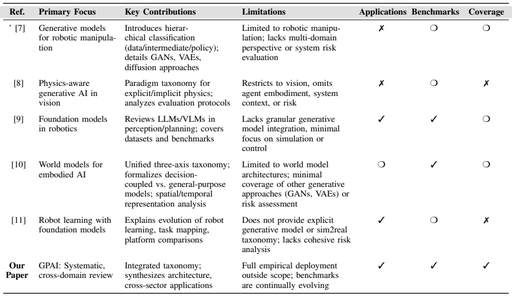
원문 그림 Table I: Comparison of related surveys in Physical AI.
원문 · CC BY 4.0 · Satyam Gaba, Krutiksinh Rana, Siva Sai, Vinay Chamola, Dusit Niyato · A Comprehensive Review of Generative Physical Artificial Intelligence · 원문 그림 인용 · 원본 PDF 3쪽에서 그림 영역을 추출했습니다.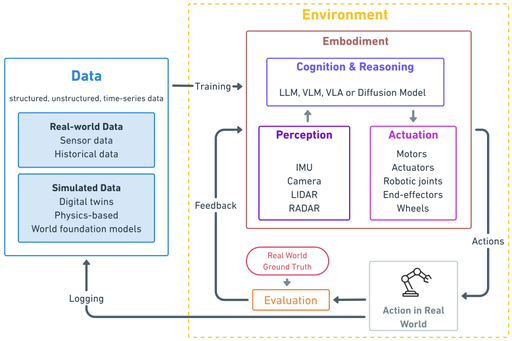
Figure 1 : Overview of a GPAI system. Data (real-world or simulated) trains the system and logs embodiment actions. The environment contains the embodiment with perception, cognition & reasoning, and actuation components. Evaluation compares outcomes against ground truth for closed-loop feedback.
원문 · CC BY 4.0 · Satyam Gaba, Krutiksinh Rana, Siva Sai, Vinay Chamola, Dusit Niyato · A Comprehensive Review of Generative Physical Artificial Intelligence · 원문 그림 인용 · 원본 PDF 4쪽에서 그림 영역을 추출했습니다.다섯 가지 GPAI 패러다임의 분류
논문은 GPAI를 기능 역할에 따라 Generative Control Models, Generative Action Policy Models, Generative Data Generation Models로 묶고, 이를 RFMs, VLAs, LBMs, DPMs, WFMs의 다섯 패러다임으로 구체화합니다. 제어 모델은 감각 입력과 액추에이터 명령을 연결하고, 정책 모델은 행동 궤적을 생성하며, 데이터 모델은 학습과 평가에 쓸 합성 데이터를 만듭니다. 저자들은 실제 시스템이 이 세 축의 기능을 결합하는 경우가 많다고 설명합니다.
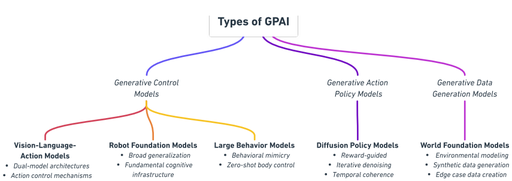
Figure 2 : Taxonomy of GPAI showing major model families and their functional roles across control, policy generation, and data synthesis.
원문 · CC BY 4.0 · Satyam Gaba, Krutiksinh Rana, Siva Sai, Vinay Chamola, Dusit Niyato · A Comprehensive Review of Generative Physical Artificial Intelligence · 원문 그림 인용 · 원본 PDF 7쪽에서 그림 영역을 추출했습니다.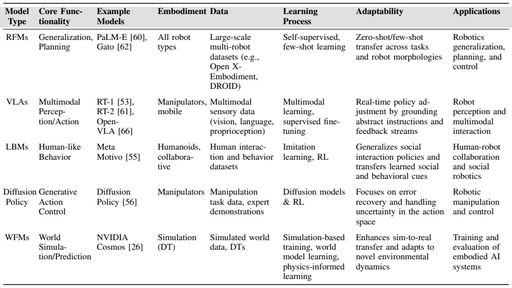
원문 그림 Table III: Comparison of different GPAI model types for embodied AI systems.
원문 · CC BY 4.0 · Satyam Gaba, Krutiksinh Rana, Siva Sai, Vinay Chamola, Dusit Niyato · A Comprehensive Review of Generative Physical Artificial Intelligence · 원문 그림 인용 · 원본 PDF 16쪽에서 그림 영역을 추출했습니다.Diffusion Policy의 반복 디노이징 동작
Diffusion Policy 모델은 행동을 직접 한 단계로 예측하지 않고, 무작위 가우시안 노이즈에서 시작한 행동 시퀀스를 여러 번 디노이징하여 코히런트한 연속 행동을 만듭니다. 관측 임베딩이 디노이징 네트워크를 조건화하며, 각 단계에서 네트워크가 노이즈 ε를 예측해 현재 행동 후보를 다듬습니다. 저자들은 이 방식이 여러 유효한 해를 표현할 수 있어 결정론적 행동 복제에서 나타나는 평균화 문제를 줄인다고 설명합니다. 이 장점은 저자가 인용한 설명이며, 본 논문이 별도의 통제 실험으로 증명한 것은 아닙니다.
보고된 성공률과 비교 결과
RT-1은 700개 이상의 서로 다른 조작 과제에서 67%의 성공률을 보고합니다. RT-2는 unseen tasks에서 62%의 성공률을 보이며, RT-1의 32%와 비교됩니다. Diffusion Policy는 12개 로봇 과제와 4개 벤치마크 모음에서 평균 47%의 성공률 개선을 보고합니다. 이 수치들은 각 원 논문에서 가져온 보고 값이며, 모델과 과제 조건이 서로 다르므로 하나의 통제된 비교로 합칠 수 없습니다.
적용 범위와 남은 한계
WFM의 예측 오류는 긴 호라이즌에서 누적되므로, 저자들은 짧은 호라이즌 롤아웃과 빈번한 재계획이 필요하다고 설명합니다. Diffusion Policy는 제어 결정마다 여러 번의 순전파가 필요하여 빠른 조작에서 요구되는 지연 시간과 충돌할 수 있습니다. 또한 시뮬레이션과 실제 환경 사이의 Sim2Real 격차는 WFM이 줄일 수는 있지만 불확실성을 완전히 없애지는 못한다고 설명됩니다.
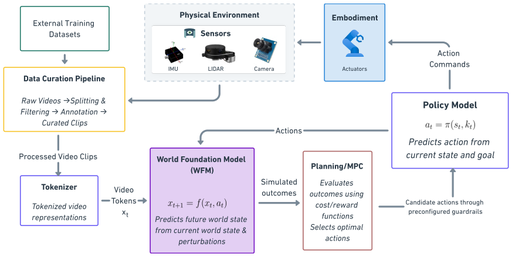
Figure 7 : WFM training and closed-loop control architecture. Raw sensor streams and video data are tokenized to train the WFM to predict future states (x t+1 =f(x t, at)). During control, the planner/MPC queries the WFM to generate simulated rollouts and select optimal candidate actions, which the policy model executes on the robot.
원문 · CC BY 4.0 · Satyam Gaba, Krutiksinh Rana, Siva Sai, Vinay Chamola, Dusit Niyato · A Comprehensive Review of Generative Physical Artificial Intelligence · 원문 그림 인용 · 원본 PDF 15쪽에서 그림 영역을 추출했습니다.논문 정보
- 저자
- Satyam Gaba, Krutiksinh Rana, Siva Sai, Vinay Chamola, Dusit Niyato
- 학회·저널
- arXiv · 프리프린트
- 최초 공개일
- 2026년 9월 16일
- 등록일
- 2026년 11월 6일
- 수정일
- 2026년 9월 16일
- 버전
- v1
- arXiv
- 2609.18111
- DOI
- 10.1109/jiot.2026.3671268
- 분류
- cs.RO · cs.AI · cs.CL · cs.CV · cs.LG
- 원문 이용 조건
- CC BY 4.0
- 제공 범위
- 논문 정보, 해설, 허용된 원문 그림
AI 해설은 논문 원문과 별개의 설명이며 오류가 있을 수 있습니다. 원문과 그림은 각 출처의 이용 조건과 따로 표시된 권리를 따릅니다.
초록
The integration of large-scale foundation models with physical embodiments has led to significant advancements in robotics known as Generative Physical Artificial Intelligence (GPAI). These agentic AI systems autonomously perceive, reason, and act in complex real-world situations. This survey comprehensively analyzes GPAI systems, focusing on their architectural foundations, current applications, and key limitations. We introduce a taxonomy of five distinct approaches: Robot Foundation Models (RFMs) for cross-platform skill transfer; Vision-Language Action (VLA) models for end-to-end multi-modal perception and control; Large Behavior Models (LBMs) for human-like movement generation; Diffusion Policy Models (DPMs) for diffusion model-based temporally coherent action generation; and World Foundation Models (WFMs) for physics-compliant simulation and data generation. We examine how these approaches complement each other: WFMs generate training data for VLAs and DPMs, RFMs enable cross-platform deployment of learned policies, while LBMs provide motion priors for natural behavior. Through examples across autonomous vehicles, industrial automation, healthcare robotics, and humanoid systems, we identify significant performance improvements and summarize promising research directions in data-efficient learning, sim-to-real transfer, edge-compatible architectures, and safety frameworks. These insights advance embodied AI for IoT-connected environments where intelligent agents interact with networked sensors, actuators, and edge devices.
원문 인용
Satyam Gaba, Krutiksinh Rana, Siva Sai, Vinay Chamola, Dusit Niyato (2026). A Comprehensive Review of Generative Physical Artificial Intelligence. arXiv:2609.18111v1. https://doi.org/10.1109/jiot.2026.3671268
BibTeX
@article{gaba2026comprehensive,
  title = {{A Comprehensive Review of Generative Physical Artificial Intelligence}},
  author = {Satyam Gaba and Krutiksinh Rana and Siva Sai and Vinay Chamola and Dusit Niyato},
  year = {2026},
  eprint = {2609.18111},
  archivePrefix = {arXiv},
  doi = {10.1109/jiot.2026.3671268},
  url = {https://arxiv.org/abs/2609.18111v1}
}