논문 해설
Poisson Super Learning For Survival And Competing Risks On A Discretized Time Scale
이산화된 시간 척도에서의 생존 및 경쟁 위험을 위한 푸아송 슈퍼 러닝
- 연구 문제 우측 검열이 있는 생존 및 경쟁위험 자료에서 원인별 hazard 후보를 Poisson 우도 기반으로 교차검증해 결합하는 방법을 제안합니다.
- 연구 방법 구간별 상수 hazard를 Poisson 우도로 학습하고, 교차검증된 log-hazard 예측을 시간 불변 Poisson 메타 학습기로 결합합니다.
- 주요 결과 시뮬레이션에서는 조사된 설정에서 가장 강한 후보 학습기와 비슷했고, 비선형 시나리오에서는 GAM을 포함한 라이브러리가 선형 라이브러리보다 높았습니다.
생존 및 경쟁위험 예측의 문제
시간-사건 자료에서 개인별 절대위험을 예측하려면 임상적으로 의미 있는 시간 지평에서의 위험을 추정해야 합니다. 경쟁위험 설정에서는 관심 사건과 경쟁 사건의 원인특이 hazard를 결합해야 하므로, 문제는 단순히 유연한 hazard를 추정하는 것이 아니라 후보 hazard 추정기들 가운데 예측에 맞는 것을 고르는 데 있습니다. 우측 검열이 있는 자료에서는 생존확률과 절대위험을 hazard로부터 유도하므로 학습 목표와 손실의 선택이 핵심이 됩니다. 이 논문은 이 문제를 이산화된 시간 척도 위의 우도 기반 앙상블로 다룹니다.
구간별 상수 hazard와 Poisson 결합
Poisson Super Learner는 추적 기간을 구간으로 나누고, 원인별 hazard를 구간별 상수 함수로 근사합니다. 이 근사에서 구간별 사건 지시자와 위험 시간의 로그우도는 Poisson 모델의 형태를 갖습니다. 각 후보 학습기는 Poisson 음의 로그우도 손실로 학습되며, 교차검증으로 얻은 구간별 log-hazard 예측이 메타 학습기의 입력이 됩니다. 메타 학습기는 시간에 따라 변하지 않는 계수로 후보 log-hazard의 선형 결합을 학습하므로, 결과 앙상블은 후보 hazard의 기하적 결합이 됩니다. 저자들은 이 구성이 hazard 척도에서 검열 분포를 명시적으로 모델링하지 않고도 목표를 직접 학습하게 한다고 설명합니다.
시뮬레이션 비교와 결과의 범위
시뮬레이션에서 시나리오 Alpha는 원인 1 hazard가 공변량에 대해 대략 선형이고, 시나리오 Beta는 나이와 LDL 콜레스테롤의 비선형 항을 추가합니다. 두 시나리오에서 훈련 표본 크기를 500, 1000, 2500, 4500으로 바꾸고, 각 시나리오의 동일한 대규모 독립 테스트 표본에서 IPA를 5년 지평으로 비교합니다. Alpha에서는 PSL-Linear와 PSL-Full이 비슷했는데, 저자들은 선형 라이브러리가 이미 데이터 생성 기전에 잘 맞는 학습기를 포함하기 때문이라고 해석합니다. Beta에서는 GAM 학습기를 포함한 PSL-Full이 조사된 표본 크기 전반에서 PSL-Linear보다 높은 IPA를 보였습니다.
이 결과는 두 시나리오와 시뮬레이션 설정에서 얻은 것이며, 다른 데이터와 과제로 일반화된 결론이 아닙니다.
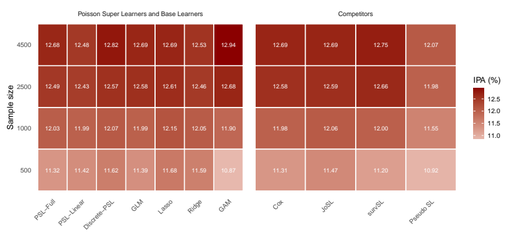
Figure 1 : Scenario Alpha. Average IPA scores for increasing sample sizes (y-axis) for the different methods (x-axis).
원문 · CC BY 4.0 · Gabriele Pittarello, Thomas Gerds, Pernille Falberg Rønn, Helene Charlotte Rytgaard · Poisson Super Learning For Survival And Competing Risks On A Discretized Time Scale · 원문 그림 인용 · 원본 PDF 11쪽에서 그림 영역을 추출했습니다.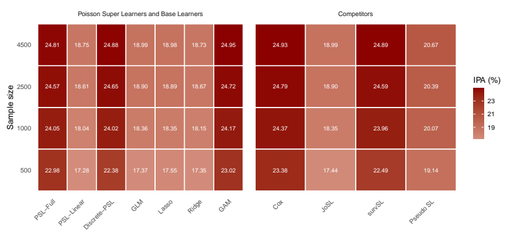
Figure 2 : Scenario Beta. Average IPA scores for increasing sample sizes (y-axis) for the different methods (x-axis).
원문 · CC BY 4.0 · Gabriele Pittarello, Thomas Gerds, Pernille Falberg Rønn, Helene Charlotte Rytgaard · Poisson Super Learning For Survival And Competing Risks On A Discretized Time Scale · 원문 그림 인용 · 원본 PDF 12쪽에서 그림 영역을 추출했습니다.Steno 자료의 적용 결과
Steno Diabetes Center 자료는 제1형 당뇨 환자 4821명을 대상으로 하며, 2005년부터 2014년까지 3583명을 훈련에, 2015년부터 2022년까지 1238명을 테스트에 사용합니다. 원인 1 라이브러리는 PSL-Linear와 같은 학습기 집합이고, 원인 2는 sex와 age를 포함한 GLM과 age 스플라인 GAM의 두 학습기로 구성됩니다. 표 3의 예측 기간 1부터 7까지에서 Ridge는 기간 1, 4, 5에서, GAM은 기간 6과 7에서, CSC는 기간 2와 3에서 가장 높은 값을 보였습니다. PSL은 최고 개별 모델과 가까운 값을 유지했고, Discrete-PSL은 PSL보다 낮았습니다.
이 결과는 해당 자료의 IPA 표에 근거한 것입니다.
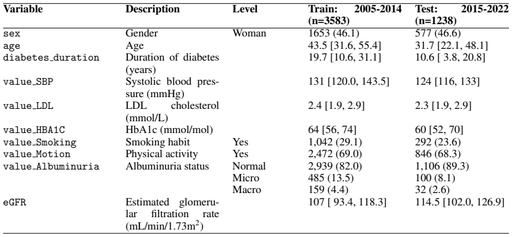
Table 2 : Baseline covariates of the Steno data set of patients with type 1 diabetes. The covariates are listed in column 1 and described in column 2. Column 3 reports the levels of the categorical covariates. Columns 4 and 5 report the distribution of the categorical covariates in the training and test sets, respectively, or the median and interquartile range in brackets for the continuous covariates.
원문 · CC BY 4.0 · Gabriele Pittarello, Thomas Gerds, Pernille Falberg Rønn, Helene Charlotte Rytgaard · Poisson Super Learning For Survival And Competing Risks On A Discretized Time Scale · 원문 그림 인용 · 원본 PDF 14쪽에서 그림 영역을 추출했습니다.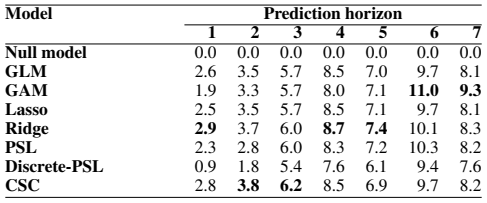
Table 3 : Integrated prediction accuracy (IPA, %) by prediction horizon and model. For each prediction horizon, the highest IPA value is shown in bold.
원문 · CC BY 4.0 · Gabriele Pittarello, Thomas Gerds, Pernille Falberg Rønn, Helene Charlotte Rytgaard · Poisson Super Learning For Survival And Competing Risks On A Discretized Time Scale · 원문 그림 인용 · 원본 PDF 14쪽에서 그림 영역을 추출했습니다.대규모 표본에서의 계산 비용
확장성 실험은 시나리오 Alpha에서 표본 크기 1000부터 1000000까지의 자료를 사용해 CSC-Cox의 실행 시간을 기준으로 다른 모델의 상대 시간을 측정합니다. 각 모델은 10회 재적합의 평균 실행 시간으로 계산되며, Super Learner는 V=3과 3개의 시간 매듭을 사용합니다. Poisson 기반 모델의 상대 계산 시간은 표본 크기가 커질수록 감소했고, 범주형 공변량을 이산화한 GLM-disc는 큰 표본에서 CSC-Cox보다 빨랐습니다. 예측 성능은 CSC-Cox와 비슷하다고 보고되었습니다. 이 비용 비교는 같은 데이터 생성 설정에서의 실행 시간에 한정됩니다.
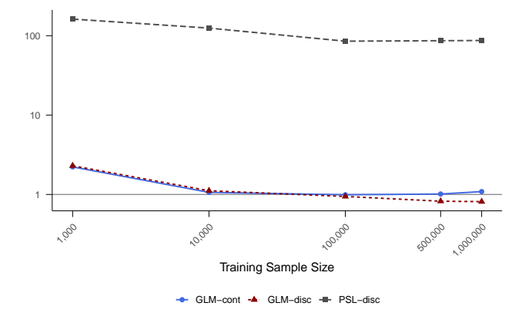
Figure 3 : Average computation time relative to the cause-specific Cox model,CSC-Cox, by training sample size, based on five data sets from Scenario Alpha. Average computation times were calculated over ten refits. The horizontal line aty= 1denotes theCSC-Coxbenchmark. The Poisson-based models arePSL-disc,GLM-cont, andGLM-disc.
원문 · CC BY 4.0 · Gabriele Pittarello, Thomas Gerds, Pernille Falberg Rønn, Helene Charlotte Rytgaard · Poisson Super Learning For Survival And Competing Risks On A Discretized Time Scale · 원문 그림 인용 · 원본 PDF 13쪽에서 그림 영역을 추출했습니다.한계와 확장 방향
현재 구현의 메타 학습기 계수는 시간에 의존하지 않습니다. 시간 변동 계수는 추가 모수를 요구하며, 사건이 적은 구간에서는 불안정해질 수 있다고 원문은 밝힙니다. 또한 CSC 기준 모델은 시뮬레이션 설계 지식을 사용해 명세되었으므로, 특히 시나리오를 정의하는 효과에서 유리한 기준으로 해석해야 합니다. 원문은 Highly Adaptive Lasso나 XGBoost 같은 더 유연한 학습기의 추가를 향후 확장으로 제시합니다.
논문 정보
- 저자
- Gabriele Pittarello, Thomas Gerds, Pernille Falberg Rønn, Helene Charlotte Rytgaard
- 학회·저널
- arXiv · 프리프린트
- 최초 공개일
- 2026년 11월 2일
- 등록일
- 2026년 11월 4일
- 수정일
- 2026년 11월 2일
- 버전
- v1
- arXiv
- 2611.03256
- 분류
- stat.ML · cs.LG · stat.CO
- 원문 이용 조건
- CC BY 4.0
- 제공 범위
- 논문 정보, 해설, 허용된 원문 그림
AI 해설은 논문 원문과 별개의 설명이며 오류가 있을 수 있습니다. 원문과 그림은 각 출처의 이용 조건과 따로 표시된 권리를 따릅니다.
초록
We introduce the Poisson Super Learner, a scalable ensemble method for survival and competing risks prediction with right-censored data. The approach exploits the correspondence between the likelihood of piecewise-constant hazard models and the Poisson likelihood. After expanding the data over a chosen time partition, candidate hazard learners are trained under a common Poisson loss, and cross-validated log-hazard predictions are combined by a Poisson meta learner. The resulting ensemble is a geometric combination of candidate hazards, and can be used to estimate survival probabilities and cause-specific absolute risks. The Poisson Super Learner framework is modular and can in principle incorporate any learner that can estimate interval-specific hazards, including parametric, penalised, additive, and other machine-learning hazard models. Training targets the cause-specific hazard directly and does not require explicit modelling of the censoring distribution. For competing risks, separate cause-specific ensembles are fitted and subsequently combined to obtain individualised cumulative incidence predictions. We illustrate the approach using data from the Steno Diabetes Center collected between 2005 and 2022 to predict cardiovascular disease risk in patients with type 1 diabetes from detailed covariate information. The applied analysis is complemented by simulation studies designed to reflect key features of the data and to examine the behaviour of the method under controlled settings. All analyses were implemented using the freely available R software package poissonsuperlearner.
원문 인용
Gabriele Pittarello, Thomas Gerds, Pernille Falberg Rønn, Helene Charlotte Rytgaard (2026). Poisson Super Learning For Survival And Competing Risks On A Discretized Time Scale. arXiv:2611.03256v1. https://arxiv.org/abs/2611.03256v1
BibTeX
@misc{pittarello2026poisson,
  title = {{Poisson Super Learning For Survival And Competing Risks On A Discretized Time Scale}},
  author = {Gabriele Pittarello and Thomas Gerds and Pernille Falberg Rønn and Helene Charlotte Rytgaard},
  year = {2026},
  eprint = {2611.03256},
  archivePrefix = {arXiv},
  url = {https://arxiv.org/abs/2611.03256v1}
}