논문 해설
SynForecast: Controlled Synthetic Time Series for Forecasting Research
SynForecast: 예측 연구를 위한 통제된 합성 시계열
- 연구 문제 합성 시계열로 사전학습하는 예측 모델의 효과가 이력 길이, 모델, 생성기 구성에 따라 어떻게 달라지는지 통제된 방식으로 검증하기 어렵다는 문제를 다룹니다.
- 연구 방법 SynForecast는 32개 생성기, 긴 형식 패널 출력, 기본 궤적을 고정한 섭동, 작업자 수와 무관한 시드 할당을 제공하는 오픈소스 Python 라이브러리입니다.
- 주요 결과 짧은 이력에서는 합성 pre-training이 처음부터 학습한 조건보다 최대 34% 낮은 오차를 보였지만 전체 이력에서는 그렇지 않았습니다. 시간 단위의 실패는 일 주기 부재와 관련이 있었습니다.
합성 pre-training은 언제 도움이 되는가
합성 시계열은 최근 예측 기반 모델의 pre-training 말뭉치에서 상당한 비중을 차지합니다. 그러나 기존 연구는 개별 모델과 생성기의 조합을 각각 평가했기 때문에, 이력 길이가 바뀔 때 합성 pre-training이 새 데이터셋에서 언제 성능을 높이는지 체계적으로 말하기 어렵습니다. 이 논문은 설정을 통제하고 섭동을 분리하며 재현 가능하게 생성할 수 있는 도구가 필요하다고 봅니다. 이에 따라 SynForecast는 생성기 구성, 긴 형식 패널 출력, 기본 궤적을 고정한 섭동, 작업자 수와 무관한 결정성을 제공하는 Python 라이브러리로 제시됩니다.
SynForecast의 생성 구조
SynForecast는 32개 생성기를 통계, 확률, 다변량, 도메인, pre-training의 다섯 묶음으로 제공하며 그중 19개는 출판된 출처를 가진 명명된 메커니즘입니다. 생성 전에 마스터 난수 흐름이 시계열 길이, 생성 시드, 변화점·이상치·결측 섭동 시드를 순서대로 할당합니다. 기본 궤적은 할당된 시드로 생성되고, 이후 변화점, 이상치, 결측 섭동이 각자의 시드로 적용됩니다. 섭동을 끄면 항등 연산이 되므로 다른 섭동의 시드 할당과 기본 궤적은 유지됩니다. 출력은 unique_id, ds, y 열의 긴 형식 데이터프레임이어서 예측 라이브러리가 별도 변환 없이 읽을 수 있습니다. 이 설계는 작업자 수에 따라 출력이 바뀌지 않도록 하는 것을 목표로 하며, 저자들은 테스트 스위트에서 한 작업자와 네 작업자의 결과를 비교해 확인합니다.
통제된 M4 실험 설계
실험은 M4의 시간 단위, 일 단위, 주 단위, 월 단위, 분기 단위 데이터를 사용하며 연간 데이터는 계절 주기가 필요한 분석 때문에 제외됩니다. pre-training 말뭉치는 pretraining_pool의 54개 생성기 인스턴스로 구성되고 두 모델이 같은 코퍼스를 공유합니다. 학습 모델로는 신경망 NHITS와 래그 특징에 대한 트리 앙상블 LightGBM이 쓰이며 둘 다 입력 창을 예측 지평과 같게 둡니다. 조건은 대상 시계열만으로 300 단계 학습하는 처음부터 학습 조건, 합성 데이터로 1,000 단계 사전학습한 제로샷 조건, pre-training 모델을 대상 데이터에서 300 단계 추가 학습하는 fine-tuning 조건으로 구분됩니다.
평가는 평균 계절 MASE로 측정하고 30 복제에서 조건 간 상대 개선율 Δ를 계산하며, 이력 수준별로 Wilcoxon 부호순위 검정과 Holm 보정을 적용합니다.
pre-training의 이점은 짧은 이력에서 나타나고 긴 이력에서는 사라집니다
처음부터 학습한 NHITS와 비교하면, 합성 pre-training 모델은 일부 짧은 이력에서 최대 34%의 오차 감소를 보였습니다. 그러나 전체 이력에서는 여러 빈도에서 처음부터 학습한 네트워크보다 오차가 큽니다. 교차점은 빈도에 따라 84에서 317개 관측 사이에 놓였고, 원문에서 사전에 정한 세 가지 이력 정규화 중 어느 것도 이 교차점을 예측하지 못했습니다. 이 결과는 저자들이 사용한 작은 NHITS 구성과 고정 예산 조건에서 얻은 것입니다. 또한 처음부터 학습한 조건의 1,000 단계 추가 실험에서 긴 이력의 일부 차이가 줄어들었기 때문에, 교차점의 위치는 학습 예산에 의존한다고 저자들은 해석합니다.
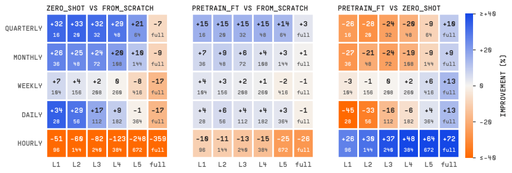
Figure 3 : Relative improvement∆ a→b (Eq. 3, %) of the condition named first over the condition named second, NHITS, mean over 30 replicates, by frequency and history level; the small number in each cell is the history in observations; Table S2 in the supplementary material gives each value with its 95% interval. Bold values are significant after Holm correction within the 30 tests of a panel (Wilcoxon signed-rank test across replicates). Blue favors the first condition, orange the second; the color scale is clipped at±40%.
원문 · CC BY 4.0 · Olivier Sprangers, Cristian Challu, Jan Rathfelder, Han Wang, Max Mergenthaler Canseco · SynForecast: Controlled Synthetic Time Series for Forecasting Research · 원문 그림 인용 · 원본 PDF 9쪽에서 그림 영역을 추출했습니다.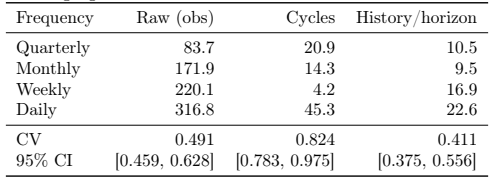
Table 2 : Crossover location by frequency and normalization, NHITS, in realized training observations, over 30 replicates. Hourly is excluded because the effect is negative at every level; that exclusion was the pre-specified handling for a frequency with no crossing. CV is the coefficient of variation across the four remaining frequencies, with a bootstrap 95% interval over replicates. Figure 4 is generated independently from the same cells and its interpolated crossings agree with this table to within 0.1 observations.
원문 · CC BY 4.0 · Olivier Sprangers, Cristian Challu, Jan Rathfelder, Han Wang, Max Mergenthaler Canseco · SynForecast: Controlled Synthetic Time Series for Forecasting Research · 원문 그림 인용 · 원본 PDF 11쪽에서 그림 영역을 추출했습니다.시간 단위 실패는 일 주기 부재와 관련이 있습니다
시간 단위 빈도에서는 합성 pre-training이 모든 이력 수준에서 도움이 되지 않았습니다. 저자들은 원인을 정규화, 코퍼스의 커버리지, 주기성으로 나누어 검사했습니다. 정규화는 이력이 길어질수록 오차가 커지는 현상을 일부 설명하지만 실패 자체를 없애지는 못했습니다. 달력 주기를 추가한 후속 코퍼스에서는 제로샷 오차가 NHITS에서 43에서 62%, LightGBM에서 52에서 63% 줄었고, NHITS pre-training 모델은 96 관측에서 처음부터 학습한 조건보다 16% 낮은 오차를 보였습니다. 다만 이 달력 주기 결과는 후속 실험의 한 커밋에서 얻은 것이며, 전체 이력에서는 여전히 처음부터 학습한 조건보다 나쁩니다.
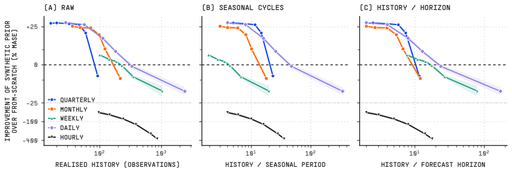
Figure 4 : Improvement of the synthetic prior (zero_shot) over target-specific training (from_scratch) against history, NHITS, under the three candidate normalizations. Bands are 95% intervals over 30 replicates; the dashed line is parity. The vertical scale is linear within±25% and logarithmic beyond it, with the transition marked by a dotted rule: hourly reaches−359%, which on a linear scale compresses the four frequencies that carry the argument into an illegible band around parity. No point is clipped. All three panels are shown because none of them collapses the five frequencies onto a common curve: in (b), seasonal cycles, the crossings span 4.2 (weekly) to 45.3 (daily). Hourly is negative throughout.
원문 · CC BY 4.0 · Olivier Sprangers, Cristian Challu, Jan Rathfelder, Han Wang, Max Mergenthaler Canseco · SynForecast: Controlled Synthetic Time Series for Forecasting Research · 원문 그림 인용 · 원본 PDF 11쪽에서 그림 영역을 추출했습니다.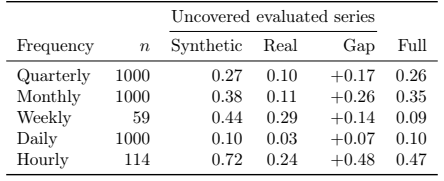
Table 3 : Feature-space coverage of the evaluated M4 series, mean over replicates 0–2. “Uncovered” is the fraction of evaluated series lying in grid cells (30×30, PCA fitted on the evaluated series) that the comparison sample does not occupy. The comparison samples are the round’s pretraining corpus and other M4 series of the same frequency, subsampled to the same size,n; at weekly and hourlynis limited by the series M4 has outside the evaluated subsample. “Full” scores the whole control corpus instead of a sample of sizen. At weekly, 54 to 56 of the 300 evaluated series have undefined features and are dropped.
원문 · CC BY 4.0 · Olivier Sprangers, Cristian Challu, Jan Rathfelder, Han Wang, Max Mergenthaler Canseco · SynForecast: Controlled Synthetic Time Series for Forecasting Research · 원문 그림 인용 · 원본 PDF 13쪽에서 그림 영역을 추출했습니다.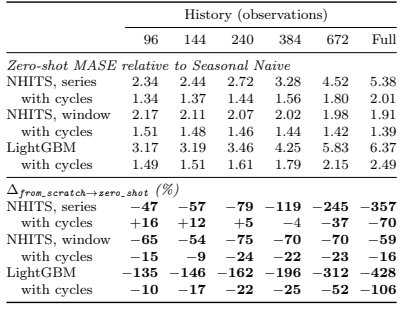
Table 4 : Hourly follow-up: the pretraining corpus without (control) and with calendar cycles, mean over 30 replicates. Top: zero-shot MASE relative to Seasonal Naive. Bottom: improvement∆(Eq. 3, %) of the zero-shot model over the same model trained from scratch; bold values are significant after Holm correction across the six his- tory levels (Wilcoxon signed-rank test across replicates). Series and window name NHITS’s input standardization. The control rows, in- cluding those with the window scaler, come from the follow-up run, not from the main experiment, so they differ slightly from the main- experiment values quoted in the text.
원문 · CC BY 4.0 · Olivier Sprangers, Cristian Challu, Jan Rathfelder, Han Wang, Max Mergenthaler Canseco · SynForecast: Controlled Synthetic Time Series for Forecasting Research · 원문 그림 인용 · 원본 PDF 13쪽에서 그림 영역을 추출했습니다.통계 기준선과 fine-tuning의 해석 범위
통계 기준선과의 비교에서는 Seasonal Naive 또는 AutoETS가 열 가운데 아홉 행에서 가장 낮은 오차를 보였습니다. 월 단위와 분기 단위에서 AutoETS는 학습 모델보다 0.20에서 0.45 MASE 낮았습니다. fine-tuning은 분기 데이터에서 처음부터 학습한 조건보다 평균 약 13% 낮은 오차를 보였지만, 짧은 이력에서는 300 단계 고정 fine-tuning이 pre-training 모델을 그대로 쓰는 것보다 나빴습니다. 이 해석은 검증 분할과 조기 종료 없이 고정 예산으로 학습한 설정에 한정됩니다.
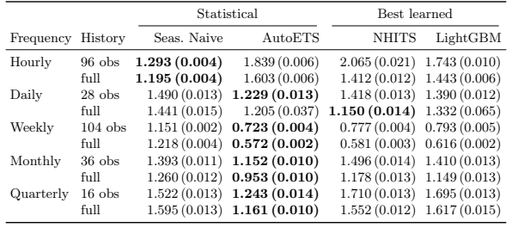
Table 1 : Mean seasonal MASE, control arm, over 30 replicates and 300 series, with the standard error across replicates in parentheses. “Best learned” is the lowest offrom_scratch,zero_shotandpretrain_ftfor NHITS, or of the first two for LightGBM. Lower is better; the best value in each row is bold.
원문 · CC BY 4.0 · Olivier Sprangers, Cristian Challu, Jan Rathfelder, Han Wang, Max Mergenthaler Canseco · SynForecast: Controlled Synthetic Time Series for Forecasting Research · 원문 그림 인용 · 원본 PDF 9쪽에서 그림 영역을 추출했습니다.생성기 계열 제거와 구조적 단절의 영향
생성기 계열 절제에서는 한 계열을 제거하면서 코퍼스 크기를 대략 유지하고, 제거 후 효과를 로그 MASE 차이로 측정했습니다. 고전 계열을 제거하면 두 모델 모두 정확도가 약 2% 악화되었습니다. 이 결과는 제거한 계열의 기여를 나타내며 다른 계열의 가중치 변화가 함께 섞인 비교입니다. 별도 실험에서는 같은 기본 궤적에 수준 이동을 주어 세 예측 방법의 MASE 변화를 측정했습니다. Seasonal Naive는 마지막 계절 안의 단절에만 영향을 받았고, AutoETS는 전체 이력을 쓰므로 여섯 관측 이전 단절에 작은 비용이 있었으며, NHITS는 마지막 18 관측 안의 단절에 강하게 반응했습니다.
적용 범위와 독립성의 한계
본 결과는 두 개의 작은 학습 모델, 같은 코퍼스와 전처리, 하나의 데이터셋 계열에서 얻은 것입니다. 대형 예측 기반 모델로의 적용성은 평가되지 않았습니다. 학습된 조건들은 검증 분할이나 조기 종료 없이 고정 예산으로 학습되었으므로 결과 해석에 이 조건이 반영되어야 합니다. 또한 저자가 라이브러리를 개발했으므로 본 평가는 독립적인 평가가 아닙니다.
논문 정보
- 저자
- Olivier Sprangers, Cristian Challu, Jan Rathfelder, Han Wang, Max Mergenthaler Canseco
- 학회·저널
- arXiv · 프리프린트
- 최초 공개일
- 2026년 11월 2일
- 등록일
- 2026년 11월 4일
- 수정일
- 2026년 11월 2일
- 버전
- v1
- arXiv
- 2611.02802
- 분류
- cs.LG · stat.CO
- 원문 이용 조건
- CC BY 4.0
- 제공 범위
- 논문 정보, 해설, 허용된 원문 그림
AI 해설은 논문 원문과 별개의 설명이며 오류가 있을 수 있습니다. 원문과 그림은 각 출처의 이용 조건과 따로 표시된 권리를 따릅니다.
초록
Synthetic time series constitute a substantial share of the training corpora of several recent forecasting foundation models. Existing studies report benefits at small data budgets and modest synthetic proportions, but each evaluates individual combinations of model and generator. Studying these benefits systematically requires generators that support controlled configuration, perturbation, reproducibility and mechanism-level ablation, and the 11 existing generators we review show gaps in this combined support. We present SynForecast, an open-source Python library with 32 generators, 19 of which implement named mechanisms with a published source in econometrics, quantitative finance, statistical physics and point-process theory. Perturbations and mechanism families can be varied while everything else is held fixed, output comes in the long format that forecasting libraries accept, and output does not depend on the number of parallel workers. We evaluate SynForecast on M4 at five frequencies with a neural network and a gradient-boosted ensemble. A classical baseline attains the lowest error in nine of ten frequency-history combinations. A synthetic prior outperforms the same network trained from scratch at a fixed budget by up to 34% with a few dozen observations, but loses to it at full history at every frequency, and none of three pre-specified rescalings of history predicts where the sign changes. At the hourly frequency, where the prior fails at every history, the corpus lacks daily cycles; adding them reduces zero-shot error by 43 to 63% for both models. Fine-tuning outperforms training from scratch by up to about 15%, but at short histories a fixed 300-step fine-tune is worse than the pretrained model used as is. Removing the classical mechanism family costs about 2% for both models; every other family has a smaller effect outside the hourly frequency.
원문 인용
Olivier Sprangers, Cristian Challu, Jan Rathfelder, Han Wang, Max Mergenthaler Canseco (2026). SynForecast: Controlled Synthetic Time Series for Forecasting Research. arXiv:2611.02802v1. https://arxiv.org/abs/2611.02802v1
BibTeX
@misc{sprangers2026synforecast,
  title = {{SynForecast: Controlled Synthetic Time Series for Forecasting Research}},
  author = {Olivier Sprangers and Cristian Challu and Jan Rathfelder and Han Wang and Max Mergenthaler Canseco},
  year = {2026},
  eprint = {2611.02802},
  archivePrefix = {arXiv},
  url = {https://arxiv.org/abs/2611.02802v1}
}