논문 해설
Solver-Like Behavior in Large Language Models as Formalizers
대규모 언어 모델의 정형화기로서의 솔버 유사 행동
- 연구 문제 형식화 모델은 솔버에 탐색을 맡겨야 하지만, 긴 추론 트레이스가 탐색을 미리 수행하여 비용을 키우고 출력 기반 평가로는 이를 구별하지 못합니다.
- 연구 방법 추론 트레이스, 프로그램, 출력을 솔버형 행동, 답 상속 형태, 출력 일치 기준으로 라벨링하고, 경고 프롬프트·배치·자리표시자 개입의 효과를 측정합니다.
- 주요 결과 트레이스의 85%에 솔버형 행동이 나타났고 추론 토큰의 24%를 차지했지만, 프로그램은 대부분 답을 독립적으로 재계산했습니다. 상속된 프로그램은 오류를 함께 물려받았고, 자리표시자는 솔버형 토큰을 97% 줄였습니다.
형식화 모델의 추론 트레이스가 해야 할 일과 놓치는 점
LLM-as-formalizer 패러다임에서는 대규모 언어 모델이 문제를 형식 프로그램으로 번역하고, 실제 탐색은 솔버가 보장과 함께 수행합니다. 그런데 최근 형식화 모델은 프로그램 앞에 긴 추론 트레이스를 쓰는 추론 모델인 경우가 많고, 평가는 프로그램의 출력만 보고 이루어집니다. 이 논문은 이 트레이스가 솔버의 일, 즉 변수에 값을 할당하고 검사하고 배제하는 일을 대신 수행하는 현상을 솔버형 행동(solver-like behavior, SLB)이라고 부르며, 이를 측정 대상으로 삼습니다.
문제는 두 가지입니다. 첫째, 트레이스가 솔버의 탐색을 미리 수행하므로 비용이 큽니다. 둘째, 프로그램이 트레이스의 답을 그대로 출력하면 출력 기반 평가는 이를 구별하지 못하고, 솔버의 검증 보장도 흐려질 수 있습니다. 따라서 이 연구는 형식화 결과를 출력뿐 아니라 프로그램이 답에 어떻게 도달했는지로도 평가해야 한다고 주장합니다.
온톨로지 정의와 판정 방식
연구는 한 생성(generation)을 추론 트레이스, 프로그램, 실행 출력의 세 구성요소로 나누고 각각에 라벨을 붙입니다. 트레이스에서는 A1이 솔버형 행동의 존재를, A2가 완전 또는 부분 답의 범위를 판정합니다. 프로그램에서는 B1부터 B4까지 답을 상속하는 형태를 구분합니다. B1은 답을 계산하지 않고 출력하는 하드코딩, B2는 계산은 하지만 트레이스의 결정을 소스에 적은 부분 고정, B3은 탐색 순서나 tie-break가 트레이스의 답을 재현하도록 고른 조향, B4는 모든 제약 아래에서 독립적으로 탐색하는 경우입니다. 출력에서는 C1이 트레이스 답과 프로그램 출력의 일치를, C2가 트레이스 답의 검증 통과를 봅니다.
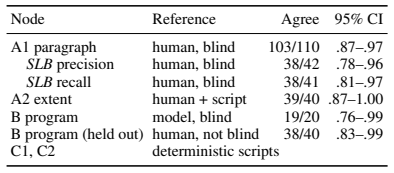
Table 1 : Agreement of each ontology judge with ref- erence labels, with Wilson 95% confidence intervals. A1: one annotator, labeling blind (70 development and 40 held-out paragraphs). A2:completelabels verified by humans,partialones by searching the trace for the program’s answer and having a second model read the passages found. B: blind reference labels by a second model; held out: a human shown the judge’s evidence, on programs labeled B1–B4. A1 and held-out B ref- erences cover both FLs of every dataset. C1 and C2 are computed by scripts from the A2 extraction, so they need no agreement check.
원문 · CC BY 4.0 · Rikhil Amonkar, Stuti Mohan, Kevin Nguyen, Ceyhun Efe Kayan, Ronan Le Bras, Li Zhang · Solver-Like Behavior in Large Language Models as Formalizers · 원문 그림 인용 · 원본 PDF 5쪽에서 그림 영역을 추출했습니다.핵심은 프로그램이 답을 계산했는지가 아니라 트레이스의 결정을 상속했는지입니다. 제약을 문제문에서 읽어 낸 것은 상속으로 보지 않으며, 트레이스에서 해를 구해 얻은 값만 상속으로 셉니다. 솔버형 비율은 트레이스 문자 중 솔버형 문단이 차지하는 비율입니다.
기준 프롬프트에서의 측정 결과
연구는 Qwen3.8-27B와 GPT-OSS-120B를 네 데이터셋의 Python과 선언적 형식 언어(Z3 또는 PDDL)에서 평가하고, DeepSeek-V4-Flash는 데이터셋마다 한 형식 언어에서 평가합니다. 데이터셋마다 같은 100개 문제를 사용하며, 기준 프롬프트에서 생성된 2,000개 트레이스를 분석합니다. 판정에는 평가 대상이 아닌 Gemma 4 31B-it가 쓰였고, 사람 참조 라벨과 일치도를 Wilson 신뢰구간과 함께 보고합니다.
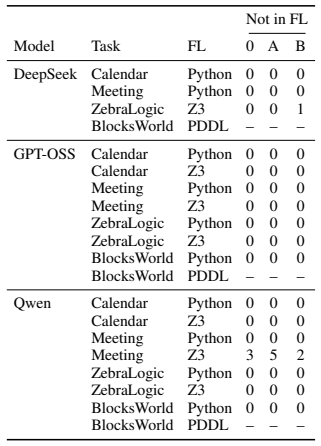
Table 2 : Runs: each model, task and formal language has 300 generations (100 problems under each of three prompts; 6,000 in total). Not in FL: programs not writ- ten in the requested FL under the baseline (0) and Cau- tionary A and B prompts. DeepSeek is run in one FL per dataset.
원문 · CC BY 4.0 · Rikhil Amonkar, Stuti Mohan, Kevin Nguyen, Ceyhun Efe Kayan, Ronan Le Bras, Li Zhang · Solver-Like Behavior in Large Language Models as Formalizers · 원문 그림 인용 · 원본 PDF 13쪽에서 그림 영역을 추출했습니다.보고된 결과에 따르면 트레이스의 85%에 솔버형 행동이 있었고, 추론 토큰의 24%가 이에 해당했습니다. 그러나 프로그램은 대부분 답을 다시 계산했습니다(B4 비율은 DeepSeek 89%, Qwen과 GPT-OSS 각각 77%). 이는 트레이스의 작업이 프로그램에서 중복된다는 해석을 뒷받침합니다. 다만 이 수치는 기준 프롬프트, 세 모델, 네 데이터셋이라는 조건에서 얻은 것입니다.
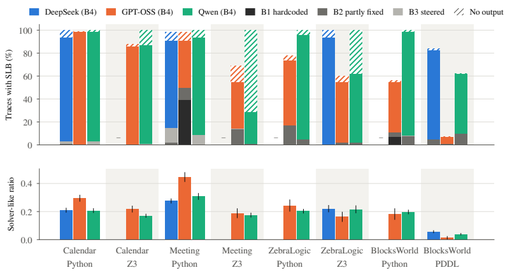
Figure 3 : H1 and H2: solver-like behavior is common, and the program rarely inherits it. For each dataset and FL, the share of traces with SLB (A1) and the mean solver-like ratio, with 95% confidence intervals. Each SLB bar is split by the program’s label (B): programs that inherit the reasoning answer (B1–B3, grey) at the bottom, independent programs (B4) in the model’s colour, and programs with no output (missing, failed, or printed nothing) hatched; most of these are Qwen’s Z3 programs, which call Z3 methods that do not exist. DeepSeek is run in one FL per dataset (–).
원문 · CC BY 4.0 · Rikhil Amonkar, Stuti Mohan, Kevin Nguyen, Ceyhun Efe Kayan, Ronan Le Bras, Li Zhang · Solver-Like Behavior in Large Language Models as Formalizers · 원문 그림 인용 · 원본 PDF 6쪽에서 그림 영역을 추출했습니다.상속 형태별 정확도와 오류 전파
상속된 프로그램은 드물었습니다. 실행된 1,791개 프로그램 중 163개가 추론 답을 상속했고, 이 중 B1 하드코딩 47개, B2 부분 고정 88개, B3 조향 28개였습니다. 추론 답이 틀렸을 때 하드코딩 프로그램 19개는 모두 틀렸고, 부분 고정 프로그램 13개 중 1개만 맞았습니다. 반면 독립 프로그램 84개 중에서는 32%가 맞았습니다. 따라서 상속은 트레이스의 오류를 그대로 옮기는 경향이 있습니다.
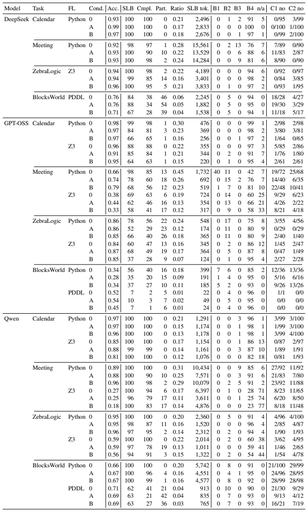
Table 3 : Ontology labels per cell (100 generations). FL: formal language (DeepSeek: one per dataset). Cond.: 0 = Baseline, A and B = Cautionary A and B. Acc.: program accuracy. SLB: % of traces with SLB (A1). Cmpl., Part.: % of traces with a complete or partial reasoning answer (A2). Ratio: mean solver-like ratio. SLB tok.: mean solver-like tokens per trace. B1–B4, n/a: % of programs. C1 no: reasoning answers that differ from the program’s output, of those compared. C2 no: wrong reasoning answers, of those checked.
원문 · CC BY 4.0 · Rikhil Amonkar, Stuti Mohan, Kevin Nguyen, Ceyhun Efe Kayan, Ronan Le Bras, Li Zhang · Solver-Like Behavior in Large Language Models as Formalizers · 원문 그림 인용 · 원본 PDF 17쪽에서 그림 영역을 추출했습니다.다만 재계산이 항상 보호 장치가 되는 것은 아닙니다. 독립 프로그램 84개 중 37개는 트레이스와 같은 잘못된 답을 출력했습니다. 또한 추론 답이 맞을 때는 네 종류의 프로그램 모두 93% 이상 맞았으므로, 출력 기반 평가로는 하드코딩과 독립 프로그램을 구별할 수 없습니다.
솔버형 행동의 양과 정확도
같은 문제 안에서 솔버형 행동의 양이 정확도와 연관되는지를 선형 확률 모델로 검정합니다. 이 모델은 모델, 데이터셋, 형식 언어, 문제에 고정 효과를 둡니다. 솔버형 비율이 10포인트 늘어날 때 정확도 변화는 +0.007 [−0.011, +0.022]로 보고되었고, 1,000 토큰 증가는 +0.005 [−0.002, +0.013]이었습니다. 데이터셋 내 비율 효과는 대부분 −0.03에서 +0.02 사이이며, BlocksWorld에서만 +0.047 [+0.004, +0.083]이었습니다.
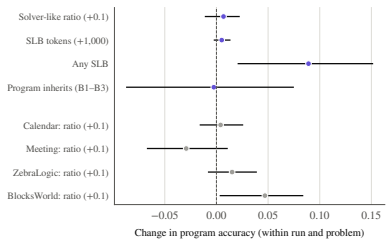
Figure 4 : H3: the amount of solver-like behavior is not associated with accuracy. Change in the probability that the program is correct per unit of each measure, from a linear model with fixed effects for model, dataset and FL and for the problem, with 95% confidence intervals. Grey: the ratio’s effect within each dataset.
원문 · CC BY 4.0 · Rikhil Amonkar, Stuti Mohan, Kevin Nguyen, Ceyhun Efe Kayan, Ronan Le Bras, Li Zhang · Solver-Like Behavior in Large Language Models as Formalizers · 원문 그림 인용 · 원본 PDF 6쪽에서 그림 영역을 추출했습니다.따라서 보고된 결과는 솔버형 행동의 양이 정확도와 검출 가능한 연관을 보이지 않는다는 것입니다. 저자들은 문제를 풀어 가는 과정이 실행 가능한 프로그램 작성에 도움이 될 가능성은 배제할 수 없다고 덧붙입니다.
형식 언어에 따른 차이
같은 문제에서 Python은 Z3나 PDDL보다 솔버형 행동을 더 많이 끌어냈습니다. Qwen의 ZebraLogic을 제외하면 모든 데이터셋에서 그랬습니다. 비율 차이는 Calendar에서 0.06, Meeting Planning에서 0.20, ZebraLogic에서 0.03, BlocksWorld에서 0.16이었습니다. 저자들은 이를 선언적 형식 언어가 어려운 탐색을 넘겨받는 정도와 연결해 해석합니다. PDDL에서는 계획자가 계획을 찾고, Z3에서는 솔버가 친구 순서를 고르는 반면, Python에서는 모델이 탐색을 직접 설계해야 하기 때문입니다.
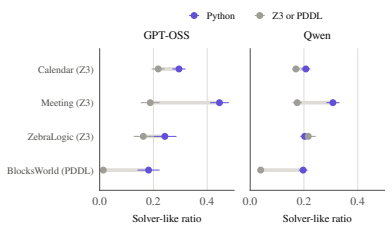
Figure 5 : H4: on the same 100 problems, Python draws more solver-like behavior than each dataset’s declarative FL (in parentheses). Mean solver-like ratio per model, with 95% confidence intervals.
원문 · CC BY 4.0 · Rikhil Amonkar, Stuti Mohan, Kevin Nguyen, Ceyhun Efe Kayan, Ronan Le Bras, Li Zhang · Solver-Like Behavior in Large Language Models as Formalizers · 원문 그림 인용 · 원본 PDF 6쪽에서 그림 영역을 추출했습니다.다만 BlocksWorld의 PDDL 프롬프트는 참조 문제 파일을 제공하므로 이 차이에는 프롬프트의 다른 요소가 섞여 있을 수 있습니다. 그래서 Z3 비교가 형식 언어 효과를 더 깨끗하게 보여 준다고 논문은 설명합니다.
경고 프롬프트, 배치, 자리표시자 개입
연구는 세 가지 방식으로 솔버형 행동을 줄이려 했습니다. 경고 프롬프트 A는 결과를 미리 계산해 하드코딩하는 것을, B는 주어진 값을 산술식에 대입하는 행위 자체를 경고합니다. 배치는 여러 문제를 한 프롬프트에 묶어 K개의 프로그램을 요구합니다. 자리표시자는 문제의 값을 Person1, T1 같은 이름으로 바꾸고 프로그램이 실행 시점에 VALUES 사전으로 값을 받게 합니다.
결과를 보면 경고 프롬프트는 솔버형 비율을 기준 0.20에서 약 0.053과 0.058만큼 낮췄고, 솔버형 토큰은 23%와 15% 줄었습니다. 정확도는 바뀌지 않았습니다. 자리표시자는 Calendar와 Meeting Planning에서 솔버형 토큰을 97% 줄였고, 솔버형 비율은 0.25에서 0.005로 떨어졌습니다. 정확도는 2.6포인트 올랐지만 신뢰구간은 −0.5에서 +5.9였습니다. 배치는 솔버형 토큰을 62% 줄였지만 추론 토큰도 거의 같이 줄어 비율은 거의 움직이지 않았고, 정확도는 5.9포인트 떨어졌습니다.
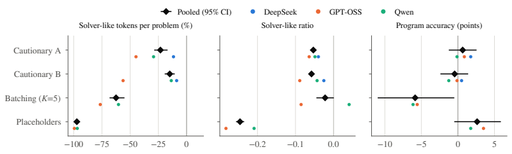
Figure 6 : Placeholders all but remove solver-like behavior without costing accuracy; cautionary prompts remove about a quarter of it, and batching shortens all reasoning at a cost in accuracy. Change from the baseline prompt on the same problems in solver-like tokens per problem (% of the baseline mean), solver-like ratio, and program accuracy (points): pooled estimate with 95% bootstrap confidence interval, and one dot per model. Each method is measured where it was run: cautionary prompts for every model, dataset and FL (2,000 pairs), batching (K= 5) for Qwen and GPT-OSS in every dataset and FL except PDDL (1,400), placeholders for Qwen and GPT-OSS on Calendar and Meeting Planning in Python and Z3 (800). The subsets differ, so the text compares each method with the cautionary prompts on its own problems.
원문 · CC BY 4.0 · Rikhil Amonkar, Stuti Mohan, Kevin Nguyen, Ceyhun Efe Kayan, Ronan Le Bras, Li Zhang · Solver-Like Behavior in Large Language Models as Formalizers · 원문 그림 인용 · 원본 PDF 8쪽에서 그림 영역을 추출했습니다.범위와 한계
연구는 세 개의 추론 모델, 네 개의 제약 만족 데이터셋, 두 형식 언어에 한정됩니다. 정리 증명이나 최적화처럼 다른 과제 유형과 다른 언어에서는 결과가 다를 수 있습니다. DeepSeek는 API 모델이 바뀌어 데이터셋마다 한 형식 언어에서만 평가되었으므로, H4는 주로 Qwen과 GPT-OSS에 근거합니다.
또한 각 문제는 설정마다 한 번 생성되었으므로 구간에는 생성 간 샘플링 변동이 반영되지 않습니다. 온톨로지 라벨은 LLM 판정기와 스크립트에 의존하며, 참조 라벨 표본은 작고 일부는 한 명의 주석자에게서 나왔습니다. 자리표시자는 값과 구조가 분리되는 과제에만 적용되었습니다. H3는 관찰 연구이므로 문제 고정 효과가 제거하지 못한 교란 요인이 남을 수 있습니다.
논문 정보
- 저자
- Rikhil Amonkar, Stuti Mohan, Kevin Nguyen, Ceyhun Efe Kayan, Ronan Le Bras, Li Zhang
- 학회·저널
- arXiv · 프리프린트
- 최초 공개일
- 2026년 11월 2일
- 등록일
- 2026년 11월 4일
- 수정일
- 2026년 11월 2일
- 버전
- v1
- arXiv
- 2611.02395
- 분류
- cs.CL · cs.AI
- 원문 이용 조건
- CC BY 4.0
- 제공 범위
- 논문 정보, 해설, 허용된 원문 그림
AI 해설은 논문 원문과 별개의 설명이며 오류가 있을 수 있습니다. 원문과 그림은 각 출처의 이용 조건과 따로 표시된 권리를 따릅니다.
초록
In the LLM-as-formalizer paradigm, a large language model translates a problem into a formal program and leaves the search to a solver, gaining the solver's guarantees. Formalizers are now often reasoning models that write a long reasoning trace before the program, yet they are judged only by the program's output. We find that the trace routinely does the solver's job, assigning, testing and ruling out values until it often reaches the full answer; we call this solver-like behavior (SLB). We define an ontology of SLB over the trace, the program and its output, and use LLM judges, checked against human labels, to label 2,000 generations from three reasoning models on four constraint satisfaction datasets, each formalized in a declarative and an imperative formal language. SLB appears in 85% of traces and takes 24% of reasoning tokens, yet the program usually recomputes the answer, so the effort is redundant. The 9% of programs that inherit the trace's answer also inherit its errors, and pass output-based evaluation whenever that answer is correct. The amount of SLB is not associated with accuracy, and SLB is more common in imperative Python than in declarative Z3 or PDDL. Cautionary prompts reduce it by only a quarter, but hiding the problem's values behind placeholders, which the program receives only at run time, removes 97% of it without loss of accuracy. Formalizers should therefore be evaluated by how their programs are reached, not only by what they output.
원문 인용
Rikhil Amonkar, Stuti Mohan, Kevin Nguyen, Ceyhun Efe Kayan, Ronan Le Bras, Li Zhang (2026). Solver-Like Behavior in Large Language Models as Formalizers. arXiv:2611.02395v1. https://arxiv.org/abs/2611.02395v1
BibTeX
@misc{amonkar2026solver,
  title = {{Solver-Like Behavior in Large Language Models as Formalizers}},
  author = {Rikhil Amonkar and Stuti Mohan and Kevin Nguyen and Ceyhun Efe Kayan and Ronan Le Bras and Li Zhang},
  year = {2026},
  eprint = {2611.02395},
  archivePrefix = {arXiv},
  url = {https://arxiv.org/abs/2611.02395v1}
}