논문 해설
Active learning for data streams: a survey
데이터 스트림을 위한 능동 학습: 서베이
- 연구 문제 레이블 비용을 줄이려면 데이터 스트림에서 실시간으로 정보량이 큰 관측치를 골라야 하지만, 기존 능동 학습 연구는 주로 정적 풀을 다뤘습니다.
- 연구 방법 이 서베이는 온라인 능동 학습의 질의 전략을 분류하고, b-sampling 같은 확률적 질의 결정과 설계 기준 기반 방법을 정리합니다.
- 주요 결과 선택적 샘플링 계열은 마진으로 질의 확률을 정하고, 최적 설계 계열은 정보 행렬 기준으로 선형 회귀의 온라인 선택을 다룹니다. 이들은 각자의 가정과 평가 조건 안에서 비교됩니다.
온라인 능동 학습이 필요한 이유
레이블이 없는 데이터가 대량으로 쌓이는 반면, 관측치마다 레이블을 붙이는 일은 시간과 비용이 많이 듭니다. 능동 학습은 레이블을 요청할 관측치를 골라 이 비용을 줄이려는 접근입니다. 기존 연구의 상당수는 닫힌 미레이블 풀에서 관측치를 고르는 풀 기반 능동 학습에 집중해 왔습니다. 반면 데이터가 연속적으로 도착하는 스트림에서는 전체 풀을 저장한 뒤 고를 수 없고, 도착하는 순간 질의 여부를 결정해야 합니다. 이 논문은 이러한 온라인 능동 학습의 질의 전략을 정리하고, 질의 시점, 모델 갱신, 확장성, 평가 방법에 관한 질문을 함께 다룹니다.
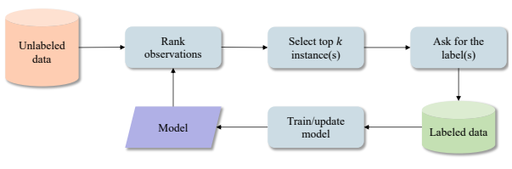
Fig. 2 Pool-based active learning.
원문 · CC BY 4.0 · Davide Cacciarelli, Murat Kulahci · Active learning for data streams: a survey · 원문 그림 인용 · 원본 PDF 4쪽에서 그림 영역을 추출했습니다.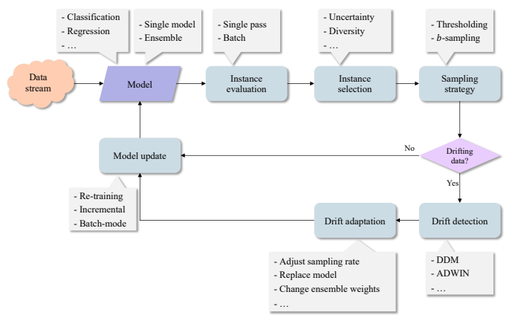
Fig. 5 Online active learning: general framework.
원문 · CC BY 4.0 · Davide Cacciarelli, Murat Kulahci · Active learning for data streams: a survey · 원문 그림 인용 · 원본 PDF 9쪽에서 그림 영역을 추출했습니다.선택적 샘플링과 확률적 질의 결정
대표적인 온라인 방법인 선택적 샘플링 퍼셉트론은 현재 선형 예측기의 예측값 p̂_t = w_{t-1}^T x_t의 절댓값으로 불확실성을 측정합니다. 이 값에 따라 b-sampling은 Bernoulli 확률 P_t = b/(b + |p̂_t|)로 레이블 요청 여부를 정하며, b>0은 요청 비율을 조절하는 평활 상수입니다. 예측 마진이 0에 가까울수록 요청 확률이 1에 가까워집니다. 레이블이 요청되면 퍼셉트론 규칙으로 가중치를 갱신하고, 요청하지 않으면 모델을 유지합니다. 로지스틱 마진 샘플링은 같은 아이디어에서 확률을 e^{-γ|p̂_t|}로 바꾸어 분포 모양만 달리합니다. 온라인 수동-공격적 방법은 이 질의 규칙에 손실이 0이 아닐 때 가중치를 갱신하는 수동-공격적 갱신을 결합합니다.
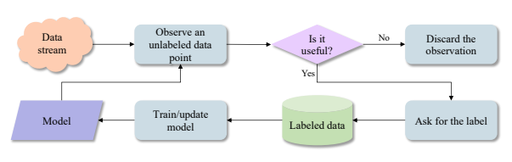
Fig. 3 Single-pass online active learning.
원문 · CC BY 4.0 · Davide Cacciarelli, Murat Kulahci · Active learning for data streams: a survey · 원문 그림 인용 · 원본 PDF 5쪽에서 그림 영역을 추출했습니다.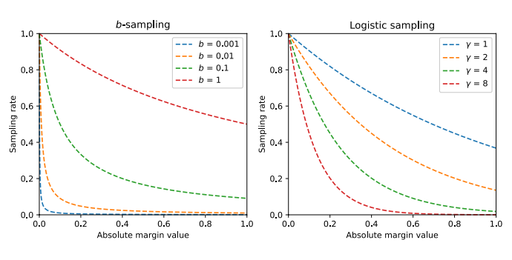
Fig. 6 Shape of the sampling distributions for b-sampling (a) and logistic sampling (b), for different values of b and γ.
원문 · CC BY 4.0 · Davide Cacciarelli, Murat Kulahci · Active learning for data streams: a survey · 원문 그림 인용 · 원본 PDF 10쪽에서 그림 영역을 추출했습니다.정보 행렬 기반 설계와 평가 기준
최적 실험 설계 관점의 온라인 선형 회귀 방법은 회귀계수 추정의 정확도를 설계 기준으로 평가합니다. 원문은 A-, D-, E-최적성을 각각 계수 분산의 합, 신뢰 타원체의 부피, 최대 고유값으로 정의합니다. D-최적성은 정보 행렬 행렬식의 최대화로 표현되며, 이는 신뢰 타원체의 전체 부피를 줄이는 기준입니다. 이 설계 기준을 온라인으로 확장한 CDO 알고리즘은 초기 레이블 집합과 워밍업 집합으로 임계값 Γ를 추정하고, 설계 기준에 따른 질의 확률 또는 임계 조건으로 새 관측치를 선택합니다. 평가에서는 학습 곡선과 비모수 통계 검정을 사용하며, 드리프트가 있는 스트림에서는 prequential(test-then-train) 평가가 주로 선택됩니다.
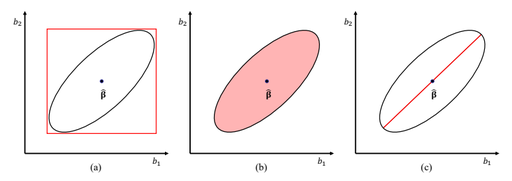
Fig. 12 Confidence ellipsoid around the model parameters and optimality criteria: A-optimality (a) shrinks the hyperrectangular enclosing the confidence ellipsoid (Asprey and Macchietto, 2002; Galvanin, 2010), D-optimality (b) aim to shrink the total volume of the ellipsoid, and E-optimality (c) tries to reduce the length of the longest axis (Jamieson, 2018).
원문 · CC BY 4.0 · Davide Cacciarelli, Murat Kulahci · Active learning for data streams: a survey · 원문 그림 인용 · 원본 PDF 25쪽에서 그림 영역을 추출했습니다.남은 과제와 적용 범위
이 논문은 기존 연구를 분류한 서베이이며, 새로운 실험을 수행하지 않습니다. 원문은 온라인 능동 선형 회귀 연구가 상대적으로 제한적이라고 설명하며, 단일 패스 방식으로 동적 데이터 스트림을 다루는 연구의 필요성을 제시합니다. 레이블 지연은 null, intermediate, extreme 세 가지로 구분되고, 지연 조건에서는 중복 질의가 생길 수 있습니다. 따라서 이 분류의 결론은 각 연구가 가정한 레이블 지연, 드리프트 조건, 과제의 범위 안에서 읽어야 합니다.
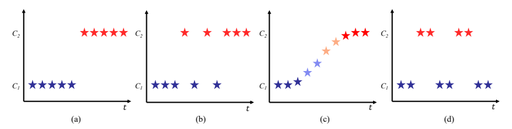
Fig. 7 Different types of drifts that can affect the data stream: abrupt drift (a), gradual drift (b), incremental drift (c), recurring concepts (d). C1 and C2 indicate the two concepts that might characterize the data distribution.
원문 · CC BY 4.0 · Davide Cacciarelli, Murat Kulahci · Active learning for data streams: a survey · 원문 그림 인용 · 원본 PDF 17쪽에서 그림 영역을 추출했습니다.논문 정보
- 저자
- Davide Cacciarelli, Murat Kulahci
- 학회·저널
- arXiv · 프리프린트
- 최초 공개일
- 2023년 2월 17일
- 등록일
- 2026년 11월 6일
- 수정일
- 2023년 11월 29일
- 버전
- v4
- arXiv
- 2302.08893
- DOI
- 10.1007/s10994-023-06454-2
- 분류
- stat.ML · cs.LG · stat.ME
- 원문 이용 조건
- CC BY 4.0
- 제공 범위
- 논문 정보, 해설, 허용된 원문 그림
AI 해설은 논문 원문과 별개의 설명이며 오류가 있을 수 있습니다. 원문과 그림은 각 출처의 이용 조건과 따로 표시된 권리를 따릅니다.
초록
Online active learning is a paradigm in machine learning that aims to select the most informative data points to label from a data stream. The problem of minimizing the cost associated with collecting labeled observations has gained a lot of attention in recent years, particularly in real-world applications where data is only available in an unlabeled form. Annotating each observation can be time-consuming and costly, making it difficult to obtain large amounts of labeled data. To overcome this issue, many active learning strategies have been proposed in the last decades, aiming to select the most informative observations for labeling in order to improve the performance of machine learning models. These approaches can be broadly divided into two categories: static pool-based and stream-based active learning. Pool-based active learning involves selecting a subset of observations from a closed pool of unlabeled data, and it has been the focus of many surveys and literature reviews. However, the growing availability of data streams has led to an increase in the number of approaches that focus on online active learning, which involves continuously selecting and labeling observations as they arrive in a stream. This work aims to provide an overview of the most recently proposed approaches for selecting the most informative observations from data streams in real time. We review the various techniques that have been proposed and discuss their strengths and limitations, as well as the challenges and opportunities that exist in this area of research.
원문 인용
Davide Cacciarelli, Murat Kulahci (2023). Active learning for data streams: a survey. arXiv:2302.08893v4. https://doi.org/10.1007/s10994-023-06454-2
BibTeX
@article{cacciarelli2023active,
  title = {{Active learning for data streams: a survey}},
  author = {Davide Cacciarelli and Murat Kulahci},
  year = {2023},
  eprint = {2302.08893},
  archivePrefix = {arXiv},
  doi = {10.1007/s10994-023-06454-2},
  url = {https://arxiv.org/abs/2302.08893v4}
}