논문 해설
Continual Normalization: Rethinking Batch Normalization for Online Continual Learning
지속 정규화: 온라인 지속 학습을 위한 배치 정규화 재고찰
- 연구 문제 온라인 지속 학습에서 BN은 현재 과제에 치우친 모멘트로 이전 과제를 정규화하여 망각을 키웁니다.
- 연구 방법 CN은 Group Normalization으로 공간 정규화를 먼저 수행한 뒤 Batch Normalization을 적용하여 BN의 지식 공유 이점을 유지하면서 cross-task normalization effect를 줄입니다.
- 주요 결과 Split CIFAR-100의 ER 설정에서 CN의 ACC는 67.48±0.81로 BN의 64.97±1.09보다 높게 보고되었으며, CN의 학습 시간 증가율은 BN 대비 3.72%입니다.
온라인 지속 학습에서 BN의 문제
온라인 지속 학습에서는 데이터가 스트림으로 들어오고 각 단계에서 현재 과제의 샘플만 관찰됩니다. 이 설정에서 Batch Normalization은 학습 중 미니배치 모멘트의 이동 평균을 쌓아 두고 테스트 시에 그 전역 추정치를 사용합니다. 그런데 최근 데이터에 포함된 과제가 현재 과제 하나뿐이므로 이 전역 추정치는 현재 과제 쪽으로 치우칩니다. 그 결과 이전 과제의 테스트 데이터도 현재 과제의 모멘트로 정규화되며, 저자들은 이를 cross-task normalization effect라고 부르고 이로 인해 망각이 증가한다고 설명합니다.
저자들은 이 문제를 해결하면서도 BN이 주는 학습 이점을 잃지 않는 정규화 계층이 필요하다고 봅니다. 여기서 이점은 미니배치 차원의 정규화가 과제 간 지식 공유를 돕는다는 점을 가리킵니다.
Continual Normalization의 두 단계 계산
Continual Normalization(CN)은 BN을 대체하는 계층으로, 입력 특징 맵 a에 먼저 Group Normalization을 적용합니다. 이 첫 단계의 GN은 affine 변환 없이 수행되어 중간 결과가 미니배치 차원과 공간 차원 모두에서 잘 정규화되도록 합니다. 이후 GN 출력에 BN 계층을 적용하고, 학습된 affine 파라미터 γ와 β를 곱하고 더해 최종 출력 aCN을 얻습니다. 원문은 이 계산을 aGN←GN1,0(a), aCN←γBN1,0(aGN)+β로 제시합니다.
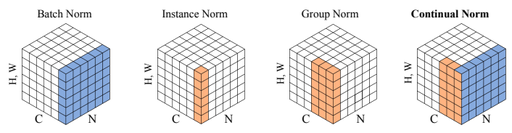
Figure 1 : An illustration of different normalization methods using cube diagrams derived from Wu & He (2018). Each cube represents a feature map tensor with N as the batch axis, C as the channel axis, and (H,W) as the channel axes. Pixels in blue are normalized by the same moments calculated from different samples while pixels in orange are normalized by the same moments calculated from within sample. Best viewed in colors.
원문 · CC BY 4.0 · Quang Pham, Chenghao Liu, Steven Hoi · Continual Normalization: Rethinking Batch Normalization for Online Continual Learning · 원문 그림 인용 · 원본 PDF 2쪽에서 그림 영역을 추출했습니다.이 순서가 중요한 이유는 GN을 먼저 적용하면 공간적으로 정규화된 특징이 BN의 이동 평균 통계에 기여하므로 cross-task normalization effect가 줄어든다는 저자들의 설명 때문입니다. CN은 추가 학습 파라미터를 도입하지 않으며, 테스트 시 과제 식별자나 에피소드 메모리 같은 추가 입력을 요구하지 않습니다.
과제 증분 벤치마크에서의 비교
Split CIFAR-100과 Split Mini IMN의 온라인 task-incremental 설정에서 CN은 BN, BRN, IN, GN, SN과 비교되었습니다. 기본 백본은 사전 학습되지 않은 ResNet 18이며, 배치 크기 10으로 한 epoch 동안 SGD로 최적화되었습니다. 비교는 ER과 DER++ 두 전략에서 수행되었고, CN과 GN의 그룹 수 G는 32로 교차 검증되었습니다. 각 벤치마크는 20개 과제로 나뉘며 그중 3개는 하이퍼파라미터 교차 검증에, 나머지 17개는 지속 학습에 쓰였습니다.
ER 설정에서 Split CIFAR-100의 ACC는 CN이 67.48±0.81, BN이 64.97±1.09로 보고되었습니다. 저자들은 BN이 지식 전달에서는 높은 LA를 보이지만 망각 지표인 FM이 더 높고, GN과 SN은 FM이 낮은 대신 LA가 낮다고 해석합니다. 이 결과는 위 두 벤치마크와 ResNet 18 설정에서 얻은 것입니다.
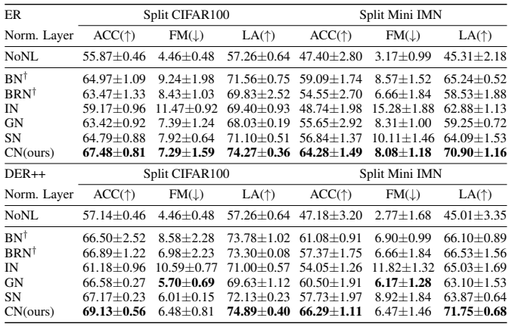
Table 2 : Evaluation metrics of different normalization layers on the Split CIFAR100 and Split Mini IMN benchmarks. Bold indicates the best averaged scores,† suffix indicates non-adaptive method
원문 · CC BY 4.0 · Quang Pham, Chenghao Liu, Steven Hoi · Continual Normalization: Rethinking Batch Normalization for Online Continual Learning · 원문 그림 인용 · 원본 PDF 6쪽에서 그림 영역을 추출했습니다.학습 시간 비교
ER 전략의 Split CIFAR100 벤치마크에서 학습 시간은 BN 기준으로 비교되었습니다. CN의 학습 시간 증가율은 3.72%이고, GN은 1.51%, SN은 28.61%입니다. 저자들은 GN과 CN이 BN 대비 최소한의 계산 부담을 가지며, SN은 서로 다른 모멘트 집합을 계산하고 정규화하는 비용 때문에 더 큰 부담을 가진다고 설명합니다. 이 수치는 해당 벤치마크와 ER 설정에서 측정된 값입니다.
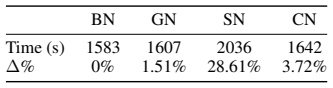
Table 3 : Running time of ER on the Split CI- FAR100 benchmarks of different normalization layers. ∆% indicates the percentage increases of training time over BN
원문 · CC BY 4.0 · Quang Pham, Chenghao Liu, Steven Hoi · Continual Normalization: Rethinking Batch Normalization for Online Continual Learning · 원문 그림 인용 · 원본 PDF 7쪽에서 그림 영역을 추출했습니다.DER++ 기반 클래스 증분 비교
Split-CIFAR10과 Split-Tiny-ImageNet에서는 DER++ 전략과 ResNet 18 백본을 사용하고, 학습 epoch 수를 1로 설정하여 Task-IL과 Class-IL 설정을 비교했습니다. 메모리 크기는 500, 2560, 5120이며, CN은 그룹 수 G=8과 G=32 두 가지 구성으로 평가되었습니다. 원문은 대부분의 경우 CN이 BN보다 두 지표에서 나은 것으로 보고하며, 특히 큰 메모리에서 차이가 더 크다고 설명합니다. 저자들은 BN이 Split CIFAR-10 Class-IL에서 표준편차가 커 불안정하다고 해석합니다.
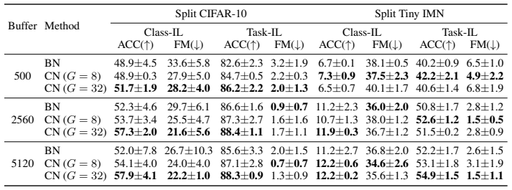
Table 4 : Evaluation metrics of DER++ with different normalization layers on the Split CIFAR-10 and Split Tiny IMN benchmarks. Parentheses indicates the number of groups in CN. Bold indicates the best averaged scores
원문 · CC BY 4.0 · Quang Pham, Chenghao Liu, Steven Hoi · Continual Normalization: Rethinking Batch Normalization for Online Continual Learning · 원문 그림 인용 · 원본 PDF 8쪽에서 그림 영역을 추출했습니다.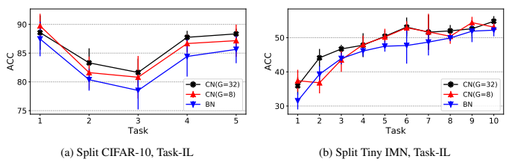
Figure 2 : The evolution of ACC(↑) on observed tasks so far on the Split CIFAR-10 and Split Tiny IMN benchmarks, Task-IL screnario with DER++ and memory size of 5120 samples.
원문 · CC BY 4.0 · Quang Pham, Chenghao Liu, Steven Hoi · Continual Normalization: Rethinking Batch Normalization for Online Continual Learning · 원문 그림 인용 · 원본 PDF 8쪽에서 그림 영역을 추출했습니다.장꼬리 분포 설정과 한계
COCOseq와 NUS-WIDEseq는 이미지가 여러 레이블을 가질 수 있어 장꼬리 분포를 보이는 온라인 벤치마크입니다. PRS 전략에서 그룹 수는 G=4로 설정되었고, 결과는 다섯 번 실행의 평균으로 보고되었습니다. COCOseq 전체 클래스에서 CN의 C-F1은 53.1이고 BN은 51.8입니다. 반면 NUS-WIDEseq의 소수 클래스에서는 CN의 C-F1이 27.3으로 BN의 28.5보다 낮습니다. 저자들은 NUS-WIDE의 잡음이 많은 특성과 레이블 수가 꼬리 클래스 성능에 영향을 줄 수 있다고 해석합니다.
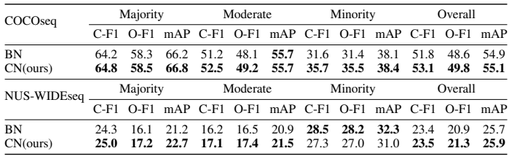
Table 5 : Evaluation metrics of the PRS strategy on the COCOseq and NUS-WIDEseq benchmarks. We report the mean performance over five runs. Bold indicates the best averaged scores
원문 · CC BY 4.0 · Quang Pham, Chenghao Liu, Steven Hoi · Continual Normalization: Rethinking Batch Normalization for Online Continual Learning · 원문 그림 인용 · 원본 PDF 9쪽에서 그림 영역을 추출했습니다.CN은 그룹 수라는 추가 하이퍼파라미터를 도입하므로 최적 성능을 위해 교차 검증이 필요합니다. 원문은 이 한계를 함께 제시합니다.
논문 정보
- 저자
- Quang Pham, Chenghao Liu, Steven Hoi
- 학회·저널
- arXiv · 프리프린트
- 최초 공개일
- 2022년 3월 30일
- 등록일
- 2026년 11월 5일
- 수정일
- 2022년 3월 30일
- 버전
- v1
- arXiv
- 2203.16102
- 분류
- cs.LG
- 원문 이용 조건
- CC BY 4.0
- 제공 범위
- 논문 정보, 해설, 허용된 원문 그림
AI 해설은 논문 원문과 별개의 설명이며 오류가 있을 수 있습니다. 원문과 그림은 각 출처의 이용 조건과 따로 표시된 권리를 따릅니다.
초록
Existing continual learning methods use Batch Normalization (BN) to facilitate training and improve generalization across tasks. However, the non-i.i.d and non-stationary nature of continual learning data, especially in the online setting, amplify the discrepancy between training and testing in BN and hinder the performance of older tasks. In this work, we study the cross-task normalization effect of BN in online continual learning where BN normalizes the testing data using moments biased towards the current task, resulting in higher catastrophic forgetting. This limitation motivates us to propose a simple yet effective method that we call Continual Normalization (CN) to facilitate training similar to BN while mitigating its negative effect. Extensive experiments on different continual learning algorithms and online scenarios show that CN is a direct replacement for BN and can provide substantial performance improvements. Our implementation is available at \url{https://github.com/phquang/Continual-Normalization}.
원문 인용
Quang Pham, Chenghao Liu, Steven Hoi (2022). Continual Normalization: Rethinking Batch Normalization for Online Continual Learning. arXiv:2203.16102v1. https://arxiv.org/abs/2203.16102v1
BibTeX
@misc{pham2022continual,
  title = {{Continual Normalization: Rethinking Batch Normalization for Online Continual Learning}},
  author = {Quang Pham and Chenghao Liu and Steven Hoi},
  year = {2022},
  eprint = {2203.16102},
  archivePrefix = {arXiv},
  url = {https://arxiv.org/abs/2203.16102v1}
}