논문 해설
Unisolver: PDE-Conditional Transformers Towards Universal Neural PDE Solvers
Unisolver: 범용 신경 PDE 솔버를 향한 PDE 조건부 트랜스포머
- 연구 문제 신경 PDE 솔버는 학습한 PDE 집합 밖에서 일반화하기 어렵습니다. Unisolver는 PDE 해를 결정하는 구성요소를 조건으로 넣는 Transformer로 이 문제를 다룹니다.
- 연구 방법 Unisolver는 방정식 기호, 계수, 경계 조건, 외력, 도메인 기하 등 완전한 PDE 구성요소를 도메인별과 점별 심층 조건으로 임베딩하고, 은닉 표현을 분리된 부분공간에서 Transformer에 통합합니다.
- 주요 결과 HeterNS의 zero-shot 외력 일반화와 2D 혼합 PDE의 in-distribution 평가에서 여러 기준 모델보다 낮은 상대 L2 오차를 보고합니다. 결과는 원문이 보고한 데이터셋과 평가 설정에 한정됩니다.
기존 신경 PDE 솔버의 일반화 한계
편미분방정식(PDE)을 신경망으로 푸는 연구는 크게 물리 정보 신경망(PINNs)과 신경 연산자(neural operators)의 두 흐름으로 나뉩니다. PINNs는 PDE를 목적 함수로 정식화하여 학습하지만 새로운 시나리오에 일반화하기 어렵고 새 과제마다 재학습이 필요합니다. 신경 연산자는 데이터로부터 직접 학습하여 초기 상태와 PDE에 더 잘 일반화하지만, 원문은 PDE 정보를 충분히 담지 않으면 점성 계수나 외력처럼 해를 바꾸는 요인을 구별하기 어렵다고 설명합니다. 그 결과 현재 신경 연산자는 제한된 PDE 집합에서만 학습되고 평가되는 경우가 많습니다. 이 논문은 이러한 일반화 결함을 다루며, 단순히 데이터와 파라미터를 키우는 대신 PDE 해를 결정하는 구성요소를 모델 입력의 조건으로 넣는 방향을 택합니다.
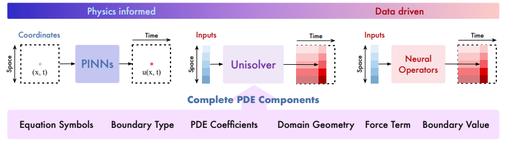
Figure 1 . Neural PDE solvers typically consist of two paradigms: physics informed and data driven. Unisolver combines data-driven methods with physical insights from PDE components in a conditional modeling framework, boosting generalizability and scalability.
원문 · CC BY 4.0 · Hang Zhou, Yuezhou Ma, Haixu Wu, Haowen Wang, Mingsheng Long · Unisolver: PDE-Conditional Transformers Towards Universal Neural PDE Solvers · 원문 그림 인용 · 원본 PDF 2쪽에서 그림 영역을 추출했습니다.완전한 PDE 구성요소의 정의
Unisolver는 진동하는 현의 방정식을 동기 예시로 삼아 해를 결정하는 PDE 구성요소를 정리합니다. 원문은 방정식 기호, 방정식 계수, 경계 조건 유형, 외력, 도메인 기하, 경계 값 함수를 포함하는 완전한 구성요소 집합을 제시합니다. 이 구성요소들은 작용 방식에 따라 두 범주로 나뉩니다. 계수 a처럼 도메인 전체에 일관되게 작용하는 방정식 기호, 계수, 경계 조건 유형은 도메인별(domain-wise) 구성요소이고, 외력 f, 도메인 기하, 경계 값 함수는 위치마다 개별적으로 작용하는 점별(point-wise) 구성요소입니다. 경계 조건은 형태가 다양하므로 경계 조건 유형과 경계 값 함수를 두 구성요소로 나누어 표현합니다.
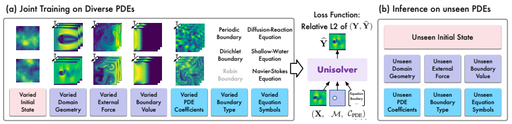
Figure 2 . Overview of universal neural PDE solving, taking the 2D mixed PDEs in Sec 4.3 as an example. Our model is jointly trained on diverse PDEs with varied initial conditions and governing PDE components, aiming for direct generalization to unseen PDEs in downstream tasks. The “Robin boundary” in gray is a valid boundary type despite not included in the example dataset.
원문 · CC BY 4.0 · Hang Zhou, Yuezhou Ma, Haixu Wu, Haowen Wang, Mingsheng Long · Unisolver: PDE-Conditional Transformers Towards Universal Neural PDE Solvers · 원문 그림 인용 · 원본 PDF 3쪽에서 그림 영역을 추출했습니다.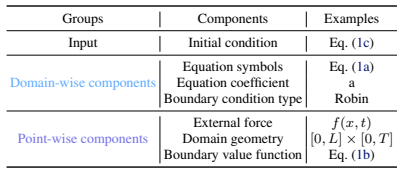
Table 1 . Categorization of complete PDE components.
원문 · CC BY 4.0 · Hang Zhou, Yuezhou Ma, Haixu Wu, Haowen Wang, Mingsheng Long · Unisolver: PDE-Conditional Transformers Towards Universal Neural PDE Solvers · 원문 그림 인용 · 원본 PDF 4쪽에서 그림 영역을 추출했습니다.심층 조건 임베딩과 분리 부분공간 Transformer
Unisolver는 도메인별 구성요소를 도메인별 심층 조건으로, 점별 구성요소를 점별 심층 조건으로 임베딩합니다. 방정식 기호는 LLaMA-3 8B에 LaTeX 코드를 입력하고 마지막 Transformer 블록의 표현을 시퀀스 방향으로 평균하여 4096차원 임베딩을 얻은 뒤 MLP로 채널 차원을 맞춥니다. 계수와 경계 조건 유형은 선형 층과 SiLU를 거치고, 외력·기하·경계 값 함수는 입력 관측과 같은 패치화 임베딩으로 처리합니다. 조건부 Transformer에서는 은닉 표현을 채널 방향으로 절반씩 나누어 한쪽은 도메인별 조건, 다른쪽은 점별 조건의 영향을 받게 합니다. 각 층에서는 도메인별 조건과 점별 조건을 투영한 뒤 스케일·시프트·선택 방식으로 어텐션과 피드포워드 모듈의 입력에 통합합니다.
이 분리 설계가 두 범주의 간섭을 줄인다는 것이 저자들의 설명입니다.
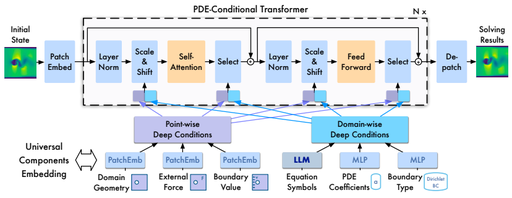
Figure 3 . Overview of Unisolver. We universally embed all PDE components, such as domain geometries, equation symbols and boundary types into deep conditions and employ a conditional Transformer to aggregate deep conditions in the decoupled subspace.
원문 · CC BY 4.0 · Hang Zhou, Yuezhou Ma, Haixu Wu, Haowen Wang, Mingsheng Long · Unisolver: PDE-Conditional Transformers Towards Universal Neural PDE Solvers · 원문 그림 인용 · 원본 PDF 4쪽에서 그림 영역을 추출했습니다.HeterNS에서의 일반화 평가
HeterNS는 2D Navier-Stokes 방정식의 점성 계수와 외력 항을 다양화한 벤치마크로, 다섯 개의 점성 계수와 세 개의 외력 항이 만드는 15개 조합과 15,000개 학습 샘플을 포함합니다. In-distribution 테스트는 초기 조건만 달라지고, zero-shot 설정은 초기 조건과 함께 점성 계수 또는 외력이 학습에 없던 값입니다. 평균 결과에서 Unisolver는 in-distribution 테스트에서 점성 항 기준 상대 향상 27.7%를, zero-shot 외력 일반화 기준 평균 66.7%의 향상을 보고합니다. 이 수치는 상대 L2 오차에 대한 상대 향상으로, 비교 대상은 FNO, PINO, ViT, FactFormer, ICON, MPP입니다.
외력 일반화는 어려운 설정으로 설명되며, 부록에서는 점성과 외력이 모두 미지인 경우에도 평균 41.3%의 향상이 있다고 보고합니다.
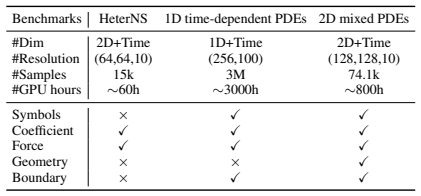
Table 2 . Summary of benchmarks. #GPU hours are calculated by averaging the training time of all models on one A100 GPU. Detailed compute resources can be found in Appendix I.7. Besides, ✓ indicates the PDE component will change among different samples, while × refers to unchanged ones.
원문 · CC BY 4.0 · Hang Zhou, Yuezhou Ma, Haixu Wu, Haowen Wang, Mingsheng Long · Unisolver: PDE-Conditional Transformers Towards Universal Neural PDE Solvers · 원문 그림 인용 · 원본 PDF 6쪽에서 그림 영역을 추출했습니다.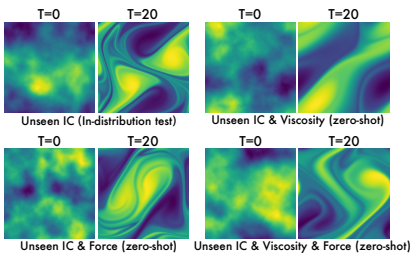
Figure 4 . Visualization of evaluation scenarios on the HeterNS.
원문 · CC BY 4.0 · Hang Zhou, Yuezhou Ma, Haixu Wu, Haowen Wang, Mingsheng Long · Unisolver: PDE-Conditional Transformers Towards Universal Neural PDE Solvers · 원문 그림 인용 · 원본 PDF 6쪽에서 그림 영역을 추출했습니다.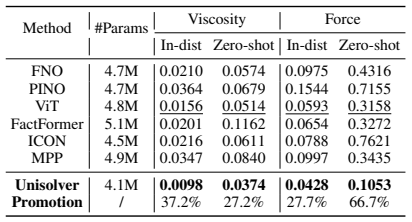
Table 3 . Performance comparison on HeterNS. Note that the re- ported In-dist and Zero-shot results are averaged over multiple sub-configurations with different viscosity coefficients and force terms. Full results can be found in Appendix D.
원문 · CC BY 4.0 · Hang Zhou, Yuezhou Ma, Haixu Wu, Haowen Wang, Mingsheng Long · Unisolver: PDE-Conditional Transformers Towards Universal Neural PDE Solvers · 원문 그림 인용 · 원본 PDF 6쪽에서 그림 영역을 추출했습니다.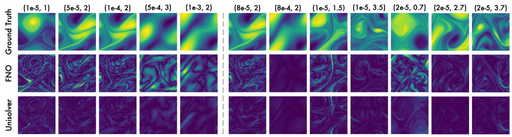
Figure 9 . Error map comparison on HeterNS, where all cases share the same initial condition but differ in viscosity (ν) and force (ω) (shown in the first row by pairs (ν, ω)). The left panel shows in-distribution tests, while the right shows zero-shot generalization.
원문 · CC BY 4.0 · Hang Zhou, Yuezhou Ma, Haixu Wu, Haowen Wang, Mingsheng Long · Unisolver: PDE-Conditional Transformers Towards Universal Neural PDE Solvers · 원문 그림 인용 · 원본 PDF 9쪽에서 그림 영역을 추출했습니다.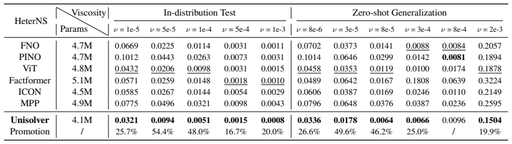
Table 10 . Relative L2 performance on HeterNS with different viscosity and fixed force frequency coefficient ω = 2. For clarity, the best result is in bold and the second best is underlined. Promtotion refers to the relative improvement over the second-best method.
원문 · CC BY 4.0 · Hang Zhou, Yuezhou Ma, Haixu Wu, Haowen Wang, Mingsheng Long · Unisolver: PDE-Conditional Transformers Towards Universal Neural PDE Solvers · 원문 그림 인용 · 원본 PDF 14쪽에서 그림 영역을 추출했습니다.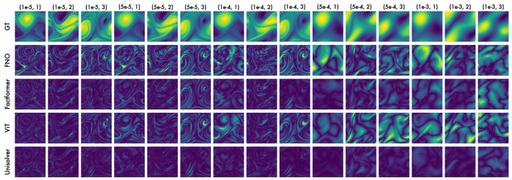
Figure 13 . Error maps (absolute difference between model predictions and ground truth) for in-distribution tests with top three baselines on HeterNS. See Table 10 and 11 for numerical comparison (relative L2). All data has the same initial condition and differs inviscosity (ν) and force (ω) (shown in the first row by the pairs (ν, ω)). Unisolver achieved the best visual performance among the compared baselines.
원문 · CC BY 4.0 · Hang Zhou, Yuezhou Ma, Haixu Wu, Haowen Wang, Mingsheng Long · Unisolver: PDE-Conditional Transformers Towards Universal Neural PDE Solvers · 원문 그림 인용 · 원본 PDF 14쪽에서 그림 영역을 추출했습니다.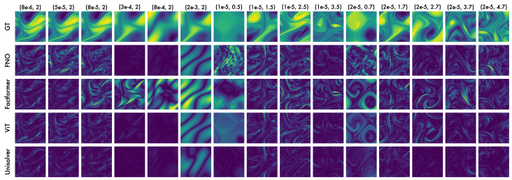
Figure 14 . Error maps for zero-shot generalization settings with top three baselines on the HeterNS dataset with the same initial conditions and differs in viscosity (ν) and force (ω) (shown in the first row by the pairs (ν, ω)). See Table 10 and 11 for numerical comparison.
원문 · CC BY 4.0 · Hang Zhou, Yuezhou Ma, Haixu Wu, Haowen Wang, Mingsheng Long · Unisolver: PDE-Conditional Transformers Towards Universal Neural PDE Solvers · 원문 그림 인용 · 원본 PDF 15쪽에서 그림 영역을 추출했습니다.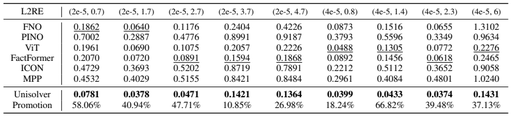
Table 17 . Performance comparison (relative L2) on zero-shot generalization settings with unseen viscosity (ν) and unseen force (ω). The pairs in the first row are in the form of (ν, ω). For clarity, the best result is in bold and the second-best is underlined.
원문 · CC BY 4.0 · Hang Zhou, Yuezhou Ma, Haixu Wu, Haowen Wang, Mingsheng Long · Unisolver: PDE-Conditional Transformers Towards Universal Neural PDE Solvers · 원문 그림 인용 · 원본 PDF 24쪽에서 그림 영역을 추출했습니다.
Table 20 . Zero-shot performance comparison (relative L2) with top three baselines
원문 · CC BY 4.0 · Hang Zhou, Yuezhou Ma, Haixu Wu, Haowen Wang, Mingsheng Long · Unisolver: PDE-Conditional Transformers Towards Universal Neural PDE Solvers · 원문 그림 인용 · 원본 PDF 25쪽에서 그림 영역을 추출했습니다.
Table 23 . Standard Deviations on the HeterNS benchmark with different viscosity coefficients and fixed force frequency coefficientω = 2.
원문 · CC BY 4.0 · Hang Zhou, Yuezhou Ma, Haixu Wu, Haowen Wang, Mingsheng Long · Unisolver: PDE-Conditional Transformers Towards Universal Neural PDE Solvers · 원문 그림 인용 · 원본 PDF 26쪽에서 그림 영역을 추출했습니다.
Table 24 . Standard Deviations on the HeterNS benchmark with different force (ω) and fixed viscosity coefficient ν = 2.
원문 · CC BY 4.0 · Hang Zhou, Yuezhou Ma, Haixu Wu, Haowen Wang, Mingsheng Long · Unisolver: PDE-Conditional Transformers Towards Universal Neural PDE Solvers · 원문 그림 인용 · 원본 PDF 26쪽에서 그림 영역을 추출했습니다.1D 시간 의존 PDE와 2D 혼합 PDE 평가
1D 시간 의존 PDE 벤치마크는 PDEformer가 제안한 약 300만 개의 샘플로 학습하고, PDEBench의 Burgers 방정식과 Advection 방정식에서 zero-shot 성능을 평가합니다. 이 비교에서 Unisolver는 PDEformer보다 in-distribution 테스트 성능이 좋고, 네 개의 zero-shot 일반화 시나리오에서 평균 27.1% 향상을 보고합니다. 2D 혼합 PDE 벤치마크는 DPOT가 수집한 4개 벤치마크의 12개 데이터셋으로 구성되며, 이 평가는 in-distribution 테스트만 수행합니다. Unisolver는 12개 중 11개 테스트 세트에서 DPOT을 앞서고 평균 상대 L2 오차가 5.50에서 4.54로 줄어든다고 보고합니다.
원문은 작은 Diffusion-Reaction 데이터셋에서는 오차가 이미 작아 포화된 상태라고 명시합니다.

Table 4 . Comparison (relative L2) of in-distribution test and zero-shot generalization on 1D time-dependent PDEs. Viscosity ν and advection velocity β are dominated components of target PDEs.
원문 · CC BY 4.0 · Hang Zhou, Yuezhou Ma, Haixu Wu, Haowen Wang, Mingsheng Long · Unisolver: PDE-Conditional Transformers Towards Universal Neural PDE Solvers · 원문 그림 인용 · 원본 PDF 7쪽에서 그림 영역을 추출했습니다.
Table 5 . Performance comparison (relative L2 (×10−2)) across 12 in-distribution test sets. We use a “source-PDE” format to denote different tasks (e.g. FNO-NS). The second row lists the primary PDE components for each dataset. See Appendix G.3 for details.
원문 · CC BY 4.0 · Hang Zhou, Yuezhou Ma, Haixu Wu, Haowen Wang, Mingsheng Long · Unisolver: PDE-Conditional Transformers Towards Universal Neural PDE Solvers · 원문 그림 인용 · 원본 PDF 7쪽에서 그림 영역을 추출했습니다.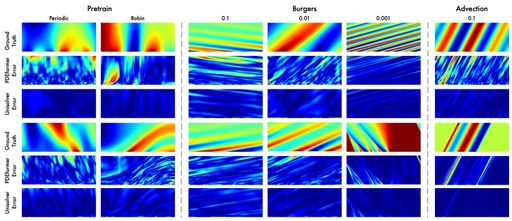
Figure 15 . Error maps on the in-distribution test and zero-shot generalization (Burgers and Advection equation from PDEBench (Takamoto et al., 2022)) settings in 1D time-dependent PDEs. See Table 4 for numerical comparison. We visualize two cases: periodic boundary conditions and Robin boundary conditions in in-distribution tests. The number in the Burgers columns is the diffusion coefficient ν while the number in the Advection column is the advection speed β.
원문 · CC BY 4.0 · Hang Zhou, Yuezhou Ma, Haixu Wu, Haowen Wang, Mingsheng Long · Unisolver: PDE-Conditional Transformers Towards Universal Neural PDE Solvers · 원문 그림 인용 · 원본 PDF 15쪽에서 그림 영역을 추출했습니다.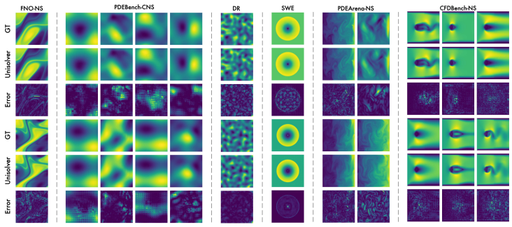
Figure 16 . Unisolver predictions and error maps on 2D mixed PDEs. See Table 5 for numerical results. Both predictions and error maps are provided. As shown in the CFDBench-NS columns, Unisolver presents an impressive ability to handle different geometry conditions.
원문 · CC BY 4.0 · Hang Zhou, Yuezhou Ma, Haixu Wu, Haowen Wang, Mingsheng Long · Unisolver: PDE-Conditional Transformers Towards Universal Neural PDE Solvers · 원문 그림 인용 · 원본 PDF 15쪽에서 그림 영역을 추출했습니다.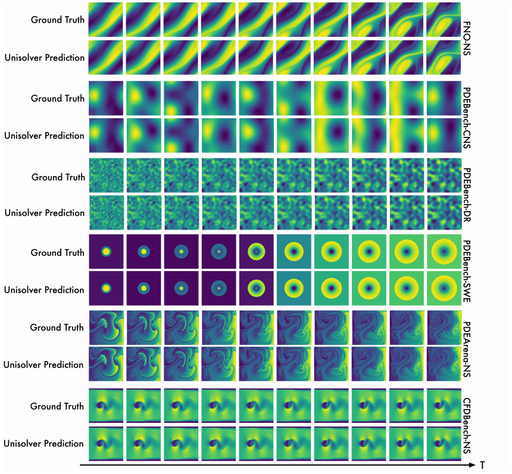
Figure 17 . Visualization of the full trajectories in the 2D mixed PDEs, with the names of the subsets displayed on the right. Ground truth and Unisolver predictions are presented, visually highlighting the complexity and diversity of the 2D mixed PDEs.
원문 · CC BY 4.0 · Hang Zhou, Yuezhou Ma, Haixu Wu, Haowen Wang, Mingsheng Long · Unisolver: PDE-Conditional Transformers Towards Universal Neural PDE Solvers · 원문 그림 인용 · 원본 PDF 27쪽에서 그림 영역을 추출했습니다.절제 실험과 부분 관측 분석
절제 실험에서 LLM 임베딩을 제거하면 1D 시간 의존 PDE 평가의 오차가 가장 크게 늘고, 저자들은 LLM이 방정식 기호의 수학적 정보를 인코딩하는 데 기여한다고 해석합니다. 또한 부분 공간 분리를 제거하거나 조건을 단순 연결하면 zero-shot 성능이 악화됩니다. 부분 관측 실험에서는 PDE 구성요소의 일부를 학습 가능한 토큰으로 대체하여, 구성요소가 없는 경우에도 FNO보다 좋은 경우가 많고 완전한 구성요소를 제공하면 평균 21.6% 더 나아진다고 보고합니다. 이 결과는 해당 설정에서 측정된 것이며, 모든 구성요소가 항상 같은 크기의 기여를 한다는 뜻은 아닙니다.
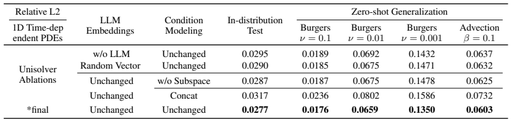
Table 6 . Ablation results on the LLM embeddings and the Condition Modeling. Variants of the former include without LLM embeddings (w/o LLM) and replacing by orthogonal random vectors (Random Vector), and variants of the latter include without subspace decoupling (w/o Subspace) and directly concatenating components (Concat). “Unchanged” means no changes to the default design.
원문 · CC BY 4.0 · Hang Zhou, Yuezhou Ma, Haixu Wu, Haowen Wang, Mingsheng Long · Unisolver: PDE-Conditional Transformers Towards Universal Neural PDE Solvers · 원문 그림 인용 · 원본 PDF 8쪽에서 그림 영역을 추출했습니다.
Figure 7 . Capability of Unisolver to handle partial-observed data simulated on the HeterNS.
원문 · CC BY 4.0 · Hang Zhou, Yuezhou Ma, Haixu Wu, Haowen Wang, Mingsheng Long · Unisolver: PDE-Conditional Transformers Towards Universal Neural PDE Solvers · 원문 그림 인용 · 원본 PDF 8쪽에서 그림 영역을 추출했습니다.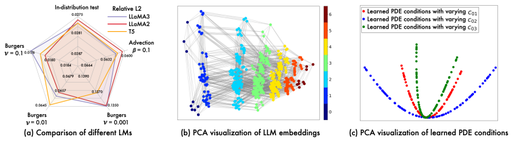
Figure 8 . (a) Comparison of utilizing different language models to encode equation symbols. (b) PCA visualization of LLM embeddings. The considered PDE family contains six coefficients, such asc01, c02, c03, as well as source and viscosity terms. Different colors represent the number of non-zero coefficients, intuitively indicating the complexity of PDEs. A zero coefficient results in the removal of a term from the equation, impacting the representations embedded by the LLM. (c) PCA visualization of learned deep PDE conditions, Iselect in Eq. (2). We vary only one coefficient at a time and keep the others fixed at zero, forming the shown parabolic-like trajectories.
원문 · CC BY 4.0 · Hang Zhou, Yuezhou Ma, Haixu Wu, Haowen Wang, Mingsheng Long · Unisolver: PDE-Conditional Transformers Towards Universal Neural PDE Solvers · 원문 그림 인용 · 원본 PDF 9쪽에서 그림 영역을 추출했습니다.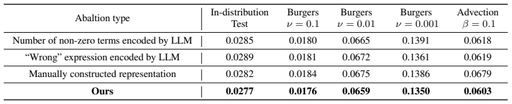
Table 7 . More ablations about LLM embeddings. We include three more ablations to further demonstrate the rationale for using LLM embeddings. Relative L2 loss is reported.
원문 · CC BY 4.0 · Hang Zhou, Yuezhou Ma, Haixu Wu, Haowen Wang, Mingsheng Long · Unisolver: PDE-Conditional Transformers Towards Universal Neural PDE Solvers · 원문 그림 인용 · 원본 PDF 12쪽에서 그림 영역을 추출했습니다.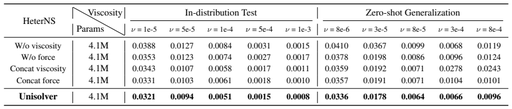
Table 18 . Ablations with different viscosity coefficient ν and fixed force ω = 2on the HeterNS on removing some PDE components (W/o), and replacing domain-wise or point-wise conditions from our design to directly concat (Concat).
원문 · CC BY 4.0 · Hang Zhou, Yuezhou Ma, Haixu Wu, Haowen Wang, Mingsheng Long · Unisolver: PDE-Conditional Transformers Towards Universal Neural PDE Solvers · 원문 그림 인용 · 원본 PDF 24쪽에서 그림 영역을 추출했습니다.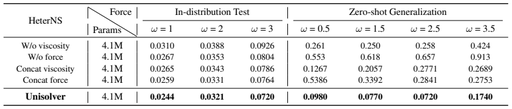
Table 19 . Ablations with different force ω and fixed viscosity ν = 10−5 on the HeterNS on removing some PDE components (W/o), and replacing domain-wise or point-wise conditions from our design to directly concat (Concat).
원문 · CC BY 4.0 · Hang Zhou, Yuezhou Ma, Haixu Wu, Haowen Wang, Mingsheng Long · Unisolver: PDE-Conditional Transformers Towards Universal Neural PDE Solvers · 원문 그림 인용 · 원본 PDF 25쪽에서 그림 영역을 추출했습니다.적용 범위와 한계
저자들은 점별 구성요소를 패치화하여 임베딩하기 때문에 현재 방법이 격자 데이터에 제한된다고 밝힙니다. 불규칙 메쉬용 대규모 PDE 데이터셋이 부족하다는 점도 이유로 제시합니다. 따라서 불규칙 메쉬 처리를 위해 기하 일반 PDE 솔버인 Transolver로 Transformer를 교체하는 방향을 향후 과제로 남깁니다. 또한 이 논문의 주요 검증은 HeterNS, 1D 시간 의존 PDE, 2D 혼합 PDE 벤치마크에 한정됩니다.
논문 정보
- 저자
- Hang Zhou, Yuezhou Ma, Haixu Wu, Haowen Wang, Mingsheng Long
- 학회·저널
- arXiv · 프리프린트
- 최초 공개일
- 2024년 5월 27일
- 등록일
- 2026년 10월 29일
- 수정일
- 2025년 9월 4일
- 버전
- v5
- arXiv
- 2405.17527
- 분류
- cs.LG · cs.AI · math.NA
- 원문 이용 조건
- CC BY 4.0
- 제공 범위
- 논문 정보, 해설, 허용된 원문 그림
AI 해설은 논문 원문과 별개의 설명이며 오류가 있을 수 있습니다. 원문과 그림은 각 출처의 이용 조건과 따로 표시된 권리를 따릅니다.
초록
Deep models have recently emerged as promising tools to solve partial differential equations (PDEs), known as neural PDE solvers. While neural solvers trained from either simulation data or physics-informed loss can solve PDEs reasonably well, they are mainly restricted to a few instances of PDEs, e.g. a certain equation with a limited set of coefficients. This limits their generalization to diverse PDEs, preventing them from being practical surrogate models of numerical solvers. In this paper, we present Unisolver, a novel Transformer model trained on diverse data and conditioned on diverse PDEs, aiming towards a universal neural PDE solver capable of solving a wide scope of PDEs. Instead of purely scaling up data and parameters, Unisolver stems from the theoretical analysis of the PDE-solving process. Inspired by the mathematical structure of PDEs that a PDE solution is fundamentally governed by a series of PDE components such as equation symbols and boundary conditions, we define a complete set of PDE components and flexibly embed them as domain-wise and point-wise deep conditions for Transformer PDE solvers. Integrating physical insights with recent Transformer advances, Unisolver achieves consistent state-of-the-art on three challenging large-scale benchmarks, showing impressive performance and generalizability. Code is available at https://github.com/thuml/Unisolver.
원문 인용
Hang Zhou, Yuezhou Ma, Haixu Wu, Haowen Wang, Mingsheng Long (2024). Unisolver: PDE-Conditional Transformers Towards Universal Neural PDE Solvers. arXiv:2405.17527v5. https://arxiv.org/abs/2405.17527v5
BibTeX
@misc{zhou2024unisolver,
  title = {{Unisolver: PDE-Conditional Transformers Towards Universal Neural PDE Solvers}},
  author = {Hang Zhou and Yuezhou Ma and Haixu Wu and Haowen Wang and Mingsheng Long},
  year = {2024},
  eprint = {2405.17527},
  archivePrefix = {arXiv},
  url = {https://arxiv.org/abs/2405.17527v5}
}