논문 해설
Riemannian Neural Optimal Transport
리만 신경 최적 수송
- 연구 문제 컴팩트 리만 다양체 위의 OT는 이산 근사 방법이 차원의 저주를 겪는다는 한계가 있습니다.
- 연구 방법 RNOT는 거리-랜드마크 특징 위의 신경망 포텐셜을 c-변환해 c-오목성을 보장하고, 지수 사상으로 연속 수송 사상을 얻습니다.
- 주요 결과 S^2와 T^2 실험 및 차원 스윕에서 RNOT는 RCPM보다 안정적인 차원 확장성을 보였으나 일부 지표에서는 RCPM이 더 좋은 값을 보고합니다.
연속 OT 맵이 필요한 이유
컴팩트 리만 다양체 위에서 최적수송(OT) 맵을 학습하려면, 이산화에 기반한 방법이 어떤 한계를 갖는지부터 살펴볼 필요가 있습니다. 논문은 임의의 이산 근사 OT 방법이 고정된 정확도를 얻기 위해 다양체 차원에 지수적으로 증가하는 매개변수를 요구한다는 차원의 저주 하한을 제시합니다. 이 하한은 이산 출력 사상 클래스 D_m(µ)에 대한 Theorem 3.1로 정리되며, RCPM 같은 방법은 유한 개의 사이트로 인해 이 제약을 받는다고 분석됩니다. 따라서 저자들은 이산화 없이 연속 신경망으로 OT 포텐셜을 표현하는 방향을 제안합니다.
RNOT의 포텐셜과 수송 사상
RNOT는 신경망 특징 사상 위에서 OT 포텐셜을 정의하고 c-변환으로 c-오목성을 구성상 보장합니다. 특징 사상 φ는 Gromov의 거리-랜드마크 임베딩으로 구성되며, 준포텐셜 ψ_θ=f_θ∘φ의 c-변환 ϕ=ψ^c로부터 수송 사상 T(x)=exp_x(−∇ϕ(x))가 얻어집니다. 학습은 샘플 기반 Kantorovich semi-dual objective를 사용하며, 목표 J(ψ)=E_µ[ψ^c]+E_ν[ψ]의 음수를 최소화합니다. 이 방식은 Jacobian 행렬식을 직접 계산하는 우도 기반 학습을 피합니다. 다만 c-변환은 각 원본 샘플에 대해 내부 최소화를 요구하며, 이것이 학습 비용의 주요 원인입니다.
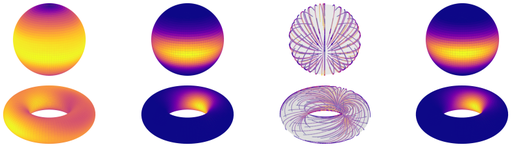
Figure 2 . Optimal transport on S 2 (top) and T 2 (bottom) from a representative run corresponding to Tables 1 and 2, respectively. From left to right: uniform source µ, wrapped normal target ν, geodesic trajectories induced by the learned transport T, and pushforward T#µ.
원문 · CC BY 4.0 · Micheli, Alessandro, Cao, Yueqi, Monod, Anthea, Bhatt, Samir · Riemannian Neural Optimal Transport · 원문 그림 인용 · 원본 PDF 7쪽에서 그림 영역을 추출했습니다.연속 근사와 다항 복잡도 주장
논문은 비선형 조각별 선형 활성화에 대해 Theorem 5.1로 매끄러운 함수의 균일 근사 복잡도를 제시하고, Corollary 5.2로 이를 c-변환을 거쳐 OT 포텐셜 근사로 확장합니다. 그 결과 매개변수 수와 깊이는 ε^{-1}의 다항식으로 주어집니다. Theorem 5.3은 포텐셜의 균일 근사로부터 µ에 대해 거의 확실한 점별 수송 사상 오차 O(√ε)를 얻는다고 밝힙니다. 이 결과들은 µ가 vol_M에 절대연속이고 피처 맵이 연속·단사라는 가정 아래 성립하며, 이 조건 밖의 일반적 결론으로 확장되지 않습니다.
실세계 및 합성 실험 결과
대륙 이동 사례에서 RNOT(FPS)는 KL 0.03±0.00, ESS 0.97±0.00을 보고하며, RCPM은 KL 0.0037±0.0008, ESS 0.996±0.000으로 KL과 ESS 모두 더 좋은 값을 보입니다. T^2 실험에서는 RNOT(FPS)가 KL 0.13±0.01, ESS 0.93±0.01을 보이고, RCPM은 KL 0.93±0.02, ESS 0.55±0.03을 보입니다. 차원 스윕에서 RCPM의 KL은 차원이 커질수록 악화되며 작은 γ에서 특히 두드러지고, RNOT는 시험 범위에서 대체로 평탄하다고 보고됩니다. 이 결과들은 5회 독립 실행과 1024개 샘플 조건에서의 관찰이며, 모든 설정에서 RNOT가 우세하다는 뜻은 아닙니다.
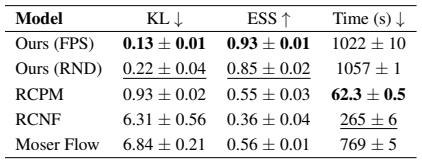
Table 2 .KL divergence and ESS on T2 across methods. Bold denotes the best result (up to statistical significance), and under- lining denotes the second best. Reported values are means with confidence intervals over 5 independent runs.
원문 · CC BY 4.0 · Micheli, Alessandro, Cao, Yueqi, Monod, Anthea, Bhatt, Samir · Riemannian Neural Optimal Transport · 원문 그림 인용 · 원본 PDF 8쪽에서 그림 영역을 추출했습니다.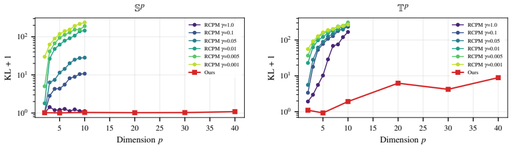
Figure 5 .KL divergence scaling with dimension on high-dimensional manifolds. We compare our approach against RCPMs with varying regularization parameters γ∈ {0.001,0.005,0.01,0.05,0.1,1.0} . RCPM results are shown for p∈ {2, . . . ,10}only due to computational intractability at higher dimensions, while our method extends to p= 40 . Our method achieves consistently lower KL divergence across all tested dimensions and scales favorably to high-dimensional settings, empirically supporting our theoretical results.
원문 · CC BY 4.0 · Micheli, Alessandro, Cao, Yueqi, Monod, Anthea, Bhatt, Samir · Riemannian Neural Optimal Transport · 원문 그림 인용 · 원본 PDF 30쪽에서 그림 영역을 추출했습니다.한계와 측정상의 주의
저자들은 논문이 컴팩트 다양체에 초점을 맞추며, 근사율에 정칙성 가정이 필요하고, 내부 최소화 때문에 학습 비용이 크다고 밝힙니다. 또한 KL 추정은 로그 밀도와 야코비안 행렬식을 결합하므로 수치적으로 민감하며, 유한 N에서 음수 추정이 나올 수 있다고 보고합니다. 따라서 KL은 학습 목표가 아니라 진단 요약으로 해석됩니다. 절제 실험에서는 FPS 선택과 LogSumExp 초기화의 영향이 크다고 보고되어, 설정에 따른 성능 민감도도 함께 고려해야 합니다.
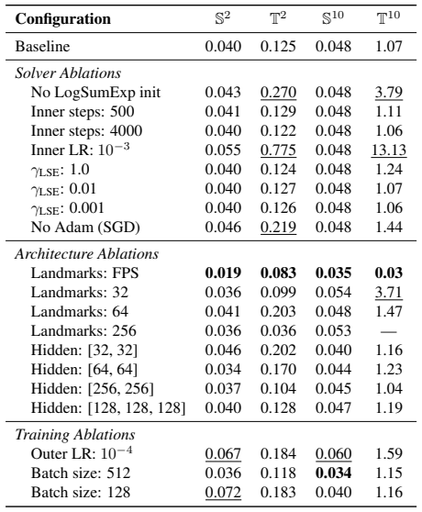
Table 3 .Ablation study results showing KL divergence ( ↓) across manifolds. Bold indicates best result; underline indicates >50% degradation from baseline. All results averaged over 5 evaluation batches of 1024 samples.
원문 · CC BY 4.0 · Micheli, Alessandro, Cao, Yueqi, Monod, Anthea, Bhatt, Samir · Riemannian Neural Optimal Transport · 원문 그림 인용 · 원본 PDF 30쪽에서 그림 영역을 추출했습니다.논문 정보
- 저자
- Micheli, Alessandro, Cao, Yueqi, Monod, Anthea, Bhatt, Samir
- 학회·저널
- arXiv · 프리프린트
- 최초 공개일
- 2026년 2월 3일
- 등록일
- 2026년 10월 30일
- 수정일
- 2026년 2월 3일
- 버전
- v1
- arXiv
- 2602.03566
- 원문 이용 조건
- CC BY 4.0
- 제공 범위
- 논문 정보, 해설, 허용된 원문 그림
AI 해설은 논문 원문과 별개의 설명이며 오류가 있을 수 있습니다. 원문과 그림은 각 출처의 이용 조건과 따로 표시된 권리를 따릅니다.
초록
Computational optimal transport (OT) offers a principled framework for generative modeling. Neural OT methods, which use neural networks to learn an OT map (or potential) from data in an amortized way, can be evaluated out of sample after training, but existing approaches are tailored to Euclidean geometry. Extending neural OT to high-dimensional Riemannian manifolds remains an open challenge. In this paper, we prove that any method for OT on manifolds that produces discrete approximations of transport maps necessarily suffers from the curse of dimensionality: achieving a fixed accuracy requires a number of parameters that grows exponentially with the manifold dimension. Motivated by this limitation, we introduce Riemannian Neural OT (RNOT) maps, which are continuous neural-network parameterizations of OT maps on manifolds that avoid discretization and incorporate geometric structure by construction. Under mild regularity assumptions, we prove that RNOT maps approximate Riemannian OT maps with sub-exponential complexity in the dimension. Experiments on synthetic and real datasets demonstrate improved scalability and competitive performance relative to discretization-based baselines.
원문 인용
Micheli, Alessandro, Cao, Yueqi, Monod, Anthea, Bhatt, Samir (2026). Riemannian Neural Optimal Transport. arXiv:2602.03566v1. https://arxiv.org/abs/2602.03566v1
BibTeX
@misc{alessandro2026riemannian,
  title = {{Riemannian Neural Optimal Transport}},
  author = {Micheli, Alessandro and Cao, Yueqi and Monod, Anthea and Bhatt, Samir},
  year = {2026},
  eprint = {2602.03566},
  archivePrefix = {arXiv},
  url = {https://arxiv.org/abs/2602.03566v1}
}