논문 해설
Accelerating Linear Recurrent Neural Networks for the Edge with Unstructured Sparsity
비구조적 희소성을 이용한 엣지용 선형 순환 신경망 가속
- 연구 문제 비정형 희소성과 저정밀 양자화를 결합한 선형 RNN을 에지 환경에서 효율적으로 실행할 수 있는지 확인합니다.
- 연구 방법 S5 기반 선형 RNN을 반복 가지치기, ReLU화, 양자화 인식 학습으로 희소·저정밀화하고 Loihi 2의 고정소수점 실행으로 옮깁니다.
- 주요 결과 같은 정확도에서 희소 모델은 밀집 모델보다 적은 연산과 메모리를 요구하며, Loihi 2 실행은 Jetson Orin Nano 대비 토큰당 지연과 에너지에서 큰 이득을 보고합니다.
선형 RNN을 에지에서 가속하는 문제
선형 순환 신경망(Linear RNN)은 추론 시 메모리가 시퀀스 길이와 무관하게 일정하고 토큰당 연산이 일정하게 유지되어, 스트리밍 오디오처럼 긴 시퀀스를 에지 기기에서 처리하기에 적합합니다. 그러나 자원이 제한된 환경에서 배포하려면 지연 시간과 에너지를 줄이는 하드웨어 인지형 최적화가 필요합니다. 본 논문은 비정형 희소성(unstructured sparsity)이 이 목적에 유망하지만, 이를 가속할 수 있는 하드웨어에서만 이득이 실현된다는 점을 문제의 출발점으로 삼습니다. 따라서 연구의 범위는 희소화된 선형 RNN의 성능-효율 경계를 탐색하고, 이를 고정소수점으로 양자화해 Loihi 2 뉴로모픽 칩에서 실행했을 때의 이득을 확인하는 데 있습니다.
희소화, ReLU화, 양자화의 결합 방법
기반 모델은 S5 구조의 선형 RNN입니다. 상태 갱신은 대각 순환 가중치와 Hadamard 곱으로 이루어지며, 출력 뒤에는 GLU 블록이 채널 혼합을 담당합니다. 희소 모델을 만들기 위해 사전 학습된 밀집 모델에서 시작해 반복적 크기 기반 가지치기(iterative magnitude pruning)를 적용합니다. 희소도는 3차 다항식 스케줄로 증가하며, 층별 희소도는 ERK 방식으로 나눕니다. 마스크된 가중치는 순전파에서 mask와 곱해 사용되고, 역전파에서는 직선 추정(straight-through estimation)으로 기울기를 전달합니다. 활성 희소성을 위해 GLU의 GELU를 ReLU로 바꾸고, 잔차 덧셈 뒤와 S5 은닉 층의 실수 성분에 ReLU를 추가합니다.
이 수정은 가지치기 절차를 시작하기 전에 pre-training 모델에 적용됩니다. 양자화는 양자화 인식 학습(QAT)과 정적 양자화를 사용하며, 가중치는 8비트, 대각 순환 가중치는 16비트, 활성값은 16비트로 두는 W8A16 설정을 씁니다. 정적 양자화는 스케일을 미리 고정해 정수 연산만으로 순전파를 구성하게 합니다.
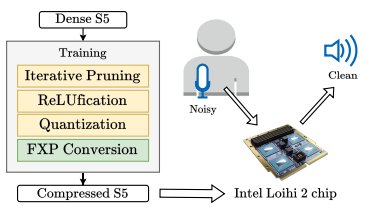
Figure 1 . Model compression and acceleration pipeline for linear RNNs, tailored to the Intel Loihi 2 chip.
원문 · CC BY 4.0 · Alessandro Pierro, Steven Abreu, Jonathan Timcheck, Philipp Stratmann, Andreas Wild, Sumit Bam Shrestha · Accelerating Linear Recurrent Neural Networks for the Edge with Unstructured Sparsity · 원문 그림 인용 · 원본 PDF 1쪽에서 그림 영역을 추출했습니다.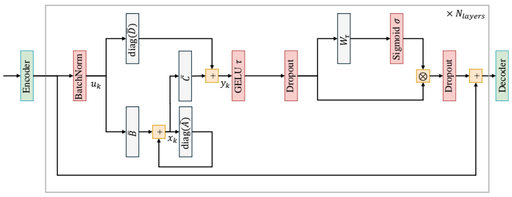
Figure 2 . Overview of the S5 architecture. Symbols are shown as defined by equations in Section 2.1.
원문 · CC BY 4.0 · Alessandro Pierro, Steven Abreu, Jonathan Timcheck, Philipp Stratmann, Andreas Wild, Sumit Bam Shrestha · Accelerating Linear Recurrent Neural Networks for the Edge with Unstructured Sparsity · 원문 그림 인용 · 원본 PDF 2쪽에서 그림 영역을 추출했습니다.Loihi 2 위의 S5 구현
Loihi 2는 복소수를 기본적으로 지원하지 않으므로, 복소 행렬 B와 C는 각각 두 개의 시냅스 층으로 나뉘고 복소 상태는 두 개의 뉴런 상태로 저장됩니다. 원소별 연산인 ReLU, BatchNorm, Hadamard 곱, 잔차 덧셈, 대각 행렬 곱은 뉴런 층에 융합되어 구현됩니다. 이 방식으로 인코더, 디코더, 각 S5 블록에 필요한 뉴런 그룹이 정해집니다.
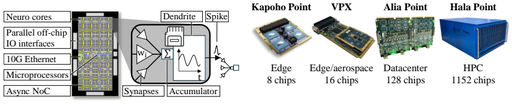
Figure 3 . (a) Loihi 2 implements a network of neurons, which are processed by neuro-cores and communicate via an asynchronous network-on-chip. Parallel IO and 10 GbitEthernet interfaces enable a Loihi 2 chip to communicate with other Loihi 2 chips and external hosts, respectively. Embedded microprocessors provide a flexible method of interaction with neuro-core registers, management, and communication. On a neuro-core, each neuron receives spike messages from other neurons via synapses with multiplicative weights wi, and sums them up by one or multiple dendritic accumulators. The input is used by a dendrite to update memory states that are local to the respective neuron. The neuron communicates with other neurons by sending spike messages. (b) Different Loihi 2 systems are available to cover a wide range of applications from the edge to HPC with up to 1 Bneurons.
원문 · CC BY 4.0 · Alessandro Pierro, Steven Abreu, Jonathan Timcheck, Philipp Stratmann, Andreas Wild, Sumit Bam Shrestha · Accelerating Linear Recurrent Neural Networks for the Edge with Unstructured Sparsity · 원문 그림 인용 · 원본 PDF 3쪽에서 그림 영역을 추출했습니다.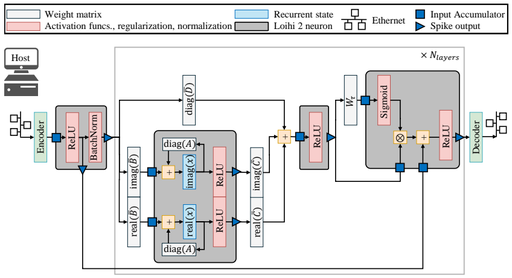
Figure 8 . Diagram of S5 as implemented on Loihi 2. To leverage the neuromorphic hardware architecture, several adjustments are made in comparison to the original S5 model shown in Figure 2: First, complex numbers are split into real and complex components for processing. Second, ReLUs are introduced to increase activation sparsity. Third, multiple element-wise operations are fused into single neuromorphic neurons. Symbols are shown as defined in Section 2.1.
원문 · CC BY 4.0 · Alessandro Pierro, Steven Abreu, Jonathan Timcheck, Philipp Stratmann, Andreas Wild, Sumit Bam Shrestha · Accelerating Linear Recurrent Neural Networks for the Edge with Unstructured Sparsity · 원문 그림 인용 · 원본 PDF 15쪽에서 그림 영역을 추출했습니다.음성 디노이징에서의 파레토 분석
실험은 Intel N-DNS Challenge의 음성 디노이징 과제에서 수행되며, 품질은 SI-SNR로 측정합니다. 밀집 모델군은 폭 스케일 k_dense가 0.25에서 1.0 사이이고, 희소 모델군은 k_sparse가 0.5에서 3.0 사이입니다. 희소 모델은 학습 종료 시 가중치의 90%를 가지치기하며, 모든 모델은 S5 층 3개와 50 epoch 학습을 사용합니다. 계산량은 effective MACs로, 메모리는 메모리 사용량으로 측정합니다. 결과에서 희소화를 과소 파라미터화된 밀집 모델에 적용하면 성능이 떨어지지만, 모델 차원을 키우면 희소 모델이 밀집 모델과 같은 정확도를 더 적은 MAC과 메모리로 달성합니다.
같은 정확도 수준에서 sparse-8 모델은 dense-3 모델보다 2배 적은 연산과 36% 낮은 메모리를 보입니다. 저자들은 이를 희소-광폭 네트워크의 용량에 관한 이론적 연구와 일치하는 실험적 증거로 해석합니다. 또한 sparse-11 S5 모델은 Spiking-FullSubNet-XL 대비 3.2배 적은 연산과 5.37배 낮은 메모리를 요구한다고 보고됩니다. 토론 절은 같은 접근의 메모리 절감을 5.7배로 요약하며, 결과 절의 5.37배 보고와 표기가 다르므로 두 값을 구분해 읽어야 합니다.
Loihi 2와 Jetson Orin Nano의 지연 및 에너지 비교
양자화된 희소 S5 모델은 Loihi 2에서 실행되고, 같은 테스트 성능에 도달하는 더 작은 밀집 모델은 Jetson Orin Nano에서 FP32로 실행됩니다. 토큰 단위 fall-through 모드에서 Loihi 2는 한 STFT 프레임을 35배 빠르게, 1200배 적은 에너지로 처리합니다. 실시간 조건인 지연 8 ms 이하를 만족하는 최대 청크에서는 Loihi 2가 토큰당 지연에서 42배, 에너지에서 149배 유리하다고 보고됩니다. 이 비교는 정밀도가 다르다는 점을 함께 읽어야 하며, Jetson 구현은 FP32이고 Loihi 2 구현은 W8A16입니다.
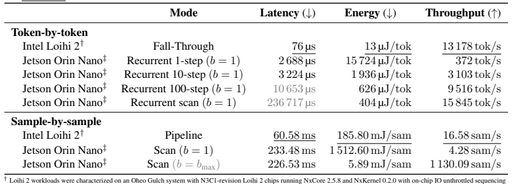
Table 1 . Power and performance results∗. The Loihi 2 is running a sparse and quantized S5 model, while the Jetson Orin Nano is running a smaller dense S5 model that reaches similar test performance. All measurements are averaged over 8 random samples from the test set, each containing 3 750time steps. Gray highlights denote violation of real-time constraints for the audio denoising task. Best real-time results are underlined.
원문 · CC BY 4.0 · Alessandro Pierro, Steven Abreu, Jonathan Timcheck, Philipp Stratmann, Andreas Wild, Sumit Bam Shrestha · Accelerating Linear Recurrent Neural Networks for the Edge with Unstructured Sparsity · 원문 그림 인용 · 원본 PDF 8쪽에서 그림 영역을 추출했습니다.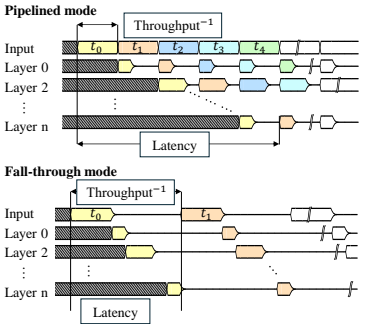
Figure 10 . (a) Loihi 2 offers two processing modes that optimize either throughput or latency. In the pipelined mode, a new data point is inserted in each time step, to use all processing cores and maximize the throughput–at the expense of latency because equal time bins t0 = t1 = . . .are enforced. In the fall-through mode, a new data points is only provided once the last data point has been fully processed with minimum latency. Only a single neuronal layer is active at any step as data travels through the network. The time per step is thus minimized as traffic is reduced and potentially more complex neuronal layers are not updated. (b) Comparison of execution mode and time per step.
원문 · CC BY 4.0 · Alessandro Pierro, Steven Abreu, Jonathan Timcheck, Philipp Stratmann, Andreas Wild, Sumit Bam Shrestha · Accelerating Linear Recurrent Neural Networks for the Edge with Unstructured Sparsity · 원문 그림 인용 · 원본 PDF 17쪽에서 그림 영역을 추출했습니다.고정소수점 변환의 정확도 차이
양자화 인식 학습은 학습 후 양자화와 비교해 정적 양자화 이후 테스트 SI-SNR을 더 잘 유지합니다. 그러나 정수 연산으로 구현한 FXP 시뮬레이션과 Loihi 2 실행에서는 추가 저하가 관찰됩니다. 원문은 이 차이를 Loihi 2에서 융합 층의 정수 연산 차이와 오버플로 처리 방식의 차이에서 비롯될 가능성으로 설명합니다. FXP 시뮬레이션은 최댓값으로 제한하는 방식을 쓰고, Loihi 2는 값을 감싸는 방식을 씁니다. 층 깊이에 따라 평균 오차가 커지는 경향도 보고되어, 깊은 선형 RNN의 고정소수점 충실도는 추가 완화 기법이 필요할 수 있습니다.
적용 범위와 한계
Jetson Orin Nano 구현은 FP32로 실행되고 Loihi 2 구현은 W8A16로 실행되므로, 에너지와 지연 비교에는 정밀도 차이가 포함되어 있습니다. 또한 더 큰 모델과 언어 또는 다중모달 과제로의 확장은 본 논문에서 검증되지 않았으며 향후 과제로 제시됩니다. 키워드 스포팅 확장 실험에서는 희소 모델이 같은 정확도 수준에서 비슷한 경향을 보였지만, 더 높은 정확도에서 밀집 모델과 비교하려면 희소 모델군의 추가 확장이 필요합니다.
논문 정보
- 저자
- Alessandro Pierro, Steven Abreu, Jonathan Timcheck, Philipp Stratmann, Andreas Wild, Sumit Bam Shrestha
- 학회·저널
- arXiv · 프리프린트
- 최초 공개일
- 2025년 2월 3일
- 등록일
- 2026년 10월 30일
- 수정일
- 2025년 8월 13일
- 버전
- v2
- arXiv
- 2502.01330
- 분류
- cs.LG · cs.NE
- 원문 이용 조건
- CC BY 4.0
- 제공 범위
- 논문 정보, 해설, 허용된 원문 그림
AI 해설은 논문 원문과 별개의 설명이며 오류가 있을 수 있습니다. 원문과 그림은 각 출처의 이용 조건과 따로 표시된 권리를 따릅니다.
초록
Linear recurrent neural networks enable powerful long-range sequence modeling with constant memory usage and time-per-token during inference. These architectures hold promise for streaming applications at the edge, but deployment in resource-constrained environments requires hardware-aware optimizations to minimize latency and energy consumption. Unstructured sparsity offers a compelling solution, enabling substantial reductions in compute and memory requirements--when accelerated by compatible hardware platforms. In this paper, we conduct a scaling study to investigate the Pareto front of performance and efficiency across inference compute budgets. We find that highly sparse linear RNNs consistently achieve better efficiency-performance trade-offs than dense baselines, with 2x less compute and 36% less memory at iso-accuracy. Our models achieve state-of-the-art results on a real-time streaming task for audio denoising. By quantizing our sparse models to fixed-point arithmetic and deploying them on the Intel Loihi 2 neuromorphic chip for real-time processing, we translate model compression into tangible gains of 42x lower latency and 149x lower energy consumption compared to a dense model on an edge GPU. Our findings showcase the transformative potential of unstructured sparsity, paving the way for highly efficient recurrent neural networks in real-world, resource-constrained environments.
원문 인용
Alessandro Pierro, Steven Abreu, Jonathan Timcheck, Philipp Stratmann, Andreas Wild, Sumit Bam Shrestha (2025). Accelerating Linear Recurrent Neural Networks for the Edge with Unstructured Sparsity. arXiv:2502.01330v2. https://arxiv.org/abs/2502.01330v2
BibTeX
@misc{pierro2025accelerating,
  title = {{Accelerating Linear Recurrent Neural Networks for the Edge with Unstructured Sparsity}},
  author = {Alessandro Pierro and Steven Abreu and Jonathan Timcheck and Philipp Stratmann and Andreas Wild and Sumit Bam Shrestha},
  year = {2025},
  eprint = {2502.01330},
  archivePrefix = {arXiv},
  url = {https://arxiv.org/abs/2502.01330v2}
}