논문 해설
DataDecide: How to Predict Best Pretraining Data with Small Experiments
DataDecide: 작은 실험으로 최적의 pre-training 데이터를 예측하는 방법
- 연구 문제 작은 규모의 pre-training 실험으로 큰 모델에서 더 좋은 데이터를 고를 수 있는지 측정합니다.
- 연구 방법 25개 데이터 레시피와 14개 모델 규모를 통제 학습하고, 단일 규모 순위와 스케일링 법칙 예측의 쌍별 결정 정확도를 비교합니다.
- 주요 결과 작은 규모 순위는 목표 1B 규모 예측의 강한 기준선이며, 8개 스케일링 법칙 기준선은 이를 넘지 못합니다. 연속 우도 지표는 여러 코드·지식 과제의 예측을 개선합니다.
데이터 선택을 작은 실험으로 예측하는 문제
대규모 언어 모델은 pre-training 데이터에 따라 성능이 크게 달라지지만, 데이터 구성마다 큰 모델을 처음부터 학습하는 비용은 매우 큽니다. 그래서 실무에서는 작은 규모의 실험 결과로 어떤 데이터가 큰 모델에서 더 좋을지 판단합니다. 이 논문은 이 판단이 실제로 얼마나 정확한지를 측정하기 어렵다는 점을 문제로 삼습니다. 기존 접근은 작은 규모에서 여러 데이터 레시피를 비교하는 방식과, 여러 규모의 결과에 스케일링 법칙을 맞춰 목표 규모를 외삽하는 방식으로 나뉩니다. DATADECIDE는 25개 pre-training 데이터 레시피와 14개 모델 규모, 3개의 랜덤 시드를 통제 조건에서 학습하여 이 예측의 정확도를 쌍별 결정 정확도로 직접 측정합니다.
목표 규모는 1B 매개변수이며, 작은 규모 예측이 그 목표 승자를 얼마나 맞히는지가 핵심 질문입니다.
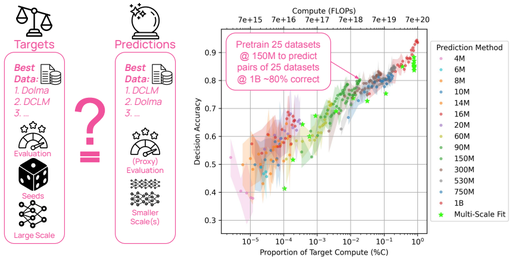
Figure 1 . Which pretraining data to use? Ideally, compare performance of large models with fixed configurations averaged over random seeds (left). In practice, cheaper, smaller-scale experiments are used (center). Here DATADECIDE measures accuracy of pairwise decisions between 25 pretraining corpora to find efficient prediction methods (right).
원문 · CC BY 4.0 · Ian Magnusson, Nguyen Tai, Ben Bogin, David Heineman, Jena D. Hwang, Luca Soldaini, Akshita Bhagia, Jiacheng Liu, Dirk Groeneveld, Oyvind Tafjord, Noah A. Smith, Pang Wei Koh, Jesse Dodge · DataDecide: How to Predict Best Pretraining Data with Small Experiments · 원문 그림 인용 · 원본 PDF 2쪽에서 그림 영역을 추출했습니다.DATADECIDE 스위트와 두 예측 방법
DATADECIDE는 25개 데이터 레시피를 각각 14개 모델 규모로 학습한 스위트입니다. 모델 설정은 OLMo 모델 사다리로 생성되며, 토큰 대 매개변수 비율은 100으로 고정됩니다. 1B 규모의 모델은 3개 시드로 끝까지 학습하고, 그 밖의 규모의 추가 시드는 목표 컴퓨트의 25%에서 조기 종료합니다. 첫 번째 예측 방법은 단일 규모 순위입니다. 하나의 작은 규모에서 데이터 레시피를 비교하고, 그 규모의 우수한 레시피가 목표 규모에서도 우수하다고 가정합니다. 두 번째 방법은 여러 규모에 스케일링 법칙을 맞추는 방식입니다. 첫 단계는 컴퓨트 C에서 손실 L을 예측하는 L(C)=A·C^α+E 형태이며 최종 체크포인트에 맞춥니다.
둘째 단계는 손실에서 과제 정확도로 가는 시그모이드 함수입니다. 결정 정확도는 레시피 쌍 (A,B)에서 예측값의 대소 방향 sign(ŷA−ŷB)이 목표 평균 성능의 대소 방향 sign(yA−yB)과 같은 비율이며, 목표 승자는 3개 시드의 평균으로 정의됩니다.
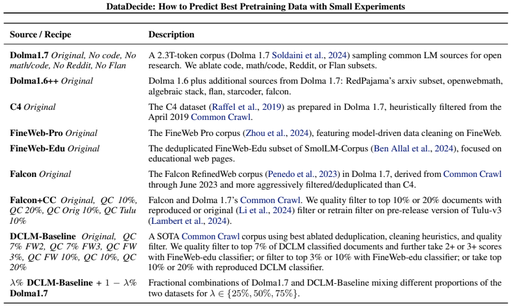
Table 1 . DATADECIDE enables the study of data differences over scales through controlled pretraining experiments on 25 data recipes. These take different source datasets and apply interventions from ablating domains, deduplication, mixing, to quality filtering with different classifiers and thresholds. We release all pretraining corpora, as well as models trained on each recipe and each of the 14 model configurations in Table 2 with 3 random seeds.
원문 · CC BY 4.0 · Ian Magnusson, Nguyen Tai, Ben Bogin, David Heineman, Jena D. Hwang, Luca Soldaini, Akshita Bhagia, Jiacheng Liu, Dirk Groeneveld, Oyvind Tafjord, Noah A. Smith, Pang Wei Koh, Jesse Dodge · DataDecide: How to Predict Best Pretraining Data with Small Experiments · 원문 그림 인용 · 원본 PDF 3쪽에서 그림 영역을 추출했습니다.연속 우도 대리 지표와 과제별 예측 가능성
작은 규모에서는 OLMES의 이산 정확도가 목표 규모의 신호를 충분히 드러내지 못할 수 있어, 저자들은 연속 우도 기반 대리 지표를 시험합니다. CORRECT PROB는 정답 연속의 평균 확률이고, TOTAL PROB는 정답과 오답 연속 전체의 확률 합에 대한 평균입니다. 이 지표들은 작은 규모에서 이산 ACCURACY나 MARGIN, NORM CORRECT PROB보다 결정 정확도가 같거나 더 나은 경우가 많다고 보고됩니다. 특히 CORRECT PROB를 사용하면 MBPP와 HumanEval 같은 코드 과제의 목표 규모 결정 예측이 크게 개선되어 80%에 도달합니다. 같은 지표 전환으로도 수학 과제는 개선되지 않는다고 보고됩니다.
과제별로는 MMLU와 ARC가 HellaSwag보다 적은 컴퓨트로 예측 가능하며, 일부 과제는 모든 규모에서 예측하기 어렵습니다.
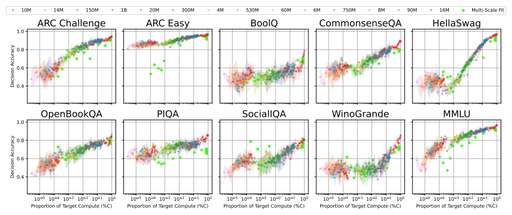
Figure 2 . Accuracy in pairwise decisions on best data when evaluating on the 10 OLMES tasks with ACCURACY (shown aggregated in Figure 1). Specific tasks have very distinct ranges of sensitivity, with some like ARC Easy being predictable at small scales and others like HellaSwag requiring substantially more compute to predict.
원문 · CC BY 4.0 · Ian Magnusson, Nguyen Tai, Ben Bogin, David Heineman, Jena D. Hwang, Luca Soldaini, Akshita Bhagia, Jiacheng Liu, Dirk Groeneveld, Oyvind Tafjord, Noah A. Smith, Pang Wei Koh, Jesse Dodge · DataDecide: How to Predict Best Pretraining Data with Small Experiments · 원문 그림 인용 · 원본 PDF 6쪽에서 그림 영역을 추출했습니다.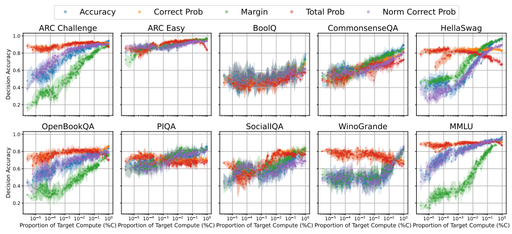
Figure 4 . Per-task decision accuracy using character normalized proxy metrics for ACCURACY targets. 5 tasks benefit at smaller scales from using raw likelihood of answers (CORRECT PROB and TOTAL PROB), as opposed to discrete ACCURACY or continuous metrics that penalize probability on incorrect answers (NORM CORRECT PROB, MARGIN ).
원문 · CC BY 4.0 · Ian Magnusson, Nguyen Tai, Ben Bogin, David Heineman, Jena D. Hwang, Luca Soldaini, Akshita Bhagia, Jiacheng Liu, Dirk Groeneveld, Oyvind Tafjord, Noah A. Smith, Pang Wei Koh, Jesse Dodge · DataDecide: How to Predict Best Pretraining Data with Small Experiments · 원문 그림 인용 · 원본 PDF 8쪽에서 그림 영역을 추출했습니다.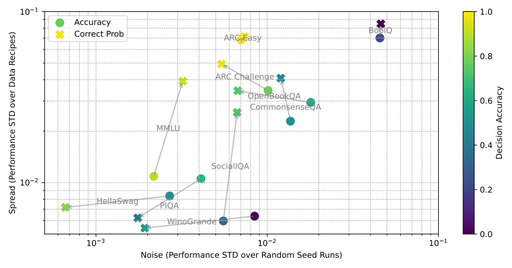
Figure 5 . Why do some tasks or metrics get better or worse decision accuracy? At 150M with CORRECT PROB tasks like HellaSwag succeed with low run-to-run variance and tasks like SocialIQA widely spread the performance assigned to different pretraining data.
원문 · CC BY 4.0 · Ian Magnusson, Nguyen Tai, Ben Bogin, David Heineman, Jena D. Hwang, Luca Soldaini, Akshita Bhagia, Jiacheng Liu, Dirk Groeneveld, Oyvind Tafjord, Noah A. Smith, Pang Wei Koh, Jesse Dodge · DataDecide: How to Predict Best Pretraining Data with Small Experiments · 원문 그림 인용 · 원본 PDF 8쪽에서 그림 영역을 추출했습니다.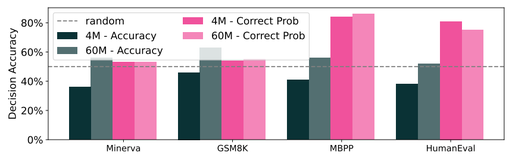
Figure 6 . Code tasks such as humaneval and MBPP go from trivial decision accuracy to largely predictable when using using continuous CORRECT PROB instead of discrete ACCURACY . Meanwhile common math tasks remain near trivial decision accuracy regardless of metric.
원문 · CC BY 4.0 · Ian Magnusson, Nguyen Tai, Ben Bogin, David Heineman, Jena D. Hwang, Luca Soldaini, Akshita Bhagia, Jiacheng Liu, Dirk Groeneveld, Oyvind Tafjord, Noah A. Smith, Pang Wei Koh, Jesse Dodge · DataDecide: How to Predict Best Pretraining Data with Small Experiments · 원문 그림 인용 · 원본 PDF 9쪽에서 그림 영역을 추출했습니다.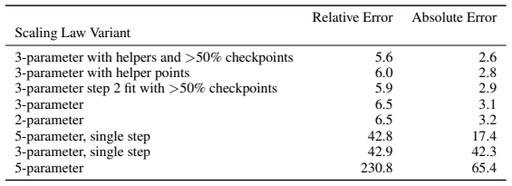
Table 3 . Proxy metrics used as alternative inputs to our prediction methods, C (i) is the set of possible continuations for item i and N is the number of items in a benchmark. Each each of the first 5 metrics have * per token and * per char variants in which likelihoods are normalized as defined in the bottom two rows.
원문 · CC BY 4.0 · Ian Magnusson, Nguyen Tai, Ben Bogin, David Heineman, Jena D. Hwang, Luca Soldaini, Akshita Bhagia, Jiacheng Liu, Dirk Groeneveld, Oyvind Tafjord, Noah A. Smith, Pang Wei Koh, Jesse Dodge · DataDecide: How to Predict Best Pretraining Data with Small Experiments · 원문 그림 인용 · 원본 PDF 15쪽에서 그림 영역을 추출했습니다.스케일링 법칙과 단일 규모 순위의 비교
8개의 스케일링 법칙 기준선은 단일 규모 순위가 만든 컴퓨트 대 결정 정확도 경계를 넘지 않습니다. 다중 규모 예측은 사용한 모델 규모의 학습 비용을 컴퓨트 예산으로 계산하며, 첫 단계 적합에 최종 체크포인트가 필요하므로 이 변형들은 기본 시드 하나로 한 번씩 예측합니다. 3개 매개변수 기준선과 2개 매개변수 변형은 상위권에 있었지만, 단일 규모 순위의 기준선을 넘지는 못했습니다. 원문은 크로스오버, 즉 한 레시피가 다른 레시피를 추월하는 현상이 이 방법의 정확도 상한을 제한할 수 있다고 설명합니다. 한편 작은 규모의 단일 순위가 높은 기준선을 제공한다는 점은 크로스오버가 자주 일어나지 않았음을 시사합니다.
이 비교는 저자들이 해석한 범위이며, 스케일링 법칙 연구 전체의 한계를 증명하는 결과가 아닙니다.
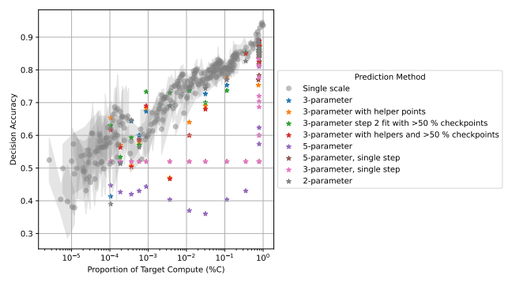
Figure 3 . Decision accuracy over 8 baseline scaling law variants. At best, these approaches reach only the same compute to decision accuracy frontier as ranking single scale experiments. DATADECIDE can be used to iterate on future scaling law prediction methods.
원문 · CC BY 4.0 · Ian Magnusson, Nguyen Tai, Ben Bogin, David Heineman, Jena D. Hwang, Luca Soldaini, Akshita Bhagia, Jiacheng Liu, Dirk Groeneveld, Oyvind Tafjord, Noah A. Smith, Pang Wei Koh, Jesse Dodge · DataDecide: How to Predict Best Pretraining Data with Small Experiments · 원문 그림 인용 · 원본 PDF 6쪽에서 그림 영역을 추출했습니다.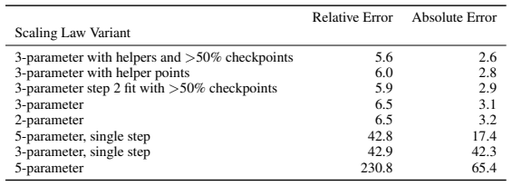
Table 4 . Average prediction error for 1B targets for the different scaling law setups across tasks and recipes on ACCURACY fit to all models but 1B. We see that other than the single step and 5-parameter variants errors are comparable, and these variants also roughly follow the compute-decision frontier in Figure 3.
원문 · CC BY 4.0 · Ian Magnusson, Nguyen Tai, Ben Bogin, David Heineman, Jena D. Hwang, Luca Soldaini, Akshita Bhagia, Jiacheng Liu, Dirk Groeneveld, Oyvind Tafjord, Noah A. Smith, Pang Wei Koh, Jesse Dodge · DataDecide: How to Predict Best Pretraining Data with Small Experiments · 원문 그림 인용 · 원본 PDF 15쪽에서 그림 영역을 추출했습니다.적용 범위와 남은 질문
이 연구는 토큰 대 매개변수 비율을 100 하나로 제한하며, 이는 5배 Chinchilla 최적 비율로 설명됩니다. 14개 설정은 4M에서 1B 매개변수 범위에서 선택된 것이고, 25개 레시피는 이전 스위트보다 많지만 모든 미래 데이터 레시피를 대표한다고 보장되지는 않습니다. 평가는 cloze 형식의 객관식 과제에 한정됩니다. 또한 1B 규모의 목표 결과는 3개 시드의 평균으로 정의되므로, 이 목표 정의가 다른 정답 기준에서도 같은 순위를 준다고 말할 수는 없습니다. 수학 과제에서는 연속 지표 전환이 결정 정확도를 높이지 못했으며, 그 이유는 이 연구에서 해결되지 않았습니다.
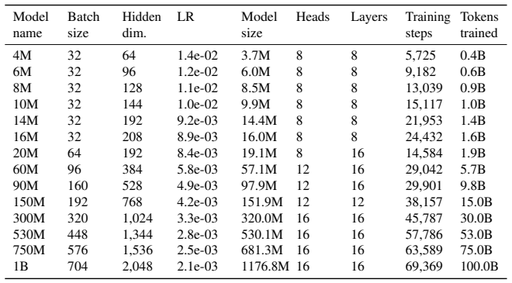
Table 2 . DATADECIDE uses OLMo’s model ladder (Groeneveld et al., 2024; OLMo et al., 2025; Bhagia et al., 2024) to programmatically create configurations for 14 model sizes with hyperparameters determined by heuristics in Porian et al. (2024). All models have sequence length of 2024 and MLP ratio of 8. Each configuration is pretrained over 25 data recipes (Table 1). Each recipe and configuration is also trained for 3 random seeds where model sizes < 1B are stopped early at 25% of the compute used to train the 1B model for all but the default seed. Model size is number of non-embedding parameters. Batch size is the number of sequences per batch.
원문 · CC BY 4.0 · Ian Magnusson, Nguyen Tai, Ben Bogin, David Heineman, Jena D. Hwang, Luca Soldaini, Akshita Bhagia, Jiacheng Liu, Dirk Groeneveld, Oyvind Tafjord, Noah A. Smith, Pang Wei Koh, Jesse Dodge · DataDecide: How to Predict Best Pretraining Data with Small Experiments · 원문 그림 인용 · 원본 PDF 15쪽에서 그림 영역을 추출했습니다.논문 정보
- 저자
- Ian Magnusson, Nguyen Tai, Ben Bogin, David Heineman, Jena D. Hwang, Luca Soldaini, Akshita Bhagia, Jiacheng Liu, Dirk Groeneveld, Oyvind Tafjord, Noah A. Smith, Pang Wei Koh, Jesse Dodge
- 학회·저널
- arXiv · 프리프린트
- 최초 공개일
- 2025년 4월 15일
- 등록일
- 2026년 10월 31일
- 수정일
- 2025년 7월 13일
- 버전
- v2
- arXiv
- 2504.11393
- 분류
- cs.LG · cs.CL
- 원문 이용 조건
- CC BY 4.0
- 제공 범위
- 논문 정보, 해설, 허용된 원문 그림
AI 해설은 논문 원문과 별개의 설명이며 오류가 있을 수 있습니다. 원문과 그림은 각 출처의 이용 조건과 따로 표시된 권리를 따릅니다.
초록
Because large language models are expensive to pretrain on different datasets, using smaller-scale experiments to decide on data is crucial for reducing costs. Which benchmarks and methods of making decisions from observed performance at small scale most accurately predict the datasets that yield the best large models? To empower open exploration of this question, we release models, data, and evaluations in DataDecide -- the most extensive open suite of models over differences in data and scale. We conduct controlled pretraining experiments across 25 corpora with differing sources, deduplication, and filtering up to 100B tokens, model sizes up to 1B parameters, and 3 random seeds. We find that the ranking of models at a single, small size (e.g., 150M parameters) is a strong baseline for predicting best models at our larger target scale (1B) (~80% of com parisons correct). No scaling law methods among 8 baselines exceed the compute-decision frontier of single-scale predictions, but DataDecide can measure improvement in future scaling laws. We also identify that using continuous likelihood metrics as proxies in small experiments makes benchmarks including MMLU, ARC, HellaSwag, MBPP, and HumanEval >80% predictable at the target 1B scale with just 0.01% of the compute.
원문 인용
Ian Magnusson, Nguyen Tai, Ben Bogin, David Heineman, Jena D. Hwang, Luca Soldaini, Akshita Bhagia, Jiacheng Liu, Dirk Groeneveld, Oyvind Tafjord, Noah A. Smith, Pang Wei Koh, Jesse Dodge (2025). DataDecide: How to Predict Best Pretraining Data with Small Experiments. arXiv:2504.11393v2. https://arxiv.org/abs/2504.11393v2
BibTeX
@misc{magnusson2025datadecide,
  title = {{DataDecide: How to Predict Best Pretraining Data with Small Experiments}},
  author = {Ian Magnusson and Nguyen Tai and Ben Bogin and David Heineman and Jena D. Hwang and Luca Soldaini and Akshita Bhagia and Jiacheng Liu and Dirk Groeneveld and Oyvind Tafjord and Noah A. Smith and Pang Wei Koh and Jesse Dodge},
  year = {2025},
  eprint = {2504.11393},
  archivePrefix = {arXiv},
  url = {https://arxiv.org/abs/2504.11393v2}
}