논문 해설
ReviewMap: Mapping Evaluative Acts and Automation Boundaries in Peer-Review Comments
ReviewMap: 동료 심사 코멘트에서 평가 행위와 자동화 경계 매핑
- 연구 문제 동료 심사 댓글은 논문의 주장과 표준을 평가하는 행위와 기여의 가치를 판단하는 행위가 섞여 있어, 이를 구분하지 않은 기존 분류로는 LLM 자동화의 신뢰 범위를 측정하기 어렵습니다.
- 연구 방법 ReviewMap은 댓글을 ASM 또는 CAL로 분류한 뒤 행위에 따라 P1, P2, grounded 속성을 조건부로 붙이며, 세 개 모델의 3회 실행을 두 단계 투표로 집계합니다.
- 주요 결과 행위 분류는 모델 간 일치도가 높고 개발 세트에서 사람 기준과 Cohen's κ 0.633~0.686을 보였습니다. 속성 층은 일치도가 낮아 사람의 확인이 필요하며, Strengths의 CAL 비율은 Weaknesses보다 약 3배 높게 나타났습니다.
동료 심사 댓글의 두 가지 평가 행위
동료 심사 댓글은 논문이 무엇을 하는지 점검하는 행위와 그 논문이 왜 중요한지 판단하는 행위가 뒤섞여 있습니다. 예를 들어 어떤 실험에 적절한 기준선이 없다는 지적은 주장과 학계 기준에 대한 평가이고, 기여가 지나치게 점진적이라는 지적은 기여의 가치와 학회 적합성에 대한 판단입니다. 기존 분류 체계는 댓글의 주제, 화용적 행위, 품질 속성을 구분하지만 평가 행위 자체를 구분하지 않습니다. 이 논문은 이 공백을 메우기 위해 평가 행위를 명시적으로 구분하고, 대규모 언어모델이 그 구분을 얼마나 신뢰성 있게 수행하는지 측정하는 것을 목표로 합니다.
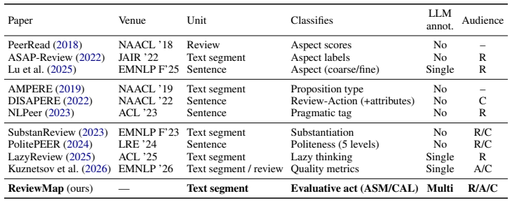
Table 1 : Selected review-text tasks; prior schemes do not distinguish assessment from calibration. Text segments cover study-specific spans, propositions, items, and comments, with differing boundaries (LazyReview: 1–5 sentences). LLM annotation counts generative models assigning the listed labels/scores, excluding models used only for preprocessing or performance comparison; Multi denotes consensus. Audience identifies roles explicitly addressed in task or use-case design: R = reviewer, A = author, C = chairs/editors; – = unspecified.
원문 · CC BY 4.0 · Kihyun Na, Injung Kim · ReviewMap: Mapping Evaluative Acts and Automation Boundaries in Peer-Review Comments · 원문 그림 인용 · 원본 PDF 3쪽에서 그림 영역을 추출했습니다.ReviewMap의 두 단계 구조
ReviewMap은 먼저 각 댓글을 평가(ASM), 교정(CAL), 또는 불확실(FLAG) 중 하나로 분류합니다. ASM은 주장이 뒷받침되는지, 분야의 표준을 충족하는지를 평가하고, CAL은 기여의 참신성, 중요성, 학회 적합성을 판단합니다. 이어서 두 번째 단계에서 행위에 따라 조건부 속성을 붙입니다. ASM 댓글에는 특정 논문 주장과 관련되는지(P1), 분야 표준과 관련되는지(P2)를 기록하고, CAL 댓글에는 판단이 명시적 근거로 뒷받침되는지(grounded)를 기록합니다. 두 속성 중 P1과 P2는 서로 독립적이며, grounded는 P2와 달리 판단의 정당화에 관한 속성입니다. 행위가 어느 쪽인지 분명하지 않으면 FLAG를 부여하며, FLAG 댓글에는 Level 2 속성이 없습니다.
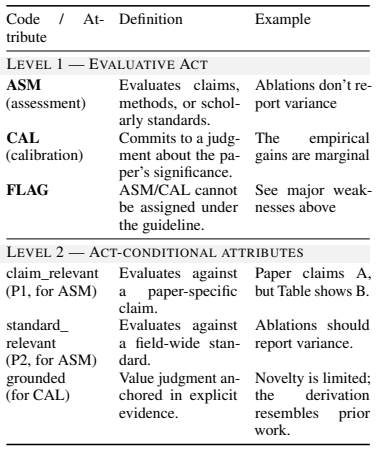
Table 2 : The ReviewMap framework. Level 1 classifies each comment by its evaluative act; Level 2 attaches binary attributes conditioned on the Level 1 act. Full op- erational definitions in Appendix A; corpus distribution and reliability in §5.
원문 · CC BY 4.0 · Kihyun Na, Injung Kim · ReviewMap: Mapping Evaluative Acts and Automation Boundaries in Peer-Review Comments · 원문 그림 인용 · 원본 PDF 4쪽에서 그림 영역을 추출했습니다.LLM 주석과 투표 집계
연구진은 500편의 ICLR 2026 논문에서 무작위 표본을 추출하고 댓글을 규칙 기반으로 나눠 총 17,654개 댓글을 얻었습니다. 주석은 Qwen 3.5, Gemma 4, Nemotron 3-Super 세 개의 공개 가중치 모델로 수행하며, 각 모델은 온도 0.6의 자기 일관성 샘플링으로 세 번 실행됩니다. 첫 단계에서는 각 모델의 세 실행 결과를 행위 최빈값으로 정하고, 속성은 같은 행위를 선택한 투표가 최소 두 개 일치할 때만 결정합니다. 두 번째 단계에서는 모델별 결과를 모델 간 투표로 합산하며, 같은 규칙을 적용합니다. 동률은 고정된 순서로 정하고 투표 수를 보존합니다. 따라서 하나의 유효한 속성 투표만으로는 최종 라벨이 결정되지 않으며, 동률이나 지지 부족은 미해결 상태로 남습니다.
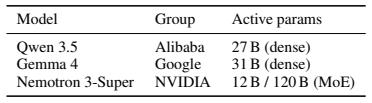
Table 3 : The three open-weight LLMs used for the corpus annotation, spanning three research groups.
원문 · CC BY 4.0 · Kihyun Na, Injung Kim · ReviewMap: Mapping Evaluative Acts and Automation Boundaries in Peer-Review Comments · 원문 그림 인용 · 원본 PDF 5쪽에서 그림 영역을 추출했습니다.
Table 11 : Final attribute counts. Coverage is the proportion of applicable fields resolved as yes or no. Unresolved P1/P2/grounding fields comprise 385/395/183 binary ties and 146/180/80 cases with insufficient support, respec- tively.
원문 · CC BY 4.0 · Kihyun Na, Injung Kim · ReviewMap: Mapping Evaluative Acts and Automation Boundaries in Peer-Review Comments · 원문 그림 인용 · 원본 PDF 18쪽에서 그림 영역을 추출했습니다.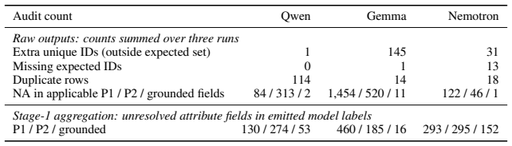
Table 17 : Raw-output quality and aggregation coverage have different units. Raw counts are summed across 3×17,654 expected comment–run opportunities per model (an extra ID can recur across runs); raw attribute-field counts follow last-row duplicate resolution. Stage-1 unresolved counts refer to one emitted label per expected comment and are deliberate abstentions, not raw-generation errors. Appendix D gives per-run and coverage denominators.
원문 · CC BY 4.0 · Kihyun Na, Injung Kim · ReviewMap: Mapping Evaluative Acts and Automation Boundaries in Peer-Review Comments · 원문 그림 인용 · 원본 PDF 20쪽에서 그림 영역을 추출했습니다.개발 세트 검증과 측정된 자동화 경계
행위 분류의 신뢰성은 470개 개발 댓글에서 다섯 명의 사람 평가자와 비교하여 검증됩니다. 이 비교는 Level 1 행위에만 해당합니다. 사람 평가자들의 Fleiss' κ는 0.551이고 원문에 따르면 다섯 명이 모두 일치한 항목은 352개입니다. 개방형 가중치 패널의 사람 기준과의 Cohen's κ는 0.633, 최첨단 모델 패널은 0.686으로 보고됩니다. 이 값은 인간 간 쌍별 κ 범위와 겹칩니다. 본 집합에서는 세 모델 모두 행위를 일관되게 분류했고, 최종 합의는 88.4%가 만장일치입니다. 반면 속성 수준의 모델 간 일치도는 행위보다 낮아 P1, P2, grounded로 갈수록 평균 κ가 0.764에서 0.577, 0.464, 0.328로 떨어집니다.
이 차이를 근거로 저자들은 행위 층은 자동화에 비교적 적합하지만 속성 층은 사람의 확인이 필요하다고 해석합니다.
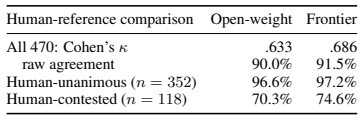
Table 4 : Level-1 dev validation against the five-human mode. All five annotators label all 470 items; subset rows report raw agreement for human-unanimous and contested items.
원문 · CC BY 4.0 · Kihyun Na, Injung Kim · ReviewMap: Mapping Evaluative Acts and Automation Boundaries in Peer-Review Comments · 원문 그림 인용 · 원본 PDF 5쪽에서 그림 영역을 추출했습니다.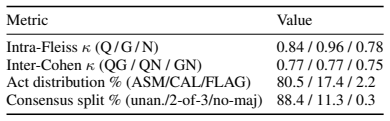
Table 5 : Act-layer reliability across the three open- weight models (main set, n= 17,654 comments). Both intra- and inter-model agreement are Substantial or higher. Intra-model n is 17,654/17,653/17,642 for Q/G/N; inter-modeln= 17,654throughout.
원문 · CC BY 4.0 · Kihyun Na, Injung Kim · ReviewMap: Mapping Evaluative Acts and Automation Boundaries in Peer-Review Comments · 원문 그림 인용 · 원본 PDF 6쪽에서 그림 영역을 추출했습니다.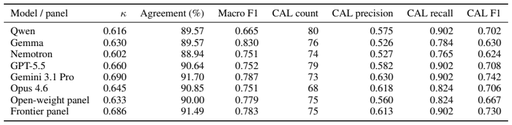
Table 13 : Dev comparisons against the five-human mode (n= 470 throughout; human-reference CAL count = 51). A panel does not necessarily outperform every constituent model.
원문 · CC BY 4.0 · Kihyun Na, Injung Kim · ReviewMap: Mapping Evaluative Acts and Automation Boundaries in Peer-Review Comments · 원문 그림 인용 · 원본 PDF 19쪽에서 그림 영역을 추출했습니다.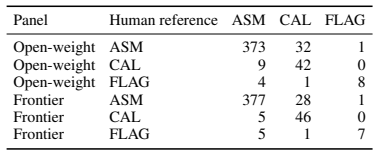
Table 14 : Dev panel confusion matrices. Rows are the five-human mode; columns are panel predictions.
원문 · CC BY 4.0 · Kihyun Na, Injung Kim · ReviewMap: Mapping Evaluative Acts and Automation Boundaries in Peer-Review Comments · 원문 그림 인용 · 원본 PDF 19쪽에서 그림 영역을 추출했습니다.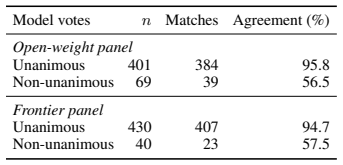
Table 15 : Dev panel agreement with the five-human mode, grouped by agreement among three per-model run-voted acts. Non-unanimous includes 2-of-3 and three-way ties; panel labels retain the specified tie-break. This groups by model votes, unlike the human-defined subsets in Table 4.
원문 · CC BY 4.0 · Kihyun Na, Injung Kim · ReviewMap: Mapping Evaluative Acts and Automation Boundaries in Peer-Review Comments · 원문 그림 인용 · 원본 PDF 19쪽에서 그림 영역을 추출했습니다.CAL 희소성과 강점·약점 구획의 차이
본 집합에서 최종 합의 기준 CAL 비율은 17.4%이며 ASM이 80.5%, FLAG가 2.2%입니다. 전체 1,955개 reviewer-paper 사례 가운데 17.0%에는 합의 CAL이 없습니다. 섹션별로는 Strengths의 CAL 비율이 34.5%, Weaknesses가 12.2%, Questions가 6.9%이며, 이는 Strengths가 Weaknesses보다 약 3배 높다는 뜻입니다. 저자들은 이를 리뷰어가 칭찬할 때 가치 판단을 더 자주 드러내고 비판할 때는 주로 주장과 표준을 평가한다는 신호로 해석합니다. 다만 이 결과는 ICLR 2026 안에서의 변이를 보여주며, 다른 학회로 일반화하지 않습니다.
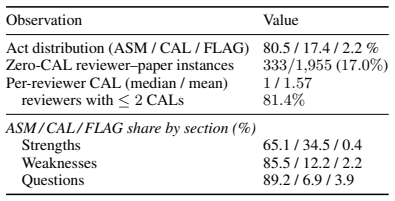
Table 7 : Corpus-level findings from final three-model consensus acts. Section shares use 5,269 Strengths, 7,390 Weaknesses, and 4,995 Questions comments; re- view statistics use1,955reviewer–paper instances.
원문 · CC BY 4.0 · Kihyun Na, Injung Kim · ReviewMap: Mapping Evaluative Acts and Automation Boundaries in Peer-Review Comments · 원문 그림 인용 · 원본 PDF 7쪽에서 그림 영역을 추출했습니다.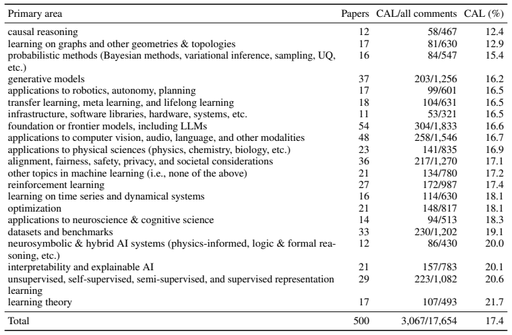
Table 16 : CAL shares across all 21 primary areas in the main corpus under the score/confidence-provided condition and two-stage aggregation. Comments are grouped by their paper’s recorded primary area; each denominator includes all original comments in that area, including FLAG. Rows are ordered by CAL share. These finite-sample descriptive rates characterize variation within ICLR 2026; they are not uncertainty bounds or evidence of cross-venue portability.
원문 · CC BY 4.0 · Kihyun Na, Injung Kim · ReviewMap: Mapping Evaluative Acts and Automation Boundaries in Peer-Review Comments · 원문 그림 인용 · 원본 PDF 20쪽에서 그림 영역을 추출했습니다.적용 범위와 한계
이 연구의 실증 분석은 ICLR 2026 영어 리뷰에 한정되며, Level 1 인간 검증은 470개 개발 댓글에서만 이뤄졌습니다. 0.17의 무CAL 결과는 샘플링된 심사 섹션에서 명시적으로 드러난 교정에 관한 것이지 리뷰어의 암묵적 추론이나 추천의 타당성을 직접 보여주지 않습니다. 속성 일치도는 공통 행위와 이진값이 있는 항목에 대한 조건부 결과이며, 주석 정확도나 모델 공통의 편향은 별도 증거가 필요합니다. 또한 규칙 기반 분할은 파편화된 댓글을 낳을 수 있습니다. 이 주석은 리뷰 구조를 설명하며 평가의 정확성이나 논문의 장단점을 검증하지 않습니다.
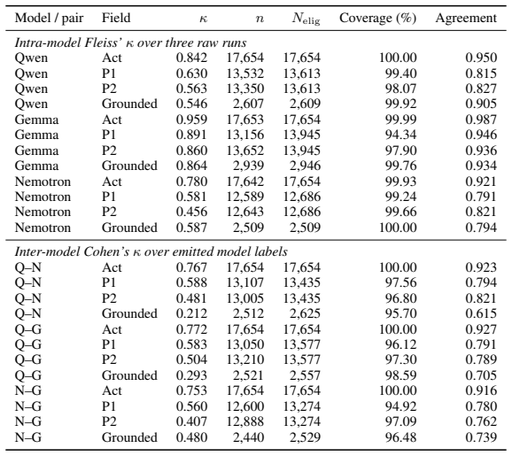
Table 9 : Main-set agreement with contributing and act-eligible denominators. Q, G, and N denote Qwen, Gemma, and Nemotron. Each attribute comparison conditions on its own applicable act and complete yes/no ratings.
원문 · CC BY 4.0 · Kihyun Na, Injung Kim · ReviewMap: Mapping Evaluative Acts and Automation Boundaries in Peer-Review Comments · 원문 그림 인용 · 원본 PDF 17쪽에서 그림 영역을 추출했습니다.논문 정보
- 저자
- Kihyun Na, Injung Kim
- 학회·저널
- arXiv · 프리프린트
- 최초 공개일
- 2026년 11월 5일
- 등록일
- 2026년 11월 6일
- 수정일
- 2026년 11월 5일
- 버전
- v1
- arXiv
- 2611.07489
- 분류
- cs.CL · cs.HC
- 원문 이용 조건
- CC BY 4.0
- 제공 범위
- 논문 정보, 해설, 허용된 원문 그림
AI 해설은 논문 원문과 별개의 설명이며 오류가 있을 수 있습니다. 원문과 그림은 각 출처의 이용 조건과 따로 표시된 권리를 따릅니다.
초록
Peer-review comments check what a paper does and judge why it matters, but no existing scheme distinguishes these two evaluative acts. We argue that making these acts explicit and measuring how reliably LLMs identify them is a prerequisite for responsible LLM-assisted review analysis: humans need to inspect review judgments and their grounds. This defines a more honest mission for NLP in peer review than full automation. We present ReviewMap, a framework that classifies each comment as assessment of claims and scholarly standards or calibration of contribution value and venue fit, with finer-grained attributes applied conditionally by act type. Applied to 500 ICLR~2026 papers through multi-model LLM consensus, the act layer proves reliably automatable under the operational guideline (inter-model $κ\geq 0.75$), supported by five-human validation on 470 development comments, while the attribute layer requires human oversight, defining a measured automation boundary. At the corpus level, 17% of reviewer-paper instances contain no panel-coded calibration, and the panel-coded calibration share is nearly $3\times$ as high in Strengths as in Weaknesses. This boundary informs three affordances: a review guideline that operationalizes the assessment-then-calibration workflow for reviewers, a per-comment rebuttal strategy scaffold for authors, and a discussion-phase dashboard for area chairs.
원문 인용
Kihyun Na, Injung Kim (2026). ReviewMap: Mapping Evaluative Acts and Automation Boundaries in Peer-Review Comments. arXiv:2611.07489v1. https://arxiv.org/abs/2611.07489v1
BibTeX
@misc{na2026reviewmap,
  title = {{ReviewMap: Mapping Evaluative Acts and Automation Boundaries in Peer-Review Comments}},
  author = {Kihyun Na and Injung Kim},
  year = {2026},
  eprint = {2611.07489},
  archivePrefix = {arXiv},
  url = {https://arxiv.org/abs/2611.07489v1}
}