논문 해설
RoboJev: An Open Vision-Language Judge for Robot Success Detection
RoboJev: 로봇 성공 감지를 위한 오픈 비전-언어 심판
- 연구 문제 로봇 조작 영상에는 성공 여부 라벨이 없는 경우가 많아, 이를 자동으로 판정하는 도구가 필요합니다. RoboJev는 작업 지시문과 영상 프레임을 받아 성공 확률을 출력하는 오픈 가중치 판정 모델입니다.
- 연구 방법 JEV-27B-VL 언어 모델 부분에 rank-32 LoRA를 적용하고 비전 인코더는 동결합니다. 연구용 출처에는 KL 앵커를 두며, 두 답 토큰의 로짓에 온도 보정을 적용해 한 번의 순전파로 성공 확률을 계산합니다.
- 주요 결과 SO-101 보류 평가에서 RoboJev-27B는 95.2% 균형 정확도와 0.993 AUROC를 보였습니다. 학습에 없던 도메인에서는 기본 모델보다 AUROC가 약간 낮아 전이 이득이 확인되지 않았습니다.
로봇 성공 판정의 필요성
많은 로봇 조작 영상에는 작업이 성공했는지를 알려 주는 라벨이 없습니다. 이런 라벨은 기계가 읽을 수 있는 형태로 제공되지 않는 경우가 많고, 궤적 길이나 데이터 출처, 움직임의 부드러움 같은 낮은 수준의 휴리스틱으로도 쉽게 얻을 수 없습니다. 이 논문은 리뷰 대기열, 학습된 종료 보상, 집계 평가에 쓸 수 있는 성공 여부를 판정하는 오픈 가중치 모델 RoboJev를 다룹니다. RoboJev는 JEV-27B-VL을 출발점으로 삼아 로봇 조작 영상의 성공 확률을 출력하도록 적응시킨 모델입니다.
입력, 출력 readout과 학습 구성
RoboJev는 작업 지시문, 주 카메라에서 균등 간격으로 뽑은 10개 프레임, 그리고 사용할 수 있을 때의 보조 카메라 마지막 프레임을 입력으로 받습니다. 출력은 생성 문장이 아니라 거짓과 참을 나타내는 두 답 토큰의 로짓에서 계산됩니다. 두 로짓에 가산 편향을 더한 뒤 온도 T로 나누어 소프트맥스를 취하는 보정된 readout이며, 릴리스에서는 T=0.9를 사용합니다. 학습에서는 JEV-27B-VL에 결정 어댑터를 병합하고 비전 인코더와 병합기는 동결한 채 언어 모델 부분에만 rank-32 LoRA를 한 번의 에포크 동안 학습합니다. 학습률은 5×10^-5입니다.
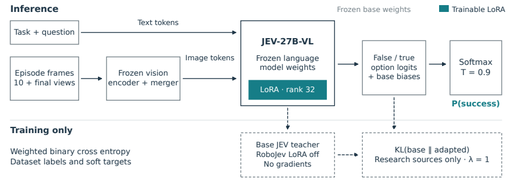
Figure2 . Anexistingvision-languagebackbonewith atask-specificdecisionadapter.LoRA(rank32)isappliedonlytothelanguage-model component, while the vision encoder and merger remain frozen. Success targets can be binary or soft, and KL anchoring to the base model is applied on a selected subset of research sources. At inference, the merged model scores the two answer tokens with the released calibration applied; the teacher branch is used only during training and is not part of the serving graph.
원문 · CC BY 4.0 · Josef Liyanjun Chen · RoboJev: An Open Vision-Language Judge for Robot Success Detection · 원문 그림 인용 · 원본 PDF 3쪽에서 그림 영역을 추출했습니다.출처별 KL 앵커와 학습 목적
학습 목적은 가중 교차 엔트로피 항과 KL 항의 합으로 구성됩니다. KL 항은 기준이 되는 원래 모델의 출력 분포 q0을 목표로 하여 적응 모델 qθ를 그 근처에 머물게 합니다. 가중치 λ는 1이고, 연구용 RBM 및 연구 출처인 ViFailback과 DROID에만 앵커를 적용하며 커뮤니티 출처와 ArmnetBench에는 적용하지 않습니다. 출처별 균형 가중치는 교차 엔트로피 항에만 영향을 주고, KL 항의 목표 분포는 시작 모델의 출력 분포 그대로입니다.
어댑터 스케일과 온도 보정
검증 데이터에서 어댑터 스케일은 {0, 0.25, 0.5, 0.75, 1} 가운데 0이 아닌 값을 고르며, 보류된 커뮤니티 검증 AUROC가 가장 높은 값을 선택합니다. 다만 지정된 검증 출처마다 기준 모델보다 AUROC가 0.005를 넘게 낮아지지 않아야 합니다. 이 조건에서는 스케일 1이 가장 높은 커뮤니티 검증 AUROC를 보였습니다. 온도 보정은 검증 데이터에서 음의 로그우도를 최소화하는 온도를 찾는 방식으로 이루어집니다.
세 가지 평가 설정
평가 산출물에는 927개의 라벨 에피소드가 있고, 그중 862개가 이진 성공·실패 지표에 기여합니다. SO-101 보류 실행은 268개, 학습에 없던 연구 도메인인 미지 lab/robot 세트는 459개, 명확히 레이블된 커뮤니티 세트는 135개입니다. 커뮤니티 세트에서 모호한 65개 클립은 이진 지표에서 제외됩니다. 저자들은 공개된 테스트 세트가 모델 릴리스 과정에서 검토되었으므로 완전한 일회성 블라인드 테스트가 아니라고 밝힙니다.
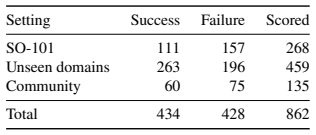
Table 1 .Evaluation composition. “Held out” has a different meaning in each setting; the SO-101 task-held-out subset contains 80 of the 268 runs.
원문 · CC BY 4.0 · Josef Liyanjun Chen · RoboJev: An Open Vision-Language Judge for Robot Success Detection · 원문 그림 인용 · 원본 PDF 4쪽에서 그림 영역을 추출했습니다.SO-101 보류 평가 결과
SO-101의 268개 보류 실행에서 RoboJev-27B는 95.2% 균형 정확도와 0.993 AUROC를 보고합니다. 같은 열 개 프레임 입력을 쓴 기본 JEV-27B-VL은 88.1% 균형 정확도와 0.979 AUROC를 보였습니다. 이 차이는 논문이 계산한 쌍체 균형 정확도 차이로 7.08 퍼센트포인트이며 95% 구간은 [3.04, 11.45]입니다. 같은 SO-101 세트의 프론티어 API 비교 조건은 입력 프레임 수가 달라 엄밀한 동일 입력 비교가 아닙니다.
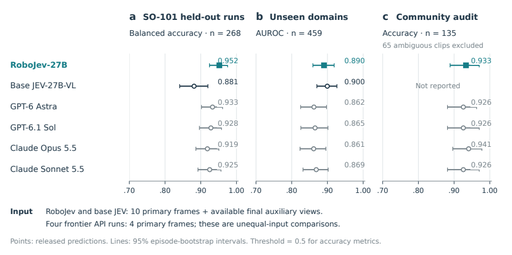
Figure 3 . Performance depends on the evaluation domain and input protocol.Shown are results on the held-out SO-101 runs, on the unseen lab/robot domains, and on the clearly labeled community subset. Error bars represent episode bootstrap intervals. All baselines using the API are given the 4 primary camera frames; RoboJev and the dense base receive 10 frames plus available final auxiliary views. There are 458 recorded answers in the unseen-domain plot for Sol. The same-input base achieves a higher unseen-domain AUROC, and Opus achieves higher community accuracy.
원문 · CC BY 4.0 · Josef Liyanjun Chen · RoboJev: An Open Vision-Language Judge for Robot Success Detection · 원문 그림 인용 · 원본 PDF 4쪽에서 그림 영역을 추출했습니다.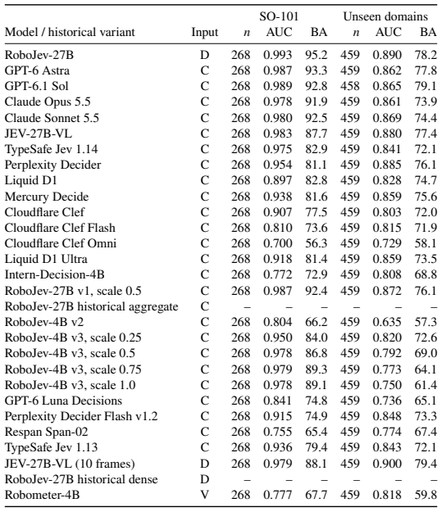
Table 3 .Complete available SO-101 and unseen-domain results. BA is balanced accuracy (%); AUC is AUROC.𝑛 is the number of available binary-labelled predictions. D: dense-v1; C: clip-v1; V: whole video.
원문 · CC BY 4.0 · Josef Liyanjun Chen · RoboJev: An Open Vision-Language Judge for Robot Success Detection · 원문 그림 인용 · 원본 PDF 11쪽에서 그림 영역을 추출했습니다.미지 도메인 전이의 한계
459개 미지 도메인 에피소드에서 RoboJev는 78.2% 균형 정확도와 0.890 AUROC를 보였습니다. 같은 이미지 해시와 작업 텍스트를 사용한 기본 모델은 79.4%와 0.900 AUROC였습니다. 따라서 이 통제된 설정에서는 어댑테이션이 전이 이득을 주지 않았으며, AUROC 차이는 -0.0092이고 95% 구간은 [-0.0218, 0.0026]입니다. 저자들은 이 결과를 적응이 일반화 개선을 보장하지 않는다는 근거로 해석합니다. 미지 도메인 ECE는 0.148로 SO-101의 0.032보다 높습니다.
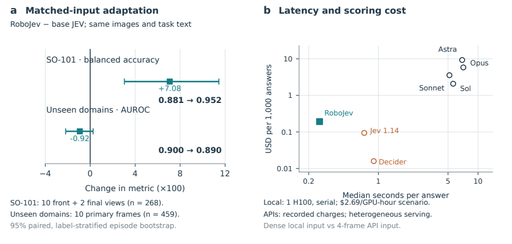
Figure 4 . Matched-input adaptation and deployment cost.Left: adapted minus base, paired at the verified identical inputs. The interval includes zero for the unseen domain. Right: Cost per 1,000 answers and response time per answer (medians). API costs are recorded charges; the H100 point uses a GPU-hour estimate. These are not controlled speedups, because the infrastructure and input budget differ.
원문 · CC BY 4.0 · Josef Liyanjun Chen · RoboJev: An Open Vision-Language Judge for Robot Success Detection · 원문 그림 인용 · 원본 PDF 6쪽에서 그림 영역을 추출했습니다.커뮤니티 명확 레이블 결과
명확히 레이블된 커뮤니티 135개 에피소드에서 RoboJev는 126개를 올바르게 분류하여 93.3% 정확도를 보였습니다. 이 세트에서 Opus는 94.1%, Astra와 Sol은 92.6%였습니다. 저자들은 방법 간 정확도 차이가 한두 에피소드 수준으로 작다고 설명합니다. 모호한 65개 클립은 전체 커뮤니티 에피소드의 32.5%를 차지하므로 이 정확도를 전체 커뮤니티로 외삽하지 않습니다.
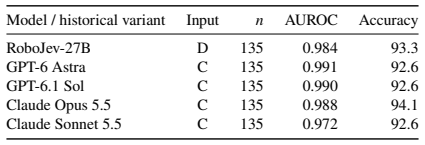
Table 4 .Available results on the 135 clearly labelled community episodes. Accuracy is ordinary accuracy (%), not balanced accuracy. The other 65 community clips are marked unclear.
원문 · CC BY 4.0 · Josef Liyanjun Chen · RoboJev: An Open Vision-Language Judge for Robot Success Detection · 원문 그림 인용 · 원본 PDF 11쪽에서 그림 영역을 추출했습니다.관찰 범위와 적용 한계
모든 성공 확률은 영상에서 볼 수 있는 내용에 의존합니다. 대상이 보이지 않거나 영상이 너무 짧거나 프레임 샘플링 사이의 짧은 사건을 놓치면 성공 여부를 확정할 수 없습니다. 원문은 여러 시드를 평균하지 않은 단일 실행 결과가 있음을 밝히고, 학습 라벨은 모델이 생성한 것이며 커뮤니티 테스트 라벨은 한 명의 주석자가 만들었음을 한계로 제시합니다. 또한 보정은 검증 세트에서 맞춘 값이므로 다른 도메인에서도 보정되었다고 볼 수 없습니다. 이 모델은 안전 모니터로도 간주되지 않습니다.
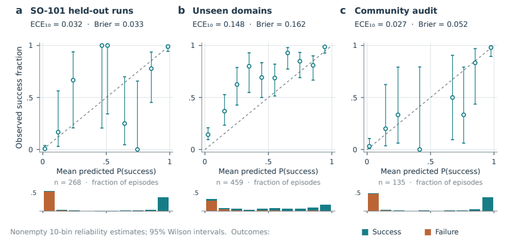
Figure5 . Goodcalibrationinonesettingdoesnottransferautomatically.Thereliabilitydiagramforthereleasedmodelusestenequal-width bins; the vertical error bars represent 95% Wilson intervals on the observed fraction of successes. In the histograms, we show the fraction of episodes falling into each bin, separated by outcome. The ECE and Brier score are computed over all scored episodes in a given panel. A diagonal line indicates perfect calibration. This represents a post-hoc diagnostic of the evaluation set, rather than another calibration fit.
원문 · CC BY 4.0 · Josef Liyanjun Chen · RoboJev: An Open Vision-Language Judge for Robot Success Detection · 원문 그림 인용 · 원본 PDF 6쪽에서 그림 영역을 추출했습니다.논문 정보
- 저자
- Josef Liyanjun Chen
- 학회·저널
- arXiv · 프리프린트
- 최초 공개일
- 2026년 10월 24일
- 등록일
- 2026년 11월 4일
- 수정일
- 2026년 10월 24일
- 버전
- v1
- arXiv
- 2610.33718
- 분류
- cs.RO · cs.LG
- 원문 이용 조건
- CC BY 4.0
- 제공 범위
- 논문 정보, 해설, 허용된 원문 그림
AI 해설은 논문 원문과 별개의 설명이며 오류가 있을 수 있습니다. 원문과 그림은 각 출처의 이용 조건과 따로 표시된 권리를 따릅니다.
초록
Many robot manipulation videos do not indicate whether the task was successfully completed. RoboJev-27B is an open-weight vision-language model that takes a task instruction, 10 frames of a manipulation attempt, and (if available) final frames from auxiliary cameras and predicts whether the robot accomplished the task. RoboJev-27B is a variant of JEV-27B-VL, trained with a rank-32 LoRA adapter on the language model only (keeping the vision encoder frozen) using 52,598 episode records. It also uses a source-specific KL penalty that applies only to research data, anchoring predictions closer to the original model on those sources. It uses a calibrated two-token readout that outputs success/failure probabilities in a single forward pass. On 268 held-out episodes of the same robot model (SO-101), RoboJev-27B attains 95.2% balanced accuracy and 0.993 AUROC. It also generalises to episodes collected by unseen labs/robots (AUROC = 0.890 over 459 episodes) as well as to clearly labelled community-collected episodes (accuracy = 93.3% over 135 episodes), where the base model attains an AUROC = 0.900 on the unseen-lab/robot subset with the same inputs. It takes 0.26 seconds per episode (median, serial) to infer on a single H100, which is about \$0.19 per 1,000 success predictions at \$2.69 per GPU-hour (not including media processing and serving costs). RoboJev-27B is released together with its inference code, along with a transparent evaluation: 20,628 predictions organized into 29 model/protocol entries are made available to facilitate browsing and to enable reproducible benchmarking of success detection. We also compare against strong API-based frontier VLMs, which take in fewer input frames (4 images from the primary camera only); note that this comparison is not strictly like-for-like because RoboJev-27B is given more frames at inference.
원문 인용
Josef Liyanjun Chen (2026). RoboJev: An Open Vision-Language Judge for Robot Success Detection. arXiv:2610.33718v1. https://arxiv.org/abs/2610.33718v1
BibTeX
@misc{chen2026robojev,
  title = {{RoboJev: An Open Vision-Language Judge for Robot Success Detection}},
  author = {Josef Liyanjun Chen},
  year = {2026},
  eprint = {2610.33718},
  archivePrefix = {arXiv},
  url = {https://arxiv.org/abs/2610.33718v1}
}