논문 해설
Selecting or Solving? What Best-of-N Verification Delivers in Video Reasoning
선택인가, 해결인가? 비디오 추론에서 Best-of-N 검증이 제공하는 것
- 연구 문제 긴 비디오 질의응답에서 검증자의 다수결 대비 이득은 후보 선택과 검증자 자체의 풀이 효과가 섞여 있어 분리해서 봐야 합니다.
- 연구 방법 후보 풀에서 검증자의 선택 정확도와 후보 없이 한 독립 풀이 정확도를 비교하는 Selection Increment로 두 효과를 나눕니다.
- 주요 결과 Video-Holmes에서 약한 검증자는 선택 증분이 크지만 다수결보다 낮고, 강한 검증자는 다수결을 이기지만 선택 증분은 작습니다.
긴 비디오 추론에서 선택의 효과를 어떻게 측정할까
긴 비디오에 대한 질문은 몇 초의 근거를 찾아야 답할 수 있으므로 본질적으로 grounding 문제입니다. 이 논문은 같은 모델이 여러 사고 연쇄(chain-of-thought)를 샘플하고, 두 번째 검증자 VLM이 비디오를 다시 보고 그중 하나를 고르는 best-of-N 선택 파이프라인을 다룹니다. 기존 보고는 이런 파이프라인의 이득을 다수결(self-consistency) 대비 한 개의 헤드라인 차이로 제시하는데, 저자들은 이 차이가 두 효과를 함께 담고 있다고 지적합니다. 하나는 후보 중에서 고르는 선택 효과이고, 다른 하나는 검증자가 질문을 직접 풀어서 얻는 효과입니다. 두 효과는 배포 관점에서 서로 다른 결론을 낳으므로 분리해서 봐야 합니다.
선택 증분과 두 가지 채점 정책
저자들은 같은 후보 풀에서 세 가지 규칙을 비교합니다. 첫째는 후보 C의 최빈값을 고르는 다수결이고, 둘째는 검증자 J가 K개의 프레임을 다시 보고 후보 중에서 고르는 선택이며, 셋째는 같은 검증자가 후보 없이 자기 프레임만으로 답하는 독립 풀이입니다. 이때 선택 증분은 SI = acc(sel) − acc(standalone)으로 정의되고, 다수결 대비 차이는 ∆maj = acc(sel) − acc(maj)로 정의됩니다. 헤드룸 h = acc(oracle) − acc(maj)는 어떤 규칙도 회복할 수 있는 상한을 나타냅니다. 채점에서는 검증자가 후보 밖 문자(OOC)를 고르고 그것이 정답이면 Solver 정책은 이를 정답으로 셉니다.
Selector 정책은 후보 집합 안에서 나온 정답만 인정하고, Snap 정책은 OOC 선택을 가장 가까운 후보로 바꿉니다. 헤드라인 수치는 선행 연구와 비교하기 위해 Solver 정책을 사용하고, Selector는 별도 절제 결과로 보고합니다. 독립 풀이 leg는 검증자가 후보를 보지 않으므로 채점 정책과 무관합니다.
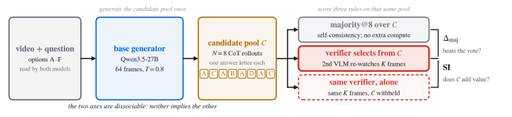
Figure 1 :What a best-of- N verifier pipeline measures.A base generator (Qwen3.5-27B) samples N=8 chain-of-thought rollouts per question, each ending in a candidate letter. Three rules score that same pool: majority voting; the verifier selecting among the candidates after re-watching K frames; and the same verifier with the candidates withheld. Their differences define our two axes, ∆maj and SI.
원문 · CC BY 4.0 · Martin Q. Ma, Yuxiao Qu, Ruslan Salakhutdinov, Louis-Philippe Morency, Paden Tomasello, Juan Pino · Selecting or Solving? What Best-of-N Verification Delivers in Video Reasoning · 원문 그림 인용 · 원본 PDF 2쪽에서 그림 영역을 추출했습니다.Video-Holmes와 전체 분할에서 나타난 두 축의 분리
주요 분석 대상인 Video-Holmes에서 N=8개 후보의 다수결 정확도는 58.9%이고, 최선의 oracle은 78.8%입니다. 가장 강한 검증자인 GPT-5.6 Sol은 62.0%를 기록해 다수결보다 3.1포인트 높지만 oracle과는 여전히 약 17포인트 차이가 남습니다. 전체 분할에서는 Muse 검증자가 TempCompass에서 다수결보다 +7.94포인트 높지만 SI는 −1.08입니다. MLVU-Test에서는 차이가 +0.81로 유의하지 않고 SI는 +5.68입니다. VRBench에서는 다수결이 91%에 가까운데 Muse 검증자는 −3.26포인트 낮고 SI는 +3.67입니다. 따라서 다수결 대비 차이와 SI는 서로 독립적으로 움직입니다.
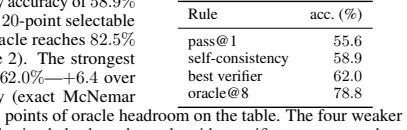
Table 2 :Video-Holmes( 1,837 six- way MCQs), N=8. Best verifier: GPT-5.6 Sol.
원문 · CC BY 4.0 · Martin Q. Ma, Yuxiao Qu, Ruslan Salakhutdinov, Louis-Philippe Morency, Paden Tomasello, Juan Pino · Selecting or Solving? What Best-of-N Verification Delivers in Video Reasoning · 원문 그림 인용 · 원본 PDF 5쪽에서 그림 영역을 추출했습니다.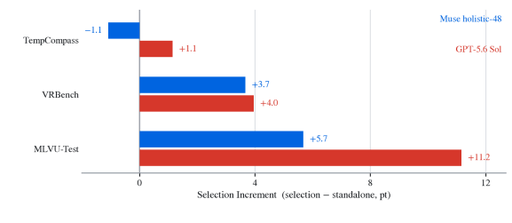
Figure 3 :Selection Increment by benchmark and verifier.SI (selection accuracy minus the same verifier answering directly, both under the Solver policy) for the Muse holistic-48 verifier (blue) and GPT-5.6 Sol (red). GPT-5.6 Sol yields positive SI on all three benchmarks while Muse splits (negative on TempCompass)—not because GPT is the stronger selector but because its standalone accuracy typically sits below Muse’s, leaving the candidates more room, consistent with SI tracking standalone accuracy inversely (Section 4). VRBench cells use the first 1,000 questions of its split (118of960videos).
원문 · CC BY 4.0 · Martin Q. Ma, Yuxiao Qu, Ruslan Salakhutdinov, Louis-Philippe Morency, Paden Tomasello, Juan Pino · Selecting or Solving? What Best-of-N Verification Delivers in Video Reasoning · 원문 그림 인용 · 원본 PDF 16쪽에서 그림 영역을 추출했습니다.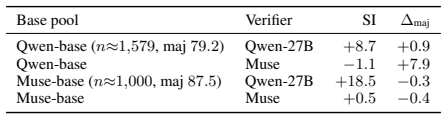
Table 6 :Base × verifier on TempCompass (full 2×2 ).Selection Increment and gain over self- consistency (∆maj), in points, for a weak (Qwen-27B) and a strong (Muse) verifier over each of two candidate pools. SI is acolumneffect (large for the weak verifier, near zero for the strong one on both bases); beating self-consistency is aroweffect (attainable on the harder Qwen-base pool, out of reach on the near-saturated Muse-base pool). The two axes are governed by different factors. The three small ∆maj cells (+0.9, −0.3, −0.4) are effectively at parity; the row effect is clearest in the Muse column (+7.9→ −0.4).Provenance.SI is reported with both of its legs—selection and standalone—at the original 1,024-token generation cap, since re-measuring one leg alone would mix compute budgets within a single difference. Each SI cell is differenced on its verifier’s matched non-empty support. The two Qwen-27B ∆maj cells are re-measured at 8,192 tokens with a corrected answer extractor; the Muse cells never bound the cap but retain the original extractor (Appendix B). In both base-varying 2×2 s the base axis moves the generator’s frame budget together with its identity—the Qwen-base pools read 64 frames, the Muse-base pools 32—so a row effect is a property of each pool as produced rather than of model identity alone.
원문 · CC BY 4.0 · Martin Q. Ma, Yuxiao Qu, Ruslan Salakhutdinov, Louis-Philippe Morency, Paden Tomasello, Juan Pino · Selecting or Solving? What Best-of-N Verification Delivers in Video Reasoning · 원문 그림 인용 · 원본 PDF 17쪽에서 그림 영역을 추출했습니다.같은 후보 풀에서 검증자 강도가 결과를 바꾸는 방식
Video-Holmes의 Qwen 기반 후보 풀에서 저자들은 검증자만 바꾸어 두 축을 비교합니다. 약한 Phi-3.5 검증자는 독립 정확도 32.5%에서 SI +19.3을 보이지만 선택 정확도는 51.8%로 다수결 58.9%보다 7.1포인트 낮습니다. 강한 Muse 검증자는 SI가 +2.5에 그치지만 다수결을 +2.8 앞섭니다. 같은 후보 풀에서 독립 정확도가 올라갈수록 SI는 +28.7, +19.3, +17.6, +10.9, +7.9로 감소합니다. 이 관찰은 SI가 검증자의 독립 풀이 능력과 반대로 움직이는 증분이며, 다수결을 이기는 능력과는 다르다는 해석을 뒷받침합니다. 다만 이것은 이 후보 풀과 이 검증자 사다리에서 얻은 결과입니다.
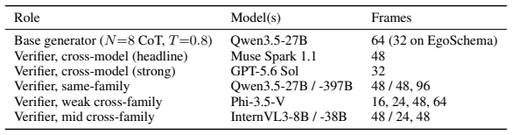
Table 1 :Base and verifier roles.Allheadlinebest-of- N results fix Qwen3.5-27B as the base generator and vary the verifier; two base-varying 2×2 s (Video-Holmes, TempCompass; Section 4) also vary the base. The standalone solver is the same verifier answering directly from its own K frames.
원문 · CC BY 4.0 · Martin Q. Ma, Yuxiao Qu, Ruslan Salakhutdinov, Louis-Philippe Morency, Paden Tomasello, Juan Pino · Selecting or Solving? What Best-of-N Verification Delivers in Video Reasoning · 원문 그림 인용 · 원본 PDF 4쪽에서 그림 영역을 추출했습니다.답 위치 편향과 적용 범위의 한계
약한 검증자에서는 후보의 내용보다 답 위치를 선호하는 편향이 관찰됩니다. EgoSchema에서 Phi-3.5-Vision은 16프레임과 48프레임에서 A 선택 편향이 각각 +4.4와 +8.0포인트로 나타나며, 골드 답의 A 비율은 20.2%입니다. 능력이 있는 검증자는 골드 대비 1.4포인트 이내에 머무릅니다. 다만 이 편향은 주로 terse 응답 모드에 집중되어 있고, 검증자 강도와 응답 모드가 InternVL3-38B 대조군에서 함께 움직여 분리되지 않습니다. 헤드룸 규칙은 세 벤치마크의 압축된 6–14포인트 범위에서 시험되어 규칙을 지지하지도 반박하지도 않습니다. 강한 두 검증자는 모두 닫힌 API 모델이므로 일반화 범위도 제한됩니다.
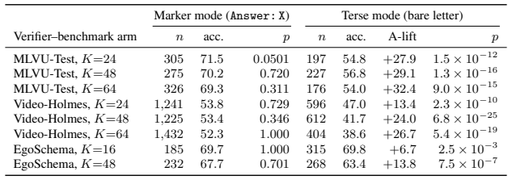
Table 5 : Position bias by response mode, weak verifier (Phi-3.5-Vision). Modes are disjoint and separated by output length. All tests are exact two-sided binomial McNemar on non-empty picks; A- lift is 100(bA−cA)/n. Marker-mode A-lift magnitudes are withheld pending independent verification: no marker-mode cell reaches significance in any of the ten arms as scored here, each on its own full row set, and every marker-mode |A-lift| is below 4 points, though at these per-arm n that is a failure to distinguish the marker mode from zero rather than a demonstration that it is unbiased—the closest cell sits just aboveα, atp=0.0501. Accuracies are under the Solver policy.
원문 · CC BY 4.0 · Martin Q. Ma, Yuxiao Qu, Ruslan Salakhutdinov, Louis-Philippe Morency, Paden Tomasello, Juan Pino · Selecting or Solving? What Best-of-N Verification Delivers in Video Reasoning · 원문 그림 인용 · 원본 PDF 15쪽에서 그림 영역을 추출했습니다.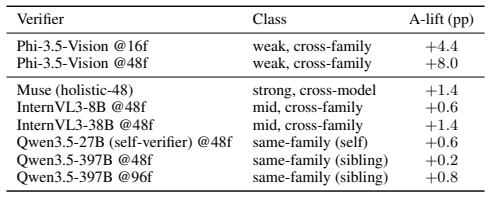
Table 7 :Answer-position bias on EgoSchema is a weak-verifier property.Per-verifier A-lift (pick-“A” rate minus gold-“A” rate, in points, under the Solver scoring policy; gold-“A”= 20.2%, gold mode E, n=500), ordered weak to strong. Only the weak cross-family verifier Phi-3.5-Vision lifts “A” above gold, at both of its compute budgets; every capable verifier stays within1.4 points of gold.
원문 · CC BY 4.0 · Martin Q. Ma, Yuxiao Qu, Ruslan Salakhutdinov, Louis-Philippe Morency, Paden Tomasello, Juan Pino · Selecting or Solving? What Best-of-N Verification Delivers in Video Reasoning · 원문 그림 인용 · 원본 PDF 17쪽에서 그림 영역을 추출했습니다.논문 정보
- 저자
- Martin Q. Ma, Yuxiao Qu, Ruslan Salakhutdinov, Louis-Philippe Morency, Paden Tomasello, Juan Pino
- 학회·저널
- arXiv · 프리프린트
- 최초 공개일
- 2026년 10월 31일
- 등록일
- 2026년 11월 3일
- 수정일
- 2026년 10월 31일
- 버전
- v1
- arXiv
- 2611.00507
- 분류
- cs.CV
- 원문 이용 조건
- CC BY 4.0
- 제공 범위
- 논문 정보, 해설, 허용된 원문 그림
AI 해설은 논문 원문과 별개의 설명이며 오류가 있을 수 있습니다. 원문과 그림은 각 출처의 이용 조건과 따로 표시된 권리를 따릅니다.
초록
Answering a complex question about a long video is a grounding problem: the answer turns on a few seconds of evidence, and vision-language models remain well below human accuracy at finding them. The standard way to spend extra test-time compute on this kind of video reasoning is best-of-N selection: sample several chain-of-thought answers from a fixed model, then let a second model re-watch the video and pick one. Such pipelines are reported by a single headline number, their margin over a majority vote. That number conflates two effects with opposite deployment consequences: the benefit the second model adds by selecting among candidates, and the benefit it would have supplied by solving the question itself. We separate them, measuring the Selection Increment (SI) -- selection accuracy minus the same verifier's accuracy with the candidates withheld -- alongside the margin over self-consistency, across five long-video benchmarks. The Selection Increment is largest for the weakest verifiers: a verifier that solves poorly on its own leaves the candidates the most room to help. Beating the majority vote follows the opposite profile: where the vote already sits near its ceiling no verifier we test improves on it; below that ceiling only the strongest do. On Video-Holmes, the two come apart on a single pool of candidates -- a weak verifier gains +19.3 points from the candidates yet lands 7.1 points below the vote, while the frontier verifier gains the least and beats the vote. The weakest verifier also shows a failure mode: on EgoSchema it picks by where an option sits in the list rather than by what the video shows. Read as a merit score, SI puts a verifier that fails to beat a majority vote at the top of its ranking; read as an audit, it says which of the two effects a headline number delivers. Code is available at https://github.com/facebookresearch/best-n-selection-video-reasoning.
원문 인용
Martin Q. Ma, Yuxiao Qu, Ruslan Salakhutdinov, Louis-Philippe Morency, Paden Tomasello, Juan Pino (2026). Selecting or Solving? What Best-of-N Verification Delivers in Video Reasoning. arXiv:2611.00507v1. https://arxiv.org/abs/2611.00507v1
BibTeX
@misc{ma2026selecting,
  title = {{Selecting or Solving? What Best-of-N Verification Delivers in Video Reasoning}},
  author = {Martin Q. Ma and Yuxiao Qu and Ruslan Salakhutdinov and Louis-Philippe Morency and Paden Tomasello and Juan Pino},
  year = {2026},
  eprint = {2611.00507},
  archivePrefix = {arXiv},
  url = {https://arxiv.org/abs/2611.00507v1}
}