논문 해설
Does Your Generalist Skill Optimizer Really Incentivize Agentic Tasks? Rethinking Skill Optimization via Bipartite Attribution
범용 스킬 최적화기는 실제로 에이전트 작업을 유도하는가? 이분 귀속을 통한 스킬 최적화 재고
- 연구 문제 스킬 최적화기는 작은 개발 집합의 이득과 성공 점수만으로 편집의 효과와 입력 토큰 비용을 판단하기 어렵습니다.
- 연구 방법 BiPA는 selection replay로 보고 이득이 선택만으로 나타나는 정도를 계산하고, 이분 그래프와 턴 탄력성, 네 항 분해로 입력 토큰 증가를 설명합니다.
- 주요 결과 DeepSeek 학습 스킬은 시드보다 입력 토큰을 1.08배에서 1.43배 읽었고, 열여섯 스킬 전체의 시험 성공 차이는 평균 0.1점이었습니다.
스킬 최적화의 문제와 선택 잡음
스킬 최적화기는 에이전트가 읽는 자연어 절차인 스킬을 편집하고, 개발 집합에서 성공이 오르는 편집만 남깁니다. 장기 과제는 개발 집합이 작고 성공이 확률적이어서, 개발 집합의 작은 이득이 편집의 효과를 보여준다고 볼 수 없습니다. 또한 성공 점수는 편집이 입력 토큰을 얼마나 늘렸는지를 보여주지 않습니다. 이 논문은 최적화기를 바꾸지 않고, 에이전트 기록으로 이 두 가지 질문을 분석하는 측정 도구 BiPA를 제안합니다.
selection replay로 선택만의 이득 측정
selection replay는 변경되지 않은 후보를 씨앗 스킬로 다시 평가하고, 최적화기의 수용 규칙을 그대로 적용합니다. 이렇게 얻은 보고 이득이 선택만으로 나타나는 정도를 계산합니다. 각 개발 과제의 난이도는 씨앗 스킬의 개발 및 시험 에피소드로부터 맞춘 베타 사전분포의 사후분포에서 뽑힙니다. 따라서 P(G0 ≥ G)가 크면 보고된 이득 G는 개선의 증거가 아닙니다.
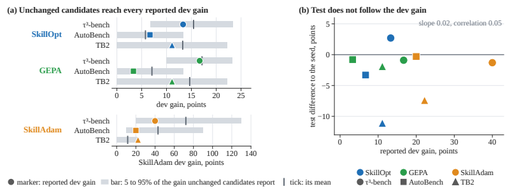
Figure 3 :Reported dev gains are what selection alone reports, and test does not follow them.DeepSeek-V4.1- Flash. (a) Each run’s reported dev gain against replays with all candidates unchanged. (b) Test difference to the seed against the reported dev gain, nine returned skills (Table 1). SkillAdam’s dev gain sums its accepted edits’ margins on small batches, so it has its own axis in (a). Replays: Appendix C.3.
원문 · CC BY 4.0 · Jiawei Zhou, Bo Peng, Yuxuan Huang, Ming Zhang, Youbang Sun, Xiang Wang, Chaochao Lu · Does Your Generalist Skill Optimizer Really Incentivize Agentic Tasks? Rethinking Skill Optimization via Bipartite Attribution · 원문 그림 인용 · 원본 PDF 7쪽에서 그림 영역을 추출했습니다.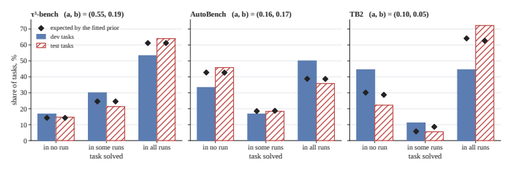
Figure 6 :Most tasks are solved almost always or almost never, about as the fitted prior expects.Bars: share of dev and test tasks the seed solves in none, some or all of its runs, DeepSeek-V4.1-Flash; diamonds: the share the fitted prior expects; titles: its(a, b).
원문 · CC BY 4.0 · Jiawei Zhou, Bo Peng, Yuxuan Huang, Ming Zhang, Youbang Sun, Xiang Wang, Chaochao Lu · Does Your Generalist Skill Optimizer Really Incentivize Agentic Tasks? Rethinking Skill Optimization via Bipartite Attribution · 원문 그림 인용 · 원본 PDF 15쪽에서 그림 영역을 추출했습니다.이분 그래프와 턴 탄력성
각 에피소드는 턴과 문맥 구성요소를 잇는 이분 그래프로 기록됩니다. 턴이 읽은 토큰과 호출한 도구 수가 이 그래프에 연결됩니다. 기록을 압축하지 않는 하네스에서는 턴 r이 F+(r−1)h 토큰을 읽으며, 이때 턴 탄력성 eR=1+sH·R/(R−1)은 고정된 턴당 내용과 접두사에서 턴 수 1%의 증가가 입력 토큰을 몇 %나 늘리는지를 나타냅니다. 명제 1은 eR이 1보다 크고 sH가 커질수록 증가하며 R이 커지면 2에 가까워진다고 주장합니다.
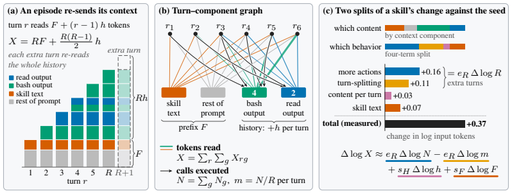
Figure 2 :BiPA splits a skill’s extra input tokens by content and by behavior.(a) Each turn re-sends the prefix and the history. (b) Turns linked to the context components they read or call. (c) The two splits against the seed.
원문 · CC BY 4.0 · Jiawei Zhou, Bo Peng, Yuxuan Huang, Ming Zhang, Youbang Sun, Xiang Wang, Chaochao Lu · Does Your Generalist Skill Optimizer Really Incentivize Agentic Tasks? Rethinking Skill Optimization via Bipartite Attribution · 원문 그림 인용 · 원본 PDF 4쪽에서 그림 영역을 추출했습니다.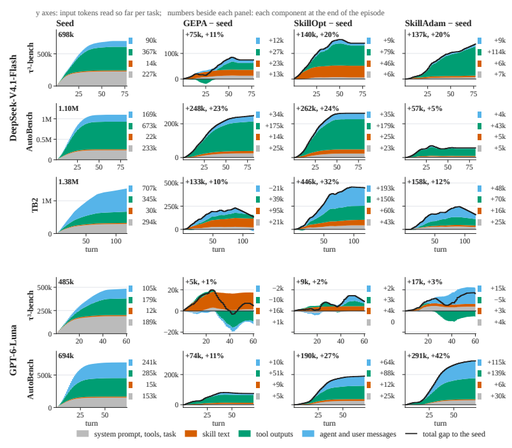
Figure 13 :Tool outputs are the largest part of the extra input tokens for seven of the nine DeepSeek skills and for the three Luna skills on AutoBench.One row per model and benchmark; curves average over test runs, then over tasks, and an ended episode keeps its total, so a gap can fall where the seed’s longer episodes keep reading. Left: the seed, stacked by context component; other columns: learned skill minus seed, black line the total gap, one vertical scale for a row’s three gap panels. Bold, top left: the seed’s total, or the skill’s total gap and that gap as a percentage of the seed’s total, a ratio of totals, notρ.
원문 · CC BY 4.0 · Jiawei Zhou, Bo Peng, Yuxuan Huang, Ming Zhang, Youbang Sun, Xiang Wang, Chaochao Lu · Does Your Generalist Skill Optimizer Really Incentivize Agentic Tasks? Rethinking Skill Optimization via Bipartite Attribution · 원문 그림 인용 · 원본 PDF 22쪽에서 그림 영역을 추출했습니다.네 항 분해
입력 토큰의 로그 변화는 더 많은 행동, 턴 분할, 턴당 내용, 스킬 텍스트의 네 항으로 나뉩니다. 앞의 두 항은 턴 탄력성과 턴 로그 변화를 곱한 턴 항이며, 같은 호출을 더 많은 턴에 나누는 것도 턴 항에 포함됩니다. 턴당 내용과 스킬 텍스트는 읽는 양을 설명합니다. 이 분해는 비용이 어떤 행동과 함께 나타나는지를 설명하는 회계 분해이며, 인과 증명이 아닙니다.
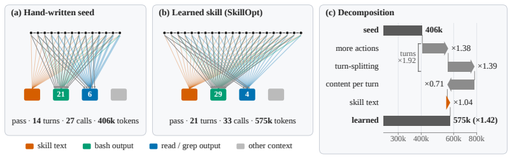
Figure 1 :On one AutomationBench task, SkillOpt’s skill passes like the seed but reads 1.42 times its input tokens, through extra turns.(a) Seed, (b) learned skill; box numbers: tool calls. (c) The ratio as a product of four factors.
원문 · CC BY 4.0 · Jiawei Zhou, Bo Peng, Yuxuan Huang, Ming Zhang, Youbang Sun, Xiang Wang, Chaochao Lu · Does Your Generalist Skill Optimizer Really Incentivize Agentic Tasks? Rethinking Skill Optimization via Bipartite Attribution · 원문 그림 인용 · 원본 PDF 2쪽에서 그림 영역을 추출했습니다.실험 설정과 비교 조건
실험은 GEPA, SkillOpt, SkillAdam 세 최적화기를 Terminal-Bench 2.1, τ3-bench, AutomationBench에서 적용합니다. 에이전트는 DeepSeek-V4.1-Flash와 GPT-6-Luna를 OpenCode에서 실행하며, 모든 최적화기는 같은 씨앗 스킬에서 시작합니다. 시험 성공은 avg@3로 측정하고, 입력 토큰 비율 ρ는 씨앗 대비 로그 비율로 계산합니다. 모델과 벤치마크마다 결과의 조건이 다르므로 이 점을 구분해 읽어야 합니다.
시험 성공과 비용 결과
DeepSeek 기반 아홉 개 학습 스킬은 입력 토큰을 시드의 1.08배에서 1.43배 읽는 것으로 보고되었습니다. 모든 열여섯 학습 스킬을 합치면 시험 성공은 시드보다 0.1점 높게 보고됩니다. 같은 결과에서 DeepSeek 스킬의 시험 성공은 −11.1점에서 +2.7점까지 흩어져 있습니다. 따라서 평균 차이는 개별 스킬의 차이를 가리므로, 성공이 개선되었다고 단정하기보다 시드와 대체로 비슷하다고 읽어야 합니다.
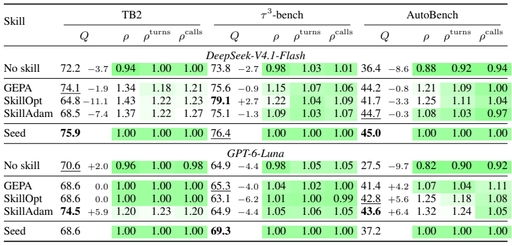
Table 1 :Test results(avg@3). Q: success (%), small: change from the seed in points; ρ, ρturns, ρcalls: input tokens, turns and tool calls relative to the seed (Eq. (1)), greener: lower. Bold, underline: best, second-bestQ.
원문 · CC BY 4.0 · Jiawei Zhou, Bo Peng, Yuxuan Huang, Ming Zhang, Youbang Sun, Xiang Wang, Chaochao Lu · Does Your Generalist Skill Optimizer Really Incentivize Agentic Tasks? Rethinking Skill Optimization via Bipartite Attribution · 원문 그림 인용 · 원본 PDF 6쪽에서 그림 영역을 추출했습니다.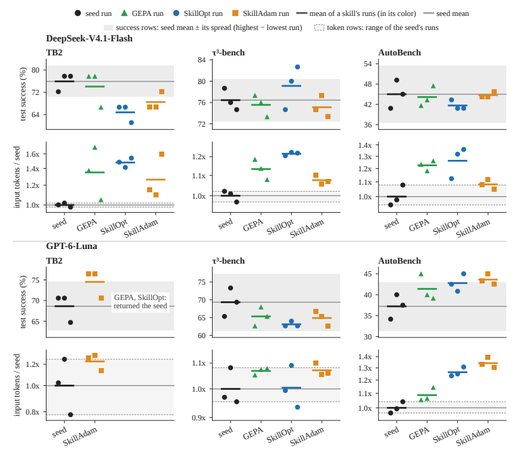
Figure 7 :Most learned skills differ from the seed in success by less than the seed’s own spread from run to run, but under DeepSeek-V4.1-Flash almost every one of them reads more input tokens than any run of the seed.One point per test run, DeepSeek-V4.1-Flash above and GPT-6-Luna below; a mean of a skill’s runs inside a success row’s grey band differs from the seed by at most the seed’s spread. A run’s input tokens: per task, the ratio to the geometric mean of the seed’s three runs, then the geometric mean over tasks; token-row means are geometric.
원문 · CC BY 4.0 · Jiawei Zhou, Bo Peng, Yuxuan Huang, Ming Zhang, Youbang Sun, Xiang Wang, Chaochao Lu · Does Your Generalist Skill Optimizer Really Incentivize Agentic Tasks? Rethinking Skill Optimization via Bipartite Attribution · 원문 그림 인용 · 원본 PDF 16쪽에서 그림 영역을 추출했습니다.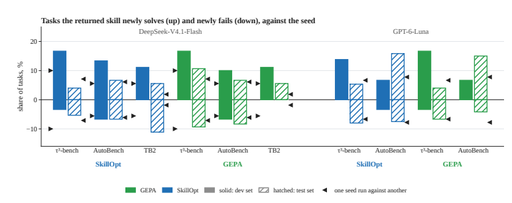
Figure 8 :On dev the returned skill rarely loses a task the seed solved; on test it gains about as many tasks as it loses, except GPT-6-Luna on AutoBench, where it gains more.Per optimizer run, the returned skill against the seed, both scored once inside that run on the whole dev set (solid bars) and on the whole test set (hatched bars); up: share of tasks the seed fails and the skill solves; down: the reverse; triangles: the share of tasks one run of the seed solves and another fails on the same set, averaged over pairs of its runs, so the same up and down; GPT-6-Luna’s dev bars have none.
원문 · CC BY 4.0 · Jiawei Zhou, Bo Peng, Yuxuan Huang, Ming Zhang, Youbang Sun, Xiang Wang, Chaochao Lu · Does Your Generalist Skill Optimizer Really Incentivize Agentic Tasks? Rethinking Skill Optimization via Bipartite Attribution · 원문 그림 인용 · 원본 PDF 17쪽에서 그림 영역을 추출했습니다.턴 비용과 편집 규칙의 영향
DeepSeek 학습 스킬에서 턴 항은 로그 토큰 증가의 73%를 차지합니다. 스킬 텍스트는 21%를 차지합니다. 편집기는 규칙을 추가하고 그 규칙들은 행동으로 실행되어 추가 턴을 만듭니다. 원문은 추가된 규칙 가운데 절반 가까이가 검증을 요구하며, 행동을 줄이라는 요구는 없었다고 보고합니다. 이는 편집이 만든 행동 변화에 대한 관찰이며, 편집기 내부의 의도를 직접 측정한 것은 아닙니다.
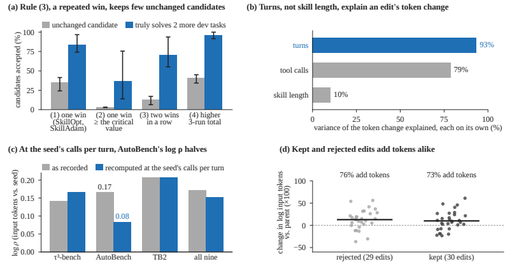
Figure 10 :One panel per design principle of Section 6, in order.DeepSeek-V4.1-Flash. (a) Simulated acceptance rules (1) to (4) of Appendix C.4; grey: an unchanged candidate, blue: one that truly solves two more dev tasks; bar: mean over the three benchmarks, whiskers: lowest and highest benchmark. (b) Share of the variance of an edit’s change in log input tokens that its change in turns, tool calls or skill length explains, each on its own. (c) Mean logρ of a benchmark’s three learned skills, or of all nine; grey: as recorded, blue: recomputed with each skill’s calls packed into turns as densely as the seed’s. (d) One dot per edit; short bar: mean, dashed line: zero.
원문 · CC BY 4.0 · Jiawei Zhou, Bo Peng, Yuxuan Huang, Ming Zhang, Youbang Sun, Xiang Wang, Chaochao Lu · Does Your Generalist Skill Optimizer Really Incentivize Agentic Tasks? Rethinking Skill Optimization via Bipartite Attribution · 원문 그림 인용 · 원본 PDF 19쪽에서 그림 영역을 추출했습니다.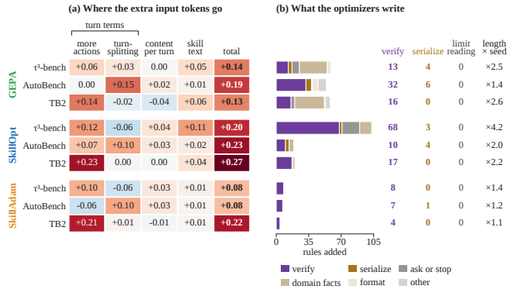
Figure 12 :Over the nine learned skills, extra turns carry most of the extra input tokens, and half of the added rules ask the agent to verify (DeepSeek-V4.1-Flash).(a) Each skill’s change in log input tokens against the seed (total, mean over tasks), split into the four terms of Eq. (6), which add up to it (rounded): more tool calls (more actions), the same calls spread over more turns (turn-splitting), more text per turn (content per turn) and a longer skill (skill text); the first two, the turn terms, sum to the cost of extra turns; red: more tokens than the seed, blue: fewer. (b) Rules added to the seed, by category (Appendix E.1); verify: re-check a result; serialize: act one call at a time; ask or stop: ask the user, hand off or stop; domain facts: about the domain and its tools; format: how to word the answer; other: the rest, parallelize included. Right: how many added rules verify, serialize or limit reading, and the skill’s length as a multiple of the seed’s; limit reading is a column only, as none of the nine skills adds such a rule.
원문 · CC BY 4.0 · Jiawei Zhou, Bo Peng, Yuxuan Huang, Ming Zhang, Youbang Sun, Xiang Wang, Chaochao Lu · Does Your Generalist Skill Optimizer Really Incentivize Agentic Tasks? Rethinking Skill Optimization via Bipartite Attribution · 원문 그림 인용 · 원본 PDF 21쪽에서 그림 영역을 추출했습니다.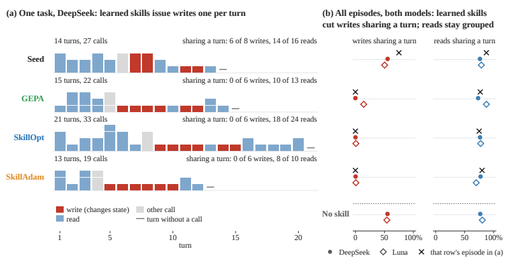
Figure 14 :On AutoBench the learned skills issue writes one per turn while reads stay grouped.(a) The task of Figure 1: one column per turn, one square per tool call issued in it; a write (read) shares a turn if another write (read) is issued in the same turn. (b) The same shares, pooled over the writes (reads) of all AutoBench test episodes with complete logs (outcome, tool calls and input tokens all recorded); bottom row: the agent without a skill; a cross marks the share in that row’s episode of (a).
원문 · CC BY 4.0 · Jiawei Zhou, Bo Peng, Yuxuan Huang, Ming Zhang, Youbang Sun, Xiang Wang, Chaochao Lu · Does Your Generalist Skill Optimizer Really Incentivize Agentic Tasks? Rethinking Skill Optimization via Bipartite Attribution · 원문 그림 인용 · 원본 PDF 23쪽에서 그림 영역을 추출했습니다.측정 도구의 범위와 한계
BiPA는 학습이 끝난 뒤 기록된 에피소드에서 변화를 설명하는 측정 도구입니다. 입력 토큰과 도구 호출은 턴과 구성요소에 따라 더해지지만, 성공은 에피소드 끝에서 한 번 점수화되므로 규칙 단위로 분해하려면 상태 가치 함수가 필요합니다. 블랙박스 모델 API에서는 이 상태를 관찰할 수 없어 그 함수를 정의하기 어렵습니다. 또한 압축되거나 캐시된 기록을 쓰는 하네스에서는 턴 탄력성을 따로 측정해야 합니다.
논문 정보
- 저자
- Jiawei Zhou, Bo Peng, Yuxuan Huang, Ming Zhang, Youbang Sun, Xiang Wang, Chaochao Lu
- 학회·저널
- arXiv · 프리프린트
- 최초 공개일
- 2026년 10월 27일
- 등록일
- 2026년 11월 1일
- 수정일
- 2026년 10월 27일
- 버전
- v1
- arXiv
- 2610.37201
- 분류
- cs.AI
- 원문 이용 조건
- CC BY 4.0
- 제공 범위
- 논문 정보, 해설, 허용된 원문 그림
AI 해설은 논문 원문과 별개의 설명이며 오류가 있을 수 있습니다. 원문과 그림은 각 출처의 이용 조건과 따로 표시된 권리를 따릅니다.
초록
Skill optimizers adapt an agent to long-horizon tasks, such as repairing a terminal environment, by rewriting its skill, a natural-language procedure in its context, and keeping the edits that raise success on a small dev set. On such tasks success is noisy, so a gain on a small dev set does not show that an edit helps, and a success score does not show what the edit costs. We introduce BiPA, which replays an optimizer's acceptance rule on candidates identical to its seed to measure what selection alone reports, and records each episode as a bipartite graph of turns and the text they read to trace extra input tokens to the behavior behind them. Across three optimizers, three agentic benchmarks and two models, the learned skills succeed about as often as their hand-written seed, 0.1 points higher on average. Their dev gains vanish on test: keeping the best of several candidates on at most 30 tasks reports gains this large even when none changed. They read about 16% more input tokens: the optimizers almost always add rules, half to re-check work and some to act one call at a time, and the agent follows them as extra turns, each re-sending the whole conversation. Four principles follow: accept an edit only if its gain exceeds what selection alone reports; charge it for the turns it adds, not for its length; let the editor delete and merge rules; show it what earlier rules cost. Code is available at https://github.com/valleysprings/BiPA.git.
원문 인용
Jiawei Zhou, Bo Peng, Yuxuan Huang, Ming Zhang, Youbang Sun, Xiang Wang, Chaochao Lu (2026). Does Your Generalist Skill Optimizer Really Incentivize Agentic Tasks? Rethinking Skill Optimization via Bipartite Attribution. arXiv:2610.37201v1. https://arxiv.org/abs/2610.37201v1
BibTeX
@misc{zhou2026does,
  title = {{Does Your Generalist Skill Optimizer Really Incentivize Agentic Tasks? Rethinking Skill Optimization via Bipartite Attribution}},
  author = {Jiawei Zhou and Bo Peng and Yuxuan Huang and Ming Zhang and Youbang Sun and Xiang Wang and Chaochao Lu},
  year = {2026},
  eprint = {2610.37201},
  archivePrefix = {arXiv},
  url = {https://arxiv.org/abs/2610.37201v1}
}