논문 해설
LF-VideoQA: Evaluating Long-Video Understanding with Long-Form Theory-of-Mind Questions
LF-VideoQA: 장문 마음이론 질문을 통한 장편 비디오 이해 평가
- 연구 문제 긴 서사 영상에서 여러 장면의 증거를 종합해야 하는 마음 이론 질문에 대해 모델이 장문 답변을 얼마나 완성할 수 있는지를 묻습니다.
- 연구 방법 스크린플레이에서 자동 추출한 장면 사건과 믿음 기록으로 질문과 루브릭을 만들고, 답변을 주장 단위로 재현율과 정밀도에 따라 채점합니다.
- 주요 결과 스크린플레이 오라클 설정에서도 재현율은 0.509에 그쳤고, 자막이나 캡션만으로는 성능이 크게 낮았으며 재현율 부족이 가장 큰 병목으로 나타났습니다.
긴 영화 이해 문제를 여러 장면의 종합으로 보기
긴 영상을 이해하는 어려움은 한 순간을 찾는 데보다 여러 순간을 엮어 설명하는 데 있습니다. 기존 장문 비디오 질의응답 벤치마크는 대개 짧은 답이나 객관식 선택을 요구하여, 질문이 관련 프레임이나 짧은 구간을 찾는 검색 문제로 단순화되는 경우가 많습니다. LF-VIDEOQA는 인물의 믿음이 그가 본 것과 들은 것에 따라 달라진다는 마음 이론(ToM) 질문을 장문 자유 서술 답변으로 묻도록 설계되었습니다. 질문 하나가 여러 장면에 흩어진 증거를 모아야 하고, 답변도 여러 주장을 포함해야 합니다. 데이터셋은 최신 영화 94편에 대해 6,300개 이상의 질문을 담고 있으며, 질문 하나당 평균 4.2개 장면과 23분 범위의 근거를 요구합니다.
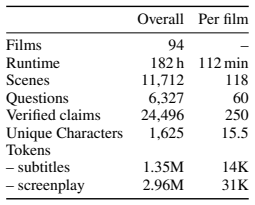
Table 2 :Dataset Size
원문 · CC BY 4.0 · Shaden Shaar, Bradon Thymes, Majd Aldaye, Claire Cardie, Bharath Hariharan · LF-VideoQA: Evaluating Long-Video Understanding with Long-Form Theory-of-Mind Questions · 원문 그림 인용 · 원본 PDF 6쪽에서 그림 영역을 추출했습니다.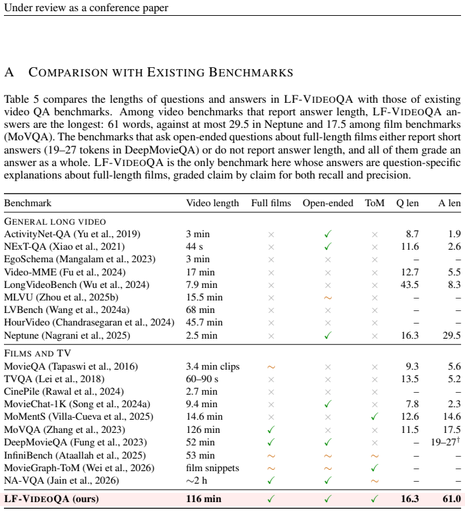
Table 5 :LF-VIDEOQA beside existing video QA benchmarks, as reported by each paper.Full films: questions are asked over entire feature films (∼: clips or selected snippets of films, or a mix of films and shorter videos).Open-ended: answers are free text (∼: some tasks).ToM: questions target characters’ mental states (∼: some question categories). Q len and A len are mean words; where answers are not open-ended, A len is the length of the correct option; –: not reported. †Tokens, as reported by DeepMovieQA. Each LF-VIDEOQA question draws on 4.2 scenes spanning 23 minutes on average, and in o200k tokens its questions and answers average 21 and 75 (Table 1).
원문 · CC BY 4.0 · Shaden Shaar, Bradon Thymes, Majd Aldaye, Claire Cardie, Bharath Hariharan · LF-VideoQA: Evaluating Long-Video Understanding with Long-Form Theory-of-Mind Questions · 원문 그림 인용 · 원본 PDF 15쪽에서 그림 영역을 추출했습니다.스크린플레이에서 질문과 루브릭을 자동으로 만드는 과정
구축 파이프라인은 스크린플레이를 장면 단위로 나누고, 대사를 자막에 맞춰 시간 구간을 부여하는 것에서 시작합니다. 이후 장면별 사건을 분해하여 각 인물의 1차 믿음과 메타 믿음을 추출하고, 이 믿음 기록을 질문 생성의 근거로 씁니다. 질문 작성자는 중심 인물, 앵커 장면, 질문 유형을 고정한 context-set만 보고 질문과 주장 개요를 만듭니다. 이때 질문은 장소나 사건의 이름으로 순간을 가리키되 결과를 미리 말하지 않도록 제한됩니다. 이어서 각 주장은 스크린플레이와 대조되어 지지, 미지지, 모순으로 판정되며, 지지되는 주장만 남습니다. 남은 주장 중 질문이 요구하는 주장이 핵심 주장이고, 전제 역할의 주장은 맥락 주장으로 구분됩니다.
질문과 주장을 생성하고 검증하는 데에는 gpt-5.6-sol이 쓰였고, 장면 분해와 믿음 기록에는 Qwen3.5-27B가 쓰였습니다.
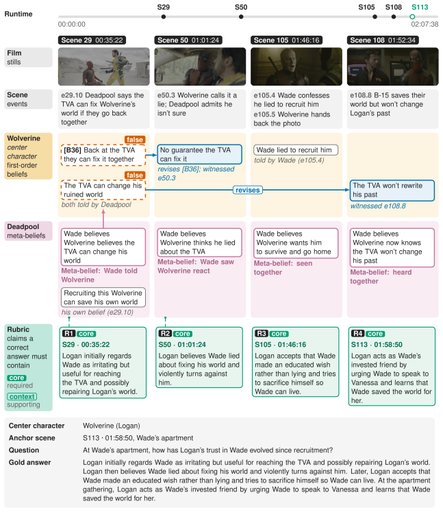
Figure 1 :Dataset Construction on an Example.This figure shows (question, answer, rubric) fromDeadpool & Wolverine(2024).Preprocessing:screenplay scenes are time-stamped against the subtitles and decomposed into scene events.Character belief annotation:scene by scene, we extract and verify each character’s first-order beliefs and meta-beliefs.Question generation and verification:for a center character (Wolverine) and an anchor (scene 113), we generate the triple and verify every rubric claim against the screenplay.
원문 · CC BY 4.0 · Shaden Shaar, Bradon Thymes, Majd Aldaye, Claire Cardie, Bharath Hariharan · LF-VideoQA: Evaluating Long-Video Understanding with Long-Form Theory-of-Mind Questions · 원문 그림 인용 · 원본 PDF 2쪽에서 그림 영역을 추출했습니다.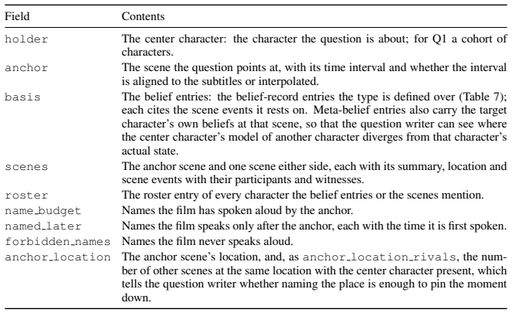
Table 6 : Fields of a context-set, given to the question writer as JSON.
원문 · CC BY 4.0 · Shaden Shaar, Bradon Thymes, Majd Aldaye, Claire Cardie, Bharath Hariharan · LF-VideoQA: Evaluating Long-Video Understanding with Long-Form Theory-of-Mind Questions · 원문 그림 인용 · 원본 PDF 17쪽에서 그림 영역을 추출했습니다.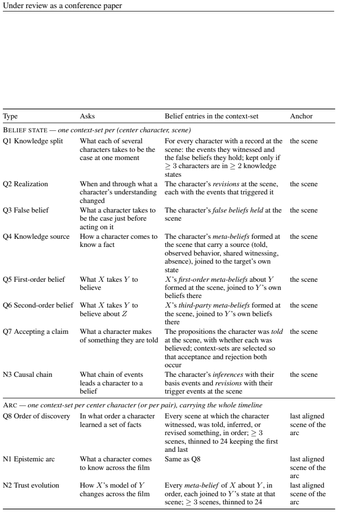
Table 7 : Belief entries of each question type. For Q1, the center character is a group of characters.
원문 · CC BY 4.0 · Shaden Shaar, Bradon Thymes, Majd Aldaye, Claire Cardie, Bharath Hariharan · LF-VideoQA: Evaluating Long-Video Understanding with Long-Form Theory-of-Mind Questions · 원문 그림 인용 · 원본 PDF 21쪽에서 그림 영역을 추출했습니다.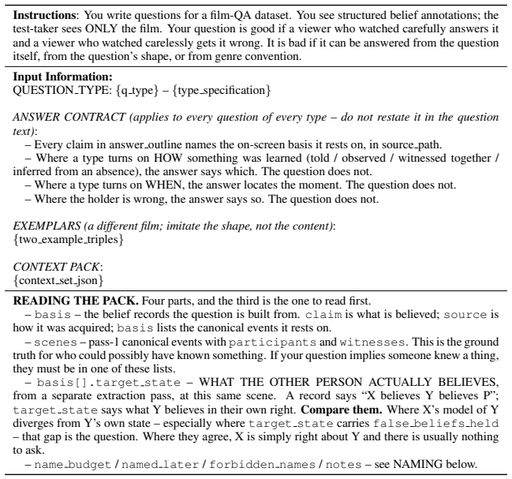
Table 23 :Prompt for writing the question (Stage 1).
원문 · CC BY 4.0 · Shaden Shaar, Bradon Thymes, Majd Aldaye, Claire Cardie, Bharath Hariharan · LF-VideoQA: Evaluating Long-Video Understanding with Long-Form Theory-of-Mind Questions · 원문 그림 인용 · 원본 PDF 46쪽에서 그림 영역을 추출했습니다.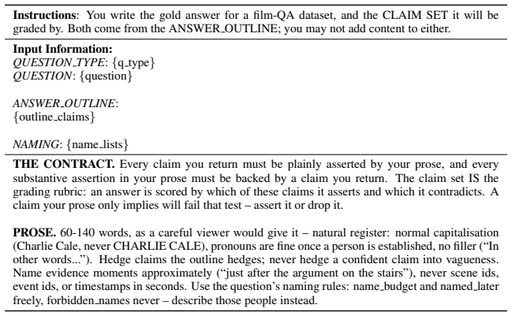
Table 24 :Prompt for writing the reference answer and rubric (Stage 2).
원문 · CC BY 4.0 · Shaden Shaar, Bradon Thymes, Majd Aldaye, Claire Cardie, Bharath Hariharan · LF-VideoQA: Evaluating Long-Video Understanding with Long-Form Theory-of-Mind Questions · 원문 그림 인용 · 원본 PDF 48쪽에서 그림 영역을 추출했습니다.주장 단위 재현율과 정밀도로 답변 채점하기
평가는 답변을 한 덩어리의 텍스트로 비교하지 않고, 각 질문의 루브릭 주장을 하나씩 판정합니다. LLM 판정자는 각 루브릭 주장을 asserted, contradicted, omitted 가운데 하나로 표시합니다. 질문 q에서 핵심 주장 집합을 C_q, 답변이 언급한 주장 집합을 A_q, 모순된 주장 집합을 X_q라 하면, recall은 |A_q ∩ C_q| / |C_q|로 계산됩니다. precision은 |A_q| / (|A_q| + |X_q|)로 계산되며, 이는 답변이 주장한 루브릭 항목 가운데 모순되지 않은 비율입니다. F1은 두 값의 조화 평균입니다. 이 값들은 질문마다 계산한 뒤 평균하여 보고됩니다.
판정자 신뢰도는 150개 질문에 대한 사람 검증과, 판정자 세 개 사이의 claim 수준 일치도 분석으로 점검되었습니다.
입력 표현에 따른 성능 차이
스크린플레이 오라클 설정에서 Qwen3.8 27B는 F1 0.544, recall 0.509, precision 0.703을 기록했습니다. 완전한 기준을 가진 입력에서도 recall이 절반을 넘지 못하므로, 긴 맥락에서 증거를 찾고 종합하는 일은 여전히 어렵습니다. 같은 모델에서 스크린플레이를 자막으로 바꾸면 F1은 0.175로 떨어집니다. 비디오 캡션만 입력하면 Qwen3.6의 F1은 0.016에 그치고, 자막만 입력하면 0.165, 캡션과 자막을 함께 입력하면 0.244가 됩니다. 직접 비디오 입력에서는 영상만 쓸 때 F1이 0.099이고, 자막과 함께 쓸 때 0.304입니다. 에이전트 설정에서 일반 에이전트의 F1은 0.201, 스크린플레이를 제공받은 오라클 에이전트는 0.332이며, 두 값 모두 스크린플레이 기반 Qwen3.6의 0.505보다 낮습니다.
따라서 증거 위치 찾기의 개선은 도움이 되지만 그것만으로 완전한 종합 답변이 만들어지지는 않습니다. 캡션과 자막의 결합도 모든 모델에서 이득을 주지는 않아서, Qwen3.8은 캡션과 자막을 함께 쓸 때 F1이 0.112로 자막 단독 0.175보다 낮습니다.
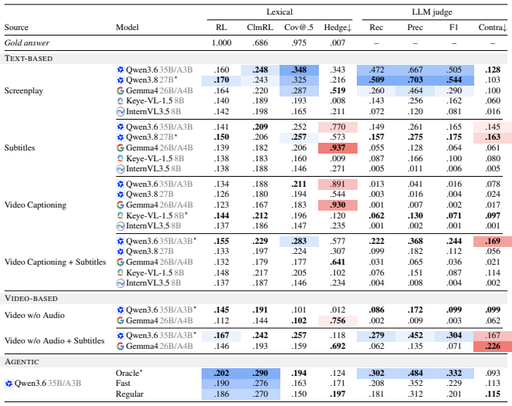
Table 3 :Results on LF-VIDEOQA.Rows are answerer models; in the video-captioning answerer also write the captions. Rec, Prec, F1, and Contra follow Section 3.3. Blue: five best values across all runs; red: five worst values of Hedge and Contra.Bold: highest value within a source.
원문 · CC BY 4.0 · Shaden Shaar, Bradon Thymes, Majd Aldaye, Claire Cardie, Bharath Hariharan · LF-VideoQA: Evaluating Long-Video Understanding with Long-Form Theory-of-Mind Questions · 원문 그림 인용 · 원본 PDF 8쪽에서 그림 영역을 추출했습니다.평가의 범위와 남은 불확실성
사람 검증은 두 주석자가 150개 질문과 494개 주장을 점검한 결과이며, 보고된 일치도는 우연 보정 기준에서 제한적입니다. 그래서 검증 결과가 우호적으로 보이더라도 재현성에 대한 결론은 제한됩니다. 판정자 사이의 claim 수준 일치도는 κ 기준 0.71에서 0.78 사이로 보고되어, 판정 결과가 판정자 선택에 따라 달라질 수 있음을 보여 줍니다. 또한 오라클 스크린플레이조차 완전한 답을 만들지 못하므로, 높은 점수가 곧 완전한 이해를 뜻하지는 않습니다. 평가 대상은 최신 영화 94편과 특정 오픈소스 VLM 계열에 한정됩니다.
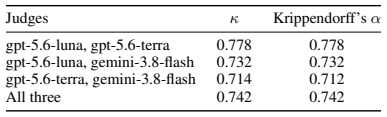
Table 8 :Claim-level agreement between judgeson 27,875 claim verdicts (asserted, contradicted, or omitted).κis Cohen’s for a pair of judges and Fleiss’ for all three.
원문 · CC BY 4.0 · Shaden Shaar, Bradon Thymes, Majd Aldaye, Claire Cardie, Bharath Hariharan · LF-VideoQA: Evaluating Long-Video Understanding with Long-Form Theory-of-Mind Questions · 원문 그림 인용 · 원본 PDF 22쪽에서 그림 영역을 추출했습니다.논문 정보
- 저자
- Shaden Shaar, Bradon Thymes, Majd Aldaye, Claire Cardie, Bharath Hariharan
- 학회·저널
- arXiv · 프리프린트
- 최초 공개일
- 2026년 10월 30일
- 등록일
- 2026년 11월 3일
- 수정일
- 2026년 10월 30일
- 버전
- v1
- arXiv
- 2611.00383
- 분류
- cs.CV · cs.AI · cs.CL
- 원문 이용 조건
- CC BY 4.0
- 제공 범위
- 논문 정보, 해설, 허용된 원문 그림
AI 해설은 논문 원문과 별개의 설명이며 오류가 있을 수 있습니다. 원문과 그림은 각 출처의 이용 조건과 따로 표시된 권리를 따릅니다.
초록
The hardest part of understanding a long video is not pinpointing any one moment but synthesizing many, e.g., answering a question that requires tracking what develops across hours of content and articulating how the pieces fit together. To date, most long-video QA datasets require only a short answer or a multiple-choice selection, oversimplifying the long-video understanding task to retrieval. We introduce LF-VideoQA, a dataset for long-form, open-ended question answering over long narrative videos built on theory-of-mind questions: a character's belief depends on everything they have seen or been told, so each question demands assembling and reasoning from evidence distributed across the video. The dataset contains more than 6,300 questions on 94 recent films; each requires reasoning over scenes spanning an average of 23 minutes and comes with a question-specific rubric for recall and precision scoring. The dataset is created entirely automatically by annotating screenplays with scene events and each character's first-order beliefs and meta-beliefs, then generating (question, answer, rubric) triples through LLM-based question generation and verification; human studies validate their quality. We evaluate four families of state-of-the-art open-source VLMs across three settings and find the task highly challenging: (i) even an oracle with access to the screenplay falls well short of complete answers; (ii) the best non-oracle model attains barely half of the recall level of the oracle; (iii) unlike on prior long-video benchmarks, captions and subtitles underperform the video itself, indicating that the questions need visual evidence; and (iv) recall is the predominant bottleneck, with answers omitting many required rubric claims.
원문 인용
Shaden Shaar, Bradon Thymes, Majd Aldaye, Claire Cardie, Bharath Hariharan (2026). LF-VideoQA: Evaluating Long-Video Understanding with Long-Form Theory-of-Mind Questions. arXiv:2611.00383v1. https://arxiv.org/abs/2611.00383v1
BibTeX
@misc{shaar2026videoqa,
  title = {{LF-VideoQA: Evaluating Long-Video Understanding with Long-Form Theory-of-Mind Questions}},
  author = {Shaden Shaar and Bradon Thymes and Majd Aldaye and Claire Cardie and Bharath Hariharan},
  year = {2026},
  eprint = {2611.00383},
  archivePrefix = {arXiv},
  url = {https://arxiv.org/abs/2611.00383v1}
}