논문 해설
Continual Learning from Demonstration of Robotics Skills
로봇 기술의 시연 기반 지속 학습
- 연구 문제 과거 시연 데이터를 저장하지 않고 로봇이 여러 궤적 학습 과제를 순차적으로 익히면서 이전 과제를 기억하는 문제를 다룹니다.
- 연구 방법 하이퍼네트워크가 과제 임베딩으로 NODE 파라미터를 생성하고, 정규화된 두 단계 학습으로 과제를 추가합니다.
- 주요 결과 LASA에서 하이퍼네트워크는 과제별 기준선과 비슷한 궤적 오차를 유지하며 파라미터 증가를 과제당 256개로 제한합니다.
순차적 궤적 학습에서 생기는 망각 문제
로봇이 새로운 동작을 배울 때 이전 동작을 잊지 않으려면 어떤 방식이 필요한지가 이 논문의 출발점입니다. 기존 학습 방법은 대개 하나의 동작을 한 번에 학습하므로, 여러 동작을 순서대로 익히면 나중에 배운 동작이 이전 동작을 덮어씁니다. 여러 동작을 다루려면 과제마다 모델을 따로 만들거나 모든 시연 데이터를 함께 학습해야 하는데, 전자는 파라미터가 늘고 후자는 과거 데이터를 저장해야 합니다.
이 논문은 시연 학습(Learning from Demonstration)을 지속 학습으로 확장하여, 과거 시연 데이터를 다시 학습하지 않고 과제를 순차적으로 추가하는 문제를 다룹니다. 원문은 이 방향을 궤적 학습에서의 첫 연구로 제시합니다.
하이퍼네트워크와 NODE의 결합
제안 방법에서 NODE는 궤적을 예측하는 과제 학습기이며, 하이퍼네트워크는 각 과제의 NODE 파라미터를 생성하는 메타 모델입니다. 하이퍼네트워크는 과제 임베딩 벡터를 입력으로 받아 목표 네트워크의 파라미터를 출력합니다. 과제 임베딩은 과제마다 학습되며, 테스트 시 해당 과제의 임베딩을 넣으면 그 과제의 NODE가 만들어집니다.
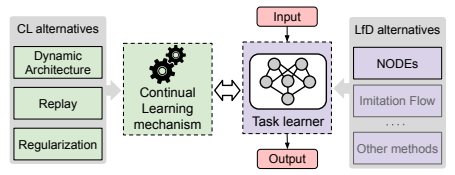
Figure 2 : Overview of a continual learning system. The task learner performs the task we are interested in (pur- ple dashed box) and the continual learning mechanism (green dashed box) mitigates the effect of catastrophic forgetting. The continual learning (CL) mechanism can be one of many alternatives: dynamic architecture-based, replay-based, or regularization-based. For learning from demonstration (LfD), the task learner can be any trajectory learning approach, but we use NODEs for LfD (reasons are detailed in Sec. 4.1). Methods depicted with gray text are not considered for continual LfD in this paper.
원문 · CC BY 4.0 · Sayantan Auddy, Jakob Hollenstein, Matteo Saveriano, Antonio Rodríguez-Sánchez, Justus Piater · Continual Learning from Demonstration of Robotics Skills · 원문 그림 인용 · 원본 PDF 7쪽에서 그림 영역을 추출했습니다.학습은 두 단계로 진행됩니다. 먼저 현재 과제의 손실을 줄이는 하이퍼네트워크 파라미터의 변화량을 구하고, 이어서 이전 과제 임베딩으로 계산한 정규화 항을 포함한 손실로 실제 변화를 학습합니다. 이 정규화는 이전 과제에서 생성되는 파라미터가 크게 바뀌지 않도록 하는 역할을 합니다. 청크 하이퍼네트워크는 파라미터를 여러 청크로 나누어 생성하며, 청크 임베딩을 과제 임베딩과 함께 입력받아 하이퍼네트워크 출력 차원을 줄입니다.
LASA 순차 학습 결과
LASA 벤치마크의 처음 26개 과제를 순서대로 학습한 실험에서 하이퍼네트워크(HN)는 단일 NODE를 과제마다 두는 기준선(SG)과 비슷한 궤적 오차를 유지했습니다. 원문은 HN의 파라미터 크기가 과제마다 256개씩만 늘어난다고 보고하며, 26개 과제 후 HN의 크기는 4.3×10^6, SG의 결합 크기는 52.2×10^6으로 제시합니다.
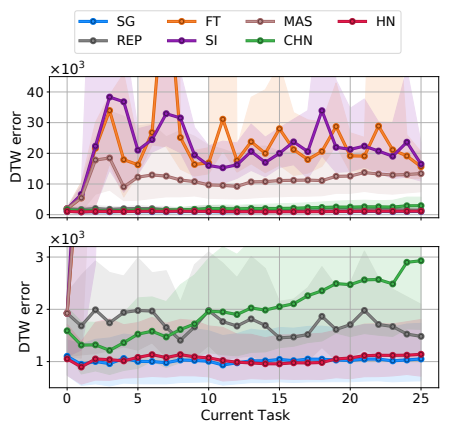
Figure 4 : DTW errors of trajectories predicted for the LASA dataset (lower is better). The x-axis shows the current task. After learning a task (using NODET), all current and previous tasks are evaluated. HN performs as well as SG but with negligible growth in parameter size. Lines show medians and shaded regions denote the lower and upper quartiles of the errors over 5 independent seeds. (top) The DTW errors for all methods. (bottom) A zoomed-in view of the methods that perform well.
원문 · CC BY 4.0 · Sayantan Auddy, Jakob Hollenstein, Matteo Saveriano, Antonio Rodríguez-Sánchez, Justus Piater · Continual Learning from Demonstration of Robotics Skills · 원문 그림 인용 · 원본 PDF 13쪽에서 그림 영역을 추출했습니다.지속 학습 지표에서 HN은 NODET 설정에서 CLscore 0.88을 기록했고, 미세조정(FT)과 SI, MAS는 낮은 ACC를 보였습니다. 이 수치들은 5개 독립 시드의 중앙값이며, 학습 시간은 과제가 늘수록 HN과 CHN에서 증가한다고 원문이 밝힙니다.
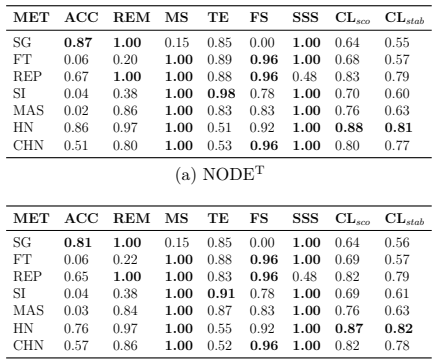
Table 1 : Continual learning metrics for the LASA dataset (median over 5 seeds). Values range from 0 (worst) to 1 (best).
원문 · CC BY 4.0 · Sayantan Auddy, Jakob Hollenstein, Matteo Saveriano, Antonio Rodríguez-Sánchez, Justus Piater · Continual Learning from Demonstration of Robotics Skills · 원문 그림 인용 · 원본 PDF 14쪽에서 그림 영역을 추출했습니다.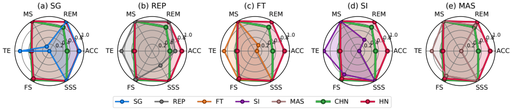
Figure 8 : Continual learning metrics (0: worst, 1: best) for the different methods (with NODET) on the LASA dataset. In (a)-(e), each of the baseline methods is compared against HN and CHN to illustrate the different tradeoffs made by the methods. HN shows good performance for almost all metrics (apart from TE, in which it performs moderately). CHN is similar to HN in terms of TE but scores lower in REM and ACC. REP also performs well but has a low score for SSS, and the other methods fail in multiple metrics.
원문 · CC BY 4.0 · Sayantan Auddy, Jakob Hollenstein, Matteo Saveriano, Antonio Rodríguez-Sánchez, Justus Piater · Continual Learning from Demonstration of Robotics Skills · 원문 그림 인용 · 원본 PDF 14쪽에서 그림 영역을 추출했습니다.HelloWorld와 RoboTasks에서의 확인
HelloWorld 데이터셋은 로봇이 7개 글자를 쓰도록 기록한 2차원 궤적이며, 이 실험에서는 SG, REP, HN, CHN의 궤적 오차가 거의 같고 FT, SI, MAS는 뚜렷한 망각을 보였습니다. 원문은 NODET의 시간 입력이 루프가 있는 궤적 학습에 필요하다고 보고합니다.
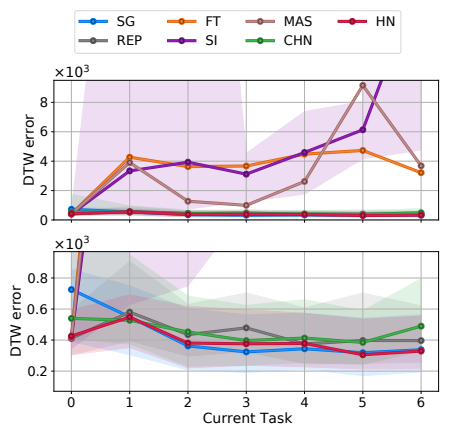
Figure 9 : DTW errors of trajectories predicted for the HelloWorld dataset (lower is better). The x-axis shows the current task. After learning a task (using NODET), all current and previous tasks are evaluated. Lines show medians and shaded regions denote the lower and upper quartiles of the errors over 5 independent seeds. (top) The DTW errors for all methods. (bottom) A zoomed-in view of the methods that perform well. The performance of SG, REP, HN and CHN are nearly identical and much better than FT, SI and MAS.
원문 · CC BY 4.0 · Sayantan Auddy, Jakob Hollenstein, Matteo Saveriano, Antonio Rodríguez-Sánchez, Justus Piater · Continual Learning from Demonstration of Robotics Skills · 원문 그림 인용 · 원본 PDF 15쪽에서 그림 영역을 추출했습니다.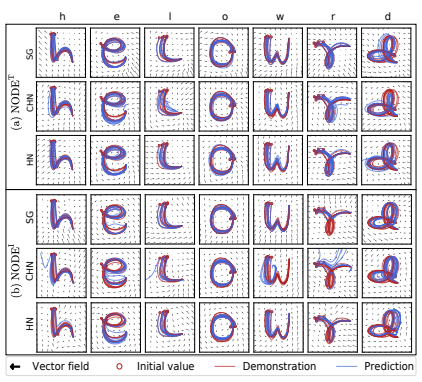
Figure 10 : Example of trajectories predicted by SG, CHN and HN using NODET for all past HelloWorld tasks after learning the last task. With NODET, even trajectories with loops can be learned. HN and CHN (with NODET) can remember all past tasks.
원문 · CC BY 4.0 · Sayantan Auddy, Jakob Hollenstein, Matteo Saveriano, Antonio Rodríguez-Sánchez, Justus Piater · Continual Learning from Demonstration of Robotics Skills · 원문 그림 인용 · 원본 PDF 16쪽에서 그림 영역을 추출했습니다.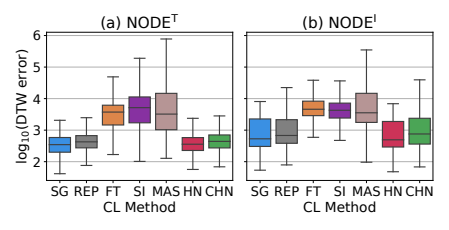
Figure 11 : DTW errors (lower is better) of all trajectory predictions during the learning of all tasks of the Hel- loWorld dataset. Results are obtained using 5 independent seeds. HN, CHN perform as well as the upper baseline SG.
원문 · CC BY 4.0 · Sayantan Auddy, Jakob Hollenstein, Matteo Saveriano, Antonio Rodríguez-Sánchez, Justus Piater · Continual Learning from Demonstration of Robotics Skills · 원문 그림 인용 · 원본 PDF 16쪽에서 그림 영역을 추출했습니다.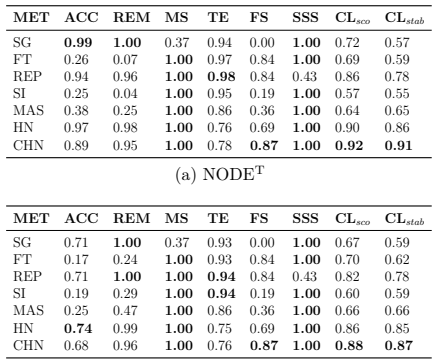
Table 3 : Continual learning metrics for the HelloWorld dataset (median over 5 seeds). Values range from 0 (worst) to 1 (best).
원문 · CC BY 4.0 · Sayantan Auddy, Jakob Hollenstein, Matteo Saveriano, Antonio Rodríguez-Sánchez, Justus Piater · Continual Learning from Demonstration of Robotics Skills · 원문 그림 인용 · 원본 PDF 16쪽에서 그림 영역을 추출했습니다.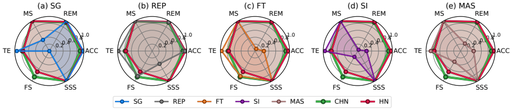
Figure 12 : Continual learning metrics (0: worst, 1: best) for the different methods (with NODET) on the HelloWorld dataset. In (a)-(e), each of the baseline methods is compared against HN and CHN to illustrate the different tradeoffs made by the methods. The hypernetwork methods (HN,CHN) show good performance for all metrics whereas the other methods perform well only in some metrics and poorly for others.
원문 · CC BY 4.0 · Sayantan Auddy, Jakob Hollenstein, Matteo Saveriano, Antonio Rodríguez-Sánchez, Justus Piater · Continual Learning from Demonstration of Robotics Skills · 원문 그림 인용 · 원본 PDF 16쪽에서 그림 영역을 추출했습니다.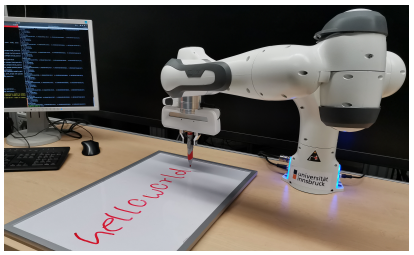
Figure 13 : After being continually trained using learning from demonstration to write single letters, the robot can reproduce all the trajectories that it has learned in the past with a single HN network and without having access to training data from past tasks. Video is available at https://youtu.be/0gdIImIBnXc.
원문 · CC BY 4.0 · Sayantan Auddy, Jakob Hollenstein, Matteo Saveriano, Antonio Rodríguez-Sánchez, Justus Piater · Continual Learning from Demonstration of Robotics Skills · 원문 그림 인용 · 원본 PDF 17쪽에서 그림 영역을 추출했습니다.RoboTasks 데이터셋은 4개의 위치·방향 과제로 구성되며, 위치 궤적에서는 SG, REP, HN이 거의 같고 CHN이 약간 나쁘며 방향 궤적에서는 SG, REP, CHN, HN이 비슷하다고 원문이 보고합니다. 실제 로봇에서 과거 과제를 재현한 결과도 함께 제시됩니다.
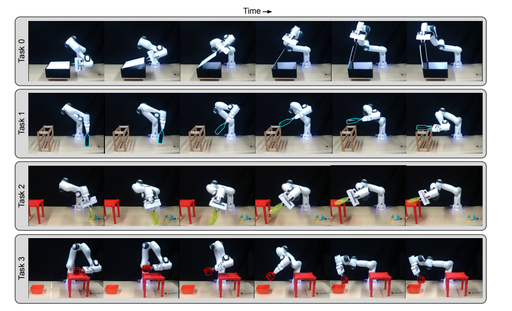
Figure 1 : A robot, continually trained using learning from demonstration to perform real-world tasks involving changing positions and orientations of the end-effector, can reproduce all the tasks that it has learned in the past with negligible parameter growth and without retraining on past tasks. The order of tasks during sequential training is 0: box opening, 1: bottle shelving, 2: plate stacking, 3: pouring. Video of the robot performing these tasks is available at https://youtu.be/0gdIImIBnXc. Further details can be found in Sec. 5.3.3.
원문 · CC BY 4.0 · Sayantan Auddy, Jakob Hollenstein, Matteo Saveriano, Antonio Rodríguez-Sánchez, Justus Piater · Continual Learning from Demonstration of Robotics Skills · 원문 그림 인용 · 원본 PDF 2쪽에서 그림 영역을 추출했습니다.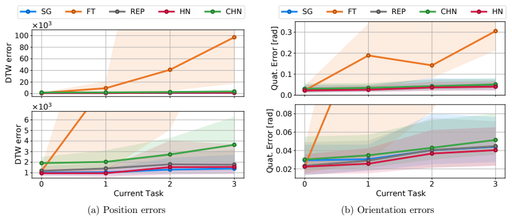
Figure 14 : Position (a) and orientation (b) errors of trajectories predicted for the RoboTasks dataset (lower is better). The x-axis shows thecurrent task. After learning a task (using NODET), all current and previous tasks are evaluated. Lines show medians and shaded regions denote the lower and upper quartiles of the errors over 5 independent seeds. (top row) The errors for all methods are plotted. (bottom row) A detailed view of the methods that perform well. The performance of HN is comparable to the upper baseline SG.
원문 · CC BY 4.0 · Sayantan Auddy, Jakob Hollenstein, Matteo Saveriano, Antonio Rodríguez-Sánchez, Justus Piater · Continual Learning from Demonstration of Robotics Skills · 원문 그림 인용 · 원본 PDF 18쪽에서 그림 영역을 추출했습니다.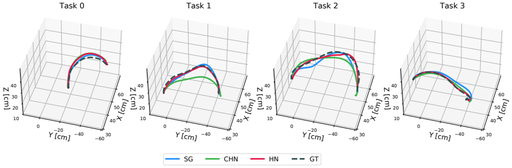
Figure 15 : Example of end-effector position trajectories predicted for all past tasks after sequentially learning all the tasks of the RoboTasks dataset. All methods employ NODET as the trajectory learning method. Hypernetworks (HN and CHN) remember all past tasks and mimic the demonstrations accurately.
원문 · CC BY 4.0 · Sayantan Auddy, Jakob Hollenstein, Matteo Saveriano, Antonio Rodríguez-Sánchez, Justus Piater · Continual Learning from Demonstration of Robotics Skills · 원문 그림 인용 · 원본 PDF 18쪽에서 그림 영역을 추출했습니다.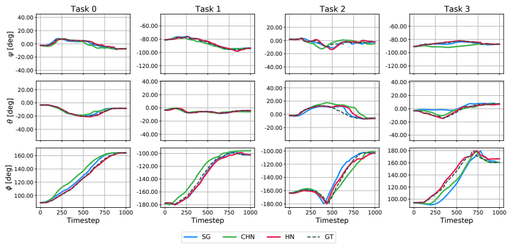
Figure 16 : Example of end-effector orientation trajectories predicted for all past tasks after sequentially learning all the tasks of the RoboTasks dataset. All methods employ NODET as the trajectory learning method. The ground truth demonstrations as well as the predictions of the orientation consist of a sequence of unit quaternions. Here, we convert each quaternion in the sequence to its corresponding Euler angle representation (z-y-x convention) for easier interpretation. Columns show the predictions for each task, and rows show the different Euler angles in degrees. A figure with the original quaternion sequences can be seen in Fig. A.4. Hypernetworks (HN and CHN) remember all past tasks and mimic the ground truth orientations accurately.
원문 · CC BY 4.0 · Sayantan Auddy, Jakob Hollenstein, Matteo Saveriano, Antonio Rodríguez-Sánchez, Justus Piater · Continual Learning from Demonstration of Robotics Skills · 원문 그림 인용 · 원본 PDF 19쪽에서 그림 영역을 추출했습니다.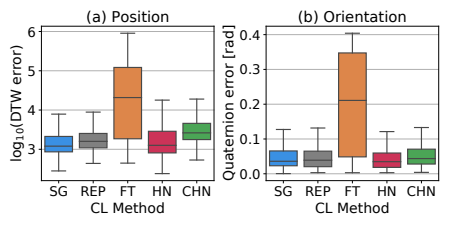
Figure 17 : Prediction errors (lower is better) showing DTW position errors (a) and Quaternion orientation errors (b) of all trajectory predictions during the learning of all tasks of the RoboTasks dataset. Results are obtained using 5 independent seeds. Overall, HN and CHN produce low errors which are comparable to the performance of the upper baseline SG.
원문 · CC BY 4.0 · Sayantan Auddy, Jakob Hollenstein, Matteo Saveriano, Antonio Rodríguez-Sánchez, Justus Piater · Continual Learning from Demonstration of Robotics Skills · 원문 그림 인용 · 원본 PDF 19쪽에서 그림 영역을 추출했습니다.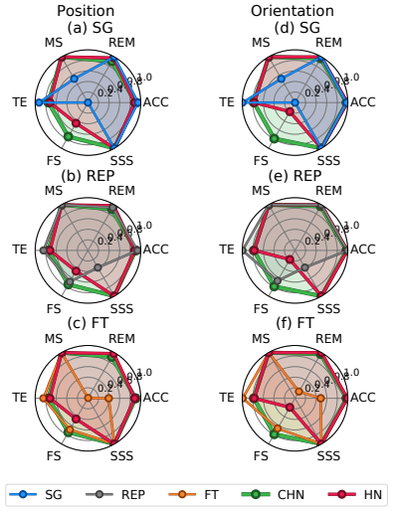
Figure 18 : Continual learning metrics (0: worst, 1: best) for the different methods (with NODET) on the RoboTasks dataset. In each individual plot, one of the baseline meth- ods is compared against HN and CHN to illustrate the different tradeoffs made by the methods. The first column (a)-(c) shows the results for position, and the second col- umn (d)-(f) shows the results for orientation. Across all metrics, CHN shows good performance for both position and orientation. HN exhibits a similar performance but due to its bigger size, achieves a low score for FS for orientation. REP’s score for SSS is low due to its requirement of storing training data of all tasks. SG and FT achieve low scores in multiple metrics.
원문 · CC BY 4.0 · Sayantan Auddy, Jakob Hollenstein, Matteo Saveriano, Antonio Rodríguez-Sánchez, Justus Piater · Continual Learning from Demonstration of Robotics Skills · 원문 그림 인용 · 원본 PDF 20쪽에서 그림 영역을 추출했습니다.학습 시간과 안정성의 한계
원문은 하이퍼네트워크 기반 접근의 한계로 학습 시간 증가를 명시합니다. 정규화 항이 과제마다 추가되므로 HN은 LASA에서 과제 0을 620초, 과제 25를 1609초에 학습한다고 보고됩니다. 원문은 샘플 기반 정규화로 이를 줄일 수 있다고 제안하지만 이 논문에서는 실험하지 않았다고 밝힙니다.
또한 NODE 자체는 예측 궤적의 안정성을 보장하는 메커니즘이 없다고 원문이 명시합니다. 저자들은 CHN이 초기 조건 변화에 더 견고하다는 부록 결과를 함께 보고하지만, 이것이 안정성 보장을 의미하지는 않습니다.
논문 정보
- 저자
- Sayantan Auddy, Jakob Hollenstein, Matteo Saveriano, Antonio Rodríguez-Sánchez, Justus Piater
- 학회·저널
- arXiv · 프리프린트
- 최초 공개일
- 2022년 2월 14일
- 등록일
- 2026년 11월 6일
- 수정일
- 2023년 4월 12일
- 버전
- v4
- arXiv
- 2202.06843
- 분류
- cs.RO · cs.LG
- 원문 이용 조건
- CC BY 4.0
- 제공 범위
- 논문 정보, 해설, 허용된 원문 그림
AI 해설은 논문 원문과 별개의 설명이며 오류가 있을 수 있습니다. 원문과 그림은 각 출처의 이용 조건과 따로 표시된 권리를 따릅니다.
초록
Methods for teaching motion skills to robots focus on training for a single skill at a time. Robots capable of learning from demonstration can considerably benefit from the added ability to learn new movement skills without forgetting what was learned in the past. To this end, we propose an approach for continual learning from demonstration using hypernetworks and neural ordinary differential equation solvers. We empirically demonstrate the effectiveness of this approach in remembering long sequences of trajectory learning tasks without the need to store any data from past demonstrations. Our results show that hypernetworks outperform other state-of-the-art continual learning approaches for learning from demonstration. In our experiments, we use the popular LASA benchmark, and two new datasets of kinesthetic demonstrations collected with a real robot that we introduce in this paper called the HelloWorld and RoboTasks datasets. We evaluate our approach on a physical robot and demonstrate its effectiveness in learning real-world robotic tasks involving changing positions as well as orientations. We report both trajectory error metrics and continual learning metrics, and we propose two new continual learning metrics. Our code, along with the newly collected datasets, is available at https://github.com/sayantanauddy/clfd.
원문 인용
Sayantan Auddy, Jakob Hollenstein, Matteo Saveriano, Antonio Rodríguez-Sánchez, Justus Piater (2022). Continual Learning from Demonstration of Robotics Skills. arXiv:2202.06843v4. https://arxiv.org/abs/2202.06843v4
BibTeX
@misc{auddy2022continual,
  title = {{Continual Learning from Demonstration of Robotics Skills}},
  author = {Sayantan Auddy and Jakob Hollenstein and Matteo Saveriano and Antonio Rodríguez-Sánchez and Justus Piater},
  year = {2022},
  eprint = {2202.06843},
  archivePrefix = {arXiv},
  url = {https://arxiv.org/abs/2202.06843v4}
}