논문 해설
GlossGau: Efficient Inverse Rendering for Glossy Surface with Anisotropic Spherical Gaussian
GlossGau: 이방성 구면 가우시안을 활용한 광택 표면의 효율적인 역렌더링
- 연구 문제 3D-GS는 실시간 렌더링이 가능하지만 SH 외관 표현의 한계로 광택 표면의 specular 하이라이트를 충분히 재구성하지 못합니다.
- 연구 방법 GlossGau는 2D Gaussian Splatting 기반 surfel을 사용하고, specular BRDF의 법선 분포를 ASG로 근사하며, 법선 정규화와 세 단계 학습을 결합합니다.
- 주요 결과 NeRF Synthetic에서 PSNR 평균은 33.41로 2D-GS의 32.67보다 높습니다. Glossy Synthetic에서는 PSNR 평균이 26.77로 GaussianShader의 27.31보다 낮으며, 학습 시간은 0.34h로 보고됩니다.
3D-GS의 광택 표면 한계
3D Gaussian Splatting(3D-GS)은 3D Gaussian 표현과 타일 기반 splatting으로 실시간 렌더링을 가능하게 합니다. 그러나 외관을 저차 Spherical Harmonics(SH)로 표현하기 때문에 고주파 정보를 잘 담지 못하고, 그 결과 광택 표면의 specular 하이라이트와 view-dependent 변화를 충분히 재구성하지 못합니다. 기존에 3D-GS 위에 역렌더링을 얹은 방법들은 specular 표현을 개선했지만 학습과 렌더링 효율이 떨어져 3D-GS의 장점을 잃는다고 원문은 지적합니다. GlossGau는 이 지점에서 광택 표면의 specular 외관을 재구성하면서도 학습과 렌더링 속도를 3D-GS에 가깝게 유지하는 것을 목표로 합니다.
이 연구는 알려진 카메라 포즈를 가진 다중 시점 이미지를 입력으로 사용합니다.
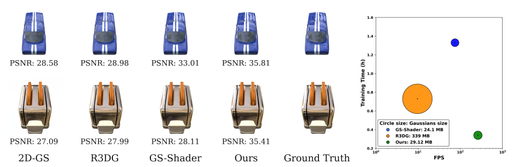
Figure 1 . GlossGau preserves the real-time rendering capabilities of 3D-GS while producing photorealistic images across diverse surface materials. Our method successfully captures glossy highlights and shadowing without compromising the quality of surrounding areas. GlossGau utilizes less storage space and optimizes at faster speed compared with [20] and [15].
원문 · CC BY 4.0 · Bang Du, Runfa Blark Li, Chen Du, Truong Nguyen · GlossGau: Efficient Inverse Rendering for Glossy Surface with Anisotropic Spherical Gaussian · 원문 그림 인용 · 원본 PDF 1쪽에서 그림 영역을 추출했습니다.Surfel 기반 Gaussian과 ASG 기반 specular 항
GlossGau는 2D Gaussian Splatting을 기반 primitive로 사용합니다. 각 Gaussian은 두 접선 벡터와 스케일로 정의되는 평면 surfel이며, 법선은 두 접선 벡터의 외적으로 명시적으로 정의됩니다. 조명은 전역 16x32 direct environment map과 Gaussian별 3차 SH로 표현되는 간접 조명 성분으로 분해됩니다. 색은 diffuse 성분 cd와 specular 성분 cs의 합으로 나뉘며, SH가 저주파를 낮은 비용으로 담당하므로 BRDF 파라미터는 specular 성분 cs에만 계산합니다. specular 항은 simplified Disney 모델의 형태를 따르며, 그중 normal distribution function D를 Anisotropic Spherical Gaussian(ASG)으로 근사합니다.
등방성 SG를 쓰는 기존 방식은 여러 SG의 혼합이 필요해 최적화 부담이 생기지만, ASG는 적은 수의 함수로 이방성 분포를 표현합니다. 렌더링 단계에서는 SG로 표현한 법선 분포를 view 방향으로 늘리는 warping 연산을 적용해 실제 BRDF에 더 가까운 ASG를 얻으며, 이때 추가 파라미터는 추정하지 않습니다. 따라서 2D Gaussian의 ASG 파라미터는 표면 법선과 roughness에 의해 결정됩니다.
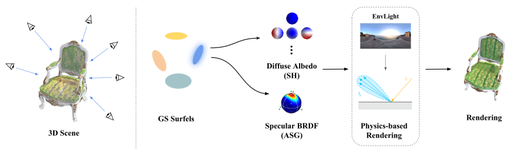
Figure 2 . GlossGau Pipeline. Our framework initializes with surfel-based Gaussian primitives, where each primitive carries both geometric attributes (position, covariance, and opacity) and appearance properties. The appearance representation decomposes into view-dependent diffuse albedo, parameterized via Spherical Harmonics, and specular BRDF terms, modeled through Anisotropic Spherical Gaussians. The final rendering integrates these material maps with differentiable environment lighting to achieve high-fidelity inverse rendering results.
원문 · CC BY 4.0 · Bang Du, Runfa Blark Li, Chen Du, Truong Nguyen · GlossGau: Efficient Inverse Rendering for Glossy Surface with Anisotropic Spherical Gaussian · 원문 그림 인용 · 원본 PDF 3쪽에서 그림 영역을 추출했습니다.법선 정규화와 학습 단계
표면 법선은 각 Gaussian의 최적화 가능한 속성으로 포함되며, photometric loss만으로는 재구성 artifact가 생길 수 있어 기하 정규화를 추가합니다. 렌더링된 normal map과 depth에서 유도한 법선 N의 정합을 손실 Ln으로 강제합니다. 또한 전경 마스크가 있을 때는 입력 alpha와 렌더링된 opacity의 차이를 L1로 제약하는 Lalpha를 사용합니다. 재질과 조명의 모호성을 줄이기 위해 중립적인 입사 조명 가정에 따른 Llight 정규화도 적용됩니다. 학습은 세 단계로 나뉩니다. 첫 단계에서는 photometric 및 alpha 제약만 사용하고, 둘째 단계에서 normal 정규화를 도입하며, 셋째 단계에서는 기하 속성을 고정한 채 색상 파라미터만 최적화합니다.
이 분리는 기하와 재질을 따로 다루기 위한 설계로 설명됩니다.
NeRF Synthetic 비교 결과
NeRF Synthetic 데이터셋의 novel view synthesis에서 PSNR 평균은 GlossGau가 33.41이고 2D-GS는 32.67, Scaffold-GS는 33.12, R3DG는 32.46입니다. 이 PSNR 평균 비교는 해당 표의 평균 열에서 확인되는 값입니다. SSIM과 LPIPS에서는 GlossGau가 모든 기준선보다 높거나 낮은 것이 아니라 근접한 수준입니다. 저자들은 이 데이터셋에서 point 기반 방법과 inverse rendering 방법에 대해 양적·지각적으로 비슷한 결과를 얻었다고 보고합니다. 따라서 이 결과는 NeRF Synthetic에서의 PSNR 평균 비교로 읽어야 하며, 모든 지표에서 우위라는 뜻은 아닙니다.
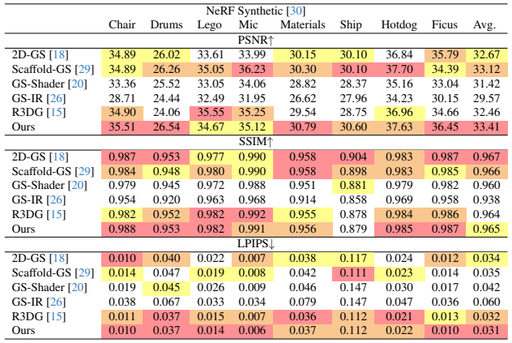
Table 1 . Quantitative comparisons on NeRF Synthetic dataset. We report color each cell as best , second best and third best .
원문 · CC BY 4.0 · Bang Du, Runfa Blark Li, Chen Du, Truong Nguyen · GlossGau: Efficient Inverse Rendering for Glossy Surface with Anisotropic Spherical Gaussian · 원문 그림 인용 · 원본 PDF 6쪽에서 그림 영역을 추출했습니다.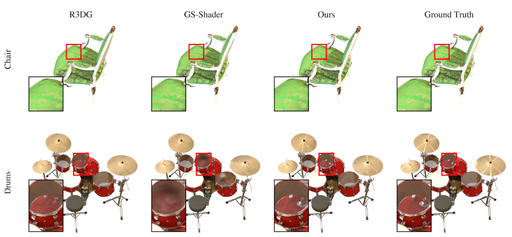
Figure 4 . The qualitative comparisons on NeRF Synthetic Dataset [ 30]. Our method renders the glossy surfaces with high fidelity and reconstructs accurate shadowing. Some areas are zoomed in for better visualization.
원문 · CC BY 4.0 · Bang Du, Runfa Blark Li, Chen Du, Truong Nguyen · GlossGau: Efficient Inverse Rendering for Glossy Surface with Anisotropic Spherical Gaussian · 원문 그림 인용 · 원본 PDF 7쪽에서 그림 영역을 추출했습니다.Glossy Synthetic과 Shiny Blender 결과
Glossy Synthetic 데이터셋의 PSNR 평균에서 GlossGau는 26.77이고, GaussianShader는 27.31로 더 높습니다. GlossGau의 평균 SSIM은 0.920으로 표에 함께 보고되며, 원문은 이 데이터셋에서 GaussianShader와 비교 가능하다고 설명합니다. 시각 비교에서는 비광택 영역의 잡음이 적고 하이라이트가 더 사실적으로 나타난다고 보고합니다. Shiny Blender 데이터셋의 시각 비교에서도 광택 표면과 반사 특성을 더 잘 재구성한다고 저자들은 서술합니다. 이 결과들은 각 데이터셋의 해당 표와 그림에서 확인되는 비교이며, 두 데이터셋 전반에서 항상 우위라는 결론은 아닙니다.
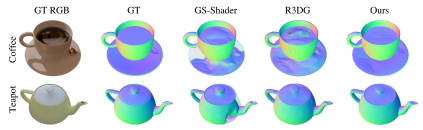
Figure 3 . Visualized normal results on Shiny Blender dataset [39]. It illustrates the superior normal estimation achieved by our method.
원문 · CC BY 4.0 · Bang Du, Runfa Blark Li, Chen Du, Truong Nguyen · GlossGau: Efficient Inverse Rendering for Glossy Surface with Anisotropic Spherical Gaussian · 원문 그림 인용 · 원본 PDF 5쪽에서 그림 영역을 추출했습니다.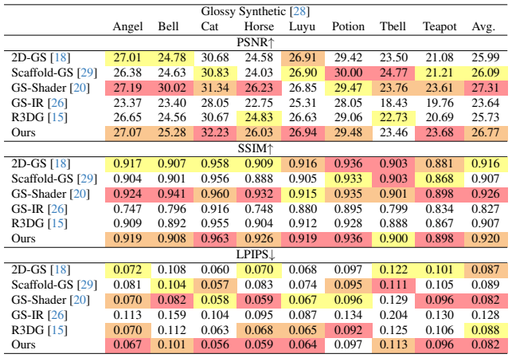
Table 2 . Quantitative comparisons on Glossy Synthetic. We report color each cell as best , second best and third best .
원문 · CC BY 4.0 · Bang Du, Runfa Blark Li, Chen Du, Truong Nguyen · GlossGau: Efficient Inverse Rendering for Glossy Surface with Anisotropic Spherical Gaussian · 원문 그림 인용 · 원본 PDF 6쪽에서 그림 영역을 추출했습니다.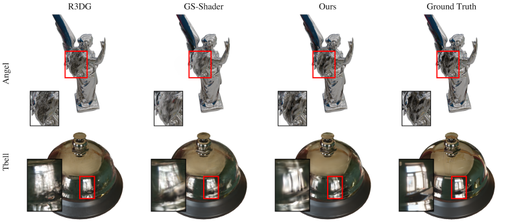
Figure 6 . The qualitative comparisons on Glossy Synthetic Dataset [ 28]. Our method accurately characterizes surface roughness and generates realistic and smooth reflection effects compared with prior GS-based inverse rendering methods.
원문 · CC BY 4.0 · Bang Du, Runfa Blark Li, Chen Du, Truong Nguyen · GlossGau: Efficient Inverse Rendering for Glossy Surface with Anisotropic Spherical Gaussian · 원문 그림 인용 · 원본 PDF 8쪽에서 그림 영역을 추출했습니다.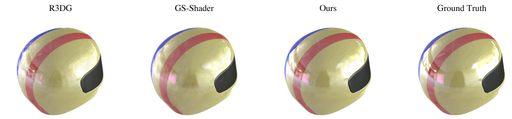
Figure 7 . Visualized comparisons on Shiny Blender Dataset [39].
원문 · CC BY 4.0 · Bang Du, Runfa Blark Li, Chen Du, Truong Nguyen · GlossGau: Efficient Inverse Rendering for Glossy Surface with Anisotropic Spherical Gaussian · 원문 그림 인용 · 원본 PDF 8쪽에서 그림 영역을 추출했습니다.학습 시간과 저장 비용
효율 비교는 NeRF 합성 데이터셋 객체의 평균으로 보고됩니다. 평균 학습 시간은 GlossGau가 0.34h이고, GS-Shader 1.03h, GS-IR 0.76h, R3DG 0.73h입니다. 저장 크기는 GlossGau가 29.12MB로 GS-Shader 24.10MB보다 크지만 R3DG 339MB보다 작습니다. 렌더링 FPS는 GlossGau가 262이며 GS-IR의 253과 비슷하고 GS-Shader의 75보다 높습니다. 저자들은 이 결과를 근거로 최적화 시간을 최대 66% 줄였다고 주장하지만, 이 수치는 같은 하드웨어에서의 측정에 기반한 저자 주장입니다. 따라서 저장 비용이 모든 기준선보다 낮다는 뜻이 아니라, 제시된 비교 대상에서 학습 시간과 저장 크기를 함께 본 결과입니다.
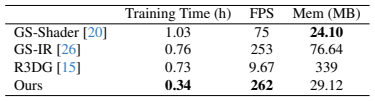
Table 3 . Comparisons over average training time, rendering FPS, and result memory size. Our method achieves the best competitive training/rendering speed with the lowest storage consumption.
원문 · CC BY 4.0 · Bang Du, Runfa Blark Li, Chen Du, Truong Nguyen · GlossGau: Efficient Inverse Rendering for Glossy Surface with Anisotropic Spherical Gaussian · 원문 그림 인용 · 원본 PDF 7쪽에서 그림 영역을 추출했습니다.정규화 제거 절제 실험
절제 실험은 NeRF Synthetic 데이터셋에서 수행됩니다. Normal regularization을 제거하고 photometric loss만 쓴 변형의 PSNR은 28.45이며, 전체 모델의 PSNR은 33.41입니다. 이 차이는 법선 정규화를 유지하는 쪽이 재구성 품질에 기여함을 보여 줍니다. 원문은 ASG warping과 phased training의 제거 결과도 같은 표에 보고하지만, 이 절에서는 정규화 축의 결과를 중심으로 읽습니다. 이 실험은 해당 데이터셋과 설정에서의 제거 효과이며, 다른 데이터셋이나 모든 구성요소에 대한 일반 인과 결론으로 확장할 수 없습니다.
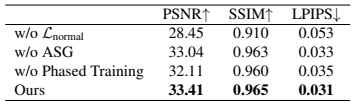
Table 4 . Ablation studies on Normal Regularization, ASG Warping, and Phased Training on NeRF Synthetic Dataset.
원문 · CC BY 4.0 · Bang Du, Runfa Blark Li, Chen Du, Truong Nguyen · GlossGau: Efficient Inverse Rendering for Glossy Surface with Anisotropic Spherical Gaussian · 원문 그림 인용 · 원본 PDF 8쪽에서 그림 영역을 추출했습니다.적용 범위와 남은 질문
원문은 GlossGau가 3D-GS 수준의 효율을 목표로 하며, 광택 표면에서 경쟁력 있는 재구성을 보인다고 설명합니다. 그러나 주요 평가는 NeRF Synthetic, Glossy Synthetic, Shiny Blender 데이터셋과 제시된 기준선에 한정됩니다. 여러 비교 결과에서 기준선이 PSNR이나 SSIM 등 일부 지표에서 더 높으며, 전체 지표의 우위는 확인되지 않습니다. 학습 시간 비교는 단일 GPU 환경의 측정에 기반하므로 다른 하드웨어의 결과를 같은 수치로 옮길 수 없습니다. 원문이 명시한 범위 밖의 장면이나 다른 재질에 대한 일반화는 이 논문의 근거로 판단할 수 없습니다.
논문 정보
- 저자
- Bang Du, Runfa Blark Li, Chen Du, Truong Nguyen
- 학회·저널
- arXiv · 프리프린트
- 최초 공개일
- 2025년 2월 19일
- 등록일
- 2026년 11월 4일
- 수정일
- 2025년 2월 19일
- 버전
- v1
- arXiv
- 2502.14129
- 분류
- cs.CV
- 원문 이용 조건
- CC BY 4.0
- 제공 범위
- 논문 정보, 해설, 허용된 원문 그림
AI 해설은 논문 원문과 별개의 설명이며 오류가 있을 수 있습니다. 원문과 그림은 각 출처의 이용 조건과 따로 표시된 권리를 따릅니다.
초록
The reconstruction of 3D objects from calibrated photographs represents a fundamental yet intricate challenge in the domains of computer graphics and vision. Although neural reconstruction approaches based on Neural Radiance Fields (NeRF) have shown remarkable capabilities, their processing costs remain substantial. Recently, the advent of 3D Gaussian Splatting (3D-GS) largely improves the training efficiency and facilitates to generate realistic rendering in real-time. However, due to the limited ability of Spherical Harmonics (SH) to represent high-frequency information, 3D-GS falls short in reconstructing glossy objects. Researchers have turned to enhance the specular expressiveness of 3D-GS through inverse rendering. Yet these methods often struggle to maintain the training and rendering efficiency, undermining the benefits of Gaussian Splatting techniques. In this paper, we introduce GlossGau, an efficient inverse rendering framework that reconstructs scenes with glossy surfaces while maintaining training and rendering speeds comparable to vanilla 3D-GS. Specifically, we explicitly model the surface normals, Bidirectional Reflectance Distribution Function (BRDF) parameters, as well as incident lights and use Anisotropic Spherical Gaussian (ASG) to approximate the per-Gaussian Normal Distribution Function under the microfacet model. We utilize 2D Gaussian Splatting (2D-GS) as foundational primitives and apply regularization to significantly alleviate the normal estimation challenge encountered in related works. Experiments demonstrate that GlossGau achieves competitive or superior reconstruction on datasets with glossy surfaces. Compared with previous GS-based works that address the specular surface, our optimization time is considerably less.
원문 인용
Bang Du, Runfa Blark Li, Chen Du, Truong Nguyen (2025). GlossGau: Efficient Inverse Rendering for Glossy Surface with Anisotropic Spherical Gaussian. arXiv:2502.14129v1. https://arxiv.org/abs/2502.14129v1
BibTeX
@misc{du2025glossgau,
  title = {{GlossGau: Efficient Inverse Rendering for Glossy Surface with Anisotropic Spherical Gaussian}},
  author = {Bang Du and Runfa Blark Li and Chen Du and Truong Nguyen},
  year = {2025},
  eprint = {2502.14129},
  archivePrefix = {arXiv},
  url = {https://arxiv.org/abs/2502.14129v1}
}