논문 해설
DONeRF: Towards Real-Time Rendering of Compact Neural Radiance Fields using Depth Oracle Networks
DONeRF: 깊이 오라클 네트워크를 이용한 컴팩트 신경 복사장의 실시간 렌더링을 향하여
- 연구 문제 NeRF는 광선마다 많은 샘플에 네트워크를 평가해 실시간 렌더링이 어렵습니다.
- 연구 방법 깊이 오라클 네트워크가 광선당 한 번 샘플 위치를 예측하고, 셰이딩 네트워크가 소수 샘플로 색을 누적합니다.
- 주요 결과 DONeRF는 표 2 설정에서 NeRF와 비교해 2~4 샘플에서 동등하거나 더 나은 품질을 보이며 계산량은 48배에서 78배 적다고 보고됩니다.
NeRF의 실시간 렌더링 병목
NeRF는 광선마다 많은 샘플에 대해 네트워크를 평가하므로 실시간 렌더링에 큰 계산 비용이 듭니다. 원문은 VR 헤드셋 해상도와 90 Hz 조건에서 256개 네트워크 평가를 가정하면 약 37 petaFLOPS가 필요하다고 계산합니다. 이 논문은 장면 표면 주변에만 샘플을 배치하면 광선당 샘플 수를 크게 줄일 수 있다는 관찰에서 출발합니다.
깊이 오라클과 지역 샘플링 셰이딩 네트워크
DONeRF는 두 개의 네트워크로 구성됩니다. 깊이 오라클 네트워크는 광선당 한 번 평가되어 샘플이 놓일 구간의 분류 결과를 출력하고, 셰이딩 네트워크는 그 위치의 소수 샘플에서 색을 누적합니다. 오라클의 분류 출력은 구간별 상수 확률 밀도로 해석되어 누적 분포 함수를 거쳐 샘플 위치로 변환됩니다. 학습 중에는 정답 깊이로부터 만든 분류 목표를 사용하고, 추론에서는 필터링 없이 오라클 출력만 사용합니다.
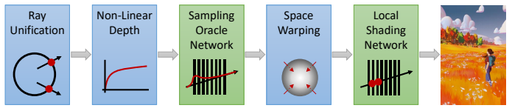
Figure 2 : To enable efficient rendering of large-scale neural representations, DONeRF uses a five stage pipeline: (1) ray descriptions are unified within a view cell, (2) depth is considered in a non-linear space, (3) an oracle network estimates the importance of samples, (4) sample positions are warped towards the view cell, and (5) radiance is generated from the shading MLP with only a few samples along each ray.
원문 · CC BY 4.0 · Thomas Neff, Pascal Stadlbauer, Mathias Parger, Andreas Kurz, Joerg H. Mueller, Chakravarty R. Alla Chaitanya, Anton Kaplanyan, Markus Steinberger · DONeRF: Towards Real-Time Rendering of Compact Neural Radiance Fields using Depth Oracle Networks · 원문 그림 인용 · 원본 PDF 3쪽에서 그림 영역을 추출했습니다.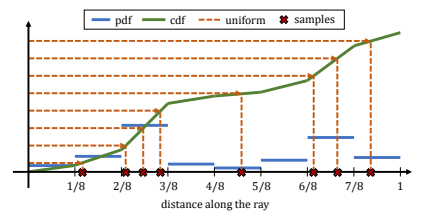
Figure 9 : To place samples along the ray, we treat the classified depth output from the oracle as a piecewise-constant PDF (blue) and translate it into a CDF (green). Sampling the CDF at uniform steps (orange) concentrates samples (red×) around regions with a high classification value.
원문 · CC BY 4.0 · Thomas Neff, Pascal Stadlbauer, Mathias Parger, Andreas Kurz, Joerg H. Mueller, Chakravarty R. Alla Chaitanya, Anton Kaplanyan, Markus Steinberger · DONeRF: Towards Real-Time Rendering of Compact Neural Radiance Fields using Depth Oracle Networks · 원문 그림 인용 · 원본 PDF 6쪽에서 그림 영역을 추출했습니다.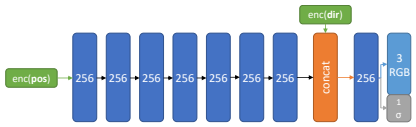
Figure 14 : For evaluation, we use the same MLP architecture for both NeRF and DONeRF: 8 layers with 256 hidden units each, with a single skip connection to forward the encoded directions to the last layer. For the depth oracle network, we do not use a skip connection. The inputs and outputs are described in Section 5.1.
원문 · CC BY 4.0 · Thomas Neff, Pascal Stadlbauer, Mathias Parger, Andreas Kurz, Joerg H. Mueller, Chakravarty R. Alla Chaitanya, Anton Kaplanyan, Markus Steinberger · DONeRF: Towards Real-Time Rendering of Compact Neural Radiance Fields using Depth Oracle Networks · 원문 그림 인용 · 원본 PDF 13쪽에서 그림 영역을 추출했습니다.샘플 배치 전략과 로그·워핑 변환
샘플 배치 방식은 uniform, 로그 비선형, log+warp, NDC, 지역 샘플링으로 비교됩니다. 로그 비선형은 가까운 구간에 샘플을 더 모읍니다. log+warp는 여기에 뷰 셀 중심 방향의 역제곱근 기반 공간 워핑을 더해 배경의 고주파가 위치 인코딩에서 줄어들도록 합니다. NDC 샘플링은 모든 샘플이 평균 카메라 프레임의 앞쪽 반구에 있을 때만 적용할 수 있습니다. 원문의 절제 결과에서 log+warp는 uniform 대비 샘플 수를 절반으로 줄여도 같은 품질을 얻는다고 보고됩니다.
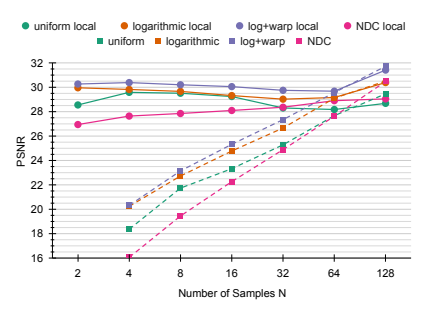
Figure 5 : Average PSNR results for various sample reduction schemes over the sample count N. Uniform sampling roughly in- creases quality by 1.8 dB for each doubling of N. logarithmic in- creases PSNR by1.3 dB and inverse square root warping (log+warp) adds another 0.6 dB on top. Sampling in NDC only manages to sur- pass uniform sampling at 128 samples. When sampling around the ground truth depth ( local), the number of samples hardly affects quality. Still, PSNR roughly increases by0.75 dB with logarithmic and another 0.6 dB with log+warp. Local NDC sampling performs worse than all other local sampling approaches until N = 32.
원문 · CC BY 4.0 · Thomas Neff, Pascal Stadlbauer, Mathias Parger, Andreas Kurz, Joerg H. Mueller, Chakravarty R. Alla Chaitanya, Anton Kaplanyan, Markus Steinberger · DONeRF: Towards Real-Time Rendering of Compact Neural Radiance Fields using Depth Oracle Networks · 원문 그림 인용 · 원본 PDF 4쪽에서 그림 영역을 추출했습니다.분류 목표와 필터링
오라클은 깊이 값을 회귀하지 않고 광선 구간의 분류 문제로 학습합니다. 첫 표면이 속한 구간에는 1, 그 밖에는 0을 주는 one-hot 목표를 BCE 손실로 학습합니다. 여기에 이미지 공간과 깊이 축의 필터를 적용해 불연속 주변의 목표를 부드럽게 만들며, 필터는 학습 목표에만 쓰이고 추론에는 쓰이지 않습니다. 필터는 위양성을 늘리는 대신 위음성을 줄이는 방향으로 작동합니다.
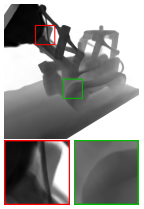
Figure 6 : (a) A depth oracle network with a single depth output smooths depth around discontinuities. (b) As a result, local sampling mixes fore- and background and distorts features. (c) This becomes apparent when compared to the ground truth.
원문 · CC BY 4.0 · Thomas Neff, Pascal Stadlbauer, Mathias Parger, Andreas Kurz, Joerg H. Mueller, Chakravarty R. Alla Chaitanya, Anton Kaplanyan, Markus Steinberger · DONeRF: Towards Real-Time Rendering of Compact Neural Radiance Fields using Depth Oracle Networks · 원문 그림 인용 · 원본 PDF 5쪽에서 그림 영역을 추출했습니다.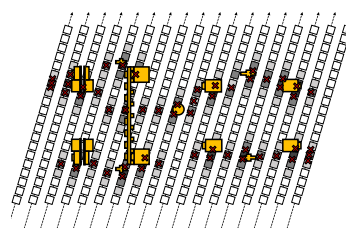
Figure 7 : A horizontal slice through theBulldozer dataset. Filtering the depth classification target (black = 1, white = 0) in both image dimensions and along depth smooths the classification target. An oracle producing such an output still results in high quality sample locations (red×), with additional samples placed in free space. A smooth target is easier to learn as labels vary with lower frequency.
원문 · CC BY 4.0 · Thomas Neff, Pascal Stadlbauer, Mathias Parger, Andreas Kurz, Joerg H. Mueller, Chakravarty R. Alla Chaitanya, Anton Kaplanyan, Markus Steinberger · DONeRF: Towards Real-Time Rendering of Compact Neural Radiance Fields using Depth Oracle Networks · 원문 그림 인용 · 원본 PDF 5쪽에서 그림 영역을 추출했습니다.
Figure 8 : Visualization of the classified depth target for 16 classes along each ray and the largest classes mapped toG, R, B, i.e., a green value indicates a single class with the brightness encoding depth; a gray value means that all classes are at similar depth; and different colors in proximity indicate that classes vary. Small features are smoothed to neighboring pixels with increasing filter sizes (1-5-9).
원문 · CC BY 4.0 · Thomas Neff, Pascal Stadlbauer, Mathias Parger, Andreas Kurz, Joerg H. Mueller, Chakravarty R. Alla Chaitanya, Anton Kaplanyan, Markus Steinberger · DONeRF: Towards Real-Time Rendering of Compact Neural Radiance Fields using Depth Oracle Networks · 원문 그림 인용 · 원본 PDF 6쪽에서 그림 영역을 추출했습니다.품질과 계산량 비교
표 2 설정에서 DONeRF는 NeRF와 비교해 2~4개 샘플에서 동등하거나 더 나은 PSNR을 보고합니다. 원문은 이 구간에서 48배에서 78배 적은 광선당 FLOP를 보고합니다. NSVF, LLFF, NeX와의 비교에서도 DONeRF는 여러 장면에서 품질과 효율 절충이 좋다고 보고됩니다. 다만 LLFF는 계산량이 가장 작고 NeX는 렌더링이 빠르다고 보고되므로, DONeRF가 모든 지표에서 최선이라는 뜻은 아닙니다.
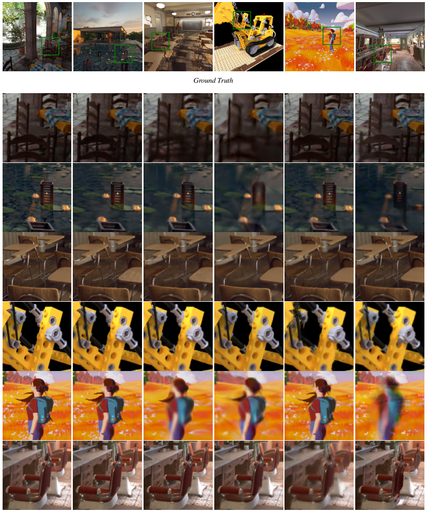
Figure 11 : Even on our challenging dataset, DONeRF achieves higher quality on average than all other methods at only 4 samples per ray. NeRF manages to faithfully reconstruct smaller scenes such as Bulldozer and Barbershop, but struggles with large-scale scenes such as Forest or highly complex geometry such as in Classroom. NSVF shows worse quality on average compared to DONeRF-4 at increased memory requirements and much worse performance. Although LLFF requires significantly more memory, it still struggles to represent fine details accurately, even at a cropped field of view. NeX achieves good quality forSan Miguel, but larger rotations and offsets from its reference pose cause significant artifacts due to its explicit MPI representation.
원문 · CC BY 4.0 · Thomas Neff, Pascal Stadlbauer, Mathias Parger, Andreas Kurz, Joerg H. Mueller, Chakravarty R. Alla Chaitanya, Anton Kaplanyan, Markus Steinberger · DONeRF: Towards Real-Time Rendering of Compact Neural Radiance Fields using Depth Oracle Networks · 원문 그림 인용 · 원본 PDF 8쪽에서 그림 영역을 추출했습니다.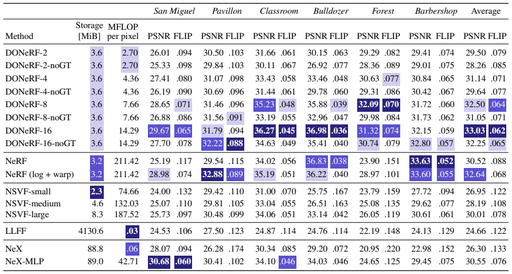
Table 2 : Across all our test scenes, DONeRF shows a significant improvement in quality-speed tradeoff, beating NeRF in most scenes with only 2− 4 samples per ray, resulting in 48× to 78× fewer FLOP per pixel at equal or better quality. Where NSVF struggles to achieve a consistent quality or performance for our tested scenes, especially for larger scenes such asForest, DONeRF performs consistently well across all scales. LLFF is the cheapest to compute, but fails to replicate the quality of the other methods, in addition to requiring storage that scales unfavorably with the amount of training images. Although NeX is also very efficient at rendering, it suffers from artifacts related to the MPI representation when poses differ too much from the reference pose, and requires roughly24× the amount of storage to achieve worse quality than DONeRF across the board. NeX-MLP is able to remedy some of the artifacts at a cost of 9× worse performance compared to DONeRF-4. Finally, using depth maps extracted from a dense NeRF without depending on available ground truth depth, DONeRF-noGT still achieves the best tradeoff between performance, quality and storage overall. Top results in each column are color coded asT op 1, Top 2 and Top 3.
원문 · CC BY 4.0 · Thomas Neff, Pascal Stadlbauer, Mathias Parger, Andreas Kurz, Joerg H. Mueller, Chakravarty R. Alla Chaitanya, Anton Kaplanyan, Markus Steinberger · DONeRF: Towards Real-Time Rendering of Compact Neural Radiance Fields using Depth Oracle Networks · 원문 그림 인용 · 원본 PDF 9쪽에서 그림 영역을 추출했습니다.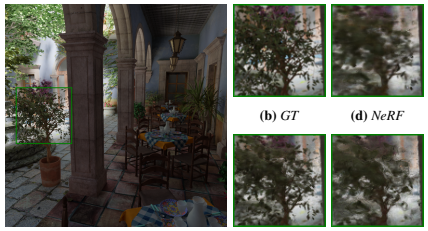
Figure 12 : (a) Example ground truth view of the test set of San Miguel with the corresponding inset (b). (c) DONeRF manages to preserve high-frequency detail around the leaves of the tree at only 4 samples per ray. (d) Although NeRF also preserves the tree faithfully, the edges are blurrier. (e) Even when trained with extracted NeRF depth maps (no GT depth), DONeRF produces slightly sharper results than NeRF.
원문 · CC BY 4.0 · Thomas Neff, Pascal Stadlbauer, Mathias Parger, Andreas Kurz, Joerg H. Mueller, Chakravarty R. Alla Chaitanya, Anton Kaplanyan, Markus Steinberger · DONeRF: Towards Real-Time Rendering of Compact Neural Radiance Fields using Depth Oracle Networks · 원문 그림 인용 · 원본 PDF 10쪽에서 그림 영역을 추출했습니다.한계와 적용 범위
원문은 투명 표면과 완전 반사 거울이 낮은 샘플 수와 단일 깊이 추정 때문에 완벽히 재현되기 어렵다고 설명합니다. 정답 깊이 없이 NeRF에서 추출한 깊이로 학습한 DONeRF-noGT는 평균적으로 약 1 dB 낮은 품질을 보입니다. 또한 평가는 정적 장면에 한정되며 동적 장면은 다루지 않았다고 명시됩니다.
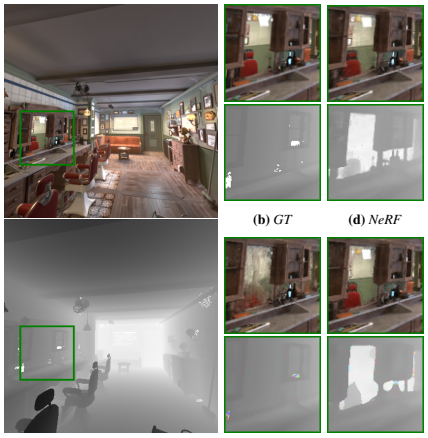
Figure 13 : (a) Example image and ground truth depth from theBar- bershop test set with the corresponding inset (b). (c) The reflective mirrors cannot be accurately represented by just sampling around the mirror’s depth in DONeRF . (d) NeRF places samples behind the mirror, constructing a virtual reflected room. (e) As depth maps extracted from NeRF include the virtual room, DONeRF-4-noGT learns to represent the mirrors with much fewer samples than NeRF.
원문 · CC BY 4.0 · Thomas Neff, Pascal Stadlbauer, Mathias Parger, Andreas Kurz, Joerg H. Mueller, Chakravarty R. Alla Chaitanya, Anton Kaplanyan, Markus Steinberger · DONeRF: Towards Real-Time Rendering of Compact Neural Radiance Fields using Depth Oracle Networks · 원문 그림 인용 · 원본 PDF 11쪽에서 그림 영역을 추출했습니다.논문 정보
- 저자
- Thomas Neff, Pascal Stadlbauer, Mathias Parger, Andreas Kurz, Joerg H. Mueller, Chakravarty R. Alla Chaitanya, Anton Kaplanyan, Markus Steinberger
- 학회·저널
- arXiv · 프리프린트
- 최초 공개일
- 2021년 3월 4일
- 등록일
- 2026년 11월 6일
- 수정일
- 2021년 6월 25일
- 버전
- v4
- arXiv
- 2103.03231
- DOI
- 10.1111/cgf.14340
- 분류
- cs.CV · cs.GR
- 원문 이용 조건
- CC BY 4.0
- 제공 범위
- 논문 정보, 해설, 허용된 원문 그림
AI 해설은 논문 원문과 별개의 설명이며 오류가 있을 수 있습니다. 원문과 그림은 각 출처의 이용 조건과 따로 표시된 권리를 따릅니다.
초록
The recent research explosion around implicit neural representations, such as NeRF, shows that there is immense potential for implicitly storing high-quality scene and lighting information in compact neural networks. However, one major limitation preventing the use of NeRF in real-time rendering applications is the prohibitive computational cost of excessive network evaluations along each view ray, requiring dozens of petaFLOPS. In this work, we bring compact neural representations closer to practical rendering of synthetic content in real-time applications, such as games and virtual reality. We show that the number of samples required for each view ray can be significantly reduced when samples are placed around surfaces in the scene without compromising image quality. To this end, we propose a depth oracle network that predicts ray sample locations for each view ray with a single network evaluation. We show that using a classification network around logarithmically discretized and spherically warped depth values is essential to encode surface locations rather than directly estimating depth. The combination of these techniques leads to DONeRF, our compact dual network design with a depth oracle network as its first step and a locally sampled shading network for ray accumulation. With DONeRF, we reduce the inference costs by up to 48x compared to NeRF when conditioning on available ground truth depth information. Compared to concurrent acceleration methods for raymarching-based neural representations, DONeRF does not require additional memory for explicit caching or acceleration structures, and can render interactively (20 frames per second) on a single GPU.
원문 인용
Thomas Neff, Pascal Stadlbauer, Mathias Parger, Andreas Kurz, Joerg H. Mueller, Chakravarty R. Alla Chaitanya, Anton Kaplanyan, Markus Steinberger (2021). DONeRF: Towards Real-Time Rendering of Compact Neural Radiance Fields using Depth Oracle Networks. arXiv:2103.03231v4. https://doi.org/10.1111/cgf.14340
BibTeX
@article{neff2021donerf,
  title = {{DONeRF: Towards Real-Time Rendering of Compact Neural Radiance Fields using Depth Oracle Networks}},
  author = {Thomas Neff and Pascal Stadlbauer and Mathias Parger and Andreas Kurz and Joerg H. Mueller and Chakravarty R. Alla Chaitanya and Anton Kaplanyan and Markus Steinberger},
  year = {2021},
  eprint = {2103.03231},
  archivePrefix = {arXiv},
  doi = {10.1111/cgf.14340},
  url = {https://arxiv.org/abs/2103.03231v4}
}