논문 해설
CIFAKE: Image Classification and Explainable Identification of AI-Generated Synthetic Images
CIFAKE: AI 생성 합성 이미지의 이미지 분류 및 설명 가능한 식별
- 연구 문제 AI가 생성한 사진 같은 이미지는 사람이 실제 사진과 구별하기 어려워, 데이터의 진위를 가려내는 자동화된 방법이 필요합니다.
- 연구 방법 CIFAR-10 클래스에 대응하는 합성 이미지를 Stable Diffusion 1.4로 만들어 실제와 합성 이미지를 CNN으로 이진 분류하고, Grad-CAM으로 판단 영역을 시각화합니다.
- 주요 결과 최적 구성은 92.98%의 정확도를 보였고, Grad-CAM에서 합성 이미지의 판단은 배경의 시각적 결함 영역에 집중되는 경향이 확인되었습니다.
AI 생성 이미지 식별의 필요성
생성 모델의 품질이 높아지면서 사람이 실제 사진과 AI가 만든 이미지를 육안으로 구분하기 어려워졌습니다. 이 논문은 이러한 상황에서 데이터 진위를 확인할 수 있는 컴퓨터 비전 방법이 필요하다고 봅니다. 연구의 범위는 CIFAR-10과 같은 10개 클래스의 소형 이미지를 대상으로 실제 이미지와 잠재 확산 모델(Latent Diffusion Models)로 생성한 이미지를 이진 분류하는 문제로 한정됩니다.
저자들은 이 문제를 해결하기 위해 두 가지를 함께 제시합니다. 하나는 실제 이미지와 합성 이미지를 묶은 CIFAKE 데이터셋이고, 다른 하나는 합성곱 신경망(CNN)으로 두 종류를 구분하고 Grad-CAM으로 판단 근거를 시각화하는 방법입니다.
실제 이미지와 합성 이미지의 데이터 구성
실제 이미지 클래스(REAL, 양성 값 1)는 CIFAR-10의 32×32 RGB 이미지에서 가져옵니다. CIFAR-10은 10개 클래스에 클래스당 6,000장씩 총 60,000장이며, 이 연구는 학습 이미지 50,000장을 REAL 학습에 사용하고 테스트 이미지 10,000장을 평가에 사용합니다.
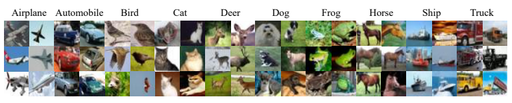
Figure 1 : Examples of images from the CIFAR-10 image classification dataset [24].
원문 · CC BY 4.0 · Jordan J. Bird, Ahmad Lotfi · CIFAKE: Image Classification and Explainable Identification of AI-Generated Synthetic Images · 원문 그림 인용 · 원본 PDF 4쪽에서 그림 영역을 추출했습니다.합성 이미지(FAKE, 값 0)는 Stable Diffusion 1.4를 사용해 생성합니다. 각 클래스에 대해 "a photograph of {a/an}"으로 시작하는 프롬프트에 클래스별 수식어를 붙여 다양성을 높이고, 수식어는 6,000장 생성에 고르게 사용됩니다. 생성한 합성 이미지는 512px로 만든 뒤 CIFAR-10과 같은 32px로 쌍선형 보간하여 줄입니다. 따라서 두 집합의 해상도는 맞춰져 있습니다.
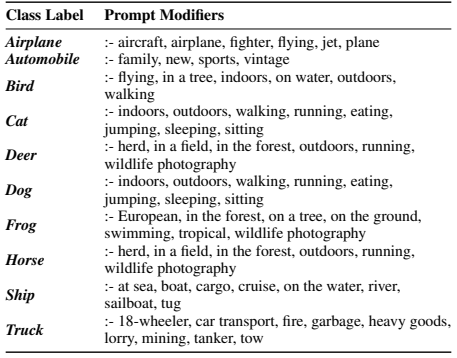
Table 1 : Latent Diffusion prompt modifiers for generating the 10-class synthetic dataset. All prompts are preceded by “a photograph of {a/an}” and modifiers are used equally for the 6000 images.
원문 · CC BY 4.0 · Jordan J. Bird, Ahmad Lotfi · CIFAKE: Image Classification and Explainable Identification of AI-Generated Synthetic Images · 원문 그림 인용 · 원본 PDF 4쪽에서 그림 영역을 추출했습니다.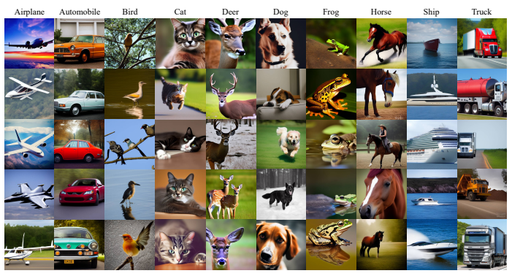
Figure 2 : Examples of AI-generated images within the dataset contributed by this study, selected at random with regards to their real CIFAR-10 equivalent labels.
원문 · CC BY 4.0 · Jordan J. Bird, Ahmad Lotfi · CIFAKE: Image Classification and Explainable Identification of AI-Generated Synthetic Images · 원문 그림 인용 · 원본 PDF 7쪽에서 그림 영역을 추출했습니다.CNN 분류기와 확률 출력
분류기는 합성곱 층과 완전연결 층으로 구성된 CNN입니다. 합성곱 층은 입력과 학습되는 필터의 곱을 이동하며 더하고, 활성화 함수 ReLU f(x)=max(0,x)를 적용하여 특징 맵을 만듭니다. 이후 풀링과 평탄화를 거쳐 밀집 층에 넘깁니다.
최종 출력은 단일 뉴런의 시그모이드 값입니다. 가까운 값일수록 REAL(1) 또는 FAKE(0) 쪽 가능성이 높다고 해석되며, 학습은 이진 교차 엔트로피 손실을 줄이는 방향으로 이루어집니다. 추론 시에는 이 출력값을 가장 가까운 값으로 반올림하여 클래스를 정합니다.
구조 탐색과 평가 지표
먼저 필터 수 {16, 32, 64, 128}과 합성곱 층 수 {1, 2, 3}을 조합하여 특징 추출기를 비교합니다. 그다음 가장 좋은 특징 추출기 위에 {32, 64, 128, 256, ..., 4096}개의 ReLU 뉴런을 갖는 밀집 층을 1~3개 쌓아 비교합니다. 이 과정에서 비교한 구조는 총 36개의 신경망입니다.
성능은 정밀도, 재현율, F1 score로 함께 봅니다. 정밀도는 거짓 양성을, 재현율은 거짓 음성을 분석하는 데 쓰이며, F1 score는 둘을 결합한 지표입니다. 저자들은 합성 이미지를 실제라고 놓치는 거짓 음성이 중요하다고 설명합니다.
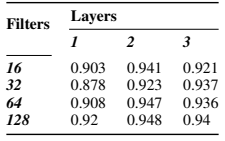
Table 4 : Observed validation precision for the filters within the Convolutional Neural Network.
원문 · CC BY 4.0 · Jordan J. Bird, Ahmad Lotfi · CIFAKE: Image Classification and Explainable Identification of AI-Generated Synthetic Images · 원문 그림 인용 · 원본 PDF 9쪽에서 그림 영역을 추출했습니다.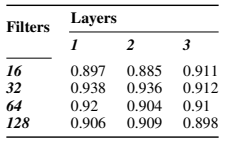
Table 5 : Observed validation recall for the filters within the Convolutional Neural Network.
원문 · CC BY 4.0 · Jordan J. Bird, Ahmad Lotfi · CIFAKE: Image Classification and Explainable Identification of AI-Generated Synthetic Images · 원문 그림 인용 · 원본 PDF 9쪽에서 그림 영역을 추출했습니다.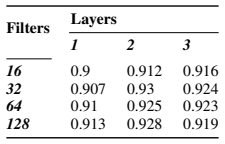
Table 6 : Observed validation F1-Score for the filters within the Convolutional Neural Network.
원문 · CC BY 4.0 · Jordan J. Bird, Ahmad Lotfi · CIFAKE: Image Classification and Explainable Identification of AI-Generated Synthetic Images · 원문 그림 인용 · 원본 PDF 9쪽에서 그림 영역을 추출했습니다.분류 결과와 최적 구성
특징 추출기 실험에서 2개 층, 32개 필터 구성의 손실이 가장 낮았고 0.18의 이진 교차 엔트로피를 보였습니다. 같은 실험에서 정확도가 가장 높았던 구성은 2개 층, 128개 필터로 92.98%였고 손실은 0.221이었습니다. 이 점수들은 검증 세트에서 보고된 값입니다.
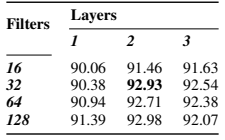
Table 2 : Observed classification accuracy metrics for feature extraction networks.
원문 · CC BY 4.0 · Jordan J. Bird, Ahmad Lotfi · CIFAKE: Image Classification and Explainable Identification of AI-Generated Synthetic Images · 원문 그림 인용 · 원본 PDF 8쪽에서 그림 영역을 추출했습니다.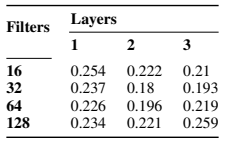
Table 3 : Observed validation loss for the filters within the Convolutional Neural Network.
원문 · CC BY 4.0 · Jordan J. Bird, Ahmad Lotfi · CIFAKE: Image Classification and Explainable Identification of AI-Generated Synthetic Images · 원문 그림 인용 · 원본 PDF 8쪽에서 그림 영역을 추출했습니다.밀집 층 실험에서는 단일 층 64개 뉴런 구성이 93.55%의 최고 정확도를 보였습니다. 그러나 F1 score 최댓값은 단일 밀집 층 64개 ReLU 구성의 0.936이었고, 저자들은 이 모델을 최종 구조 설명에 사용합니다. 요약에 나온 92.98%는 특징 추출기 실험의 최고 정확도이므로 밀집 층 실험의 정확도와 구분해야 합니다.
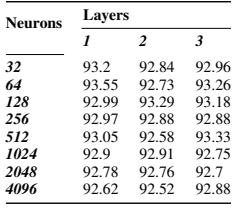
Table 7 : Observed validation accuracy for the dense layers within the Convolutional Neural Network.
원문 · CC BY 4.0 · Jordan J. Bird, Ahmad Lotfi · CIFAKE: Image Classification and Explainable Identification of AI-Generated Synthetic Images · 원문 그림 인용 · 원본 PDF 9쪽에서 그림 영역을 추출했습니다.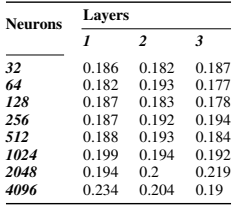
Table 8 : Observed validation loss for the dense layers within the Convolutional Neural Network.
원문 · CC BY 4.0 · Jordan J. Bird, Ahmad Lotfi · CIFAKE: Image Classification and Explainable Identification of AI-Generated Synthetic Images · 원문 그림 인용 · 원본 PDF 9쪽에서 그림 영역을 추출했습니다.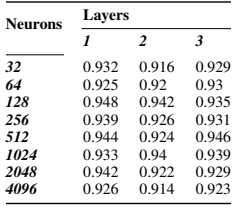
Table 9 : Observed validation precision for the dense layers within the Convolutional Neural Network.
원문 · CC BY 4.0 · Jordan J. Bird, Ahmad Lotfi · CIFAKE: Image Classification and Explainable Identification of AI-Generated Synthetic Images · 원문 그림 인용 · 원본 PDF 10쪽에서 그림 영역을 추출했습니다.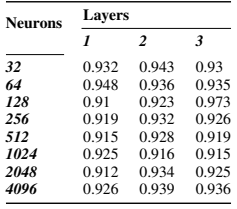
Table 10 : Observed validation recall for the dense layers within the Convolutional Neural Network.
원문 · CC BY 4.0 · Jordan J. Bird, Ahmad Lotfi · CIFAKE: Image Classification and Explainable Identification of AI-Generated Synthetic Images · 원문 그림 인용 · 원본 PDF 10쪽에서 그림 영역을 추출했습니다.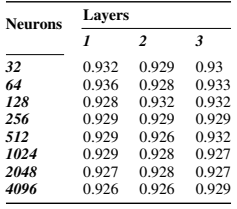
Table 11 : Observed validation F1-Score for the dense layers within the Convolutional Neural Network.
원문 · CC BY 4.0 · Jordan J. Bird, Ahmad Lotfi · CIFAKE: Image Classification and Explainable Identification of AI-Generated Synthetic Images · 원문 그림 인용 · 원본 PDF 10쪽에서 그림 영역을 추출했습니다.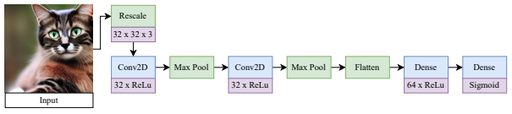
Figure 5 : An example of one of the final model architectures following hyperparameter search for the classification of real or AI-generated images.
원문 · CC BY 4.0 · Jordan J. Bird, Ahmad Lotfi · CIFAKE: Image Classification and Explainable Identification of AI-Generated Synthetic Images · 원문 그림 인용 · 원본 PDF 11쪽에서 그림 영역을 추출했습니다.Grad-CAM으로 본 판단 영역
Grad-CAM은 예측 클래스에 대한 기울기와 CNN의 특징 맵을 곱하고 합산한 뒤 ReLU를 적용하여 입력 이미지의 중요 영역을 히트맵으로 나타냅니다. 이 방법은 학습된 모델의 예측을 바꾸지 않고, 어느 위치가 출력에 기여했는지 시각화합니다.
시각화 결과, 실제 이미지의 판단은 이미지 전체에 걸쳐 넓게 분포하는 경향이 있었습니다. 반면 합성 이미지의 판단은 배경의 흐림이나 천의 무늬처럼 시각적 결함이 있을 만한 일부 영역에 집중되었습니다. 비행기, 새, 개구리, 말, 배 이미지에서는 개체 자체에 활성화가 거의 나타나지 않았습니다. 이 결과는 무작위로 고른 소수 이미지를 시각적으로 해석한 것이며, 정량적 위치 평가로 검증한 것은 아닙니다.
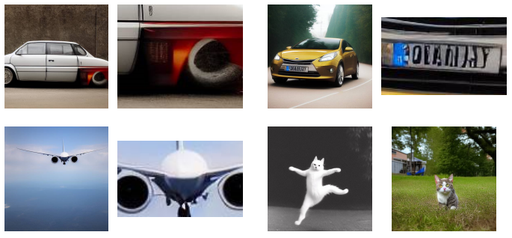
Figure 3 : Examples of visual defects found within the synthetic image dataset.
원문 · CC BY 4.0 · Jordan J. Bird, Ahmad Lotfi · CIFAKE: Image Classification and Explainable Identification of AI-Generated Synthetic Images · 원문 그림 인용 · 원본 PDF 7쪽에서 그림 영역을 추출했습니다.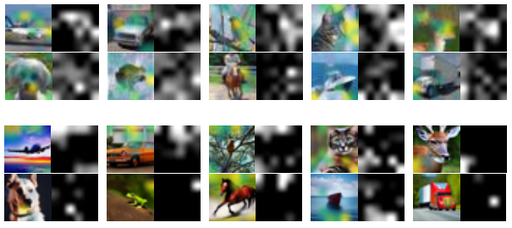
Figure 6 : Gradient class activation maps (Grad-CAM) overlays and raw heatmaps for prediction interpretation. Top examples show real images and bottom examples show AI-generated images. Brighter pixels represent features contributing to the output class label.
원문 · CC BY 4.0 · Jordan J. Bird, Ahmad Lotfi · CIFAKE: Image Classification and Explainable Identification of AI-Generated Synthetic Images · 원문 그림 인용 · 원본 PDF 11쪽에서 그림 영역을 추출했습니다.적용 범위와 남은 질문
이 결과는 CIFAR-10 클래스와 Stable Diffusion 1.4로 생성한 32px 이미지에서 얻은 것입니다. 저자들은 향후 더 새로운 생성 모델, 얼굴이나 임상 영상 등 다른 영역으로 데이터셋을 확장해야 한다고 제안합니다. 또한 어텐션 기반 방법이 분류와 설명 모두에서 대안이 될 수 있다고 언급합니다.
Grad-CAM 해석은 히트맵을 시각적으로 논의한 것이며, 이를 정량적으로 검증한 실험은 제시되지 않았습니다. 따라서 합성 이미지에서 결함 영역이 실제 판별 근거라는 결론은 이 조건과 시각적 해석의 범위 안에서 읽어야 합니다.
논문 정보
- 저자
- Jordan J. Bird, Ahmad Lotfi
- 학회·저널
- arXiv · 프리프린트
- 최초 공개일
- 2023년 3월 24일
- 등록일
- 2026년 11월 6일
- 수정일
- 2023년 3월 24일
- 버전
- v1
- arXiv
- 2303.14126
- 분류
- cs.CV · cs.AI · cs.LG
- 원문 이용 조건
- CC BY 4.0
- 제공 범위
- 논문 정보, 해설, 허용된 원문 그림
AI 해설은 논문 원문과 별개의 설명이며 오류가 있을 수 있습니다. 원문과 그림은 각 출처의 이용 조건과 따로 표시된 권리를 따릅니다.
초록
Recent technological advances in synthetic data have enabled the generation of images with such high quality that human beings cannot tell the difference between real-life photographs and Artificial Intelligence (AI) generated images. Given the critical necessity of data reliability and authentication, this article proposes to enhance our ability to recognise AI-generated images through computer vision. Initially, a synthetic dataset is generated that mirrors the ten classes of the already available CIFAR-10 dataset with latent diffusion which provides a contrasting set of images for comparison to real photographs. The model is capable of generating complex visual attributes, such as photorealistic reflections in water. The two sets of data present as a binary classification problem with regard to whether the photograph is real or generated by AI. This study then proposes the use of a Convolutional Neural Network (CNN) to classify the images into two categories; Real or Fake. Following hyperparameter tuning and the training of 36 individual network topologies, the optimal approach could correctly classify the images with 92.98% accuracy. Finally, this study implements explainable AI via Gradient Class Activation Mapping to explore which features within the images are useful for classification. Interpretation reveals interesting concepts within the image, in particular, noting that the actual entity itself does not hold useful information for classification; instead, the model focuses on small visual imperfections in the background of the images. The complete dataset engineered for this study, referred to as the CIFAKE dataset, is made publicly available to the research community for future work.
원문 인용
Jordan J. Bird, Ahmad Lotfi (2023). CIFAKE: Image Classification and Explainable Identification of AI-Generated Synthetic Images. arXiv:2303.14126v1. https://arxiv.org/abs/2303.14126v1
BibTeX
@misc{bird2023cifake,
  title = {{CIFAKE: Image Classification and Explainable Identification of AI-Generated Synthetic Images}},
  author = {Jordan J. Bird and Ahmad Lotfi},
  year = {2023},
  eprint = {2303.14126},
  archivePrefix = {arXiv},
  url = {https://arxiv.org/abs/2303.14126v1}
}