논문 해설
Harnessing Reasoning Trajectories for Hallucination Detection via Answer-agreement Representation Shaping
답변 일치 표현 형성을 통한 환각 탐지를 위한 추론 궤적 활용
- 연구 문제 대규모 추론 모델은 긴 추론 궤적을 생성하지만 최종 답변이 틀릴 수 있어 추론 궤적을 활용한 할루시네이션 탐지가 어렵습니다.
- 연구 방법 ARS는 추적 경계 은닉 상태에 작은 섭동을 주어 반사실 답변을 만들고, 원래 답변과의 일치 여부로 경량 매핑을 학습합니다.
- 주요 결과 TruthfulQA에서 Qwen3-8B 모델과 CCS 탐지기를 사용했을 때 ARS 표현은 86.64% AUROC를 보고합니다.
추론 궤적을 할루시네이션 탐지에 그대로 쓰기 어려운 이유
대규모 추론 모델(LRM)은 길고 그럴듯한 추론 궤적을 생성하지만 최종 답변이 틀릴 수 있습니다. 그래서 할루시네이션 탐지는 답변이 진실한지를 판단해야 합니다. 추론 궤적에는 유용한 신호가 있지만, 궤적 텍스트나 기본 은닉 상태를 그대로 탐지에 쓰면 궤적의 표현 형식에 따라 결과가 흔들리고 탐지기가 답변의 타당성보다 표면적 패턴에 과적합될 수 있습니다. 저자들은 같은 LRM에서 명시적 추론 궤적을 포함했을 때 탐지 성능이 일관되게 좋아지지 않는 관찰을 제시합니다. 이 절은 답변 수준의 신호를 궤적에서 안정적으로 끌어내는 문제를 다룹니다.
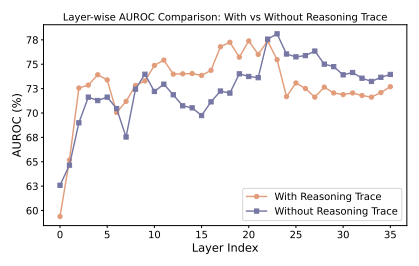
Figure 1 .Effect of reasoning trajectories on hallucination de- tection in LRMs. We compare detection performance for the same LRM (Qwen3-8B (Yang et al., 2025)) with and without an explicit reasoning trajectory, using representations extracted from each layer for the same answers. Consistent with our hypothesis, reasoning traces can sometimes obscure answer-level hallucination signals. The dataset is TruthfulQA (Lin et al., 2022b).
원문 · CC BY 4.0 · Zhang, Jianxiong, Guo, Bing, Jiang, Yuming, Wang, Haobo, An, Bo, Du, Sean · Harnessing Reasoning Trajectories for Hallucination Detection via Answer-agreement Representation Shaping · 원문 그림 인용 · 원본 PDF 1쪽에서 그림 영역을 추출했습니다.추적 경계 개입과 답변 일치 기반 표현 형성
ARS는 동결된 LRM의 추적 경계 은닉 표현 h에 작은 가우시안 섭동 δ를 더해 반사실 답변을 생성합니다. 원래 답변과 같은 반사실 답변은 양성 집합 U+에, 다른 답변은 음성 집합 U-에 모읍니다. 이후 경량 선형 매핑 gϕ만 학습하여 원래 답변 임베딩 z가 일치 샘플과는 가깝고 불일치 샘플과는 멀어지도록 InfoNCE 형태의 손실을 최소화합니다. 기본 LRM 파라미터 θ는 고정되며 할루시네이션 레이블도 사용하지 않습니다. 테스트 시점에는 샘플링 없이 gϕ(u)를 계산하여 지도 탐침 같은 임베딩 기반 탐지기에 입력합니다.
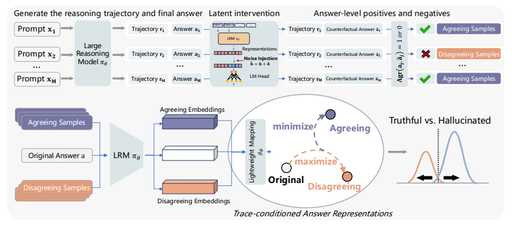
Figure 2 . Overview of ARS framework for hallucination detection in LRMs. ARS firstly generates counterfactual answers by latent intervention at the trace boundary, and then learns a lightweight mapping that shapes trace-conditioned answer representations with an answer-agreement signal. This can make truthful vs. hallucinated outputs more separable for downstream embedding-based detectors.
원문 · CC BY 4.0 · Zhang, Jianxiong, Guo, Bing, Jiang, Yuming, Wang, Haobo, An, Bo, Du, Sean · Harnessing Reasoning Trajectories for Hallucination Detection via Answer-agreement Representation Shaping · 원문 그림 인용 · 원본 PDF 3쪽에서 그림 영역을 추출했습니다.답변 안정성과 탐지 오류의 관계
논문은 답변 안정성 점수 α를 δ에 대한 일치 확률로 정의하고, 일치 분리 확률 ηϕ가 높을수록 지도 탐침의 오류가 작아진다는 명제 4.2를 제시합니다. 원문 식에 따르면 탐침의 오류는 C(1 − ηϕ) + eα 이하로 상한됩니다. 여기서 eα는 안정성 점수 α를 관측할 때 달성 가능한 최선의 오류입니다. 이 결과는 가정을 둔 상한이며 ARS가 항상 이 상한을 달성한다는 뜻은 아닙니다. 저자들은 경험적으로 안정성이 진실성을 예측하는 정도가 높다고 보고합니다.
TruthfulQA에서의 탐지 성능 비교
주요 실험은 Qwen3-8B 모델과 TruthfulQA 데이터셋에서 수행되었습니다. 이 평가는 AUROC로 측정되며 기본 설정은 zero-shot 평가입니다. CCS를 하류 탐지기로 사용할 때 ARS 표현은 86.64%의 AUROC를 보고합니다. 같은 실험 설정에서 지도 탐침은 ARS 표현 기준 83.66%를 보고합니다. 이 수치들은 특정 모델, 특정 데이터셋, 특정 탐지기의 결과이며 다른 조건에 그대로 확장되지 않습니다.
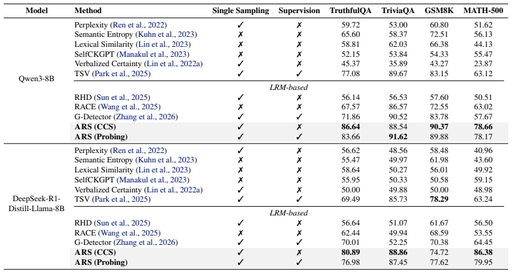
Table 1 .Comparison with competitive hallucination detection methods on different datasets. “Single sampling” indicates whether the approach requires multiple generations during inference. “Supervision” indicates whether the approach requires ground truth annotation during training or testing. All values are percentages (AUROC). We present the results of ARS with CCS and supervised probing as downstream detectors. The best results are highlighted inbold.
원문 · CC BY 4.0 · Zhang, Jianxiong, Guo, Bing, Jiang, Yuming, Wang, Haobo, An, Bo, Du, Sean · Harnessing Reasoning Trajectories for Hallucination Detection via Answer-agreement Representation Shaping · 원문 그림 인용 · 원본 PDF 6쪽에서 그림 영역을 추출했습니다.적용 범위와 한계
저자들은 ARS를 진실성 보장 장치가 아니라 탐지 구성요소로 제시합니다. 따라서 실제 배포에서는 근거 제공, 정책 필터, 사람의 검토 같은 추가 안전장치와 함께 사용되어야 한다고 밝힙니다. 본문의 주요 수치는 특정 LRM 계열과 데이터셋에서 얻은 것이며, 답변 일치 판단의 방식과 학습 설정에 따라 결과가 달라질 수 있습니다.
논문 정보
- 저자
- Zhang, Jianxiong, Guo, Bing, Jiang, Yuming, Wang, Haobo, An, Bo, Du, Sean
- 학회·저널
- arXiv · 프리프린트
- 최초 공개일
- 2026년 1월 24일
- 등록일
- 2026년 10월 29일
- 수정일
- 2026년 5월 5일
- 버전
- v3
- arXiv
- 2601.17467
- 원문 이용 조건
- CC BY 4.0
- 제공 범위
- 논문 정보, 해설, 허용된 원문 그림
AI 해설은 논문 원문과 별개의 설명이며 오류가 있을 수 있습니다. 원문과 그림은 각 출처의 이용 조건과 따로 표시된 권리를 따릅니다.
초록
Large reasoning models (LRMs) often generate long, seemingly coherent reasoning traces yet still produce incorrect answers, making hallucination detection challenging. Although trajectories contain useful signals, directly using trace text or vanilla hidden states for detection is brittle: traces vary in form and detectors can overfit to superficial patterns rather than answer validity. We introduce Answer-agreement Representation Shaping (ARS), which learns detection-friendly trace-conditioned representations by explicitly encoding answer stability. ARS generates counterfactual answers through small latent interventions, specifically, perturbing the trace-boundary embedding, and labels each perturbation by whether the resulting answer agrees with the original. It then learns representations that bring answer-agreeing states together and separate answer-disagreeing ones, exposing latent instability indicative of hallucination risk. The shaped embeddings are plug-and-play with existing embedding-based detectors and require no human annotations during training. Experiments demonstrate that ARS consistently improves detection and achieves substantial gains over strong baselines. Code is available at: https://github.com/radiolab-ntu/ars_icml2026.
원문 인용
Zhang, Jianxiong, Guo, Bing, Jiang, Yuming, Wang, Haobo, An, Bo, Du, Sean (2026). Harnessing Reasoning Trajectories for Hallucination Detection via Answer-agreement Representation Shaping. arXiv:2601.17467v3. https://arxiv.org/abs/2601.17467v3
BibTeX
@misc{jianxiong2026harnessing,
  title = {{Harnessing Reasoning Trajectories for Hallucination Detection via Answer-agreement Representation Shaping}},
  author = {Zhang, Jianxiong and Guo, Bing and Jiang, Yuming and Wang, Haobo and An, Bo and Du, Sean},
  year = {2026},
  eprint = {2601.17467},
  archivePrefix = {arXiv},
  url = {https://arxiv.org/abs/2601.17467v3}
}