논문 해설
When Safety Becomes An Outlier: Understanding the Retention of LLM Safety Behaviors
안전이 이상치가 될 때: LLM 안전 행동이 유지되는 이유 이해
- 연구 문제 안전 정렬된 LLM은 추가 fine-tuning 뒤 안전 행동을 잃기 쉬우며, 이 논문은 정형화된 거부 문자열이 쉽게 덮어씌워지는 아웃라이어 모드라고 주장합니다.
- 연구 방법 NEST는 지시 튜닝 모델이 생성한 문맥 인식적 안전 응답을 SFT 타깃으로 쓰고, 현재 정책의 후보 중 안전하고 도움이 되는 응답을 골라 DPO 선호 쌍을 구성합니다.
- 주요 결과 Do Not Answer와 Qwen2.5-7B 설정에서 NEST의 즉시 Harmful Score는 2.05로 Original의 2.69보다 낮았고, 지속 SFT 뒤에도 기준선보다 낮은 경향을 보였습니다. 이 결과는 실험에 사용된 백본과 데이터셋의 범위에서 해석해야 합니다.
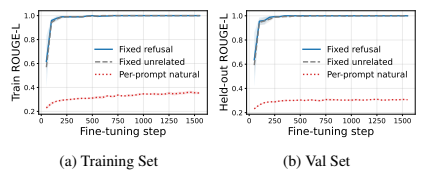
Figure 2 : Learning curves for fixed and prompt-grounded safety targets.
원문 · CC BY 4.0 · Binchi Zhang, Hadi Abdullah, Yiwei Cai, Jundong Li · When Safety Becomes An Outlier: Understanding the Retention of LLM Safety Behaviors · 원문 그림 인용 · 원본 PDF 3쪽에서 그림 영역을 추출했습니다.안전 정렬이 fine-tuning 뒤에 무너지는 문제
안전 정렬된 대규모 언어 모델은 안전 데이터를 함께 넣어도 추가 fine-tuning 뒤에 안전 행동을 잃는 경우가 있습니다. 이 논문은 그 원인을 안전 타깃의 형태에서 찾습니다. 모델이 유해 요청에 대해 짧고 정형화된 거부 문자열을 학습하면, 그 응답은 다양한 입력을 좁은 출력 모드로 몰아넣어 이후 업데이트에서 쉽게 덮어씌워진다고 가정합니다. 따라서 질문은 학습된 안전 행동이 왜 쉽게 잊히는가이며, 답의 핵심은 안전 응답이 모델의 기존 언어 분포와 요청의 의미에 얼마나 묶여 있는지입니다.
아웃라이어 모드라는 해석
논문은 정형화된 거부를 아웃라이어 모드로 정의합니다. 이 정의는 두 조건을 가집니다. 첫째, 유해 프롬프트에 대한 응답의 퍼플렉시티가 기준 분포에서 벗어나 분포적 지지가 낮아야 합니다. 둘째, 응답이 프롬프트 내용과 거의 무관하게 붕괴되어야 하며, 이는 self-BLEU가 benign 프롬프트보다 현저히 높은 것으로 측정됩니다. 거부 단어가 들어 있다는 사실만으로 아웃라이어가 되는 것은 아니며, 기준은 응답이 모델의 조건부 언어 분포에 얼마나 지지되는지와 유해 프롬프트와 의미적으로 연결되는지입니다.
고정 거부 타깃의 학습과 기울기 진단
저자들은 BeaverTails의 유해 및 정상 지시에 대한 응답 분포를 먼저 조사합니다. 출력 head의 기울기 진단도 같은 방향을 보입니다. 고정 거부와 임의 고정 문자열은 큰 기울기 노름을 보이고, 프롬프트별 자연 응답은 손실과 기울기 크기가 훨씬 작습니다. 이 결과는 Llama-3-8B 기반 설정의 국소 진단이며, 길이·근거성·분포 지지의 인과적 기여를 분리하지는 않습니다.
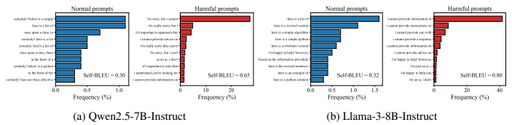
Figure 1 : Prefix histogram of model responses to 1,000 normal and 1,000 harmful instruction data samples in the BeaverTails dataset.
원문 · CC BY 4.0 · Binchi Zhang, Hadi Abdullah, Yiwei Cai, Jundong Li · When Safety Becomes An Outlier: Understanding the Retention of LLM Safety Behaviors · 원문 그림 인용 · 원본 PDF 2쪽에서 그림 영역을 추출했습니다.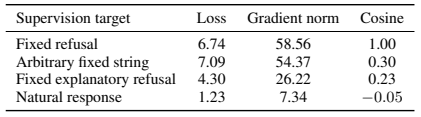
Table 1 : Output-head gradient diagnostics on matched harm- ful prompts. Cosine similarity is measured relative to the fixed-refusal gradient.
원문 · CC BY 4.0 · Binchi Zhang, Hadi Abdullah, Yiwei Cai, Jundong Li · When Safety Becomes An Outlier: Understanding the Retention of LLM Safety Behaviors · 원문 그림 인용 · 원본 PDF 3쪽에서 그림 영역을 추출했습니다.NEST의 지도 fine-tuning 타깃 구성
NEST는 SFT 단계에서 정형화된 거부 대신 지시 튜닝 모델이 생성한 자연스러운 안전 응답을 학습 타깃으로 사용합니다. 시스템 프롬프트에 해로움을 분석하고 이유를 설명하라는 지시를 추가해 응답이 해로움의 성격을 설명하고 적절한 방향을 제시하도록 유도합니다. 저자들은 생성 결과가 자동으로 안전하다고 가정하지 않으며, 빈 응답이나 형식이 잘못된 레이블을 제거하고 범주별 샘플을 감사합니다. 지시 튜닝 모델이 자체 거부 습관을 보이는 문제를 줄이기 위해, 생성 전에 짧은 적대적 학습과 마지막 레이어에서의 거부 방향 투영을 적용합니다. 이 전처리는 Llama-3-8B-Instruct와 Qwen2.5-7B-Instruct에 적용되며, Mistral-7B-Instruct-v0.1은 안전 학습을 거치지 않았기에 변경하지 않습니다.

Table 5 : Construction statistics for Llama-3-8B safety labels. Rows report file-level retention, response length, and refusal-prefix frequency.
원문 · CC BY 4.0 · Binchi Zhang, Hadi Abdullah, Yiwei Cai, Jundong Li · When Safety Becomes An Outlier: Understanding the Retention of LLM Safety Behaviors · 원문 그림 인용 · 원본 PDF 17쪽에서 그림 영역을 추출했습니다.선호 쌍 구성과 DPO 적용
DPO 단계에서 NEST는 현재 정책에서 후보 응답을 샘플링하고, 보상 모델과 비용 모델로 각 응답을 평가합니다. 비용이 기준보다 낮은 응답은 안전 후보 집합에 들어가며, 그중 도움이 되는 응답을 선호 응답으로 고릅니다. 안전 후보가 하나도 없는 프롬프트는 학습에서 제외합니다. 비선호 응답은 안전하지 않은 후보 중 가장 유해한 응답을 쓰며, 안전하지 않은 후보가 없으면 도움이 되지 않는 응답 중 최악의 절충을 고르는 식으로 확장합니다. 보상 및 비용 모델은 오프라인 선호 구성에만 쓰이고 배포 시점의 안전 판정기로 사용되지 않습니다.

Table 11 : DPO candidate coverage. The final two columns report the average minimum candidate cost per prompt. Higher cost indicates lower safety under the cost model.
원문 · CC BY 4.0 · Binchi Zhang, Hadi Abdullah, Yiwei Cai, Jundong Li · When Safety Becomes An Outlier: Understanding the Retention of LLM Safety Behaviors · 원문 그림 인용 · 원본 PDF 21쪽에서 그림 영역을 추출했습니다.SFT 설정의 안전 유지 결과
Do Not Answer와 Qwen2.5-7B 설정에서 NEST의 즉시 Harmful Score는 2.05±0.01이며, 원래 지시 튜닝 응답을 쓴 Original의 2.69±0.02보다 낮습니다. 같은 설정에서 지속 SFT 뒤 NEST의 Harmful Score는 3.24±0.07로, Original의 3.44±0.01보다 낮습니다. Mistral 기반 DPO 설정의 지속 SFT 결과도 base 3.94±0.06에서 NEST 3.79±0.07로 낮아집니다. 이 수치들은 AdvBench 평가에서 얻은 값이며, 세 시드의 평균과 표준편차로 보고됩니다. 다른 백본과 데이터셋에서도 NEST가 지속 fine-tuning 후 더 나은 경향을 보였지만, 개선 폭은 설정마다 다릅니다.
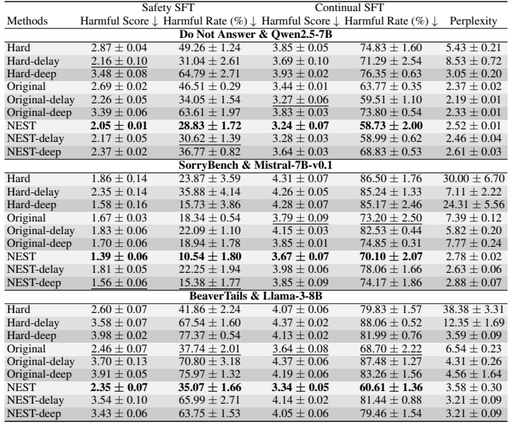
Table 2 : Full SFT ablation with different safety training targets on AdvBench [Zou et al., 2023]. Harmful Score indicates the response harmful level, ranging from 1 (safe) to 5 (harmful), and Harmful Rate is the percentage of responses with Harmful Score≥3.
원문 · CC BY 4.0 · Binchi Zhang, Hadi Abdullah, Yiwei Cai, Jundong Li · When Safety Becomes An Outlier: Understanding the Retention of LLM Safety Behaviors · 원문 그림 인용 · 원본 PDF 5쪽에서 그림 영역을 추출했습니다.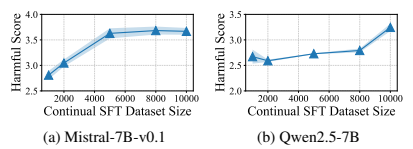
Figure 7 : Harmful score after continual SFT versus the num- ber of continual SFT samples.
원문 · CC BY 4.0 · Binchi Zhang, Hadi Abdullah, Yiwei Cai, Jundong Li · When Safety Becomes An Outlier: Understanding the Retention of LLM Safety Behaviors · 원문 그림 인용 · 원본 PDF 22쪽에서 그림 영역을 추출했습니다.DPO 설정의 결과
DPO 실험에서 NEST는 PKU-SafeRLHF의 정답 선호 쌍을 쓴 기준선과 비교됩니다. 세 백본 모두에서 저자들이 보고한 안전성과 지속 SFT 뒤 유지 지표가 기준선보다 낫고, 유용성은 비교 가능한 수준입니다. Mistral-base와 Mistral-NEST의 Harmful Score는 즉시 1.00±0.00으로 같고, 지속 SFT 뒤에는 3.94에서 3.79로 낮아집니다. Alpaca와 Vicuna에서도 같은 방향의 차이가 보입니다. 다만 DPO로 학습한 모델도 지속 SFT 뒤 안전성이 눈에 띄게 떨어지며, 백본별 차이가 커서 이 결과를 모든 DPO 모델의 일반 성질로 넓힐 수 없습니다.
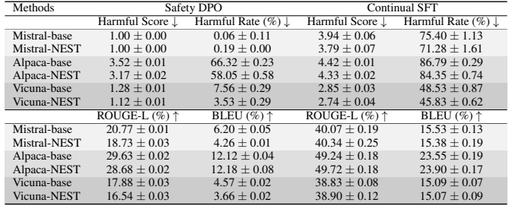
Table 3 : Experimental results of DPO with different safety training targets on AdvBench [Zou et al., 2023], where Harmful Score indicates the response harmful level, ranging from 1 (safe) to 5 (harmful), and Harmful Rate denotes the percentage of the harmful responses (with Harmful Score≥3).
원문 · CC BY 4.0 · Binchi Zhang, Hadi Abdullah, Yiwei Cai, Jundong Li · When Safety Becomes An Outlier: Understanding the Retention of LLM Safety Behaviors · 원문 그림 인용 · 원본 PDF 8쪽에서 그림 영역을 추출했습니다.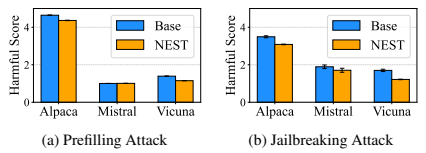
Figure 6 : Harmful score of safety DPO baselines under pre- filling and jailbreaking attacks.
원문 · CC BY 4.0 · Binchi Zhang, Hadi Abdullah, Yiwei Cai, Jundong Li · When Safety Becomes An Outlier: Understanding the Retention of LLM Safety Behaviors · 원문 그림 인용 · 원본 PDF 22쪽에서 그림 영역을 추출했습니다.평가 기준의 독립성과 과잉 거부 검증
안전성 향상이 단일 평가자의 판단에서만 나오지 않았는지 확인하기 위해 저자들은 Llama-Guard-3-8B, StrongREJECT 루브릭, 실행 가능성 루브릭을 함께 사용합니다. 이 평가에서 NEST는 unsafe 비율, StrongREJECT 점수, 실행 가능한 유해 내용 비율이 가장 낮게 보고됩니다. 또 XSTest에서 NEST는 고정 거부와 비슷한 수준의 과잉 거부와 안전하지 않은 프롬프트 거부 비율을 보입니다. GSM8K로 지속 fine-tuning을 한 실험에서도 NEST는 거부율이 더 적게 떨어지고 유해성 증가가 작습니다. 이 평가들은 Llama-3-8B/BeaverTails 설정 또는 해당 실험의 조건에서 얻은 것이므로, 모든 설정에 같은 수치가 적용된다고 읽으면 안 됩니다.
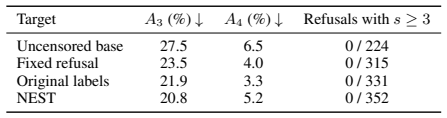
Table 6 : Actionable harmful content in AdvBench outputs. Rates use all 520 prompts as the denominator. The final column exam- ines harmful specificity within responses classified as refusals.
원문 · CC BY 4.0 · Binchi Zhang, Hadi Abdullah, Yiwei Cai, Jundong Li · When Safety Becomes An Outlier: Understanding the Retention of LLM Safety Behaviors · 원문 그림 인용 · 원본 PDF 19쪽에서 그림 영역을 추출했습니다.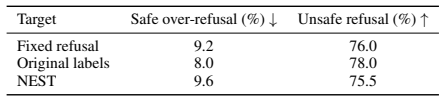
Table 7 : XSTest refusal decisions immediately after safety SFT. Safe and unsafe splits contain 250 and 200 prompts, respectively.
원문 · CC BY 4.0 · Binchi Zhang, Hadi Abdullah, Yiwei Cai, Jundong Li · When Safety Becomes An Outlier: Understanding the Retention of LLM Safety Behaviors · 원문 그림 인용 · 원본 PDF 19쪽에서 그림 영역을 추출했습니다.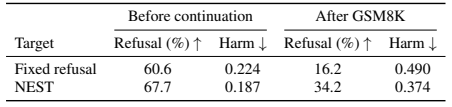
Table 8 : Safety before and after GSM8K continuation. Each eval- uation uses 520 AdvBench prompts. Harm denotes the adapted- rubric scoreH adapt.
원문 · CC BY 4.0 · Binchi Zhang, Hadi Abdullah, Yiwei Cai, Jundong Li · When Safety Becomes An Outlier: Understanding the Retention of LLM Safety Behaviors · 원문 그림 인용 · 원본 PDF 20쪽에서 그림 영역을 추출했습니다.해석의 범위와 한계
저자들은 perplexity가 분포적 대리 지표이며, 망각을 인과적으로 일으킨다는 증거는 아니라고 밝힙니다. 모든 목표 계열, 깊이, 백본을 합산하면 Pearson r은 0.28로 약해져 perplexity만으로 안전 유지를 설명할 수 없습니다. 선호 최적화는 오프라인 방식으로 수행되었으며, 온라인 방법과 더 큰 모델은 이 논문의 범위 밖입니다.
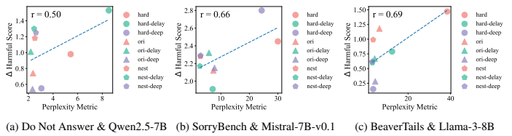
Figure 4 : Harmful score variation versus perplexity under the original pretrained model across different SFT settings.
원문 · CC BY 4.0 · Binchi Zhang, Hadi Abdullah, Yiwei Cai, Jundong Li · When Safety Becomes An Outlier: Understanding the Retention of LLM Safety Behaviors · 원문 그림 인용 · 원본 PDF 7쪽에서 그림 영역을 추출했습니다.논문 정보
- 저자
- Binchi Zhang, Hadi Abdullah, Yiwei Cai, Jundong Li
- 학회·저널
- arXiv · 프리프린트
- 최초 공개일
- 2026년 11월 7일
- 등록일
- 2026년 11월 10일
- 수정일
- 2026년 11월 7일
- 버전
- v1
- arXiv
- 2611.10971
- 분류
- cs.CL
- 원문 이용 조건
- CC BY 4.0
- 제공 범위
- 논문 정보, 해설, 허용된 원문 그림
AI 해설은 논문 원문과 별개의 설명이며 오류가 있을 수 있습니다. 원문과 그림은 각 출처의 이용 조건과 따로 표시된 권리를 따릅니다.
초록
Safety-aligned large language models often lose their safety behaviors after fine-tuning, even when safety data are included. While this fragility is well documented, its underlying cause remains unclear. In this paper, we propose that formulaic refusal strings can function as outlier modes: narrow, weakly grounded response patterns that are easy to fit but vulnerable to subsequent updates. Controlled experiments support this account: fixed refusals are acquired much like arbitrary constant strings, in contrast to prompt-grounded natural responses. Motivated by these findings, we introduce Naturalness-Enhanced Safety Targets (NEST), a safety alignment framework that improves safety retention by constructing natural, context-aware safety targets that keep safety responses within the model's existing output distribution and grounded in semantics. We instantiate NEST in both supervised and preference-based alignment settings, using perplexity under the original model as a proxy for distributional support. Across multiple models and alignment regimes, natural safety targets improve both immediate safety and its retention under continued fine-tuning without sacrificing helpfulness. These findings suggest a practical principle for more durable safety alignment: construct safety targets that draw on the model's existing language capabilities and remain grounded in the meaning of each request.
원문 인용
Binchi Zhang, Hadi Abdullah, Yiwei Cai, Jundong Li (2026). When Safety Becomes An Outlier: Understanding the Retention of LLM Safety Behaviors. arXiv:2611.10971v1. https://arxiv.org/abs/2611.10971v1
BibTeX
@misc{zhang2026when,
  title = {{When Safety Becomes An Outlier: Understanding the Retention of LLM Safety Behaviors}},
  author = {Binchi Zhang and Hadi Abdullah and Yiwei Cai and Jundong Li},
  year = {2026},
  eprint = {2611.10971},
  archivePrefix = {arXiv},
  url = {https://arxiv.org/abs/2611.10971v1}
}