논문 해설
Deep Generative Models in Engineering Design: A Review
공학 설계에서의 심층 생성 모델: 리뷰
- 연구 문제 공학 설계에 딥 생성 모델을 적용하려면 성능 평가 비용, 데이터 희소성, 창의성, 제조 가능성의 문제를 함께 풀어야 합니다.
- 연구 방법 이 리뷰는 GAN, VAE, 강화학습을 중심으로 DGM의 구성을 정리하고 설계 표현, 응용 영역, 데이터셋을 분류합니다.
- 주요 결과 문헌은 위상 최적화와 형상 합성 등 여러 영역에 DGM이 적용되었음을 보여주며, 조건부 생성과 대리 모델이 주요 도구로 쓰였습니다.
설계 합성에 DGM을 적용할 때의 어려움
이 논문은 자동 설계 합성을 위해 딥 생성 모델(DGM)을 공학 설계에 적용한 연구를 검토합니다. 영상이나 텍스트 생성에서 성공한 모델을 설계에 그대로 옮기기 어려운 이유는 성능 평가 비용, 데이터 희소성, 모방 대비 창의성 부족, 제조 가능성이라는 네 가지 과제가 얽혀 있기 때문입니다. 특히 목표 요구조건을 만족하는 역설계에서는 생성된 설계가 실제 성능과 제약을 충족해야 합니다.
GAN, VAE, 강화학습의 구성
Generative Adversarial Networks는 생성기가 잡음 분포를 설계 분포로 사상하고 판별기가 실제 설계와 생성 설계를 구분하도록 두 모델을 번갈아 학습합니다. 훈련이 불안정하거나 모드 붕괴가 생기면 WGAN은 판별기를 비평기로 바꾸고 Wasserstein 거리 추정을 사용해 손실과 학습 과정을 수정합니다. Variational Autoencoders는 인코더가 잠재 분포의 평균과 분산을 내고 샘플링한 뒤 KL 발산으로 표준 가우시안에 가깝게 정규화합니다. Reinforcement Learning은 설계 단계를 행동으로 보고 성능에 따른 보상을 최대화하며, 이때 보상 함수는 미분 가능할 필요가 없습니다.
조건부 설계에서는 Conditional GAN이 조건 벡터를 생성기와 판별기에 함께 입력합니다.
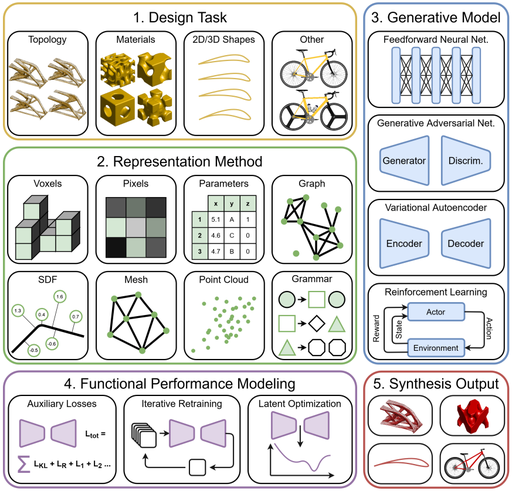
Fig. 1 : This figure outlines the typical components of design synthesis problems using Deep Generative Models. Some design problems are more suitable for specific design representation methods, which also influences the type of deep generative model architectures required.
원문 · CC BY 4.0 · Lyle Regenwetter, Amin Heyrani Nobari, Faez Ahmed · Deep Generative Models in Engineering Design: A Review · 원문 그림 인용 · 원본 PDF 3쪽에서 그림 영역을 추출했습니다.설계 응용과 데이터셋의 범위
위상 최적화에서는 Topology Optimization 결과를 학습 데이터로 삼아 TO 계산 비용을 줄이는 방향이 많이 쓰였습니다. 데이터셋은 영역마다 다르며, 항공 형상 연구에서는 UIUC airfoil database가 여러 생성 설계 연구의 사례로 쓰였고 3D 객체 연구에서는 ShapeNet이 널리 쓰였습니다. 자전거 설계에서는 BIKED가 이미지와 파라메트릭 데이터를 함께 제공합니다. 이 데이터셋들은 주로 특정 과제의 사례이므로 다른 설계 영역에서도 같은 결과가 나온다는 뜻은 아닙니다.
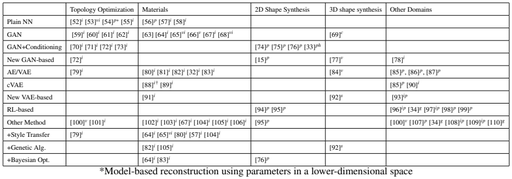
Table 1 : Characterization of application studies by domain and architecture. Some works use multiple architectures or fit into multiple application domains and are listed more than once. We additionally classify works by datatype used: Image i, Point Cloudc, V oxelelizationv, Meshm, Signed Distance Fields, Grammarg, Graphh, and Parametricp (other parameterization)
원문 · CC BY 4.0 · Lyle Regenwetter, Amin Heyrani Nobari, Faez Ahmed · Deep Generative Models in Engineering Design: A Review · 원문 그림 인용 · 원본 PDF 7쪽에서 그림 영역을 추출했습니다.데이터 부족과 평가의 한계
공학 분야에는 대규모이고 주석이 잘 된 공개 데이터셋이 심각하게 부족합니다. 설계 성능을 저비용으로 근사하기 위해 Surrogate models를 학습 목표에 넣는 방법이 흔하지만, 이 모델은 학습 데이터와 다른 설계에서 일반화가 약할 수 있습니다. 따라서 평가 비용, 데이터 분포의 편향, 벤치마크 부재가 함께 남아 있는 한계입니다.
논문 정보
- 저자
- Lyle Regenwetter, Amin Heyrani Nobari, Faez Ahmed
- 학회·저널
- arXiv · 프리프린트
- 최초 공개일
- 2021년 10월 21일
- 등록일
- 2026년 11월 6일
- 수정일
- 2022년 3월 16일
- 버전
- v4
- arXiv
- 2110.10863
- 분류
- cs.LG · stat.ML
- 원문 이용 조건
- CC BY 4.0
- 제공 범위
- 논문 정보, 해설, 허용된 원문 그림
AI 해설은 논문 원문과 별개의 설명이며 오류가 있을 수 있습니다. 원문과 그림은 각 출처의 이용 조건과 따로 표시된 권리를 따릅니다.
초록
Automated design synthesis has the potential to revolutionize the modern engineering design process and improve access to highly optimized and customized products across countless industries. Successfully adapting generative Machine Learning to design engineering may enable such automated design synthesis and is a research subject of great importance. We present a review and analysis of Deep Generative Machine Learning models in engineering design. Deep Generative Models (DGMs) typically leverage deep networks to learn from an input dataset and synthesize new designs. Recently, DGMs such as feedforward Neural Networks (NNs), Generative Adversarial Networks (GANs), Variational Autoencoders (VAEs), and certain Deep Reinforcement Learning (DRL) frameworks have shown promising results in design applications like structural optimization, materials design, and shape synthesis. The prevalence of DGMs in engineering design has skyrocketed since 2016. Anticipating continued growth, we conduct a review of recent advances to benefit researchers interested in DGMs for design. We structure our review as an exposition of the algorithms, datasets, representation methods, and applications commonly used in the current literature. In particular, we discuss key works that have introduced new techniques and methods in DGMs, successfully applied DGMs to a design-related domain, or directly supported the development of DGMs through datasets or auxiliary methods. We further identify key challenges and limitations currently seen in DGMs across design fields, such as design creativity, handling constraints and objectives, and modeling both form and functional performance simultaneously. In our discussion, we identify possible solution pathways as key areas on which to target future work.
원문 인용
Lyle Regenwetter, Amin Heyrani Nobari, Faez Ahmed (2021). Deep Generative Models in Engineering Design: A Review. arXiv:2110.10863v4. https://arxiv.org/abs/2110.10863v4
BibTeX
@misc{regenwetter2021deep,
  title = {{Deep Generative Models in Engineering Design: A Review}},
  author = {Lyle Regenwetter and Amin Heyrani Nobari and Faez Ahmed},
  year = {2021},
  eprint = {2110.10863},
  archivePrefix = {arXiv},
  url = {https://arxiv.org/abs/2110.10863v4}
}