논문 해설
CiwGAN and fiwGAN: Encoding information in acoustic data to model lexical learning with Generative Adversarial Networks
CiwGAN과 fiwGAN: 생성적 적대 신경망으로 어휘 학습을 모델링하기 위해 음향 데이터에 정보를 부호화하기
- 연구 문제 ciwGAN과 fiwGAN은 원시 음향 데이터에서 어휘 항목에 대응하는 잠재 코드를 비지도로 학습하도록 설계된 GAN 구조입니다.
- 연구 방법 WaveGAN과 InfoGAN의 정보 최대화 항을 결합하고 Q-network로 생성 출력에서 잠재 코드를 복원하도록 하며, fiwGAN은 이진 자질 코드를 사용합니다.
- 주요 결과 5개 항목 ciwGAN에서는 잠재 코드가 어휘 항목의 유의한 예측 변수였고, 8개 항목 fiwGAN에서는 여섯 항목이 고유한 이진 코드 표현을 가졌습니다.
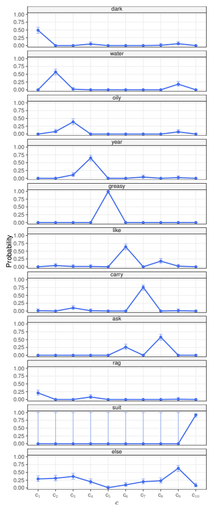
Figure 6 : Estimates of a multinomial logistic regression model with coded transcribed outputs as the dependent variable and the latent code with ten levels that correspond to the ten unique one-hot vectors in the model trained on ten lexical items from TIMIT after 27103 steps.
원문 · CC BY 4.0 · Gašper Beguš · CiwGAN and fiwGAN: Encoding information in acoustic data to model lexical learning with Generative Adversarial Networks · 원문 그림 인용 · 원본 PDF 19쪽에서 그림 영역을 추출했습니다.사람의 어휘 학습을 원시 음향에서 모델링하기
이 논문은 사람이 음성에서 단어에 해당하는 정보를 어떻게 부호화하는지를 심층 신경망으로 모델링하려 합니다. 기존 연구의 많은 모델은 이미 추상화되었거나 단순화된 특징에서 출발하거나, 자동부호화기에서 입력을 그대로 재생산하도록 학습되어 출력이 입력에 강하게 묶여 있습니다. 이 논문은 입력을 재생산하지 않고 무작위 잠재 공간에서 음향 출력을 생성하는 GAN 구조를 택하고, 생성된 출력에서 잠재 코드를 다시 추정할 수 있도록 Q-network를 추가합니다. 따라서 질문은 생성기가 어휘 항목마다 고유한 잠재 코드를 갖도록 학습할 수 있는지, 그리고 그 코드가 자질 수준의 정보도 함께 담을 수 있는지입니다.
ciwGAN과 fiwGAN의 잠재 공간 구조
ciwGAN은 WaveGAN 구조에 InfoGAN의 정보 최대화 아이디어를 결합하고, 범주형 잠재 코드를 one-hot 벡터로 둡니다. fiwGAN은 같은 틀에서 범주형 입력을 이진 코드 φ로 바꾸어, 각 이진 변수가 하나의 자질에 대응하도록 합니다. 생성기는 균등분포 잠재 변수 z와 범주형 코드를 입력받아 약 1초 분량의 16,384개 값으로 이루어진 출력을 만듭니다. Discriminator는 생성 데이터와 실제 데이터의 Wasserstein 거리를 추정하도록 학습되며, Q-network는 생성 출력에서 코드를 추정하는 별도의 심층 합성곱 네트워크입니다. 두 모델의 차이는 Q-network가 ciwGAN에서는 softmax로, fiwGAN에서는 sigmoid로 코드를 복원한다는 점에 있습니다.
Wasserstein 목적 함수와 상호정보량 항
기본 목적은 Wasserstein GAN의 가치 함수에 기반합니다. Discriminator는 실제 데이터의 기대 점수에서 생성 데이터의 기대 점수를 뺀 값을 최대화하도록 학습되고, Generator는 이 판별기 손실을 줄이는 방향으로 학습됩니다. 학습을 안정화하기 위해 보간된 입력에서 기울기 노름이 1에서 벗어나는 정도를 벌점으로 주는 gradient penalty 항이 더해집니다. 여기에 InfoGAN의 상호정보량 항 λL_I(G,Q)를 더해, 잠재 코드와 생성 출력 사이의 정보를 높이도록 합니다. 원문의 식 (2)는 min_{G,Q} max_D V_IWGAN(D,G,Q)=V_WGAN(D,G)−λL_I(G,Q)의 형태로 쓰여 있으며, 여기서 Q-network 손실을 줄이는 방향이 생성기의 코드 복원을 강제합니다.
5개 어휘 항목 실험의 생성 검증
첫 실험은 TIMIT에서 oily, rag, suit, water, year 다섯 항목을 사용하고 ciwGAN을 학습한 모델입니다. 학습 후 각 one-hot 코드를 1이 아니라 2로 설정하고 나머지 잠재 변수는 고정한 채 코드당 100개의 출력을 생성했습니다. 8011 단계와 19244 단계 모델을 모두 분석했으며, 전사 결과를 다항 로지스틱 회귀로 적합했습니다. 적합 결과 잠재 코드는 어휘 항목의 유의한 예측 변수였고, AIC는 674.7로 빈 모델의 1707.1보다 낮게 보고되었습니다. 8011 단계에서 [0,0,0,0,2]는 rag를 98/100회 생성했고, [2,0,0,0,0]은 suit를 72/100회 생성하였습니다.
반면 [0,0,0,2,0]은 water가 61회로 oily 26회보다 많아, 이 코드는 출력 비율이 가장 높은 oily로 해석되었습니다.
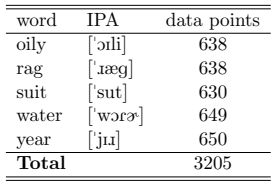
Table 1 : Five lexical items used for training in the five-word ciwGAN model with their corresponding IPA transcription (based on general American English) and counts of data points for each item.
원문 · CC BY 4.0 · Gašper Beguš · CiwGAN and fiwGAN: Encoding information in acoustic data to model lexical learning with Generative Adversarial Networks · 원문 그림 인용 · 원본 PDF 11쪽에서 그림 영역을 추출했습니다.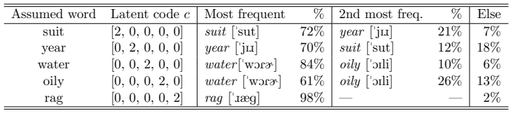
Table 2 : Generated outputs and their percentages across the five one-hot vectors in the latent code. Transcriptions of the outputs were coded as detailed in footnote 11.
원문 · CC BY 4.0 · Gašper Beguš · CiwGAN and fiwGAN: Encoding information in acoustic data to model lexical learning with Generative Adversarial Networks · 원문 그림 인용 · 원본 PDF 13쪽에서 그림 영역을 추출했습니다.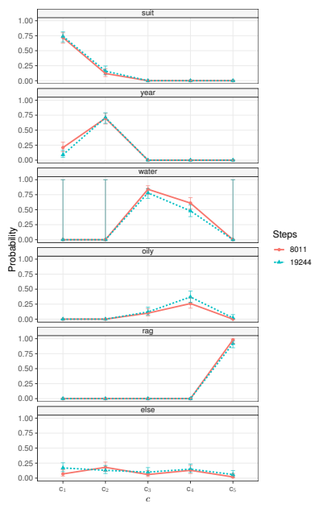
Figure 4 : Estimates of two multinomial logistic regression models (for 5-word models trained after 8011 and 19244 steps) with coded transcribed outputs as the dependent variable and the latent code with five levels that correspond to the five unique one-hot vectors in the model.
원문 · CC BY 4.0 · Gašper Beguš · CiwGAN and fiwGAN: Encoding information in acoustic data to model lexical learning with Generative Adversarial Networks · 원문 그림 인용 · 원본 PDF 15쪽에서 그림 영역을 추출했습니다.학습 단계에 따른 오류 수정
19244 단계 모델에서도 같은 잠재 변수를 유지하고 코드를 다시 생성했습니다. 성공률은 대체로 비슷했지만 oily 코드의 변화가 가장 컸으며, 8011 단계에서 26%였던 성공률이 19244 단계에서 37%로 높아졌습니다. 같은 z를 쓰므로 이 변화는 학습 진행에 따른 출력 변화로 읽을 수 있습니다. 그림 5의 비교에서는 같은 코드와 같은 잠재 변수에서 8011 단계의 water 출력이 19244 단계에서 oily로 바뀌는 사례가 나타납니다. 다만 반대 방향의 변화도 관찰되며, 이 결과는 5개 항목 모델의 특정 학습 과정에 대한 관찰입니다.
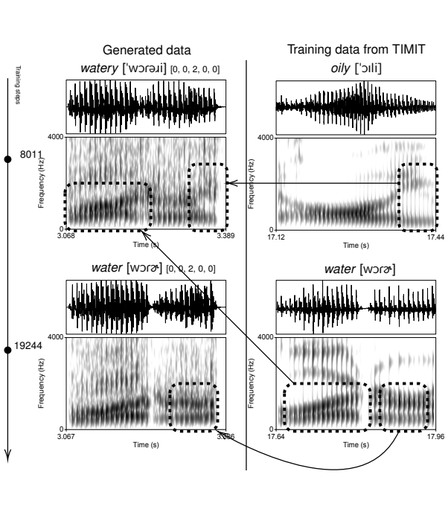
Figure 3 : A waveform and spectrogram (0–4000 Hz) of an innovative output watery ["wOR@ôi] (top right). That innovative watery is a combination of water ["wORÄ] and oily ["OIli] is illustrated by two examples from the training data (top and bottom right). The innovative output watery features a clear formant structure of water with a high front vowel [i], characteristic of the lexical item oily (see marked areas of the spectrograms). At 19244 steps, the vocalic structure of [i] is not present in the output, given the exact same latent code and random latent space. The network thus corrects the formant structure from an innovative watery into water ["wOR@ô(@)] as the training progresses. In some other cases, the network at 19244 steps outputs oily for what was watery at 8011 steps.
원문 · CC BY 4.0 · Gašper Beguš · CiwGAN and fiwGAN: Encoding information in acoustic data to model lexical learning with Generative Adversarial Networks · 원문 그림 인용 · 원본 PDF 14쪽에서 그림 영역을 추출했습니다.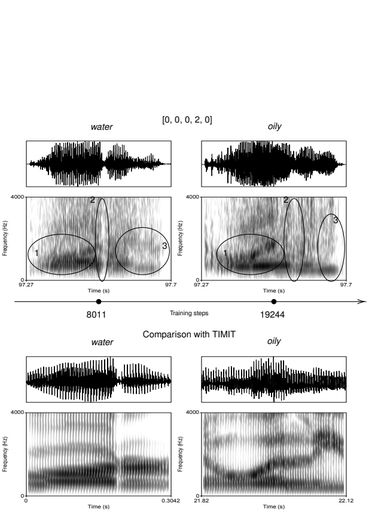
Figure 5 : Waveforms and spectrograms (0-4000 Hz) of a generated output at 8011 steps (trained on five lexical items) for latent code [0, 0, 0, 2, 0] that can be transcribed as water (top left); and of a generated output for the exact same latent code as well as other 95 latent variables, but generated by a model trained after 19244 steps (top right) transcribed as oily. Circled areas point to three major changes on the spectrogram that occur from the output at 8011 steps to the output at 19244 steps: vocalic formants change from [ wO] to [ oI] (area 1), periods characteristic of a flap [R] change to [l] (area 2) and formant structure for [ Ä] turns into an [i] (area 3). Examples for water and oily from the TIMIT database (bottom left and right) illustrate close similarity of the generated outputs to the training data. While the opposite change (from oily to water) also occurs, it appears less common.
원문 · CC BY 4.0 · Gašper Beguš · CiwGAN and fiwGAN: Encoding information in acoustic data to model lexical learning with Generative Adversarial Networks · 원문 그림 인용 · 원본 PDF 17쪽에서 그림 영역을 추출했습니다.8개 항목 fiwGAN 실험의 자질 학습
8개 항목 fiwGAN 실험은 세 개의 이진 자질로 2^3=8개 코드를 만들며, 20026 단계 모델을 분석합니다. 자질 값을 0 또는 2로 두고 이진 코드마다 100개의 출력을 생성했습니다. 여섯 항목은 고유한 이진 코드 표현을 가졌고, 그 성공률 평균은 원문에서 50.8%로 보고되었습니다. water와 like는 [0,2,0]에서 거의 같은 비율로 나타나 분명하게 구분되지 않았으며, 이 절의 결과는 두 항목의 학습이 불완전할 가능성을 남깁니다. 세 자질을 모두 포함한 모델의 AIC는 2135.5로 각 자질을 뺀 경우보다 낮았습니다. 따라서 세 자질이 모두 예측에 기여한다고 해석되지만, 각 항목의 성공률은 ciwGAN보다 낮습니다.
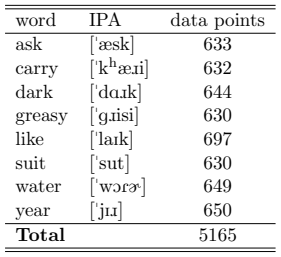
Table 4 : Eight content lexical items from the TIMIT database used for training in the fiwGAN architecture (Section 3.3) with their corresponding IPA transcription (based on general American English) and counts of data points for each item.
원문 · CC BY 4.0 · Gašper Beguš · CiwGAN and fiwGAN: Encoding information in acoustic data to model lexical learning with Generative Adversarial Networks · 원문 그림 인용 · 원본 PDF 21쪽에서 그림 영역을 추출했습니다.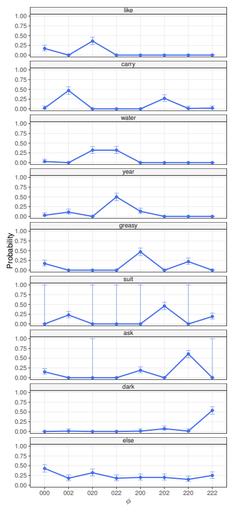
Figure 8 : Estimates of a multinomial logistic regression model with coded transcribed outputs as the dependent variable and the latent code with eight levels that correspond to the eight unique binary codes in the model trained on eight lexical items from TIMIT after 20026 steps.
원문 · CC BY 4.0 · Gašper Beguš · CiwGAN and fiwGAN: Encoding information in acoustic data to model lexical learning with Generative Adversarial Networks · 원문 그림 인용 · 원본 PDF 22쪽에서 그림 영역을 추출했습니다.분할 입력과 적용 범위
이 연구의 학습 항목은 TIMIT에서 수작업으로 잘라낸 단어 단위 슬라이스이며, 연속 음성에서 자동으로 분절하는 과정은 포함되지 않습니다. 저자들은 이 점이 모델의 중요한 제한이라고 밝히며, 분절 문제는 향후 연구로 남긴다고 설명합니다. 또한 모델 성능은 클래스 수와 어휘 항목 수가 맞을 때 가장 좋다고 보고됩니다. 다만 TIMIT 전체를 사용한 실험에서는 클래스 수가 항목 수보다 많아도 어휘 학습의 증거가 나타났습니다. 이 결과는 해당 데이터와 설정에서 얻은 것이며, 다른 코퍼스나 실제 인간 학습과의 직접 비교로 확장된 결론은 아닙니다.
논문 정보
- 저자
- Gašper Beguš
- 학회·저널
- arXiv · 프리프린트
- 최초 공개일
- 2020년 6월 4일
- 등록일
- 2026년 11월 6일
- 수정일
- 2021년 7월 28일
- 버전
- v3
- arXiv
- 2006.02951
- DOI
- 10.1016/j.neunet.2021.03.017
- 분류
- cs.CL · cs.LG
- 원문 이용 조건
- CC BY 4.0
- 제공 범위
- 논문 정보, 해설, 허용된 원문 그림
AI 해설은 논문 원문과 별개의 설명이며 오류가 있을 수 있습니다. 원문과 그림은 각 출처의 이용 조건과 따로 표시된 권리를 따릅니다.
초록
How can deep neural networks encode information that corresponds to words in human speech into raw acoustic data? This paper proposes two neural network architectures for modeling unsupervised lexical learning from raw acoustic inputs, ciwGAN (Categorical InfoWaveGAN) and fiwGAN (Featural InfoWaveGAN), that combine a Deep Convolutional GAN architecture for audio data (WaveGAN; arXiv:1705.07904) with an information theoretic extension of GAN -- InfoGAN (arXiv:1606.03657), and propose a new latent space structure that can model featural learning simultaneously with a higher level classification and allows for a very low-dimension vector representation of lexical items. Lexical learning is modeled as emergent from an architecture that forces a deep neural network to output data such that unique information is retrievable from its acoustic outputs. The networks trained on lexical items from TIMIT learn to encode unique information corresponding to lexical items in the form of categorical variables in their latent space. By manipulating these variables, the network outputs specific lexical items. The network occasionally outputs innovative lexical items that violate training data, but are linguistically interpretable and highly informative for cognitive modeling and neural network interpretability. Innovative outputs suggest that phonetic and phonological representations learned by the network can be productively recombined and directly paralleled to productivity in human speech: a fiwGAN network trained on `suit' and `dark' outputs innovative `start', even though it never saw `start' or even a [st] sequence in the training data. We also argue that setting latent featural codes to values well beyond training range results in almost categorical generation of prototypical lexical items and reveals underlying values of each latent code.
원문 인용
Gašper Beguš (2020). CiwGAN and fiwGAN: Encoding information in acoustic data to model lexical learning with Generative Adversarial Networks. arXiv:2006.02951v3. https://doi.org/10.1016/j.neunet.2021.03.017
BibTeX
@article{begu2020ciwgan,
  title = {{CiwGAN and fiwGAN: Encoding information in acoustic data to model lexical learning with Generative Adversarial Networks}},
  author = {Gašper Beguš},
  year = {2020},
  eprint = {2006.02951},
  archivePrefix = {arXiv},
  doi = {10.1016/j.neunet.2021.03.017},
  url = {https://arxiv.org/abs/2006.02951v3}
}