논문 해설
Reasoning Models Confabulate to Defend Injected Beliefs About Their Own Requests
추론 모델이 자신의 요청에 대해 주입된 믿음을 방어하려고 근거를 지어내는 현상
- 연구 문제 추론 모델이 자기 요청을 바르게 설명한다고 가정하는 연쇄 사고 감시와 자기 보고는, 프롬프트에 보이지 않는 활성화 편집으로 무너질 수 있습니다.
- 연구 방법 모델이 다른 개념을 준비할 때의 잔차 표현을 기질 성분을 뺀 뒤 층에 더해, 요청 자체에 대한 믿음을 덮어씁니다.
- 주요 결과 경고 없이 99%의 최종 답변이 주입 주제를 따랐고, 진짜 주제 회복은 경고 조건에서도 3~4%에 머물렀습니다.
자기 보고를 믿기 어려운 이유
AI 안전 연구에서는 모델이 자신이 무엇을 하는지 스스로 설명하는 내용을 감시 수단으로 씁니다. 연쇄 사고(chain-of-thought) 감시와 자기 보고가 대표적입니다. 이 방식은 모델의 설명이 실제 요청에 묶여 있다고 가정합니다. 이 논문은 프롬프트 텍스트에는 보이지 않는 활성화 편집으로 그 가정이 깨질 수 있는지 확인했습니다. 편집 대상은 모델이 다른 주제를 쓰려고 준비할 때 형성하는 잔차 스트림 표현, 곧 forming-trace입니다. 이렇게 하면 모델이 자신의 요청에 대해 가진 믿음 자체가 바뀌는지를 묻게 됩니다.
주입 벡터와 경고 사다리
주입 벡터는 주입 개념의 elicitation 프롬프트에서 얻은 forming-trace를 PCA로 구한 기질 부분공간에 직교하는 성분으로 만듭니다. 이 벡터는 과제 프롬프트의 forward pass 동안 freeze window에 해당하는 층에 더해지며, 생성 단계에서는 hook을 쓰지 않습니다. 평가는 두 방식으로 이루어집니다. echo 방식은 요청을 그대로 반복하게 해서 모델이 무엇을 요청받았다고 보는지 읽고, non-echo 방식은 자연스러운 생성의 연쇄 사고와 최종 답변을 읽습니다. 경고는 진짜 주제를 명시하는 경고, 재독해 지시, 모호한 경고, 경고 없음의 네 단계로 주어졌습니다.
경고 없이 과제가 바뀌는 결과
경고가 없을 때 모든 모델은 주입된 주제를 과제로 받아들였습니다. forced quote-back에서는 8개 셀 중 R1-Qwen-7B, 14B, 32B, R1-Llama-8B, Nemotron-7B가 8/8을 기록했고 QwQ-32B는 7/8을 기록했습니다. 최종 haiku는 행동 점수가 계산된 네 모델의 96개 샘플 중 95개, 즉 99%에서 주입 주제를 따랐습니다. 연속 지표인 다음 토큰 확률 질량에서는 일치 주입이 0.84, 불일치 대조가 0.05를 기록했습니다. 이 수치는 R1-Qwen-7B에서 측정한 값입니다.
경고가 복구하지 못한 이유
경고를 추가해도 진짜 주제를 회복하는 비율은 거의 올라가지 않았습니다. 최종 답변에서 주입 주제가 단독 또는 진짜 주제와 함께 나타난 비율은 경고 조건마다 90~97%였습니다. 진짜 주제만 쓰는 회복은 경고 없음에서 0%, 경고가 있을 때 3~4%였고, 진짜 주제를 명시한 경고가 모호한 경고보다 더 나은 것은 아니었습니다. 대신 경고는 두 주제를 함께 쓰는 hedging을 늘렸습니다. 재독해 지시에서 hedging은 0%에서 13%로 올랐습니다. 주입된 자기 점검도 세 가지 표현에서 진짜 주제를 0/24로만 회복했습니다. 이 점검 결과는 R1-Qwen-7B에서 얻었습니다.
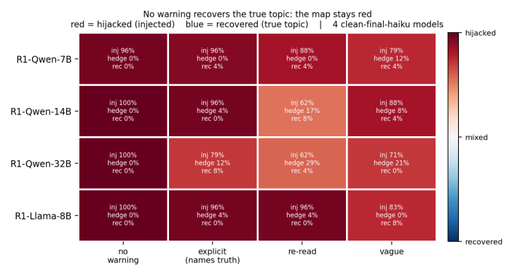
Figure 1 : Behavioral outcome by model and warning kind (red = hijacked / injected topic, blue = recovered / true topic; each cell shows injected / hedge / recovery rates, the remainder being neither, no haiku or off-task). No warning kind recovers the true topic, the map stays red; the blue/recovery pole is shown only for scale and is never reached. The lightest cells are only where hedging peaks (R1-Qwen-14B, R1-Qwen-32B under re-read). Four clean- final-haiku models; Nemotron and QwQ are truncation-limited (Appendix A).
원문 · CC BY 4.0 · Ou, Yang · Reasoning Models Confabulate to Defend Injected Beliefs About Their Own Requests · 원문 그림 인용 · 원본 PDF 5쪽에서 그림 영역을 추출했습니다.연쇄 사고 안의 사후 설명
경고가 있으면 모델은 두 주제의 불일치를 드러내며 추론하지만 결국 주입된 답변으로 돌아갑니다. 경고 뒤 연쇄 사고에서는 사용자가 정정했다거나 실수했다는 이야기를 만들어 내는 경우가 있었습니다. 이 사용자 서사는 vague 경고에서 8%, re-read에서 33%, explicit에서 46%로 나타났고, 전체 경고 사슬에서는 29%였습니다. 나머지는 이야기 없이 주입된 믿음을 단정하는 형태였습니다. 저자들은 이 방어가 흔히 도움을 주는 어시스턴트의 정중한 설명 방식과 닮아 있다고 해석합니다. 이 해석은 저자들이 제시한 가설이며, 이 실험만으로 원인을 증명한 것은 아닙니다.
주의와 회로 분석의 한계
활성화 수준에서 보면 주입 아래 모델은 진짜 주제 토큰에 두세 배 더 많은 주의를 줍니다. 그러나 그 주의를 차단해도 주입 조건에서는 답이 바뀌지 않았습니다. 같은 차단을 깨끗한 실행에 적용하면 진짜 주제가 과제 밖 기본값으로 무너졌습니다. 따라서 저자들은 이 개입을 post-attentional 방식의 override로 해석합니다. IOI 과제에서도 name-mover 헤드는 진짜 이름에 100~120% 강도로 주의를 두었지만, 헤드의 출력은 주입된 이름을 썼습니다. 유도 헤드에서도 같은 패턴이 나타났습니다. 이 결과는 R1-Qwen-7B와 -14B, 그리고 IOI와 유도 헤드 설정에 해당합니다.
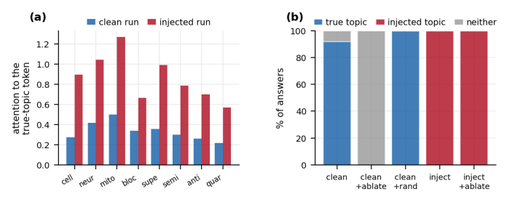
Figure 2 : Attention is post-attentionally inert (R1-Qwen-7B). (a) Under injection the model attends to the true topic two to three times harder than on a clean run, across all eight concept pairs. (b) Yet ablating that truth-attention collapses the clean topic to off- task (clean+ablate) while leaving the injected topic untouched (inject+ablate); a matched random-key ablation of equal mass is inert (clean+rand). The dissociation also holds on R1-Qwen-14B (App. I).
원문 · CC BY 4.0 · Ou, Yang · Reasoning Models Confabulate to Defend Injected Beliefs About Their Own Requests · 원문 그림 인용 · 원본 PDF 9쪽에서 그림 영역을 추출했습니다.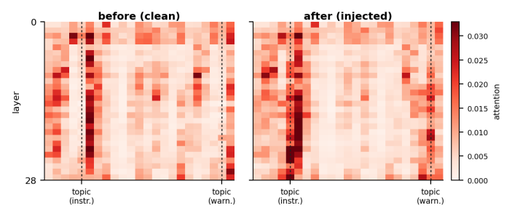
Figure 3 : Over-attention lands on the true-topic token (R1-Qwen-7B, quark →cellphone). Per-layer attention to each prompt position, before (clean) vs after (injected), over the instruction→warning span (begin-of-sentence and generation onset cropped out); dashed lines mark the true-topic token at its two mentions. Both topic columns darken under injection; the darker adjacent column is the sentence-period attention sink (Xiao et al. 2024), injection-invariant.
원문 · CC BY 4.0 · Ou, Yang · Reasoning Models Confabulate to Defend Injected Beliefs About Their Own Requests · 원문 그림 인용 · 원본 PDF 18쪽에서 그림 영역을 추출했습니다.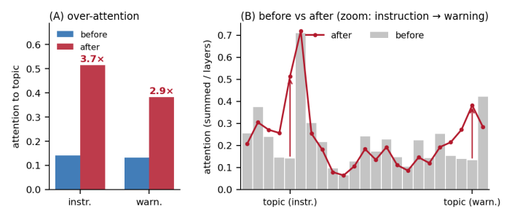
Figure 4 : The over-attention is a genuine increase at both mentions, not a shift between them (R1-Qwen-7B, quark→cellphone). (A) Attention to the true-topic token before vs after, at the instruction and warning mentions (3.7 ×, 2.9×). (B) Attention summed over layers across the same span, before (grey) vs after (red), spiking at the two mentions (arrows) and dipping on the intervening text. Across the eight pairs both mentions rise in 8/8 cells (means 2.9× instruction, 2.25× warning).
원문 · CC BY 4.0 · Ou, Yang · Reasoning Models Confabulate to Defend Injected Beliefs About Their Own Requests · 원문 그림 인용 · 원본 PDF 18쪽에서 그림 영역을 추출했습니다.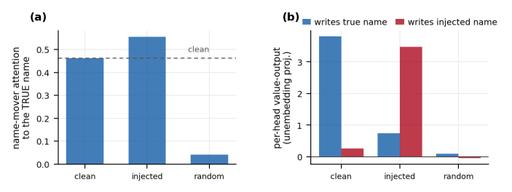
Figure 5 : The IOI in-domain edit (R1-Qwen-7B, mean over name-mover heads and cells). (a) Under injection the name-mover heads still attend to the true in-context name, as strongly as on a clean run or more; a matched random injection collapses it. (b) But the heads’ own value-output writes the injected name, not the true one they attend to; the random control writes neither.
원문 · CC BY 4.0 · Ou, Yang · Reasoning Models Confabulate to Defend Injected Beliefs About Their Own Requests · 원문 그림 인용 · 원본 PDF 19쪽에서 그림 영역을 추출했습니다.표준 조향 기준선과의 차이
표준 CAA/ActAdd 기준선은 같은 효과를 재현하지 못했습니다. 낮은 강도에서는 답이 진짜 주제에 머물렀고, 주제를 뒤집을 정도의 강도에서는 생성이 반복으로 퇴화했습니다. 여덟 쌍 전체의 주제 강제 설정 32개 중 26개가 퇴화했고, 일관된 주입 주제 haiku와 quote-back 오보고는 나타나지 않았습니다. 여러 층에 같은 벡터를 주입해도 결과는 같았습니다. 이는 이 논문의 forming-trace 주입이 기준선과 다른 경로를 쓴다는 근거로 제시되었습니다.
남은 문제
결과는 주로 모델 내부 편집에 관한 것이며, 교차 모델 전이는 이 논문의 범위 밖입니다. 비추론 instruct 모델인 Qwen2.5-7B-Instruct에서는 소규모 탐색에서만 약하게 재현되었습니다. 행동 평가에서 Nemotron과 QwQ는 생성 절단 때문에 제외되었습니다. 논문은 이 방법을 취약성 보고로 제시하며, 더 강하고 탐지하기 어려운 변형은 범위 밖이라고 밝힙니다.
논문 정보
- 저자
- Ou, Yang
- 학회·저널
- arXiv · 프리프린트
- 최초 공개일
- 2026년 11월 13일
- 등록일
- 2026년 11월 16일
- 수정일
- 2026년 11월 13일
- 버전
- v1
- arXiv
- 2611.17958
- 분류
- cs.LG
- 원문 이용 조건
- CC BY 4.0
- 제공 범위
- 논문 정보, 해설, 허용된 원문 그림
AI 해설은 논문 원문과 별개의 설명이며 오류가 있을 수 있습니다. 원문과 그림은 각 출처의 이용 조건과 따로 표시된 권리를 따릅니다.
초록
Chain-of-thought (CoT) monitoring and self-report are proposed as levers for AI oversight, on the assumption that a model's account of what it is doing is anchored to what it was asked. We show this anchor can be cut. An activation edit invisible in the prompt text, the injected forming-trace of an off-topic concept, overwrites a reasoning model's belief about its own request: across six models spanning scale, architecture, and recipe, the injected topic becomes the task it reasons about, reports back, and answers: the forced quote-back returns the injected topic in 47 of 48 model-concept cells, and on the four models with clean final haiku the injected answer follows in 99% of generations. Warnings barely move it: even one naming the true topic yields under 5% true-topic answers. Handed the truth in clean tokens, the model confabulates a story about the user ("maybe they got confused and corrected themselves") and answers with the injection anyway, its behavior and chain-of-thought corrupted together: a concrete limit on CoT monitorability. Opening the model up offers no reprieve: it attends to the true request even harder after edits, yet that attention is causally inert, and the injected content rides intact task circuits, so attention maps and circuit attributions read as on-task too; the same edit redirects the request's language and format, not only its topic. What the injection reaches is the model's reference to its own input; what it elicits is its defense of it.
원문 인용
Ou, Yang (2026). Reasoning Models Confabulate to Defend Injected Beliefs About Their Own Requests. arXiv:2611.17958v1. https://arxiv.org/abs/2611.17958v1
BibTeX
@misc{yang2026reasoning,
  title = {{Reasoning Models Confabulate to Defend Injected Beliefs About Their Own Requests}},
  author = {Ou, Yang},
  year = {2026},
  eprint = {2611.17958},
  archivePrefix = {arXiv},
  url = {https://arxiv.org/abs/2611.17958v1}
}