논문 해설
Variationally correct physics-informed operator learning for nonlinear partial differential equations
비선형 편미분방정식을 위한 변분적으로 올바른 물리 정보 기반 연산자 학습
- 연구 문제 비선형 PDE에서 잔차 손실이 PDE 준수 노름의 오차와 국소적으로 동치인지가 물리정보 연산자 학습의 신뢰성을 좌우합니다.
- 연구 방법 1차 연립 최소제곱 잔차를 손실로 쓰고, 축약 기저 신경 연산자를 유한요소 라이브러리의 손실과 기울기로 학습합니다.
- 주요 결과 세 벤치마크에서 χ의 중앙값이 0.86에서 1.48 사이였고, RBNO는 같은 유한요소 공간에서 격자 기반 기준 모델보다 작은 잔차 손실을 기록했습니다.
잔차 손실이 오차를 제어하는가
물리정보 연산자 학습은 정답 해 데이터 대신 매개변수화된 PDE의 잔차를 손실로 씁니다. 이때 손실이 작다는 사실이 해의 오차가 작다는 뜻이 되려면, 잔차가 방정식이 정하는 노름에서의 오차와 동치여야 합니다. 이 논문은 선형 문제에서 알려진 이 성질을 비선형 1차 연립 방정식으로 확장할 때 생기는 문제를 다룹니다. 비선형 방정식은 여러 해를 가질 수 있고, 선형화가 해 가지 근처에서 특이해질 수 있으며, 동치는 보통 국소적으로만 성립합니다.
1차 연립 잔차와 국소 동치
논문은 상태를 플럭스 또는 응력과 주변수의 쌍으로 두고, 잔차를 선형 1차 연산자와 주변수에 작용하는 비선형 항의 합으로 씁니다. 선형화 연산자가 해 가지 근처에서 쌍 노름에 대해 안정적이고(Assumption 1), 잔차 도함수가 강한 노름에서 Lipschitz 연속이면(Assumption 2), 정리 3.1은 잔차 노름이 해 오차와 상수 배 안에서 동치임을 보입니다. 이 결과는 선택된 해 가지의 근방에 한정되며, 조건 γ = √clin − R M_K/2 > 0이 반경 R을 제한합니다.
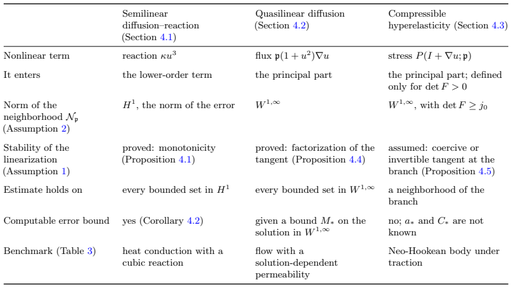
Table 2 : The three classes side by side: how the nonlinear term enters, the two properties required by Theorem 3.1, and what they imply for the residual–error estimate. Each column corresponds to one subsection and to one benchmark of Section 6.
원문 · CC BY 4.0 · Yuan Qiu, Wolfgang Dahmen, Peng Chen · Variationally correct physics-informed operator learning for nonlinear partial differential equations · 원문 그림 인용 · 원본 PDF 9쪽에서 그림 영역을 추출했습니다.유계 집합에서의 반응 문제 결과
반응항 κu³을 가진 의미선형 확산-반응 문제에서는 κ(u³−u*³)가 선형 항과 csec·eu의 곱으로 바뀌므로, 잔차가 선형 확산-반응 연산자에 오차를 적용한 형태가 됩니다. 명제 4.1은 이 구조로 임의의 유계 상태 집합에서 잔차와 오차의 동치를 보이며, 상수 c_B는 κ의 크기에 의존하지 않는다고 기술됩니다. 저자들은 이 하한이 해석적으로 보수적이라고 설명하며, 계산된 고유값으로 얻은 추정치보다 큰 값을 준다고 밝힙니다.
유한요소 공간에서의 손실 초과분
공통 유한요소 공간에서는 잔차 손실이 정지점의 최소 손실과 그 근처의 초과분으로 나뉘며, 보조정리 5.1은 이 초과분이 상태와 유한요소 해의 제곱 거리와 동치임을 보입니다. 선형 문제에서는 갈러킨 직교성으로 정확한 분해가 성립하지만, 비선형 문제에서는 근사 등식과 섭동항을 포함한 부등식으로 기술됩니다. 이 초과분은 학습이 줄일 수 있는 부분이며, 최소 손실 바닥은 근사 공간을 개선해야 줄어듭니다.
유한요소 잔차를 이용한 RBNO 학습
RBNO는 POD로 얻은 H-직교 축약 기저의 계수를 신경망이 예측하고, 유한요소 라이브러리가 잔차 손실과 계수 기울기를 계산합니다. 손실의 도함수 형식은 기호 미분으로 한 번 얻어 컴파일해 두고, 각 예측 상태마다 손실과 기울기 벡터를 조립합니다. 이때 기울기는 체인 룰로 네트워크 매개변수에 전달되므로 순방향 해석 풀이나 수반 풀이는 필요하지 않습니다. 저자들은 이 방식이 경계 페널티와 콜로케이션 점 선택을 줄인다고 봅니다.
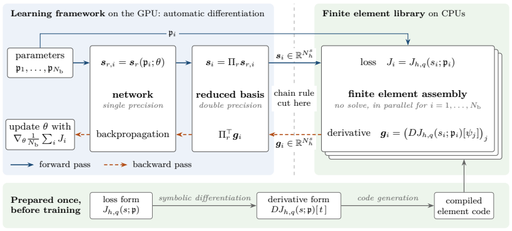
Figure 1 : Computational graph for the training step in Algorithm 1. Solid and dashed arrows indicate the forward and backward passes, respectively. The learning framework differentiates the network and the reduced basis map, while the finite element library assembles the loss and coefficient gradient for each parameter without solving a PDE. For each batch, the learning framework passes the state coefficients si to the finite element evaluator, which returns the losses Ji and gradients gi. Bottom: before training, we obtain the derivative form (56) by symbolic differentiation and compile it into element code.
원문 · CC BY 4.0 · Yuan Qiu, Wolfgang Dahmen, Peng Chen · Variationally correct physics-informed operator learning for nonlinear partial differential equations · 원문 그림 인용 · 원본 PDF 19쪽에서 그림 영역을 추출했습니다.세 벤치마크에서의 잔차와 오차 비율
세 벤치마크(반응 확산, 준선형 확산, Neo-Hookean 탄성)에서 χ는 중앙값 0.86에서 1.48 사이였고, 세 문제 모두에서 χ가 전체 범위 0.43에서 3.22 안에 있었습니다. 반응 문제의 κ = 0과 κ = 10³ 설정은 서로 다른 범위를 보였습니다. 탄성 문제에서는 바닥이 예측 손실의 약 1%에 불과해 두 비율이 거의 같았습니다. 저자들은 이 관찰이 원문의 선형 비교 범위와 비슷하다고 해석합니다.
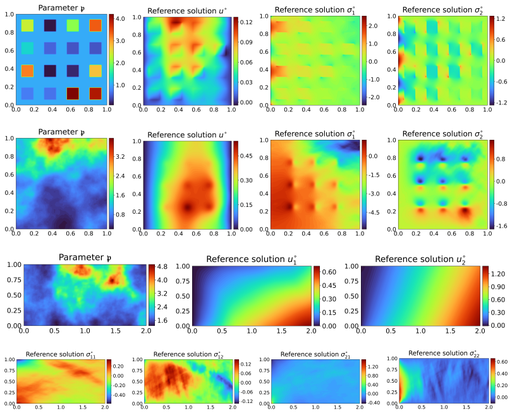
Figure 2 : One test parameter and the corresponding finite element solution for each benchmark. Top: semilinear diffusion– reaction benchmark (κ = 103), with the conductivityp, the primal variableu◦, and the two components of the fluxσ◦. Second row: quasilinear diffusion benchmark, in the same format. Bottom two rows: compressible hyperelasticity benchmark, with the Young’s modulus, the two components of the displacementu◦, and the four components of the stressσ◦. The plots show the homogeneous partsu ◦ andσ ◦ of (4).
원문 · CC BY 4.0 · Yuan Qiu, Wolfgang Dahmen, Peng Chen · Variationally correct physics-informed operator learning for nonlinear partial differential equations · 원문 그림 인용 · 원본 PDF 21쪽에서 그림 영역을 추출했습니다.이산 안정성 진단
저자들은 유한요소 해와 Gauss–Newton 반복점, RBNO 예측에서 최소 일반화 고유값 λ_min,h를 계산해 Assumption 1을 수치적으로 점검했습니다. 세 격자에서 유한요소 해의 최솟값은 거의 변하지 않았고, 예측의 고유값도 같은 범위에 있었습니다. 탄성 문제에서는 해석적 하한이 없으므로 이 진단이 안정성 가정을 확인하는 유일한 증거입니다. 다만 이 고유값은 공간을 고정한 극한의 상한이며, 수치 적분과 잔차 투영의 영향을 받습니다.
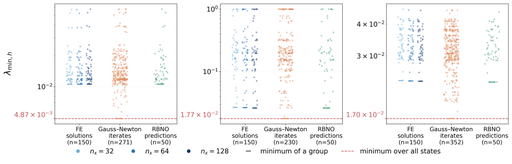
Figure 4 : Discrete stability for the first50test parameters. We plot the smallest generalized eigenvalueλmin,h defined in(45) at finite element solutions on three meshes and at Gauss–Newton iterates and RBNO predictions on the finest mesh. The meshes have nx = 32,64, and128cells in the x-direction, with ny = nx for semilinear diffusion–reaction and quasilinear diffusion, and ny = nx/2for compressible hyperelasticity. For hyperelasticity, we include only the iterates from the final load step. Left: semilinear diffusion–reaction withκ = 103. Middle: quasilinear diffusion. Right: compressible hyperelasticity. We denote the number of states in each group byn. Horizontal bars indicate the group minima, and the dashed line indicates the minimum over all states, with its value marked on the vertical axis.
원문 · CC BY 4.0 · Yuan Qiu, Wolfgang Dahmen, Peng Chen · Variationally correct physics-informed operator learning for nonlinear partial differential equations · 원문 그림 인용 · 원본 PDF 26쪽에서 그림 영역을 추출했습니다.격자 기반 신경 연산자와의 비교
PCA-Net, FNO, FC-PINO는 같은 유한요소 공간에서 평가했습니다. FC-PINO는 자체 격자 평가에서 낮은 손실을 보였지만, 같은 적분 틀의 유한요소 손실과는 달랐습니다. 저자들은 이 차이가 잔차 평가 오차가 손실 기반 오차 제어를 약화시킬 수 있음을 보여 준다고 해석합니다.
탄성 가정과 남은 한계
Neo-Hookean 탄성 문제에서는 접선 연산자의 역 유계성을 증명하지 않고 가정으로 남겼습니다. 큰 변형에서는 코어시브성이 사라질 수 있으며 저자들은 독립적인 역 경계가 필요하다고 봅니다. 반응 문제의 해석적 상수는 보수적이어서 실제 안정성 여유를 과소 평가합니다. 또한 선형 축약 기저로 날카로운 국소화 해를 잘 표현하기 어렵다는 점을 저자들이 남은 문제로 제시합니다.
논문 정보
- 저자
- Yuan Qiu, Wolfgang Dahmen, Peng Chen
- 학회·저널
- arXiv · 프리프린트
- 최초 공개일
- 2026년 11월 16일
- 등록일
- 2026년 11월 18일
- 수정일
- 2026년 11월 16일
- 버전
- v1
- arXiv
- 2611.21469
- 분류
- math.NA · cs.LG
- 원문 이용 조건
- CC BY 4.0
- 제공 범위
- 논문 정보, 해설, 허용된 원문 그림
AI 해설은 논문 원문과 별개의 설명이며 오류가 있을 수 있습니다. 원문과 그림은 각 출처의 이용 조건과 따로 표시된 권리를 따릅니다.
초록
Physics-informed operator learning trains neural operators on the residual of a parametric partial differential equation (PDE) instead of labeled solution data, but its reliability depends on a variationally correct residual: one that is equivalent to the error in a norm dictated by the equation, the PDE-compliant norm. For nonlinear equations written as first-order systems, we prove that the first-order system least-squares residual is equivalent to the error in this norm near a solution branch if the linearized residual is stable and the residual derivative is Lipschitz continuous, possibly in a norm stronger than the error norm. We verify these conditions for monotone reaction, solution- and gradient-dependent diffusion, and compressible Neo-Hookean hyperelasticity. The stability mechanisms vary across these classes, as do the regions where the equivalence holds, from arbitrary bounded sets to a neighborhood of the branch. In a conforming finite element space, we show that the loss excess of a state near the finite element solution is equivalent to its squared distance from that solution. We use this loss to train a reduced basis neural operator with values in this space, with solution snapshots needed only for the basis and the loss and its symbolically derived gradient assembled by the finite element library. At inference, this loss estimates the error. Numerically, the square root of the loss excess tracks the error within factors comparable to those of the linear case, and the operator achieves higher accuracy in the PDE-compliant norm than grid-based baselines evaluated in the same finite element space.
원문 인용
Yuan Qiu, Wolfgang Dahmen, Peng Chen (2026). Variationally correct physics-informed operator learning for nonlinear partial differential equations. arXiv:2611.21469v1. https://arxiv.org/abs/2611.21469v1
BibTeX
@misc{qiu2026variationally,
  title = {{Variationally correct physics-informed operator learning for nonlinear partial differential equations}},
  author = {Yuan Qiu and Wolfgang Dahmen and Peng Chen},
  year = {2026},
  eprint = {2611.21469},
  archivePrefix = {arXiv},
  url = {https://arxiv.org/abs/2611.21469v1}
}