論文解説
Variationally correct physics-informed operator learning for nonlinear partial differential equations
非線形偏微分方程式のための変分的に正しい物理情報付き演算子学習
- 課題 非線形PDEでは、残差損失がPDE準拠ノルムの誤差と局所的に同値かどうかが、物理情報付き演算子学習の信頼性を左右します。
- 手法 1次連立最小二乗残差を損失とし、縮約基底ニューラル演算子を有限要素ライブラリの損失と勾配で学習します。
- 結果 3つのベンチマークでχの中央値は0.86から1.48の間でした。RBNOは同じ有限要素空間で、格子ベースの基準モデルより小さい残差損失を記録しました。
残差損失は誤差を制御できるか
物理情報付き演算子学習では、正解解のデータの代わりに、パラメータ化されたPDEの残差を損失として使います。損失が小さいことが解の誤差も小さいことを意味するには、残差が方程式の定めるノルムでの誤差と同値である必要があります。この論文は、線形問題で知られたこの性質を非線形の1次連立方程式へ広げるときに生じる問題を扱います。非線形方程式は複数の解を持つことがあり、解の近くで線形化が特異になることがあります。同値性は通常、局所的にしか成り立ちません。
1次連立残差と局所的な同値性
論文は、状態をフラックスまたは応力と補助変数の組として置き、残差を線形1次演算子と補助変数に作用する非線形項の和として書きます。線形化演算子が解の近くで対ノルムに対して安定であり(Assumption 1)、残差の微分が強いノルムでLipschitz連続であれば(Assumption 2)、定理3.1は残差ノルムが解の誤差と定数倍の範囲内で同値であることを示します。この結果は選ばれた解の枝の近傍に限られ、条件γ = √clin − R M_K/2 > 0が半径Rを制限します。
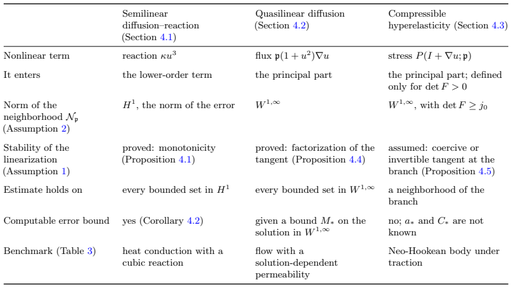
Table 2 : The three classes side by side: how the nonlinear term enters, the two properties required by Theorem 3.1, and what they imply for the residual–error estimate. Each column corresponds to one subsection and to one benchmark of Section 6.
出典 · CC BY 4.0 · Yuan Qiu, Wolfgang Dahmen, Peng Chen · Variationally correct physics-informed operator learning for nonlinear partial differential equations · 論文の図を引用 · 元のPDFの9ページ目から図の部分を抽出しています。有界集合での反応問題の結果
反応項κu³を持つ意味線形拡散反応問題では、κ(u³−u*³)が線形項とcsec·euの積に変換されるため、残差は線形拡散反応演算子に誤差を作用させた形になります。命題4.1はこの構造により、任意の有界な状態集合で残差と誤差の同値性を示し、定数c_Bはκの大きさに依存しないと記述されています。著者らは、この下界は解析的に保守的であり、計算された固有値から得られる推定値より大きな値を与えると説明しています。
有限要素空間での損失の超過分
共通の有限要素空間では、残差損失は停留点の最小損失と、その近傍の超過分に分けられます。補題5.1は、この超過分が状態と有限要素解の二乗距離と同値であることを示します。線形問題ではガラーキン直交性により正確な分解が成り立ちますが、非線形問題では近似等式と摂動項を含む不等式として記述されます。この超過分は学習によって減らせる部分であり、最小損失の下限は近似空間を改善しなければ下がりません。
有限要素残差によるRBNOの学習
RBNOは、POD で得られたH-直交の縮約基底の係数をニューラルネットワークが予測し、有限要素ライブラリが残差損失と係数の勾配を計算します。損失の微分形式は記号微分で一度求めてコンパイルしておき、予測された各状態ごとに損失と勾配ベクトルを組み立てます。このとき勾配は連鎖律によりネットワークのパラメータへ伝わるため、順方向の数値解法や随伴解法は必要ありません。著者らは、この方法により境界ペナルティとコロケーション点の選択を減らせると考えています。
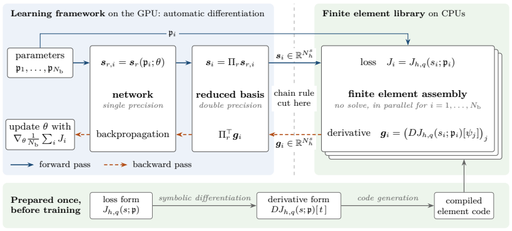
Figure 1 : Computational graph for the training step in Algorithm 1. Solid and dashed arrows indicate the forward and backward passes, respectively. The learning framework differentiates the network and the reduced basis map, while the finite element library assembles the loss and coefficient gradient for each parameter without solving a PDE. For each batch, the learning framework passes the state coefficients si to the finite element evaluator, which returns the losses Ji and gradients gi. Bottom: before training, we obtain the derivative form (56) by symbolic differentiation and compile it into element code.
出典 · CC BY 4.0 · Yuan Qiu, Wolfgang Dahmen, Peng Chen · Variationally correct physics-informed operator learning for nonlinear partial differential equations · 論文の図を引用 · 元のPDFの19ページ目から図の部分を抽出しています。3つのベンチマークでの残差と誤差の比率
3つのベンチマーク(反応拡散、準線形拡散、Neo-Hookean弾性)で、χの中央値は0.86から1.48の間でした。3つの問題すべてで、χは全体の範囲0.43から3.22の中にありました。反応問題のκ = 0とκ = 10³の設定では、異なる範囲になりました。弾性問題では、下限が予測損失の約1%にすぎず、2つの比率はほぼ同じでした。著者らは、この観察が論文の線形比較の範囲と同程度だと解釈しています。
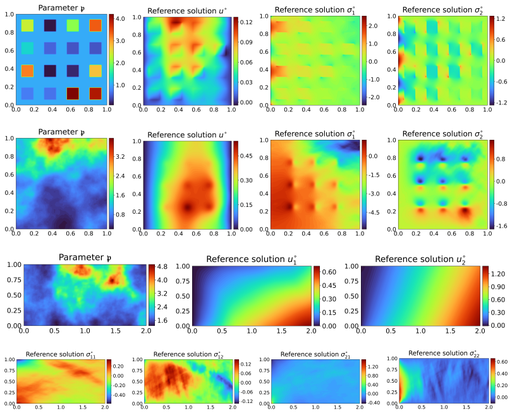
Figure 2 : One test parameter and the corresponding finite element solution for each benchmark. Top: semilinear diffusion– reaction benchmark (κ = 103), with the conductivityp, the primal variableu◦, and the two components of the fluxσ◦. Second row: quasilinear diffusion benchmark, in the same format. Bottom two rows: compressible hyperelasticity benchmark, with the Young’s modulus, the two components of the displacementu◦, and the four components of the stressσ◦. The plots show the homogeneous partsu ◦ andσ ◦ of (4).
出典 · CC BY 4.0 · Yuan Qiu, Wolfgang Dahmen, Peng Chen · Variationally correct physics-informed operator learning for nonlinear partial differential equations · 論文の図を引用 · 元のPDFの21ページ目から図の部分を抽出しています。離散安定性の診断
著者らは、有限要素解、Gauss–Newton反復点、RBNOの予測について、最小一般化固有値λ_min,hを計算し、Assumption 1を数値的に確認しました。3つの格子で有限要素解の最小値はほぼ変わらず、予測の固有値も同じ範囲にありました。弾性問題には解析的な下限がないため、この診断が安定性の仮定を確かめる唯一の根拠です。ただし、この固有値は空間を固定した極限での上界であり、数値積分と残差投影の影響を受けます。
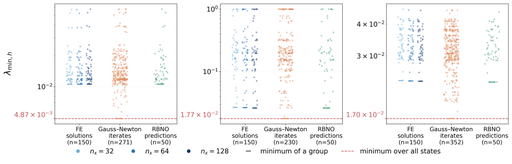
Figure 4 : Discrete stability for the first50test parameters. We plot the smallest generalized eigenvalueλmin,h defined in(45) at finite element solutions on three meshes and at Gauss–Newton iterates and RBNO predictions on the finest mesh. The meshes have nx = 32,64, and128cells in the x-direction, with ny = nx for semilinear diffusion–reaction and quasilinear diffusion, and ny = nx/2for compressible hyperelasticity. For hyperelasticity, we include only the iterates from the final load step. Left: semilinear diffusion–reaction withκ = 103. Middle: quasilinear diffusion. Right: compressible hyperelasticity. We denote the number of states in each group byn. Horizontal bars indicate the group minima, and the dashed line indicates the minimum over all states, with its value marked on the vertical axis.
出典 · CC BY 4.0 · Yuan Qiu, Wolfgang Dahmen, Peng Chen · Variationally correct physics-informed operator learning for nonlinear partial differential equations · 論文の図を引用 · 元のPDFの26ページ目から図の部分を抽出しています。格子ベースのニューラル演算子との比較
PCA-Net、FNO、FC-PINOは同じ有限要素空間で評価しました。FC-PINOは自身の格子での評価では低い損失を示しましたが、同じ積分の枠組みにおける有限要素の損失とは異なっていました。著者らは、この違いが残差の評価誤差により損失ベースの誤差制御が弱まりうることを示していると解釈しています。
弾性の仮定と残された限界
Neo-Hookean弾性問題では、接線演算子の逆有界性は証明せず、仮定として残しました。大きな変形では強制性が失われることがあり、著者らは独立した逆境界が必要だと考えています。反応問題の解析的定数は保守的であるため、実際の安定性の余裕を過小評価します。また、著者らは、線形の縮約基底では鋭い局在化解をうまく表現しにくいという点を、残された課題として挙げています。
論文情報
- 著者
- Yuan Qiu, Wolfgang Dahmen, Peng Chen
- 学会・ジャーナル
- arXiv · プレプリント
- 公開日
- 2026年11月16日
- 登録日
- 2026年11月18日
- 更新日
- 2026年11月16日
- バージョン
- v1
- arXiv
- 2611.21469
- カテゴリ
- math.NA · cs.LG
- ライセンス
- CC BY 4.0
- 掲載内容
- 論文情報・解説・論文の図
この解説は、Refivuの韓国語解説をAIで翻訳したものです。不正確な翻訳や誤りが含まれる可能性があります。論文と図の利用条件は各出典に従います。
アブストラクト
Physics-informed operator learning trains neural operators on the residual of a parametric partial differential equation (PDE) instead of labeled solution data, but its reliability depends on a variationally correct residual: one that is equivalent to the error in a norm dictated by the equation, the PDE-compliant norm. For nonlinear equations written as first-order systems, we prove that the first-order system least-squares residual is equivalent to the error in this norm near a solution branch if the linearized residual is stable and the residual derivative is Lipschitz continuous, possibly in a norm stronger than the error norm. We verify these conditions for monotone reaction, solution- and gradient-dependent diffusion, and compressible Neo-Hookean hyperelasticity. The stability mechanisms vary across these classes, as do the regions where the equivalence holds, from arbitrary bounded sets to a neighborhood of the branch. In a conforming finite element space, we show that the loss excess of a state near the finite element solution is equivalent to its squared distance from that solution. We use this loss to train a reduced basis neural operator with values in this space, with solution snapshots needed only for the basis and the loss and its symbolically derived gradient assembled by the finite element library. At inference, this loss estimates the error. Numerically, the square root of the loss excess tracks the error within factors comparable to those of the linear case, and the operator achieves higher accuracy in the PDE-compliant norm than grid-based baselines evaluated in the same finite element space.
この論文を引用
Yuan Qiu, Wolfgang Dahmen, Peng Chen (2026). Variationally correct physics-informed operator learning for nonlinear partial differential equations. arXiv:2611.21469v1. https://arxiv.org/abs/2611.21469v1
BibTeX
@misc{qiu2026variationally,
  title = {{Variationally correct physics-informed operator learning for nonlinear partial differential equations}},
  author = {Yuan Qiu and Wolfgang Dahmen and Peng Chen},
  year = {2026},
  eprint = {2611.21469},
  archivePrefix = {arXiv},
  url = {https://arxiv.org/abs/2611.21469v1}
}