論文解説
Syllable- and Word-Level Evaluation of Tibetan OCR
Tibetan OCRの音節・単語レベル評価
- 課題 CERだけで評価すると、Tibetan OCRシステムの順位や共同学習の判定が、音節・単語単位の指標でどう変わるかを確認する必要があります。
- 手法 9つの認識器設定を4つのデータセットで学習し、CER、SER、3つのSWER変種で同じ行を採点します。
Tibetan OCR評価でCERだけで十分か
Tibetan OCRは主に文字誤り率(CER)で評価されます。チベット文字は音節の境界をtshegで示しますが、単語の境界は示しません。そのため単語単位の誤り率を計算するには分節器が必要になり、他の文字体系で一般的なWERをそのまま使うのは難しいです。この論文ではCERに加え、音節単位のSERと分節器で区切った単語単位のSWERも計算し、CERがシステムの順位と共同学習の効果の判定をどの程度同じように下すかを確認しています。また、OCRの誤りが品詞タグ付け、固有表現認識、翻訳の保持率にどうつながるかも併せて調べています。
9つの認識器と誤り率の計算方法
評価対象は、CRNNとEaster2.0のCTCモデル、TrOCR-smallとTrOCR-baseのエンコーダ・デコーダモデル、そして4ビットQLoRAで学習したQwen3-VL-2Bです。TrOCRは学習後に、8ビットと4ビットのpost-training quantization版も作成しています。公開データセット4つ(KhyentseWangpo、Karmapa8、Drutsa、Betsug)で単一ドメインの条件を作り、3つの混合条件で共同学習を比較します。CTCモデルは、整列されていない目標系列の尤度を最大化するように学習されます。TrOCRのチェックポイントのエンコーダとデコーダの重みは保ったまま、デコーダの語彙をチベット文字の集合に置き換えてファインチューニングしました。
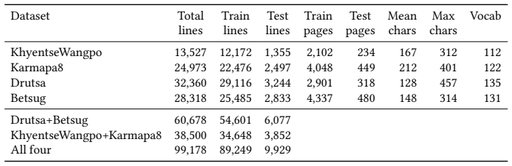
Table 1 . Dataset statistics. Mean chars and Vocab are computed on the training split. Identifiers refer to public Hugging Face repositories. The three mixed-domain conditions concatenate components, and their line counts are the sums of the component counts.
出典 · CC BY 4.0 · Jacob Moore, Paula Lauren · Syllable- and Word-Level Evaluation of Tibetan OCR · 論文の図を引用 · 元のPDFの5ページ目から図の部分を抽出しています。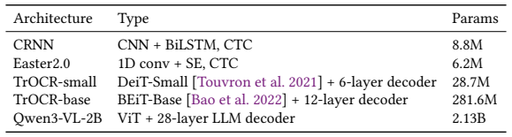
Table 2 . Model architectures. TrOCR checkpoints are stage-1 pretrained on synthetic printed text-line im- ages [Li et al. 2023].
出典 · CC BY 4.0 · Jacob Moore, Paula Lauren · Syllable- and Word-Level Evaluation of Tibetan OCR · 論文の図を引用 · 元のPDFの6ページ目から図の部分を抽出しています。誤り率はすべて編集距離に基づいています。置換、削除、挿入の和を参照単位数Nで割ります。CERはUnicode文字、SERはtsheg、shad、空白で区切られた音節を単位とします。同じ誤りでも区切り記号の上に当たると、CERでは編集1回として数えられますが、2つの単位を同時に壊すため、単位レベルの指標では影響が変わります。
順位の一致と共同学習の判定
システムの順位は、条件ごとにCERと各音節・単語指標のKendall 𝜏を比べて確認しました。CERとSER、3つのSWER変種の間の𝜏は0.833から1.000の範囲でした。分節器同士の順位の一致は、中央値1.000でした。
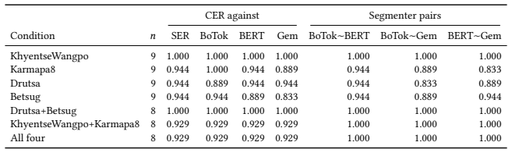
Table 6 . Kendall 𝜏 between model rankings of the configurations: under CER against under each syllable- and word-level metric, and under each pair of segmenters.
出典 · CC BY 4.0 · Jacob Moore, Paula Lauren · Syllable- and Word-Level Evaluation of Tibetan OCR · 論文の図を引用 · 元のPDFの11ページ目から図の部分を抽出しています。共同学習の効果は、同じ行で共同学習モデルと単一ドメインモデルを比較し、テストページ単位のpaired bootstrapで判断しました。多重比較の補正は適用していません。64個の構成要素セルのうち、CERとSERは符号が逆の有意な変化を7セルで記録しました。音節または単語の指標まで含めると、符号が逆のセルは10個です。このうち8つはTrOCR-small 4ビットのセルで、それらのセルではCERは減少を記録していました。逆転するペアも1組確認されましたが、これはシード3つで現れた結果でした。
モデル性能と下流タスクの保持率
単一ドメインの4条件すべてで、CRNNが最も低いCERを記録しました。Easter2.0との差は、Karmapa8とBetsugで0.001でした。下流タスクの保持率は、活字テキストではCTCモデルが最も高くなりました。同じモデルがBetsugでCERが0.024から0.025になったとき、品詞の保持率は0.880から0.895でしたが、固有表現の保持率は0.587から0.602に下がりました。固有表現の保持率が品詞の保持率より低かったのは、36測定のうち30件でした。
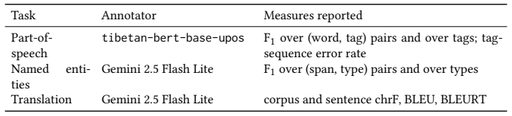
Table 4 . Downstream tasks. All are scored as preservation against reference-derived output. Entity labels are PER, LOC, ORG and WORK, the last for text titles.
出典 · CC BY 4.0 · Jacob Moore, Paula Lauren · Syllable- and Word-Level Evaluation of Tibetan OCR · 論文の図を引用 · 元のPDFの9ページ目から図の部分を抽出しています。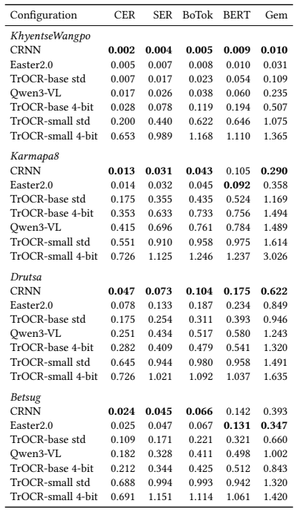
Table 5 . Macro-averaged error rates on the single-domain conditions, ordered by CER within each condition; lowest per condition in bold. The 8-bit variants, which differ from their standard counterparts by at most 0.014 in CER and 0.034 in SER, BoTok-SWER and BERT-SWER, are omitted.
出典 · CC BY 4.0 · Jacob Moore, Paula Lauren · Syllable- and Word-Level Evaluation of Tibetan OCR · 論文の図を引用 · 元のPDFの10ページ目から図の部分を抽出しています。保持率の基準値で見ると、品詞の保持率0.8はSER 0.078以下でのみ到達しました。翻訳のchrF 60はSER 0.047以下で到達しました。固有表現の保持率0.6は、どの誤り率でも到達しませんでした。この目安は、著者らが大まかな指針として任意に選んだ値です。
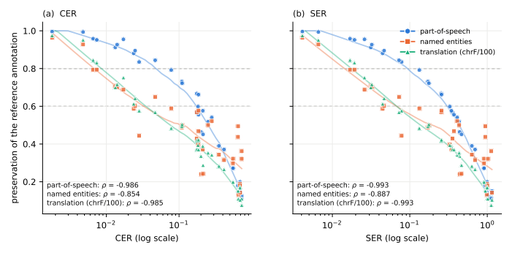
Fig. 4 . Preservation of the reference annotation on three downstream tasks, against (a) CER and (b) SER on logarithmic axes, over the 36 configuration × condition cells for which downstream measures were computed. Curves are LOWESS fits on the logarithm of the rate, one per task; dashed lines mark the targets of § 4.4.1 (0.8 for part-of-speech and entity preservation, 60 for chrF). Translation chrF is divided by 100 to share the axis. SER’s association with each measure is within 0.005 of the strongest of the five rates (Table 9).
出典 · CC BY 4.0 · Jacob Moore, Paula Lauren · Syllable- and Word-Level Evaluation of Tibetan OCR · 論文の図を引用 · 元のPDFの13ページ目から図の部分を抽出しています。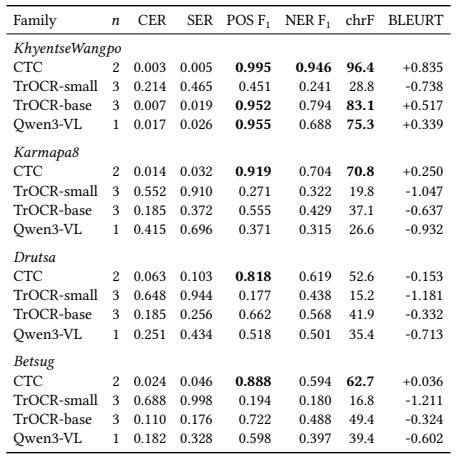
Table 8 . Downstream preservation, median over each family’s configurations, on the 500-line seeded random subset of each single-domain condition. POS F 1 is over (word, tag) pairs, NER F 1 over (surface form, type) pairs; chrF and BLEURT score the translation against the one produced from the reference. CER and SER are family medians of the full test-set rates. Bold: the downstream target of § 4.4.1 is met (POS and NER F 1 0.8, chrF 60).
出典 · CC BY 4.0 · Jacob Moore, Paula Lauren · Syllable- and Word-Level Evaluation of Tibetan OCR · 論文の図を引用 · 元のPDFの14ページ目から図の部分を抽出しています。分割方法とサンプリングの限界
分割は、テキストや筆写者ではなく、ページ単位で行われました。そのため、同じテキストや筆写者の別の行が学習データに入る可能性があります。このため、報告された誤り率は、見たことのないテキストや筆写者に対しては低く出た可能性があります。特に手書きテキストでその傾向があります。
Gem-SWERは、API費用のため、条件ごとにランダムに選んだ500行でのみ計算されました。そのため、テスト分割全体の値と同じ範囲は共有していません。下流タスクのスコアもGemini 2.5 Flash Liteの出力に依存し、注釈器が失敗した場合は空の出力として採点され、その分がスコアに反映されています。
論文情報
- 著者
- Jacob Moore, Paula Lauren
- 学会・ジャーナル
- arXiv · プレプリント
- 公開日
- 2026年11月16日
- 登録日
- 2026年11月18日
- 更新日
- 2026年11月16日
- バージョン
- v1
- arXiv
- 2611.21303
- カテゴリ
- cs.CL
- ライセンス
- CC BY 4.0
- 掲載内容
- 論文情報・解説・論文の図
この解説は、Refivuの韓国語解説をAIで翻訳したものです。不正確な翻訳や誤りが含まれる可能性があります。論文と図の利用条件は各出典に従います。
アブストラクト
Optical character recognition (OCR) for Tibetan is evaluated predominantly by character error rate (CER). Tibetan marks syllable boundaries but does not mark word boundaries, so a word error rate requires a segmenter. This study evaluates nine recognizer configurations on typeset, woodblock and two handwritten script styles, alone and in combination, and reports syllable- and word-level error rates, to our knowledge the first for Tibetan OCR. The configurations span CTC models, TrOCR encoder-decoders with and without post-training quantization, and a vision-language model, and each is scored under CER, the syllable error rate (SER) and three segmented word error rates (SWER). CER ranks systems largely as the higher-level rates do (Kendall $τ\geq 0.833$), with one pair ordered oppositely. On the effect of joint training, CER and SER record significant changes of opposite sign in 7 of 64 comparisons. SER needs no segmenter and ranks systems as SWER does under two of the three segmenters ($τ\geq 0.889$). The output of each configuration is also tagged for part of speech, annotated for named entities and machine translated, and each result is compared with that obtained on the reference text. As rough guidance, translation chrF of 60 is reached at SER of 0.047 or below and part-of-speech preservation of 0.8 at 0.078 or below, while no error rate separates the systems that reach entity preservation of 0.6 from those that do not.
この論文を引用
Jacob Moore, Paula Lauren (2026). Syllable- and Word-Level Evaluation of Tibetan OCR. arXiv:2611.21303v1. https://arxiv.org/abs/2611.21303v1
BibTeX
@misc{moore2026syllable,
  title = {{Syllable- and Word-Level Evaluation of Tibetan OCR}},
  author = {Jacob Moore and Paula Lauren},
  year = {2026},
  eprint = {2611.21303},
  archivePrefix = {arXiv},
  url = {https://arxiv.org/abs/2611.21303v1}
}