論文解説
Train After You Measure: a Pre-Registered Learning Curve for Fine-Tuning Typed Decision Models on One User's Labels
測定してから学習する:1人のユーザーのラベルでタイプ付き決定モデルをファインチューニングするための事前登録済み学習曲線
- 課題 1人のユーザーのメールラベルでTev1系モデルをファインチューニングすると、事前登録したマージンを超えてTF-IDFベースラインに勝てるのかは分かっていません。
- 手法 Tev1-0.8BとTev1-4Bに LoRAを付けてラベル予算ごとに学習し、固定テストセットでTF-IDFロジスティック回帰と比較しました。
- 結果 message typeの全ラベルでは4Bモデルがベースラインより+3.3点高かった一方、3つのaction switchesの平均精度ではベースラインがすべての予算で上回りました。
1人のユーザーのラベルによるファインチューニングとベースラインの比較
この論文は、1人のユーザーのメールラベルでtyped decision modelをファインチューニングしたとき、先行研究で最も高い精度を示したTF-IDFロジスティック回帰ベースラインを超えられるかを問うものです。著者らは、同じラベルをdecision modelに与えて、その差が縮まるかを確かめようとしました。
実験は2回の事前登録に分けられます。登録Mは一般的なQwen3.5-4Bベースにmessage typeのみを適用した予備研究で、交差検証を使いました。登録Cは公開されているTev1-0.8B-experimentalとTev1-4B-experimentalにLoRAアダプタを付け、5つのフィールドを学習した本研究です。固定テストセットは135通のメールで、学習プールは587通のメールです。
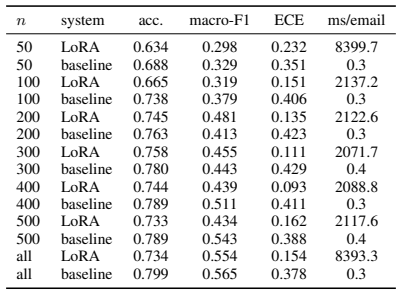
Table 6 : Registration M (preliminary): LoRA on the generic Qwen3.5-4B base vs. a word TF-IDF baseline ontype, out-of-fold, same thread-grouped folds; n = training labels per fold. Not comparable with Table 1 (cross-validation, not the fixed test). Generated from the run'smetrics.json.
出典 · CC BY 4.0 · Federico Lucca · Train After You Measure: a Pre-Registered Learning Curve for Fine-Tuning Typed Decision Models on One User's Labels · 論文の図を引用 · 元のPDFの9ページ目から図の部分を抽出しています。LoRAによるファインチューニングとデータ分割
データ分割はスレッド単位で行います。固定テストセットは129のスレッドに属する135通のメールで、残りの587通のメールが学習プールになります。プールからは50、100、200、300、400、587個のラベルの包含関係のある部分集合を、シード7と11で抽出します。小さい部分集合は、より大きい部分集合に含まれます。
ファインチューニングはLoRAで行います。rankは16、αは32、dropoutは0.05で、すべての線形レイヤーに付けます。予算とシードごとにアダプタを1つ作り、5つの質問をまとめて学習します。最大3エポックで、10%のスレッド単位の検証分割を使って早期終了を適用します。予算0はアダプタのないzero-shotモデルです。
ベースラインは、単語1–2-gramと文字3–5-gramのTF-IDFに、class-balancedなロジスティック回帰をフィールドごとに学習させたモデルです。ハイパーパラメータは固定値を使います。予測は選択肢の文字の分布を再正規化して読み取り、信頼度は選ばれた選択肢の確率とします。
message typeと3つのaction switchesの結果
message typeでは、Tev1-4B-experimentalは400個のラベルのときベースラインより+2.6点高く、登録された+3点の基準を満たせませんでした。全587個のラベルでは、Tev1-0.8B-experimentalが+0.7点、Tev1-4B-experimentalが+3.3点高くなりました。ただしこの差は、メール1通が0.74点に相当するテストの分解能の範囲内です。全ラベルでは、4Bモデルのmacro-F1は0.581、ベースラインは0.406でした。この点では、ベースラインのほうが予測しない希少クラスをよく見つけていました。
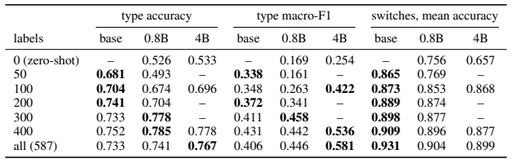
Table 1 : Registration C on the fixed test (135 emails). Accuracy and macro-F1 ontypeand mean accuracy of the three switches, by training labels; mean of the seeds run at each budget (two everywhere except zero-shot, one). Budget 0 is the same model without LoRA. Majority class of the test: 0.585 on type, 0.827 on the switches. One email is 0.74 points; the 95% Wilson interval of the baseline's type accuracy with all labels is [0.653, 0.801]. Best value per row in bold. Generated bycurve_tables.pyfrom the result JSON files.
出典 · CC BY 4.0 · Federico Lucca · Train After You Measure: a Pre-Registered Learning Curve for Fine-Tuning Typed Decision Models on One User's Labels · 論文の図を引用 · 元のPDFの4ページ目から図の部分を抽出しています。3つのaction switchesの平均精度では、ベースラインがすべてのラベル予算で2つのファインチューニングモデルを上回りました。全ラベルでは、ベースラインは0.931、0.8Bは0.904、4Bは0.899でした。ファインチューニングモデルの最良値は、0.8Bで−1.2点、4Bで−0.5点でした。
学習曲線とキャリブレーション、遅延コスト
Tev1-0.8B-experimentalのmessage type学習曲線は、300個のラベル以降で改善が止まり、その後低下しました。300個のラベル以降の最初の傾きは1点未満でした。Tev1-4B-experimentalは4つの予算しかないため、同じ収束基準は評価できませんでした。
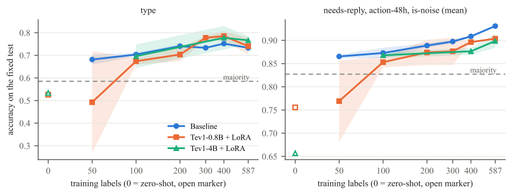
Figure 1 : RegistrationC: accuracy on the fixed test by training labels (log scale), mean of seeds 7 and 11 with the min–max band across seeds; open markers are the same models zero-shot. Left: message type. Right: mean of the three switches. Dashed: majority class of the test. Generated from the result JSON files.
出典 · CC BY 4.0 · Federico Lucca · Train After You Measure: a Pre-Registered Learning Curve for Fine-Tuning Typed Decision Models on One User's Labels · 論文の図を引用 · 元のPDFの4ページ目から図の部分を抽出しています。較正指標であるexpected calibration errorは、10個の区間で計算しました。ファインチューニングはmessage typeのzero-shot ECEを下げましたが、0.8Bモデルは200個以上のラベルがある4つの予算のうち3つで、0.10以上を維持しました。遅延はT4 GPUで質問ごとの中央値を測定しました。ファインチューニングモデルは0.8Bが306 ms、4Bが1681 msで、ベースラインは0.7 msでした。
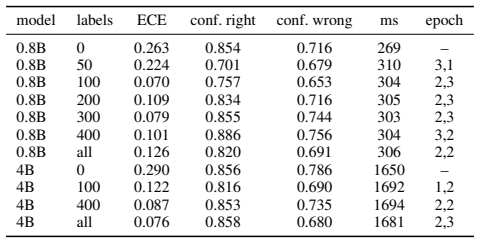
Table 4 : Registration C,type: ECE (10 bins), mean confidence on correct and wrong answers, median latency per question on a T4 (ms), best epoch per seed. Baseline median latency: 0.7 ms.
出典 · CC BY 4.0 · Federico Lucca · Train After You Measure: a Pre-Registered Learning Curve for Fine-Tuning Typed Decision Models on One User's Labels · 論文の図を引用 · 元のPDFの8ページ目から図の部分を抽出しています。残された課題
この実験は1つの受信トレイと1人のユーザーで行われました。ラベルはモデルの提案を見ながら所有者が付けたもので、その提案にアンカリングされた可能性があります。LoRAのハイパーパラメータはすべての予算で同じセットを使ったため、この曲線はデータの効果を示しますが、チューニングの効果は切り分けていません。シードは2つで、zero-shotの点はシード1つだけを使います。135通のテストでは、メール1通が精度を0.74点動かします。
ファインチューニングがベースラインを下回った理由として挙げた、希少クラスの不足、クラスの不均衡、テストの小ささ、プロンプトの長さ、fp16精度、ベースモデルの選択は、著者らが実験では検証していません。著者らは、これを検証するには2つ目の受信トレイ、クラス重み、より大きいテストセットが必要だと考えています。
論文情報
- 著者
- Federico Lucca
- 学会・ジャーナル
- arXiv · プレプリント
- 公開日
- 2026年11月16日
- 登録日
- 2026年11月18日
- 更新日
- 2026年11月16日
- バージョン
- v1
- arXiv
- 2611.21393
- カテゴリ
- cs.CL · cs.LG
- ライセンス
- CC BY 4.0
- 掲載内容
- 論文情報・解説・論文の図
この解説は、Refivuの韓国語解説をAIで翻訳したものです。不正確な翻訳や誤りが含まれる可能性があります。論文と図の利用条件は各出典に従います。
アブストラクト
Fine-tuning a small typed decision model on one user's email labels did not clear the margin we pre-registered over a logistic regression trained on the same labels. In earlier work, about two hundred labels and a TF-IDF logistic regression had the highest point accuracy on this inbox, though not significantly above the best hosted model; we ask whether the same labels, given to a decision model, close the gap. A first registered study, on a generic 4B base with cross-validation and message type only, stayed below the baseline at every label budget (-1.8 to -7.3 points). The main study was registered before any fine-tuning run: a fixed test set of 135 emails never used for selection, LoRA adapters on the public Tev1-0.8B and Tev1-4B decision models, nested subsets of 50 to 587 labels, two seeds and five decision fields on a free T4 GPU. Four of its five hypotheses are refuted--two in the fine-tunes' favour--and one is confirmed for one model. On message type the 4B model misses the registered three-point margin at 400 labels (+2.6) and passes it with all 587 (+3.3); with all labels both models are above the baseline by +0.7 and +3.3 points, where one email is 0.74 points and a 95% interval is about 15 points wide, and the 4B model is clearly ahead in type macro-F1 (0.581 vs. 0.406). On the three action switches the baseline is ahead at every label budget for both models (0.931 vs. 0.904 and 0.899 mean accuracy with all labels), at under a millisecond per question against 306 and 1681 ms. The 0.8B type curve barely improves after 300 labels and then falls. The baseline never predicts the two rarest classes (7 offers and 8 spam in the training pool); the fine-tuned models find spam in some runs, not consistently across seeds. We list the explanations we did not test and say when a new attempt would be worth making. Scripts are public; weights and emails are not.
この論文を引用
Federico Lucca (2026). Train After You Measure: a Pre-Registered Learning Curve for Fine-Tuning Typed Decision Models on One User's Labels. arXiv:2611.21393v1. https://arxiv.org/abs/2611.21393v1
BibTeX
@misc{lucca2026train,
  title = {{Train After You Measure: a Pre-Registered Learning Curve for Fine-Tuning Typed Decision Models on One User's Labels}},
  author = {Federico Lucca},
  year = {2026},
  eprint = {2611.21393},
  archivePrefix = {arXiv},
  url = {https://arxiv.org/abs/2611.21393v1}
}