논문 해설
Primitives and Paths: Predicting What Post-Training Can Do from What the Base Model Already Has
기본 모델이 이미 갖고 있는 것으로 post-training이 무엇을 할 수 있을지 예측하기: 프리미티브와 경로
- 연구 문제 RL이 기반 모델에 새 능력을 더하는지, 기존 능력을 증폭하는지는 기반 모델의 능력 상태에 따라 달라진다는 관점에서 post-training 가능성을 예측하는 문제를 다룹니다.
- 연구 방법 기반 모델을 effective full-solution support와 atomic primitive coverage의 두 축으로 측정하고, 이에 따라 amplification, composition-limited, acquisition-limited 체제를 구분합니다.
- 주요 결과 합성 조합 과제에서 원자적 기술을 모두 실행하는 M2 체크포인트도 완전 해법 지원이 없으면 RL로 개선되지 않았고, 조합 예제로 지원을 만든 뒤에는 GRPO로 큰 개선이 나타났습니다.
RL은 새 능력을 만드는가, 기존 능력을 증폭하는가
강화학습(RL)은 수학·코딩 같은 추론 과제의 post-training에 널리 쓰이지만, pre-training 이후 RL이 실제로 무엇을 더하는지는 논쟁적입니다. 한쪽에서는 pass@k 결과를 근거로 RL이 기존 잠재 행동의 가중치를 재조정할 뿐이라고 보고, 다른 쪽에서는 구성 요소 기술은 있지만 조합이 주어지지 않은 과제에서 RL이 새로운 조합을 학습할 수 있다고 봅니다. 이 논문은 두 입장이 모순된다기보다, RL이 시작되는 기반 모델의 능력 상태에 따라 결과가 달라진다고 주장합니다. 따라서 질문은 RL이 새 능력을 만드는지 여부가 아니라, 주어진 기반 모델에서 post-training이 무엇을 할 수 있는지로 바뀌어야 합니다.
두 축으로 본 상태 공간
이 논문은 기반 모델의 post-training 가능성을 두 축으로 나눕니다. 첫 번째 축은 effective full-solution support로, 성공적인 전체 해법 궤적이 feasible한 탐색 예산 안에서 샘플링될 수 있는지를 뜻합니다. 원문은 이를 운영적 의미로 사용하며 pass@k를 그 측정 중 하나로 다룹니다. 두 번째 축은 atomic primitive coverage로, 해법을 구성하는 원자적 기술이 조합의 부담이 제거되었을 때 실행될 수 있는지를 뜻합니다. 원문은 이 축을 각 기술 j의 isolated execution probability q_exec_j에 대한 최솟값 bc(x)=min_j q_exec_j(x)로 정의하며, 하나의 신뢰할 수 없는 필수 기술이 실행 병목을 만들 수 있기 때문이라고 설명합니다.
이 두 축의 조합으로 amplification, composition-limited, acquisition-limited 세 학습 체제가 나뉘고, 두 축 모두 낮지 않은 설명되지 않은 진단 불일치 영역도 함께 제시됩니다.
합성 조합 과제로 본 검증 설계
검증은 다섯 자리 문자열에 대한 두 연산 F(왼쪽으로 한 위치 회전)와 G(첫 자리 숫자를 mod 10에서 3 증가)를 사용한 합성 과제에서 이루어졌습니다. 각 문제는 F와 G를 모두 포함한 2~4개의 연산 순서이며, 프로그램 검증기가 중간 상태와 최종 답을 확인합니다. 세 개의 작은 언어 모델 Qwen3-1.7B, Gemma-3-1B, Qwen2.5-1.5B-Instruct에서 F만으로 학습한 M1, F와 G를 함께 학습한 M2, 그리고 혼합 조합 예제를 추가한 M1+C(n)와 M2+C(n) 체크포인트를 만들었습니다. 조합 예제 수 n은 100과 300이며, 각 설정에서 held-out 150개 문제를 문제당 64개 샘플로 측정한 뒤 같은 outcome-based GRPO를 150 updates와 세 seed로 적용했습니다.
보상은 완전히 올바른 궤적에만 주어졌습니다.
기술 숙달만으로는 RL 개선이 보장되지 않는 결과
M2 체크포인트는 개별 F와 G 연산을 거의 완벽하게 실행했지만, RL 전 held-out 조합에서는 관측된 성공 궤적이 없었습니다. Qwen3-1.7B와 Qwen2.5-1.5B에서는 M2에 GRPO를 적용해도 개선이 없었고, Gemma-3-1B에서는 학습 로그에서 RL 학습 프롬프트 2,000개 중 6개가 64회 사전 샘플링 안에서 한 번 이상 풀린 흔적이 있었습니다. 이는 실제 지원이 held-out 벤치마크가 아니라 학습 분포와 샘플링 정책에 의존함을 보여 줍니다. M1 체크포인트는 세 아키텍처 모두에서 RL 전후 성공률이 0이었습니다. 조합 예제가 100개일 때는 개선이 나타나지 않았으나, 300개일 때는 0이 아닌 full-solution support가 생기고 GRPO 후 pass@1이 0.17에서 0.40 사이로 올랐습니다.
다만 이 체크포인트들은 고립된 G 프로브 정확도가 여전히 거의 0에 가까웠습니다. 초기 지원이 높은 M2+C(300) 설정에서는 Qwen3-1.7B의 개선이 pass@1에 더 집중되어 증폭과 일치하는 양상을 보였습니다.
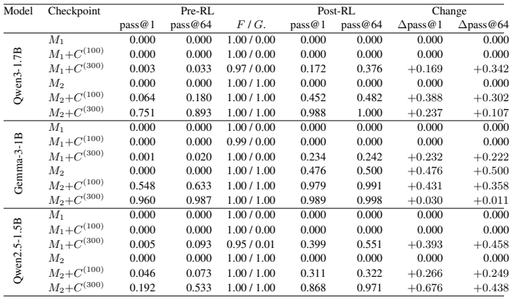
Table 1 : Pre- and post-RL performance on 150 held-out compositions (64 samples per problem). F / G is pre-RL execution accuracy on isolated single-operation prompts with held-out strings. Post-RL values and changes are averaged over three GRPO seeds.
원문 · CC BY 4.0 · Anqi Qu · Primitives and Paths: Predicting What Post-Training Can Do from What the Base Model Already Has · 원문 그림 인용 · 원본 PDF 8쪽에서 그림 영역을 추출했습니다.한계와 적용 범위
저자들은 primitive coverage가 full-solution support를 넘어 추가적인 예측력을 가지는지 아직 확인하지 못했다고 밝힙니다. 기술 분해와 프로브의 구성에 따라 coverage 추정이 달라지며, 임계값 τp와 τc에 대한 원칙적 선택 절차도 아직 제시되지 않았습니다. 실험은 작은 언어 모델과 단순하고 결정론적으로 검증되는 합성 조합 과제에 한정되어 있으므로, 수학·코딩 등 자연 추론 과제와 더 큰 모델로의 일반화는 아직 확인되지 않았습니다. 따라서 이 결과는 이 합성 설정에서 두 축이 서로 다른 병목을 드러냄을 보인 것이며, 실제 추론 과제의 체제 분류를 확정하는 근거로 읽기는 어렵습니다.
논문 정보
- 저자
- Anqi Qu
- 학회·저널
- arXiv · 프리프린트
- 최초 공개일
- 2026년 11월 8일
- 등록일
- 2026년 11월 10일
- 수정일
- 2026년 11월 8일
- 버전
- v1
- arXiv
- 2611.11260
- 분류
- cs.LG · cs.AI
- 원문 이용 조건
- CC BY 4.0
- 제공 범위
- 논문 정보, 해설, 허용된 원문 그림
AI 해설은 논문 원문과 별개의 설명이며 오류가 있을 수 있습니다. 원문과 그림은 각 출처의 이용 조건과 따로 표시된 권리를 따릅니다.
초록
Does reinforcement learning teach language models new capabilities, or merely amplify ones acquired during pre-training? The literature offers evidence for both: pass@$k$ studies suggest RL reweights latent behaviours while some controlled composition studies demonstrate gains beyond simple amplification. We argue that this question has no answer independent of the capability state of the base model, and propose a two-dimensional state space for post-trainability. The first axis, \emph{effective full-solution support}, measures whether successful trajectories can be sampled under a feasible exploration budget. The second axis, \emph{atomic primitive coverage}, measures whether the constituent skills of a solution can be executed when the burden of composition is removed. Together, these dimensions motivate three regimes -- amplification, composition-limited, and acquisition-limited -- each predicting a distinct empirical signature and calling for a distinct intervention. We propose a prospective measurement protocol and investigate the framework using synthetic composition tasks across three small language models. We find that primitive mastery alone does not guarantee that RL can learn a composition. Checkpoints that execute every primitive reliably can fail to improve when complete solutions are never sampled during training, whereas modest composition supervision that establishes nonzero support enables substantial RL gains. The framework reframes mid-training as preparation for post-training: its role is to move models into states from which RL can operate effectively.
원문 인용
Anqi Qu (2026). Primitives and Paths: Predicting What Post-Training Can Do from What the Base Model Already Has. arXiv:2611.11260v1. https://arxiv.org/abs/2611.11260v1
BibTeX
@misc{qu2026primitives,
  title = {{Primitives and Paths: Predicting What Post-Training Can Do from What the Base Model Already Has}},
  author = {Anqi Qu},
  year = {2026},
  eprint = {2611.11260},
  archivePrefix = {arXiv},
  url = {https://arxiv.org/abs/2611.11260v1}
}