논문 해설
Rethinking Visual Reasoning in Text-to-Image Reward Modeling
텍스트-이미지 보상 모델링에서의 시각적 추론 재고
- 연구 문제 텍스트-이미지 보상 모델은 객체·속성·관계·수량을 판단하는 시각 추론이 약하며, VLM 백본도 선호 fine-tuning 중 이 능력을 잃습니다.
- 연구 방법 같은 이미지에 올바른 캡션과 교란된 캡션을 짝지은 CrossPairs 쌍을 기존 선호 데이터와 섞어 Bradley-Terry 손실로 보상 모델을 학습합니다.
시각 이해가 보상 모델의 기반인 이유
텍스트-이미지 생성에서 보상 모델은 추론 시점 선택과 강화학습 post-training의 목적 함수로 쓰입니다. 보상 모델은 프롬프트에 맞는지 판단하려면 객체를 세고, 속성을 묶고, 공간 관계를 해석할 수 있어야 합니다. 이 논문은 대중적인 보상 모델들이 이런 기초 시각 추론 평가에서 낮은 성능을 보인다고 보고합니다. 예를 들어 ImageReward, PickScore, HPSv2는 Winoground, CV-Relation, WhatsUp, CV-Count 등 여러 과제에서 거의 무작위 수준에 가깝게 나타났습니다. 이 문제는 보상 모델의 선호 예측 정확도만으로는 드러나지 않습니다.
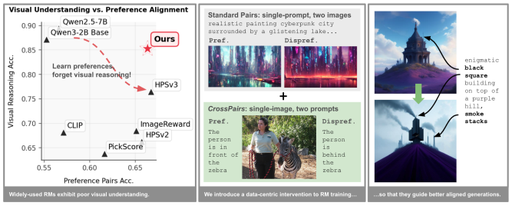
Figure 1 :(Left)Existing reward models exhibit poor visual understanding. VLM backbones possess strong visual reasoning, but this is eroded during preference fine-tuning, even with robust fine-tuning techniques.(Center)We introduce CrossPairs – preference pairs sharing a common image but differing in prompt – to isolate text-image alignment signal by eliminating aesthetic confounds. Mixed with standard pairs during training, our method achieves a Pareto improvement.(Right)The resulting reward model guides generations with superior compositional accuracy.
원문 · CC BY 4.0 · Shiye Su, Xiaohan Wang, Ludwig Schmidt, Serena Yeung-Levy · Rethinking Visual Reasoning in Text-to-Image Reward Modeling · 원문 그림 인용 · 원본 PDF 2쪽에서 그림 영역을 추출했습니다.VLM 백본의 시각 추론이 선호 fine-tuning에서 줄어드는 현상
이 논문은 Qwen2.5-VL-7B를 기반으로 한 HPSv3를 기준으로 비교합니다. ImageRewardDB 정확도는 약 10퍼센트포인트 올랐으나 여러 시각 추론 과제에서 성능이 크게 떨어졌습니다. 저자들은 이를 강한 VLM이라도 선호 fine-tuning 과정에서 기존 능력이 잊히는 현상으로 해석합니다.
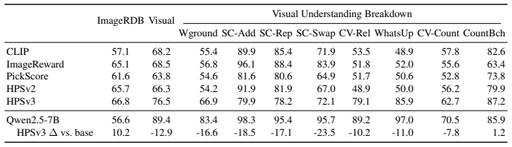
Table 1 : Accuracy of widely-used reward models on ImageRewardDB and our visual understanding evaluations. Random performance is 50%. Bottom: HPSv3 exhibits substantially degraded visual understanding relative to the base VLM it was fine-tuned from.
원문 · CC BY 4.0 · Shiye Su, Xiaohan Wang, Ludwig Schmidt, Serena Yeung-Levy · Rethinking Visual Reasoning in Text-to-Image Reward Modeling · 원문 그림 인용 · 원본 PDF 3쪽에서 그림 영역을 추출했습니다.보수적 fine-tuning과 가중치 병합의 한계
저자들은 LoRA, 일부 레이어만 미세조정하는 방법, 가중치 병합, 불확실성 보정을 비교했습니다. 보수적 fine-tuning은 시각 이해를 약간 개선했지만 선호 정확도의 손실이 따랐고, 기반 모델 수준에는 도달하지 못했습니다. 가중치 병합에서도 시각 이해가 개선되지 않았습니다. 불확실성 보정은 시각 이해를 더 잘 보존했지만 선호 적합이 약해 ImageRewardDB에서 회귀 헤드보다 2퍼센트포인트 낮았습니다. 이 결과들은 이 논문의 설정, 특히 Qwen3-2B와 ImageRewardDB 조건에서 나온 것입니다.
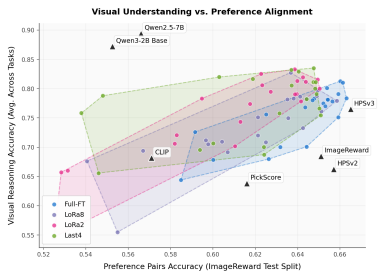
Figure 2 : Visual understanding (y) vs preference accu- racy (x) for multiple checkpoints of the reward model during conservative fine-tuning on preference pairs. Conservative fine-tuning only weakly mitigates visual understanding degradation.
원문 · CC BY 4.0 · Shiye Su, Xiaohan Wang, Ludwig Schmidt, Serena Yeung-Levy · Rethinking Visual Reasoning in Text-to-Image Reward Modeling · 원문 그림 인용 · 원본 PDF 4쪽에서 그림 영역을 추출했습니다.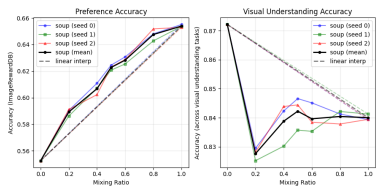
Figure 3 : Preference accuracy (left) and visual under- standing accuracy (right) as a function of the interpo- lation ratio λ for weight merging. Merging does not improve performance over the base ( λ= 0 ) or fully fine-tuned (λ= 1) model.
원문 · CC BY 4.0 · Shiye Su, Xiaohan Wang, Ludwig Schmidt, Serena Yeung-Levy · Rethinking Visual Reasoning in Text-to-Image Reward Modeling · 원문 그림 인용 · 원본 PDF 5쪽에서 그림 영역을 추출했습니다.같은 이미지에 프롬프트만 바꾼 쌍
CrossPairs는 기존 선호 쌍처럼 한 프롬프트에 두 이미지를 두는 대신, 같은 이미지에 올바른 캡션과 교란된 캡션을 두는 쌍을 만듭니다. 기존 VQA와 다지선다 데이터를 이 형식으로 바꿔 추가 이미지 생성이나 사람 주석 없이 학습 데이터를 얻습니다. 학습 신호는 이미지에 공통인 항을 상쇄하고 프롬프트 간 차이만 남기는 식으로 설명됩니다. 이 분해는 Bradley-Terry 손실의 기울기가 같은 이미지의 두 프롬프트를 구별하는 방향으로 작동함을 보여 줍니다.
데이터 구성과 학습 설정
이 혼합으로 Qwen3-2B의 마지막 9개 레이어와 readout head를 Bradley-Terry 손실로 3 epoch 학습했습니다. 시각 인코더와 어댑터는 고정되어 있습니다. 이 설정은 보상 학습의 구성 요소 중 백본 일부와 별도 head의 학습 여부를 함께 보여 줍니다.
선호 정확도와 시각 이해의 함께 개선
CrossPairs를 포함한 모델은 ImageRewardDB에서 66.3%를 기록해 CrossPairs를 제외한 모델과 같은 선호 정확도를 보였습니다. 시각 이해 평균은 85.3%로, CrossPairs를 제외한 모델의 78.4%보다 높았습니다. 이는 두 목표를 함께 개선하는 Pareto 개선으로 보고됩니다. 다만 저자들은 CrossPairs 혼합의 규모 확장성과 생성형 또는 쌍별 보상 모델로의 전이는 확인하지 않았다고 밝힙니다.
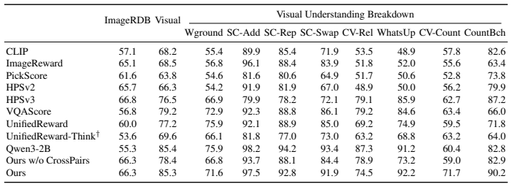
Table 3 : Accuracy of reward models on ImageRewardDB and visual understanding evaluations. Random performance is 50%. †Trained only as a pairwise model; evaluated here by prompting for a pointwise rating (see text).
원문 · CC BY 4.0 · Shiye Su, Xiaohan Wang, Ludwig Schmidt, Serena Yeung-Levy · Rethinking Visual Reasoning in Text-to-Image Reward Modeling · 원문 그림 인용 · 원본 PDF 19쪽에서 그림 영역을 추출했습니다.GenEval에서 best-of-n과 강화학습 결과
추론 시점 best-of-n 선택에서 SD-Turbo는 n=50일 때 64.5%를 기록했고, 비교한 다음 방법은 62.4%였습니다. FLUX.1-Schnell에서는 n=50일 때 78.1%를 기록했고 다음 방법은 75.7%였습니다. DiffusionNFT로 SD 3.5 Medium을 강화학습한 실험에서는 이 보상 모델이 학습 전반에 걸쳐 지속적으로 높은 GenEval 정확도를 보였습니다. 이 결과들은 GenEval이라는 구성적 프롬프트 평가에 한정됩니다.
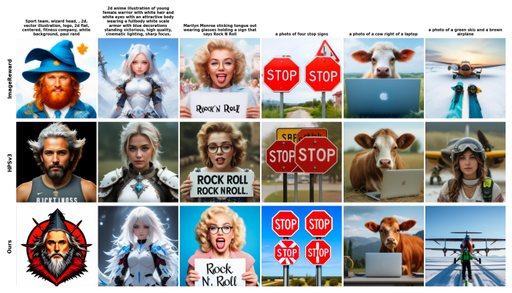
Figure 6 : Generated samples after post-training with different reward models. The first three columns are prompts from Pick-a-Pic; the last three columns are prompts from GenEval.
원문 · CC BY 4.0 · Shiye Su, Xiaohan Wang, Ludwig Schmidt, Serena Yeung-Levy · Rethinking Visual Reasoning in Text-to-Image Reward Modeling · 원문 그림 인용 · 원본 PDF 9쪽에서 그림 영역을 추출했습니다.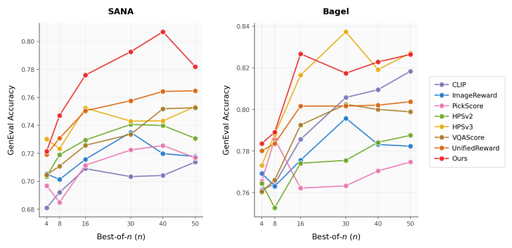
Figure 7 : Further generators.
원문 · CC BY 4.0 · Shiye Su, Xiaohan Wang, Ludwig Schmidt, Serena Yeung-Levy · Rethinking Visual Reasoning in Text-to-Image Reward Modeling · 원문 그림 인용 · 원본 PDF 20쪽에서 그림 영역을 추출했습니다.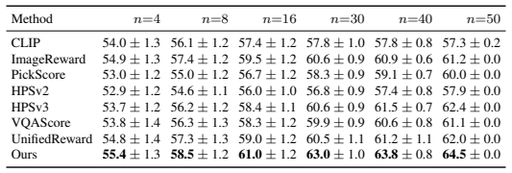
Table 9 : Best-of-n GenEval accuracy (%, mean ± std over 200 resampled n-subsets) with SD-Turbo as the generator.
원문 · CC BY 4.0 · Shiye Su, Xiaohan Wang, Ludwig Schmidt, Serena Yeung-Levy · Rethinking Visual Reasoning in Text-to-Image Reward Modeling · 원문 그림 인용 · 원본 PDF 27쪽에서 그림 영역을 추출했습니다.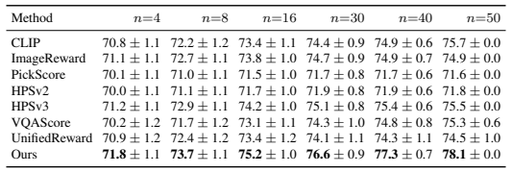
Table 10 : Best-of-n GenEval accuracy (%, mean ± std over 200 resampled n-subsets) with FLUX.1- Schnell as the generator.
원문 · CC BY 4.0 · Shiye Su, Xiaohan Wang, Ludwig Schmidt, Serena Yeung-Levy · Rethinking Visual Reasoning in Text-to-Image Reward Modeling · 원문 그림 인용 · 원본 PDF 28쪽에서 그림 영역을 추출했습니다.CrossPairs 제거 실험과 다른 감독 방식
CrossPairs를 제외한 모델은 같은 선호 데이터에서 시각 이해를 잃었습니다. VQA 보조 다음 토큰 예측 손실과 비교한 실험에서는 CrossPairs가 ImageRewardDB 66.3%와 시각 이해 85.3%로 더 높았고, 두 방식은 n=16까지 비슷하다가 이후 격차가 벌어졌습니다. 이 비교는 같은 원천 데이터를 쓰되 감독 형식만 바꾼 설정입니다.
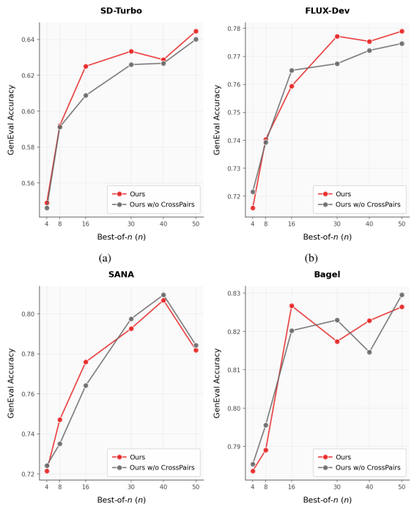
Figure 9 : Ablating out CrossPairs, evaluated best-of-n.
원문 · CC BY 4.0 · Shiye Su, Xiaohan Wang, Ludwig Schmidt, Serena Yeung-Levy · Rethinking Visual Reasoning in Text-to-Image Reward Modeling · 원문 그림 인용 · 원본 PDF 23쪽에서 그림 영역을 추출했습니다.
Table 7 : CrossPairs vs. supervising the same visual reasoning sources with an auxiliary VQA next- token-prediction loss. Accuracy on ImageRewardDB and the visual understanding evaluations; random performance is 50%.
원문 · CC BY 4.0 · Shiye Su, Xiaohan Wang, Ludwig Schmidt, Serena Yeung-Levy · Rethinking Visual Reasoning in Text-to-Image Reward Modeling · 원문 그림 인용 · 원본 PDF 24쪽에서 그림 영역을 추출했습니다.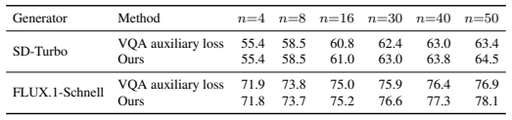
Table 8 : Best-of-n GenEval accuracy (%) for the two supervision formats. We generate 50 images per prompt; each entry is averaged over 200 randomn-subsets of those 50 generations.
원문 · CC BY 4.0 · Shiye Su, Xiaohan Wang, Ludwig Schmidt, Serena Yeung-Levy · Rethinking Visual Reasoning in Text-to-Image Reward Modeling · 원문 그림 인용 · 원본 PDF 27쪽에서 그림 영역을 추출했습니다.남은 문제
저자들은 CrossPairs 혼합 비율이 선호 데이터 규모나 베이스 모델 용량과 어떻게 함께 확장되는지 특성화하지 않았다고 밝힙니다. 또한 이 연구는 판별형 회귀 헤드 방식만 평가했고, 생성형 보상 모델이나 쌍별 보상 모델로의 전이는 시험하지 않았습니다. 이 점은 방법의 적용 범위를 제한합니다.
논문 정보
- 저자
- Shiye Su, Xiaohan Wang, Ludwig Schmidt, Serena Yeung-Levy
- 학회·저널
- arXiv · 프리프린트
- 최초 공개일
- 2026년 11월 12일
- 등록일
- 2026년 11월 16일
- 수정일
- 2026년 11월 12일
- 버전
- v1
- arXiv
- 2611.17585
- 분류
- cs.CV · cs.AI
- 원문 이용 조건
- CC BY 4.0
- 제공 범위
- 논문 정보, 해설, 허용된 원문 그림
AI 해설은 논문 원문과 별개의 설명이며 오류가 있을 수 있습니다. 원문과 그림은 각 출처의 이용 조건과 따로 표시된 권리를 따릅니다.
초록
Reward models are a core component of modern text-to-image systems, serving as the objective for inference-time selection and RL-based post-training. A key prerequisite is visual understanding: to judge prompt adherence and ground aesthetic preferences, a reward model must bind attributes, resolve relations, and count reliably. We find that widely-used reward models perform poorly on targeted visual reasoning evaluations. Even when starting from strong vision-language backbones, preference fine-tuning erodes these capabilities, and continual-learning baselines fail to mitigate a steep tradeoff between visual reasoning and preference accuracy. We propose a data-centric intervention that injects visual reasoning supervision into preference learning by flipping the pairing axis. To complement conventional human preference data (paired images under a shared prompt), we convert existing visual reasoning datasets into preference pairs that share the same image but differ in prompt, and train on the mixture. This yields a Pareto improvement in both visual understanding and preference prediction. Across inference-time best-of-n selection and RL post-training, the resulting reward model improves text-to-image generation on challenging compositional prompts (GenEval) by an average of 4.0% and 5.5% respectively, outperforming HPSv3 which was trained on 6x more preference pairs.
원문 인용
Shiye Su, Xiaohan Wang, Ludwig Schmidt, Serena Yeung-Levy (2026). Rethinking Visual Reasoning in Text-to-Image Reward Modeling. arXiv:2611.17585v1. https://arxiv.org/abs/2611.17585v1
BibTeX
@misc{su2026rethinking,
  title = {{Rethinking Visual Reasoning in Text-to-Image Reward Modeling}},
  author = {Shiye Su and Xiaohan Wang and Ludwig Schmidt and Serena Yeung-Levy},
  year = {2026},
  eprint = {2611.17585},
  archivePrefix = {arXiv},
  url = {https://arxiv.org/abs/2611.17585v1}
}