論文解説
Rethinking Visual Reasoning in Text-to-Image Reward Modeling
テキストから画像への報酬モデリングにおける視覚的推論の再考
- 課題 テキストから画像を生成する報酬モデルは、物体・属性・関係・数量を判断する視覚的推論が弱く、VLMのバックボーンも選好ファインチューニングの過程でこの能力を失います。
- 手法 同じ画像に正しいキャプションと摂動させたキャプションを組み合わせたCrossPairsの組を既存の選好データと混ぜ、Bradley-Terry損失で報酬モデルを学習します。
視覚理解が報酬モデルの基盤となる理由
テキストから画像を生成する際、報酬モデルは推論時の選択や、強化学習による事後学習の目的関数として使われます。報酬モデルがプロンプトに合っているかを判断するには、物体を数え、属性を結びつけ、空間関係を解釈できる必要があります。この論文は、一般的な報酬モデルがこうした基礎的な視覚的推論の評価で低い性能になると報告しています。たとえば、ImageReward、PickScore、HPSv2は、Winoground、CV-Relation、WhatsUp、CV-Countなど複数のタスクでほぼランダムに近い結果にとどまりました。この問題は、報酬モデルの選好予測の精度だけでは見えません。
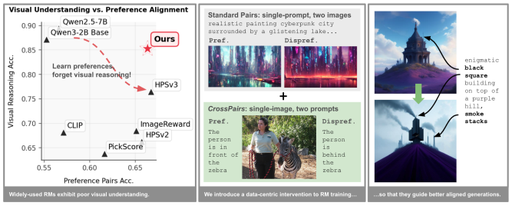
Figure 1 :(Left)Existing reward models exhibit poor visual understanding. VLM backbones possess strong visual reasoning, but this is eroded during preference fine-tuning, even with robust fine-tuning techniques.(Center)We introduce CrossPairs – preference pairs sharing a common image but differing in prompt – to isolate text-image alignment signal by eliminating aesthetic confounds. Mixed with standard pairs during training, our method achieves a Pareto improvement.(Right)The resulting reward model guides generations with superior compositional accuracy.
出典 · CC BY 4.0 · Shiye Su, Xiaohan Wang, Ludwig Schmidt, Serena Yeung-Levy · Rethinking Visual Reasoning in Text-to-Image Reward Modeling · 論文の図を引用 · 元のPDFの2ページ目から図の部分を抽出しています。選好ファインチューニングでVLMバックボーンの視覚的推論が低下する現象
この論文は、Qwen2.5-VL-7Bをベースにした HPSv3 を対象に比較しています。ImageRewardDBの精度は約10パーセントポイント上がった一方で、複数の視覚的推論タスクでは性能が大きく下がりました。著者らは、これを強力なVLMであっても、選好ファインチューニングの過程で既存の能力が忘れられる現象だと解釈しています。
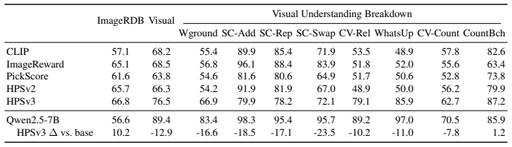
Table 1 : Accuracy of widely-used reward models on ImageRewardDB and our visual understanding evaluations. Random performance is 50%. Bottom: HPSv3 exhibits substantially degraded visual understanding relative to the base VLM it was fine-tuned from.
出典 · CC BY 4.0 · Shiye Su, Xiaohan Wang, Ludwig Schmidt, Serena Yeung-Levy · Rethinking Visual Reasoning in Text-to-Image Reward Modeling · 論文の図を引用 · 元のPDFの3ページ目から図の部分を抽出しています。保守的ファインチューニングと重みマージの限界
著者らは、LoRA、一部のレイヤーだけをファインチューニングする方法、重みのマージ、不確実性補正を比較しました。保守的ファインチューニングは視覚的理解をわずかに改善しましたが、選好精度の低下を伴い、ベースモデルの性能には届きませんでした。重みのマージでも視覚的理解は改善されませんでした。不確実性補正は視覚的理解をより保持しましたが、選好への適合が弱く、ImageRewardDBでは回帰ヘッドより2パーセントポイント低い結果でした。これらの結果は、本論文の設定、特にQwen3-2BとImageRewardDBという条件で得られたものです。
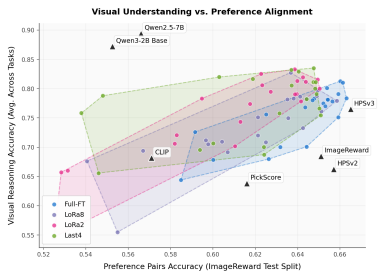
Figure 2 : Visual understanding (y) vs preference accu- racy (x) for multiple checkpoints of the reward model during conservative fine-tuning on preference pairs. Conservative fine-tuning only weakly mitigates visual understanding degradation.
出典 · CC BY 4.0 · Shiye Su, Xiaohan Wang, Ludwig Schmidt, Serena Yeung-Levy · Rethinking Visual Reasoning in Text-to-Image Reward Modeling · 論文の図を引用 · 元のPDFの4ページ目から図の部分を抽出しています。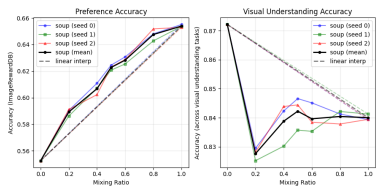
Figure 3 : Preference accuracy (left) and visual under- standing accuracy (right) as a function of the interpo- lation ratio λ for weight merging. Merging does not improve performance over the base ( λ= 0 ) or fully fine-tuned (λ= 1) model.
出典 · CC BY 4.0 · Shiye Su, Xiaohan Wang, Ludwig Schmidt, Serena Yeung-Levy · Rethinking Visual Reasoning in Text-to-Image Reward Modeling · 論文の図を引用 · 元のPDFの5ページ目から図の部分を抽出しています。同じ画像に対してプロンプトだけを変えたペア
CrossPairsでは、既存の選好ペアのように1つのプロンプトに2枚の画像を置くのではなく、同じ画像に正しいキャプションと摂動させたキャプションを置いたペアを作ります。既存のVQAと多肢選択データをこの形式に変換し、追加の画像生成や人手によるアノテーションなしで学習データを得ています。学習の信号は、画像に共通する項を打ち消し、プロンプト間の差分だけを残す形で説明されます。この分解は、Bradley-Terry損失の勾配が、同じ画像に対する2つのプロンプトを区別する方向に働くことを示しています。
データ構成と学習設定
この混合データでは、Qwen3-2Bの最後の9個のレイヤーとreadout headを、Bradley-Terry損失で3 epoch学習しました。ビジョンエンコーダとアダプタは固定されています。この設定は、報酬学習の構成要素のうち、バックボーンの一部と別のheadをそれぞれ学習するかどうかを示しています。
選好精度と視覚的理解の同時改善
CrossPairsを含むモデルは、ImageRewardDBで66.3%を記録し、CrossPairsを除いたモデルと同じ選好精度を示しました。視覚的理解の平均は85.3%で、CrossPairsを除いたモデルの78.4%を上回りました。これは両方の目標を同時に改善するパレート改善として報告されています。ただし著者らは、CrossPairs混合のスケーラビリティや、生成型またはペアワイズの報酬モデルへの転移は確認していないと述べています。
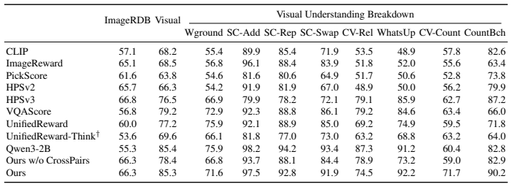
Table 3 : Accuracy of reward models on ImageRewardDB and visual understanding evaluations. Random performance is 50%. †Trained only as a pairwise model; evaluated here by prompting for a pointwise rating (see text).
出典 · CC BY 4.0 · Shiye Su, Xiaohan Wang, Ludwig Schmidt, Serena Yeung-Levy · Rethinking Visual Reasoning in Text-to-Image Reward Modeling · 論文の図を引用 · 元のPDFの19ページ目から図の部分を抽出しています。GenEvalにおけるbest-of-nと強化学習の結果
best-of-nの推論時選択では、SD-Turboはn=50で64.5%を記録し、比較した次の手法は62.4%でした。FLUX.1-Schnellでは、n=50で78.1%を記録し、次の手法は75.7%でした。DiffusionNFTでSD 3.5 Mediumを強化学習した実験では、この報酬モデルは学習全体を通じて高いGenEval精度を維持しました。これらの結果は、構成的なプロンプト評価であるGenEvalに限った結果です。
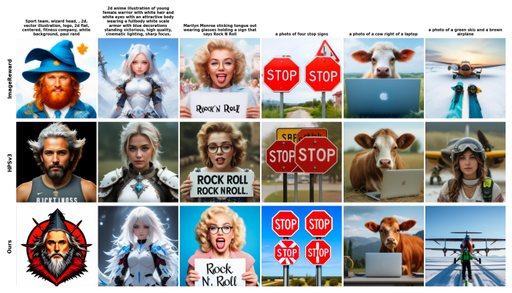
Figure 6 : Generated samples after post-training with different reward models. The first three columns are prompts from Pick-a-Pic; the last three columns are prompts from GenEval.
出典 · CC BY 4.0 · Shiye Su, Xiaohan Wang, Ludwig Schmidt, Serena Yeung-Levy · Rethinking Visual Reasoning in Text-to-Image Reward Modeling · 論文の図を引用 · 元のPDFの9ページ目から図の部分を抽出しています。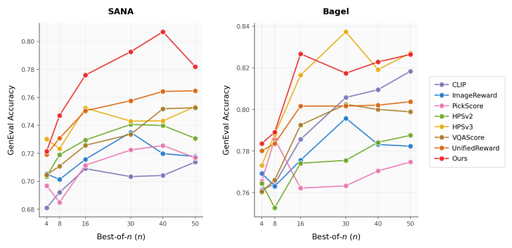
Figure 7 : Further generators.
出典 · CC BY 4.0 · Shiye Su, Xiaohan Wang, Ludwig Schmidt, Serena Yeung-Levy · Rethinking Visual Reasoning in Text-to-Image Reward Modeling · 論文の図を引用 · 元のPDFの20ページ目から図の部分を抽出しています。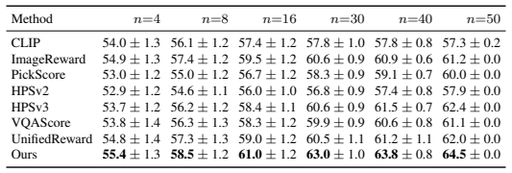
Table 9 : Best-of-n GenEval accuracy (%, mean ± std over 200 resampled n-subsets) with SD-Turbo as the generator.
出典 · CC BY 4.0 · Shiye Su, Xiaohan Wang, Ludwig Schmidt, Serena Yeung-Levy · Rethinking Visual Reasoning in Text-to-Image Reward Modeling · 論文の図を引用 · 元のPDFの27ページ目から図の部分を抽出しています。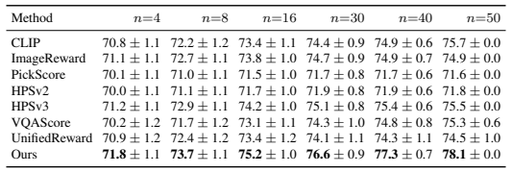
Table 10 : Best-of-n GenEval accuracy (%, mean ± std over 200 resampled n-subsets) with FLUX.1- Schnell as the generator.
出典 · CC BY 4.0 · Shiye Su, Xiaohan Wang, Ludwig Schmidt, Serena Yeung-Levy · Rethinking Visual Reasoning in Text-to-Image Reward Modeling · 論文の図を引用 · 元のPDFの28ページ目から図の部分を抽出しています。CrossPairs除去実験と別の教師信号の形式
CrossPairsを除いたモデルは、同じ選好データを使っても視覚的理解を失いました。VQA補助の次トークン予測損失と比較した実験では、CrossPairsの方がImageRewardDBで66.3%、視覚的理解で85.3%と高く、両方式はn=16までは同程度で、その後差が開きました。この比較は、同じ元データを使いつつ、教師信号の形式だけを変えた設定です。
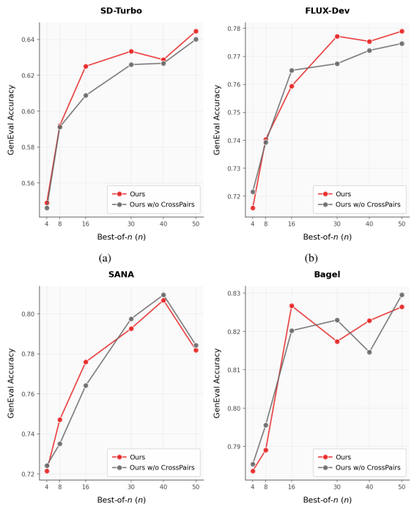
Figure 9 : Ablating out CrossPairs, evaluated best-of-n.
出典 · CC BY 4.0 · Shiye Su, Xiaohan Wang, Ludwig Schmidt, Serena Yeung-Levy · Rethinking Visual Reasoning in Text-to-Image Reward Modeling · 論文の図を引用 · 元のPDFの23ページ目から図の部分を抽出しています。
Table 7 : CrossPairs vs. supervising the same visual reasoning sources with an auxiliary VQA next- token-prediction loss. Accuracy on ImageRewardDB and the visual understanding evaluations; random performance is 50%.
出典 · CC BY 4.0 · Shiye Su, Xiaohan Wang, Ludwig Schmidt, Serena Yeung-Levy · Rethinking Visual Reasoning in Text-to-Image Reward Modeling · 論文の図を引用 · 元のPDFの24ページ目から図の部分を抽出しています。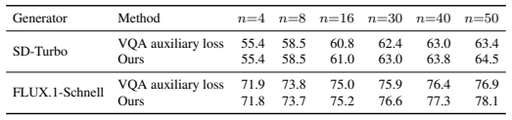
Table 8 : Best-of-n GenEval accuracy (%) for the two supervision formats. We generate 50 images per prompt; each entry is averaged over 200 randomn-subsets of those 50 generations.
出典 · CC BY 4.0 · Shiye Su, Xiaohan Wang, Ludwig Schmidt, Serena Yeung-Levy · Rethinking Visual Reasoning in Text-to-Image Reward Modeling · 論文の図を引用 · 元のPDFの27ページ目から図の部分を抽出しています。残された課題
著者らは、CrossPairs混合比率が選好データの規模やベースモデルの容量とどのように連動して拡張されるかは特徴づけていないと述べています。また、この研究では識別型の回帰ヘッドによる方式のみを評価し、生成型の報酬モデルやペアワイズ報酬モデルへの転移は試していません。この点は、本手法の適用範囲を制限しています。
論文情報
- 著者
- Shiye Su, Xiaohan Wang, Ludwig Schmidt, Serena Yeung-Levy
- 学会・ジャーナル
- arXiv · プレプリント
- 公開日
- 2026年11月12日
- 登録日
- 2026年11月16日
- 更新日
- 2026年11月12日
- バージョン
- v1
- arXiv
- 2611.17585
- カテゴリ
- cs.CV · cs.AI
- ライセンス
- CC BY 4.0
- 掲載内容
- 論文情報・解説・論文の図
この解説は、Refivuの韓国語解説をAIで翻訳したものです。不正確な翻訳や誤りが含まれる可能性があります。論文と図の利用条件は各出典に従います。
アブストラクト
Reward models are a core component of modern text-to-image systems, serving as the objective for inference-time selection and RL-based post-training. A key prerequisite is visual understanding: to judge prompt adherence and ground aesthetic preferences, a reward model must bind attributes, resolve relations, and count reliably. We find that widely-used reward models perform poorly on targeted visual reasoning evaluations. Even when starting from strong vision-language backbones, preference fine-tuning erodes these capabilities, and continual-learning baselines fail to mitigate a steep tradeoff between visual reasoning and preference accuracy. We propose a data-centric intervention that injects visual reasoning supervision into preference learning by flipping the pairing axis. To complement conventional human preference data (paired images under a shared prompt), we convert existing visual reasoning datasets into preference pairs that share the same image but differ in prompt, and train on the mixture. This yields a Pareto improvement in both visual understanding and preference prediction. Across inference-time best-of-n selection and RL post-training, the resulting reward model improves text-to-image generation on challenging compositional prompts (GenEval) by an average of 4.0% and 5.5% respectively, outperforming HPSv3 which was trained on 6x more preference pairs.
この論文を引用
Shiye Su, Xiaohan Wang, Ludwig Schmidt, Serena Yeung-Levy (2026). Rethinking Visual Reasoning in Text-to-Image Reward Modeling. arXiv:2611.17585v1. https://arxiv.org/abs/2611.17585v1
BibTeX
@misc{su2026rethinking,
  title = {{Rethinking Visual Reasoning in Text-to-Image Reward Modeling}},
  author = {Shiye Su and Xiaohan Wang and Ludwig Schmidt and Serena Yeung-Levy},
  year = {2026},
  eprint = {2611.17585},
  archivePrefix = {arXiv},
  url = {https://arxiv.org/abs/2611.17585v1}
}