논문 해설
Physics-based Shadow Image Decomposition for Shadow Removal
그림자 제거를 위한 물리 기반 그림자 영상 분해
- 연구 문제 그림자 제거는 빛과 물체가 얽힌 그림자를 단일 영상에서 복원해야 하므로 어렵습니다. 이 논문은 선형 조명 모델과 그림자 매트를 심층 네트워크로 추정하는 방법을 제안합니다.
- 연구 방법 그림자 영상을 상대 조명 영상과 매트 층의 결합으로 분해하고, SP-Net과 M-Net으로 파라미터와 매트를 예측한 뒤 I-Net으로 잔차를 보정합니다.
- 주요 결과 ISTD 완전 지도 설정에서 SP+M-Net은 그림자 영역 MAE를 6.5로, 전체 SP+M+I-Net은 6.0으로 보고합니다. 약지도 설정은 그림자 없는 영상 없이 9.7을 보고합니다.
그림자 제거의 어려움과 연구 질문
단일 영상에서 그림자를 지우는 일은 그림자가 빛, 기하, 물체 재질이 얽혀 생기기 때문에 까다롭습니다. 초기 물리 기반 방법은 조명 모델의 파라미터를 추정하려면 많은 처리 시간이나 사용자 도움이 필요했습니다. 반면 최근의 심층 학습 방법은 그림자 영상을 그림자 없는 영상으로 바로 대응시키는 end-to-end 매핑을 학습하지만, 결과가 흐리거나 아티팩트를 보이는 문제가 있습니다.
이 논문은 두 흐름을 결합합니다. 그림자 영상을 선형 조명 모델의 파라미터와 매트 층으로 분해하여, 네트워크가 픽셀 값을 직접 생성하지 않고 파라미터와 매트를 추정하도록 합니다. 두 번째 질문은 그림자 없는 영상 없이도 학습할 수 있는지입니다. 이를 위해 그림자 패치와 비그림자 패치만으로 학습하는 약지도 설정을 함께 다룹니다.
선형 조명 모델과 그림자 영상 분해
방법의 출발점은 그림자 픽셀과 그림자 없는 픽셀의 관계를 채널별 선형 변환으로 모델링하는 것입니다. 원문은 그림자 픽셀 값에 scaling factor w와 additive constant b를 적용하여 그림자 없는 값을 근사하며, 이 파라미터는 umbra 영역 전체에서 상수로 가정합니다. 이 상수 가정 덕분에 한 번 추정한 (w,b)가 그림자 영역의 모든 픽셀에 같은 선형 변환을 적용하는 전역 일관성을 가집니다.
분해 식은 그림자 없는 영상을 그림자 영상 Ishadow, 상대 조명 영상 Irelit, 매트 α의 결합으로 표현합니다. 상대 조명 영상은 Irelit = w·Ishadow + b로 계산되고, 최종 영상은 Ishadow-free = Ishadow·(1−α) + Irelit·α입니다. 여기서 α는 픽셀별 선형 결합 계수이며, 원문은 이상적으로 비그림자 영역에서 1, 완전 그림자 영역에서 0에 가깝고 반그림자 경계에서 점진적으로 변한다고 설명합니다. 이 구성은 완전 그림자 영역의 조명 변환과 경계의 부드러운 혼합을 분리합니다.
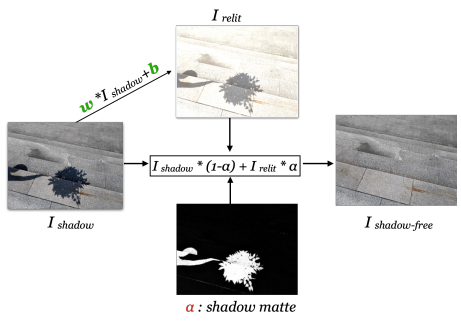
Fig. 1 : Shadow Removal via Shadow Image Decomposition. A shadow-free image Ishadow-free can be expressed in terms of a shadow image Ishadow, a relit image Irelit and a shadow matte α. The relit image is a linear transformation of the shadow image. The two unknown factors of this system are the shadow parameters (w,b ) and the shadow matte layer α. We use two deep networks to estimate these two unknown factors.
원문 · CC BY 4.0 · Hieu Le, Dimitris Samaras · Physics-based Shadow Image Decomposition for Shadow Removal · 원문 그림 인용 · 원본 PDF 1쪽에서 그림 영역을 추출했습니다.SP-Net, M-Net, I-Net의 역할 분담
완전 지도 설정에서 SP-Net은 그림자 영상과 그림자 마스크를 입력으로 받아 (w,b)를 예측합니다. 학습 쌍에서는 최소제곱법으로 파라미터를 먼저 계산하며, 그림자 마스크를 5픽셀 침식하여 반그림자 픽셀을 제외한 뒤 선형 회귀를 풉니다. w의 탐색 범위는 [1,3]으로 제한되고, 정답 파라미터는 RGB 세 채널의 6원소 벡터로 SP-Net의 목표가 됩니다.

Fig. 2 : Shadow Removal Framework. The shadow parameter estimator network SP-Net takes as input the shadow image and the shadow mask to predict the shadow parameters (w,b ). The relit image Irelit is then computed via Eq. 6 using the estimated parameters from SP-Net. The relit image, together with the input shadow image and the shadow mask are then input into the shadow matte prediction network M-Net to get the shadow matte layer α. The system outputs the shadow-free image via Eq. 5, using the shadow image, the relit image, and the shadow matte. SP-Net learns to predict the shadow parameters (w,b ), denoted as the regression loss. M-Net learns to minimize the L1 distance between the output of the system and the shadow-free image (reconstruction loss). I-Net takes as input the shadow image, shadow mask, and the shadow-free image computed from SP-Net and M-Net to output a residual image that is used to obtain the final shadow-free image.
원문 · CC BY 4.0 · Hieu Le, Dimitris Samaras · Physics-based Shadow Image Decomposition for Shadow Removal · 원문 그림 인용 · 원본 PDF 3쪽에서 그림 영역을 추출했습니다.M-Net은 SP-Net으로 계산한 상대 조명 영상과 입력을 받아 매트 α를 예측합니다. 원문은 반그림자 영역이 이진 마스크로 표현되지 않으므로 매트가 필요하다고 설명합니다. 마지막으로 I-Net은 색 포화나 그림자 강도의 불균일, 파라미터 추정 오류 같은 선형 모델 밖의 픽셀을 보정하기 위해 잔차 층을 출력합니다. 학습 손실로 SP-Net에는 파라미터 회귀 손실, M-Net에는 재구성 손실과 반그림자 재구성 손실, 평활 손실이 쓰이며, 최종 목적 함수는 이들의 가중합입니다.

Fig. 3 : A comparison of the ground truth shadow mask and our shadow matte. From left to right: The input image, the relit image computed from the parameters estimated via SP-Net, the ground truth shadow mask, the final results when we use the shadow mask, the shadow matte computed using our M-Net, and the final shadow-free image when we use the shadow matte to combine the input and relit image. The matting layer handles the soft shadow and does not generate visible boundaries in the final result. (Please view in magnification on a digital device to see the difference more clearly.)
원문 · CC BY 4.0 · Hieu Le, Dimitris Samaras · Physics-based Shadow Image Decomposition for Shadow Removal · 원문 그림 인용 · 원본 PDF 5쪽에서 그림 영역을 추출했습니다.그림자 없는 영상 없이 학습하는 약지도 방식
약지도 설정에서는 그림자 영상을 겹치는 패치로 잘라 그림자 패치, 경계 패치, 비그림자 패치로 나눕니다. 원문은 그림자 없는 영상을 쓰지 않고 그림자 경계 패치를 비그림자 패치 쪽으로 옮기는 방식을 사용합니다. 이를 위해 SP-Net과 M-Net을 생성기로, D-Net을 판별기로 둔 적대적 학습을 수행합니다.
적대적 신호만으로는 생성기가 그림자를 실제로 제거하도록 제약되지 않으므로, 원문은 매트 α의 범위를 제한합니다. 비그림자 픽셀에서는 α=0, 완전 그림자 픽셀에서는 α=1을 부여하는 매트 손실을 쓰고, 경계 손실과 평활 손실을 함께 씁니다. 목적 함수는 평활 손실, 매트 손실, 경계 손실, 적대적 손실의 가중합입니다. 전체 영상에 대한 추론은 패치 파라미터를 선형 결합하여 근사하는 방식으로 수행됩니다.
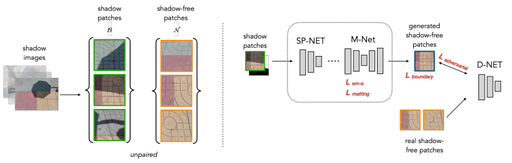
Fig. 6 : Weakly-supervised shadow decomposition. We train our SP-Net and M-Net together with an adversarial network, D-Net, using only two sets of unpaired shadow and shadow free patches. These patches are cropped directly from the shadow images (left panel). SP-Net and M-Net predict the shadow parameters (w,b ) and the matte layerα respectively to jointly remove the shadow. D-Net is the critic function distinguishing between the generated image patches and the real shadow-free patches. The only supervision signal is the set of shadow-free patches, which can be easily obtained using the shadow masks. The four losses guiding this training are the matting loss, smoothness loss, boundary loss, and adversarial loss.
원문 · CC BY 4.0 · Hieu Le, Dimitris Samaras · Physics-based Shadow Image Decomposition for Shadow Removal · 원문 그림 인용 · 원본 PDF 7쪽에서 그림 영역을 추출했습니다.ISTD 완전 지도 실험 결과
ISTD 테스트 평가는 색 불일치를 보정한 조정본에서 수행되며, 그림자 영역, 비그림자 영역, 전체 영상의 Lab 색 공간 MAE로 비교합니다. 이 조건에서 SP-Net과 M-Net을 함께 쓴 결과는 그림자 영역 MAE가 7.6에서 6.5로 낮아졌습니다. 원문은 이를 기존 Hu et al.의 값과 비교하여 14% 감소로 보고하며, 여기서의 비교는 같은 조정 조건에서 얻은 결과에 한정됩니다.
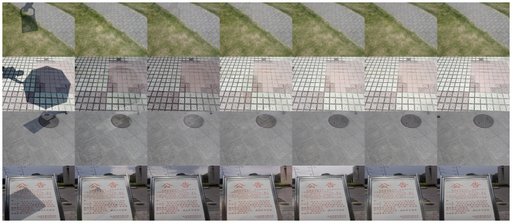
Fig. 10 : Comparison of fully-supervised shadow removal methods on the ISTD dataset. Qualitative comparison between our method and previous state-of-the-art methods: ST-CGAN [32], Cun et al. [58], and DSC [41]. “SP+M+I-Net” are the shadow removal results using the parameters computed from SP-Net, the shadow matte computed from M-Net, and the residual layer computed from I-Net.
원문 · CC BY 4.0 · Hieu Le, Dimitris Samaras · Physics-based Shadow Image Decomposition for Shadow Removal · 원문 그림 인용 · 원본 PDF 10쪽에서 그림 영역을 추출했습니다.I-Net을 더한 전체 SP+M+I-Net은 그림자 영역 MAE 6.0을 보고합니다. 그림자 마스크를 정답으로 쓴 설정의 값은 5.3이지만, 테스트에서 추정 마스크를 쓴 주 설정과 구분해야 합니다. 이 결과는 ISTD라는 단일 데이터셋과 지도 학습 조건에서의 결과입니다.
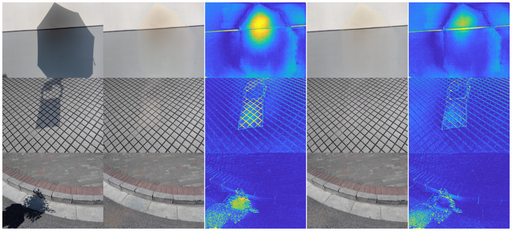
Fig. 5 : The effect of the inpainting network, I-Net. From left to right: The input images, the shadow-free images computed from our SP-Net and M-Net (SP+M-Net), the error heat maps of the SP+M-Net’s results, the shadow-free images computed with the addition of the inpainting network I-Net (SP+M+I-Net), and the error heat maps of SP+M+I-Net’s results. The inpainting network I-Net partially corrects the colors of the pixels in the umbra areas.
원문 · CC BY 4.0 · Hieu Le, Dimitris Samaras · Physics-based Shadow Image Decomposition for Shadow Removal · 원문 그림 인용 · 원본 PDF 6쪽에서 그림 영역을 추출했습니다.약지도 결과와 Mask-ShadowGAN 비교
약지도 방법인 wSP+M-Net은 ISTD 테스트에서 그림자 영역 MAE 9.7을 보고합니다. 같은 표에서 Mask-ShadowGAN은 그림자 영역 MAE 12.4로 제시되어 있으며, 원문은 이에 대해 22% 개선을 보고합니다. 이 비교는 약지도 설정 안에서 비교한 값이며, 원문 표는 Mask-ShadowGAN이 짝지어지지 않은 그림자 영상과 그림자 없는 영상을 쓰는 방법임을 함께 보여줍니다.
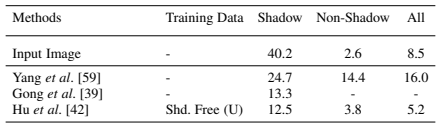
TABLE 2 : Shadow removal results of our weakly-supervised method compared to weakly-supervised and priors-based shadow removal methods on the adjusted ISTD testing set [32].
원문 · CC BY 4.0 · Hieu Le, Dimitris Samaras · Physics-based Shadow Image Decomposition for Shadow Removal · 원문 그림 인용 · 원본 PDF 9쪽에서 그림 영역을 추출했습니다.또한 정답 그림자 마스크를 쓴 약지도 설정의 그림자 영역 MAE는 9.1로 보고됩니다. 이 설정은 주 설정과 별도로 구분하여 읽어야 합니다.
절제 실험이 보여주는 구성요소의 효과
완전 지도 설정의 절제 표는 SP+M-Net 기준선 7.9에서 시작해, 파라미터 탐색 공간 제한 L.S.S를 추가하면 7.1, 반그림자 재구성 손실 Lpen을 더하면 6.7, I-Net을 더하면 6.2, 평활 손실 Lsm−α를 더하면 6.0으로 낮아집니다. 이 값들은 구성요소를 순차적으로 추가한 설정에서 얻은 그림자 영역 MAE입니다.
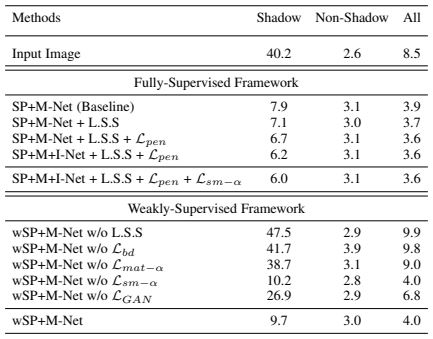
TABLE 3 : Ablation Studies. We train our networks with different settings and report the shadow removal performances on the ISTD dataset [32]. The metric is MAE (the lower, the better).
원문 · CC BY 4.0 · Hieu Le, Dimitris Samaras · Physics-based Shadow Image Decomposition for Shadow Removal · 원문 그림 인용 · 원본 PDF 10쪽에서 그림 영역을 추출했습니다.약지도 절제에서는 탐색 공간 제한을 제거한 wSP+M-Net w/o L.S.S가 47.5로 크게 나빠지고, 경계 손실을 제거하면 41.7, 매트 손실을 제거하면 38.7, 적대적 손실을 제거하면 26.9로 나타납니다. 평활 손실을 제거하면 10.2로 상승폭이 작습니다. 이 결과들은 각 구성요소를 제거했을 때의 악화를 보여주며, 그 구성요소가 항상 독립적으로 큰 효과를 가진다는 뜻은 아닙니다.
SBU-Timelapse와 적용 범위
SBU-Timelapse는 정적 장면의 타임랩스 영상 50개로 구성되며, 움직이는 그림자가 생기는 픽셀 쌍을 활용하여 평가 데이터를 만듭니다. 최대값 영상 Vmax를 의사 그림자 없는 프레임으로 사용하고, 움직이는 그림자 마스크 영역에서 MAE를 계산합니다. 입력 프레임의 MAE는 33.8이고, 완전 지도 SP+M+I-Net은 20.1로 보고됩니다.
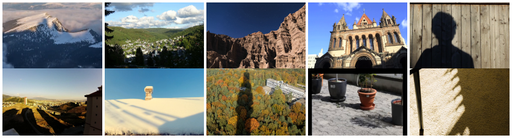
Fig. 14 : Examples of the SBU-Timelapse dataset. We collected a time-lapse video dataset where both the scene and the visible objects remain static. The dataset includes videos containing shadows cast by close-up occluders, far distance occluders, videos with simple-to-complex shadows, and shadows on various types of backgrounds and materials.
원문 · CC BY 4.0 · Hieu Le, Dimitris Samaras · Physics-based Shadow Image Decomposition for Shadow Removal · 원문 그림 인용 · 원본 PDF 13쪽에서 그림 영역을 추출했습니다.원문은 이 데이터셋에서 약지도 wSP+M-Net의 MAE가 23.4라고 보고합니다. 이 값은 ISTD에서 학습한 모델을 이 데이터셋에 적용한 결과로, 데이터 구축 방식과 평가 대상이 ISTD와 다르므로 같은 조건의 결과로 합치면 안 됩니다. 논문은 이 데이터셋에서도 방법이 더 나은 결과를 보인다고 밝히지만, 모든 비디오 그림자 상황에 대한 일반화를 증명하지는 않습니다.
한계와 확인되지 않은 범위
원문은 방법에 명확한 한계가 있다고 밝힙니다. 그림자 검출기의 오류가 최종 그림자 제거에 영향을 주며, 한 영상에 여러 그림자 인스턴스가 있는 경우를 잘 처리하지 못합니다. 실패 사례에서는 추정 마스크가 그림자 영역을 잘못 잡거나, 추정 파라미터가 틀려 밝은 영역의 색이 잘못 나타납니다.
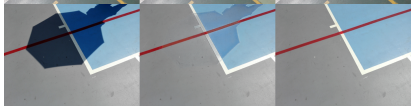
Fig. 11 : Failure cases of our method. The first row shows a case where our method fails to accurately localize the shadow area while in the second row, the color of the lit area is incorrect.
원문 · CC BY 4.0 · Hieu Le, Dimitris Samaras · Physics-based Shadow Image Decomposition for Shadow Removal · 원문 그림 인용 · 원본 PDF 10쪽에서 그림 영역을 추출했습니다.또한 약지도 결과는 완전 지도 결과보다 경계 아티팩트가 더 많다고 보고됩니다. 선형 조명 모델은 한 파라미터 집합이 그림자 전체를 표현한다는 가정에 기대므로, 그림자 강도가 불균일하거나 물리 모델이 맞지 않는 경우에는 I-Net 보정에 의존합니다. 이 논문의 결과는 ISTD와 SBU-Timelapse 데이터셋에서 얻은 것이며 다른 장면 종류에 대한 일반화는 검증되지 않았습니다.
논문 정보
- 저자
- Hieu Le, Dimitris Samaras
- 학회·저널
- arXiv · 프리프린트
- 최초 공개일
- 2020년 12월 23일
- 등록일
- 2026년 11월 6일
- 수정일
- 2021년 11월 9일
- 버전
- v2
- arXiv
- 2012.13018
- DOI
- 10.1109/tpami.2021.3124934
- 분류
- cs.CV
- 원문 이용 조건
- CC BY 4.0
- 제공 범위
- 논문 정보, 해설, 허용된 원문 그림
AI 해설은 논문 원문과 별개의 설명이며 오류가 있을 수 있습니다. 원문과 그림은 각 출처의 이용 조건과 따로 표시된 권리를 따릅니다.
초록
We propose a novel deep learning method for shadow removal. Inspired by physical models of shadow formation, we use a linear illumination transformation to model the shadow effects in the image that allows the shadow image to be expressed as a combination of the shadow-free image, the shadow parameters, and a matte layer. We use two deep networks, namely SP-Net and M-Net, to predict the shadow parameters and the shadow matte respectively. This system allows us to remove the shadow effects from images. We then employ an inpainting network, I-Net, to further refine the results. We train and test our framework on the most challenging shadow removal dataset (ISTD). Our method improves the state-of-the-art in terms of root mean square error (RMSE) for the shadow area by 20\%. Furthermore, this decomposition allows us to formulate a patch-based weakly-supervised shadow removal method. This model can be trained without any shadow-free images (that are cumbersome to acquire) and achieves competitive shadow removal results compared to state-of-the-art methods that are trained with fully paired shadow and shadow-free images. Last, we introduce SBU-Timelapse, a video shadow removal dataset for evaluating shadow removal methods.
원문 인용
Hieu Le, Dimitris Samaras (2020). Physics-based Shadow Image Decomposition for Shadow Removal. arXiv:2012.13018v2. https://doi.org/10.1109/tpami.2021.3124934
BibTeX
@article{le2020physics,
  title = {{Physics-based Shadow Image Decomposition for Shadow Removal}},
  author = {Hieu Le and Dimitris Samaras},
  year = {2020},
  eprint = {2012.13018},
  archivePrefix = {arXiv},
  doi = {10.1109/tpami.2021.3124934},
  url = {https://arxiv.org/abs/2012.13018v2}
}