논문 해설
Investigating Reasons for Disagreement in Natural Language Inference
자연어 추론에서 의견 불일치의 원인 조사
- 연구 문제 NLI 데이터셋의 주석 불일치가 어디서 생기며, 이를 모델이 어떻게 식별할 수 있는지 다룹니다.
- 연구 방법 Triangle of Reference에 따라 10개 범주의 불일치 분류체계를 만들고, 4-way 분류와 다중 레이블 분류 두 방식으로 불일치 항목을 예측합니다.
- 주요 결과 다중 레이블 모델은 4-way 분류보다 매크로 재현율이 높아 가능한 해석을 더 많이 회수합니다. 4-way 기준 모델 비교에서는 저자 모델의 매크로 F1이 MixUp보다 높았습니다.
NLI 주석 불일치의 문제
자연어 추론(NLI) 데이터셋은 전제-가설 쌍마다 여러 주석자의 판단을 모아 다수결로 하나의 정답을 정해 왔습니다. 그러나 일부 항목은 주석자 사이에 체계적인 불일치를 보이며, 단일 정답을 가정하는 것이 항상 타당하지 않습니다. 논문의 예시(1)에서 MNLI 항목은 5명 중 3명이 함의(E), 0명이 중립(N), 2명이 모순(C)으로 주석했습니다. 이 불일치가 어디에서 생기는지는 아직 체계적으로 설명되지 않았습니다. 따라서 이 논문은 불일치의 원천을 분류하고, 불일치 항목을 모델이 어떻게 식별할 수 있는지를 함께 다룹니다.
Triangle of Reference에 따른 10개 범주 분류체계
저자들은 Aroyo and Welty(2015)의 Triangle of Reference를 바탕으로 불일치 원천을 문장 의미의 불확실성, 가이드라인의 불명확성, 주석자 행동의 세 상위 클래스로 나눕니다. 이 아래에 10개 범주가 놓이며, 각 항목에는 여러 범주가 함께 붙을 수 있습니다. 예를 들어 Lexical, Implicature, Probabilistic Enrichment 같은 범주는 문장 의미의 다의성이나 함의 가능성과 관련되고, Coreference와 Temporal Reference는 가이드라인이 명시하지 않은 지시 대상과 시점의 문제를 다룹니다. Accommodating Minimally Added Content와 High Overlap은 주석자가 추가 내용을 무시하거나 어휘 중복에 끌리는 행동과 관련됩니다.
이 분류는 한 명의 주석자가 개발했고 두 주석자가 적용했으며, 두 주석자의 Krippendorff's α with MASI distance는 0.69입니다.

Table 1 : Categories of potential sources of disagreement, with examples. The last two columns give the number of annotations for each NLI label “Entailment” (E), “Neutral” (N), and “Contradiction” (C), in MNLI and ChaosNLI.
원문 · CC BY 4.0 · Nan-Jiang Jiang, Marie-Catherine de Marneffe · Investigating Reasons for Disagreement in Natural Language Inference · 원문 그림 인용 · 원본 PDF 4쪽에서 그림 영역을 추출했습니다.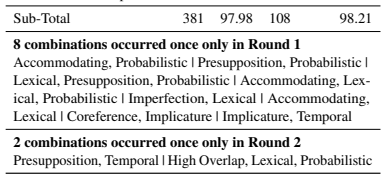
Table 2 : Frequency and percentage of each combination of categories in the taxonomy, in the two annotation rounds.
원문 · CC BY 4.0 · Nan-Jiang Jiang, Marie-Catherine de Marneffe · Investigating Reasons for Disagreement in Natural Language Inference · 원문 그림 인용 · 원본 PDF 7쪽에서 그림 영역을 추출했습니다.4-way 분류와 다중 레이블 분류의 비교
분포 예측 대신 범주형 결정이 필요하다는 점에서 저자들은 두 모델링 방식을 시험합니다. 첫째는 E, N, C에 Complicated를 더한 4-way 분류입니다. 둘째는 E, N, C 각 레이블을 시그모이드 출력으로 독립 예측하고 확률이 0.5보다 크면 그 레이블이 존재한다고 보는 다중 레이블 분류입니다. 기준 모델인 MixUp은 세 레이블에 대한 분포를 예측하고 0.2 임계값으로 다중 레이블이나 4-way 레이블로 바꿉니다. 4-way 분류 실험에서 RoBERTa 기반 저자 모델의 Chaos+Orig 테스트 세트 매크로 F1은 68.59%로, MixUp의 65.34%보다 높았습니다. 이 수치는 세 random initialization의 평균이며 Chaos+Orig 설정에 한정됩니다.
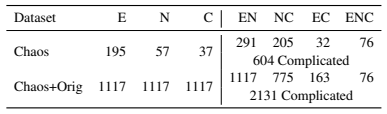
Table 4 : Number of items for each 4-way label and each combination of multilabel in each dataset. The number of “Complicated” items is the sum of the number of items with more than one label in the multilabel setup.
원문 · CC BY 4.0 · Nan-Jiang Jiang, Marie-Catherine de Marneffe · Investigating Reasons for Disagreement in Natural Language Inference · 원문 그림 인용 · 원본 PDF 9쪽에서 그림 영역을 추출했습니다.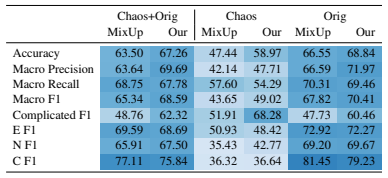
Table 5 : Left: 4-way classification performance on the test set. Right: Performance on the two subsets of the test set, Chaos and Original MNLI. Darker color indicates higher performance.
원문 · CC BY 4.0 · Nan-Jiang Jiang, Marie-Catherine de Marneffe · Investigating Reasons for Disagreement in Natural Language Inference · 원문 그림 인용 · 원본 PDF 10쪽에서 그림 영역을 추출했습니다.다중 레이블 모델의 재현율과 한계
다중 레이블 모델은 4-way 분류보다 정확도 측면에서는 낮지만 매크로 재현율이 높습니다. 원문은 다중 레이블 모델의 매크로 재현율을 83.35로, 4-way 분류의 67.78보다 높다고 보고합니다. 매크로 F1은 저자 모델 82.17, MixUp 80.29입니다. 정확도는 정답 레이블 수별로 나뉘며, 정답 레이블이 1개인 항목에서는 MixUp이 더 높고 2/3개 항목에서는 저자 모델이 더 높습니다. 이는 다중 레이블 모델이 불일치 항목의 가능한 해석을 더 많이 회수한다는 해석을 뒷받침하지만, 전체 정확도를 개선했다는 뜻은 아닙니다. 저자들은 이 점수가 가능한 해석의 재현에 대한 지표로 쓰일 수 있다고 해석합니다.
Complicated 예측과 범주별 오류 분석
4-way 모델은 Complicated 클래스에서 가장 많이 틀렸습니다. ChaosNLI의 100개 주석 항목에서 얻은 레이블은 원래 MNLI의 5개 주석 레이블보다 Complicated F1에서 더 잘 학습되었습니다. 예측된 Complicated 항목의 주석 엔트로피는 다른 예측 레이블 항목보다 높았으며, 이는 Mann-Whitney 두 측 검정으로 비교되었습니다. 범주별로는 Probabilistic Enrichment에서 다중 레이블 모델이 68%의 항목을 둘 이상의 레이블로 예측했습니다. Accommodating Minimally Added Content에서는 76%가 최소한 Neutral을 포함하는 것으로 예측되었습니다.
이 결과는 모델이 불일치의 원천과 연결된 특징을 일부 포착했음을 보여 주지만, 모든 범주에서 같은 수준으로 재현되었다고 말할 수는 없습니다.
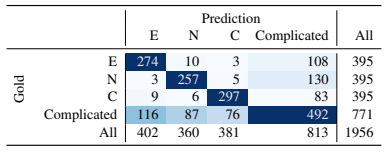
Table 6 : Confusion matrix of the 4-way classifica- tion predictions from the initialization with the highest macro F1. Darker color indicates higher numbers.
원문 · CC BY 4.0 · Nan-Jiang Jiang, Marie-Catherine de Marneffe · Investigating Reasons for Disagreement in Natural Language Inference · 원문 그림 인용 · 원본 PDF 10쪽에서 그림 영역을 추출했습니다.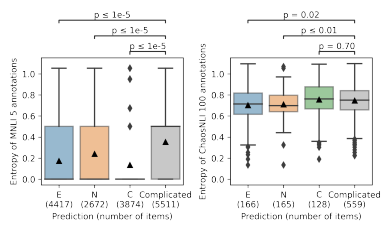
Figure 2 : Boxplots of annotation entropy (Left: from original MNLI 5 annotations, Right: from ChaosNLI 100 annotations) by predicted label. Number of items shown in parentheses. Triangles indicate the means. P-values from Mann-Whitney two-sided test.
원문 · CC BY 4.0 · Nan-Jiang Jiang, Marie-Catherine de Marneffe · Investigating Reasons for Disagreement in Natural Language Inference · 원문 그림 인용 · 원본 PDF 10쪽에서 그림 영역을 추출했습니다.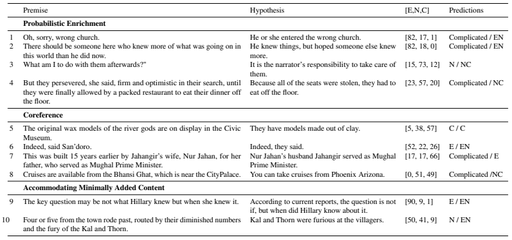
Table 9 : Examples from the categorization with ChaosNLI annotations and 4-way/multi-label model predictions.
원문 · CC BY 4.0 · Nan-Jiang Jiang, Marie-Catherine de Marneffe · Investigating Reasons for Disagreement in Natural Language Inference · 원문 그림 인용 · 원본 PDF 12쪽에서 그림 영역을 추출했습니다.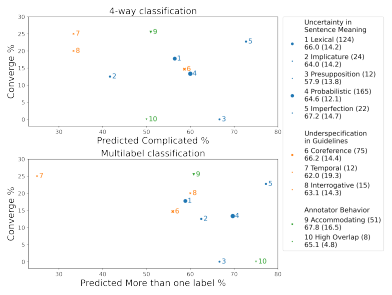
Figure 3 : For each disagreement category, percentage of ChaosNLI items annotated with that category (number in parentheses) and having converging NLI annotations (>80 majority vote) vs. percentage predicted as Com- plicated in the 4-way setup or as having more than one label in the multilabel setup. Legend also gives mean majority vote in each category, with standard deviation in parentheses.
원문 · CC BY 4.0 · Nan-Jiang Jiang, Marie-Catherine de Marneffe · Investigating Reasons for Disagreement in Natural Language Inference · 원문 그림 인용 · 원본 PDF 12쪽에서 그림 영역을 추출했습니다.적용 범위와 남은 질문
이 연구의 분류는 MNLI dev 항목의 부분 집합에 대한 질적 분석에 기반하며, 항목 수는 400개와 110개로 제한되었습니다. 모델 실험도 MNLI와 ChaosNLI의 일부 항목에 한정되어 다른 NLI 데이터셋이나 모델 계열로 일반화할 수 없습니다. 원문은 맥락을 제공하는 것이 불일치를 줄이는지 여부와, 분포형 주석과 범주형 레이블의 해석 차이를 실제로 분리하는 실험을 향후 과제로 남깁니다. 따라서 이 논문의 결론은 불일치 원천의 분류와 다중 레이블 모델의 재현율에 대한 근거이며, 불일치 자체의 최종 해결 방법을 제시하지는 않습니다.
논문 정보
- 저자
- Nan-Jiang Jiang, Marie-Catherine de Marneffe
- 학회·저널
- arXiv · 프리프린트
- 최초 공개일
- 2022년 9월 7일
- 등록일
- 2026년 11월 6일
- 수정일
- 2022년 9월 7일
- 버전
- v1
- arXiv
- 2209.03392
- 분류
- cs.CL
- 원문 이용 조건
- CC BY 4.0
- 제공 범위
- 논문 정보, 해설, 허용된 원문 그림
AI 해설은 논문 원문과 별개의 설명이며 오류가 있을 수 있습니다. 원문과 그림은 각 출처의 이용 조건과 따로 표시된 권리를 따릅니다.
초록
We investigate how disagreement in natural language inference (NLI) annotation arises. We developed a taxonomy of disagreement sources with 10 categories spanning 3 high-level classes. We found that some disagreements are due to uncertainty in the sentence meaning, others to annotator biases and task artifacts, leading to different interpretations of the label distribution. We explore two modeling approaches for detecting items with potential disagreement: a 4-way classification with a "Complicated" label in addition to the three standard NLI labels, and a multilabel classification approach. We found that the multilabel classification is more expressive and gives better recall of the possible interpretations in the data.
원문 인용
Nan-Jiang Jiang, Marie-Catherine de Marneffe (2022). Investigating Reasons for Disagreement in Natural Language Inference. arXiv:2209.03392v1. https://arxiv.org/abs/2209.03392v1
BibTeX
@misc{jiang2022investigating,
  title = {{Investigating Reasons for Disagreement in Natural Language Inference}},
  author = {Nan-Jiang Jiang and Marie-Catherine de Marneffe},
  year = {2022},
  eprint = {2209.03392},
  archivePrefix = {arXiv},
  url = {https://arxiv.org/abs/2209.03392v1}
}