논문 해설
ZEST: Zero-shot Embodied Skill Transfer for Athletic Robot Control
ZEST: 운동형 로봇 제어를 위한 제로샷 구현 기술 전이
- 연구 문제 인간형 로봇의 민첩하고 접촉이 많은 전신 동작은 기존 모델 기반 추적 방식과 강화학습 방식 모두에서 설계와 배포의 부담이 큽니다.
- 연구 방법 ZEST는 MoCap, ViCap, 키프레임 애니메이션을 같은 단일 단계 학습 절차에 넣고, 접촉 라벨 없이 참조 추적 정책을 학습해 하드웨어에 제로샷으로 배포합니다.
- 주요 결과 Atlas에서 army crawl과 breakdance 같은 동적 다중 접촉 동작을 전문화 정책으로 하드웨어에서 시연했으며, 이 결과는 시험한 기술과 참조 원천의 범위에 한정됩니다.
문제 설정: 모델 기반 모방 제어의 한계
인간형 로봇에서 민첩하고 접촉이 많은 동작을 구현하려면 고자유도, 간헐적인 다중 접촉, 모델링 오차를 동시에 다뤄야 합니다. 기존에는 오프라인 궤적 최적화로 참조 동작을 만든 뒤 모델 기반 컨트롤러로 추적하는 방식이 널리 쓰였습니다. 이 방식은 환경 모델링, 상태 추정, 참조 정확도에 대한 요구가 커서 불확실성이 크거나 접촉이 복잡한 상황에서 배포하기 어렵습니다. 반면 강화학습은 접촉 스케줄을 미리 정하지 않고도 정책을 만들 수 있지만, 보상 설계에 민감하고 표본 효율이 낮으며 시뮬레이션과 실제 로봇 사이의 간극에 취약합니다. 이 논문은 모션 데이터를 사전 정보로 사용해 이러한 문제를 함께 줄이려는 흐름 위에 놓여 있습니다.
ZEST의 단일 단계 학습 구성
ZEST는 MoCap, ViCap, 키프레임 애니메이션에서 얻은 참조 모션을 같은 학습 절차에 넣는 모션 모방 프레임워크입니다. 인간 기반 데이터는 공간-시간 최적화로 목표 로봇 골격에 운동학적으로 재타기팅되며, 접촉 라벨은 어떤 데이터 원천에도 사용하지 않습니다. 정책 입력은 IMU 기반 각속도, 중력 벡터, 관절 위치와 속도, 이전 행동 등 온보드 측정과 다음 단계의 참조 목표로 제한됩니다. 정책은 참조 행동에 더해지는 잔차 관절 목표를 출력하고, 이 목표는 관절 수준 PD 제어기로 전달됩니다. 학습 중에는 시뮬레이션에서만 얻을 수 있는 특권 정보를 쓰는 비대칭 액터-크리틱 구조를 사용하며, 배포된 정책은 상태 추정기 없이 실행됩니다.
참조 상태 초기화(RSI)는 에피소드를 참조 궤적의 임의 위상에서 시작하게 하여 긴 궤적에서도 다양한 상태를 학습하도록 돕습니다. 적응형 샘플링은 궤적을 고정 길이 구간으로 나누고 구간별 실패 수준의 이동 평균으로 어려운 구간을 더 자주 선택하며, 보조 렌치 커리큘럼은 어려운 구간에서 기저에 가상 힘과 토크를 가하고 추적이 개선되면 그 크기를 0으로 줄입니다. 이 구성요소들은 이 논문에서 함께 쓰인 방법이며, 각 구성요소를 제거한 결과는 아래 절제 실험의 해석에서 따로 다룹니다.
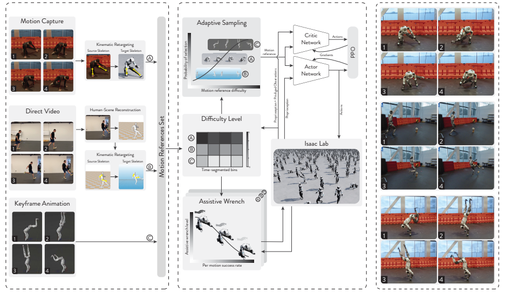
Fig. 3 .Overview ofZEST, which consists of three main stages. (1) Reference data:A diverse set of motions from MoCap, ViCap, and keyframe animation is processed; MoCap/ViCap references are kinematically retargeted to the target robot.(2) Training setup and MDP formu- lation:In simulation, the policy is trained using only on-robot signals and the next target state from the reference, while a separate critic receives privileged information (e.g., true base velocity, contact forces) to accelerate learning. To handle long-horizon clips and scale beyond single skills, an adaptive sampling scheme is proposed: trajectories are segmented into fixed-duration bins; a per-bin difficulty level metric is updated via an EMA of failure scores; and a categorical sampler biases reset-state selection toward harder bins while avoiding catastrophic forgetting of easier behaviors. A model-based virtual assistive wrench is applied at the base to stabilize training for highly dynamic behaviors; the current bin’s diffi- culty level modulates its magnitude and is automatically annealed to zero as tracking improves.(3) Zero-shot deployment:The trained policy is deployed directly to the physical robot without any fine-tuning.
원문 · CC BY 4.0 · Jean Pierre Sleiman, He Li, Alphonsus Adu-Bredu, Robin Deits, Arun Kumar, Kevin Bergamin, Mohak Bhardwaj, Scott Biddlestone, Nicola Burger, Matthew A. Estrada, Francesco Iacobelli, Twan Koolen, Alexander Lambert, Erica Lin, M. Eva Mungai, Zach Nobles, Shane Rozen-Levy, Yuyao Shi, Jiashun Wang, Jakob Welner, Fangzhou Yu, Mike Zhang, Alfred Rizzi, Jessica Hodgins, Sylvain Bertrand, Yeuhi Abe, Scott Kuindersma, Farbod Farshidian · ZEST: Zero-shot Embodied Skill Transfer for Athletic Robot Control · 원문 그림 인용 · 원본 PDF 9쪽에서 그림 영역을 추출했습니다.하드웨어 검증과 적용 범위
하드웨어 실험은 Atlas, Unitree G1, Spot에서 수행되었으며 각 실험은 대상 기술만으로 학습한 전문화 정책을 사용했습니다. Atlas에서는 MoCap 참조로 walk, jog, forward roll, army crawl, cartwheel, breakdance 등을 실행했습니다. 특히 army crawl과 breakdance는 팔, 다리, 몸통 등 발 이외의 신체 부위가 지면과 접촉하는 동적 다중 접촉 동작입니다. ViCap 참조에서는 Atlas의 soccer kick과 여러 dance 스니펫, G1의 ballet과 상자 오르기 동작을 보고했습니다. 키프레임 애니메이션 참조는 Atlas의 handstand invert와 Spot의 backflip 계열 동작에 쓰였습니다.
표 1은 관절 위치 오차와 기저 방향 오차 등을 보고하며, 다중 접촉 기술과 거친 참조 데이터에서 오차가 상대적으로 커지는 경향이 나타납니다. 이 결과는 다룬 모델과 기술, 그리고 시험한 참조 원천에 한정된 것이며, 학습 범위 밖의 미지 모션에 대한 일반화는 별도로 확인되지 않았습니다.
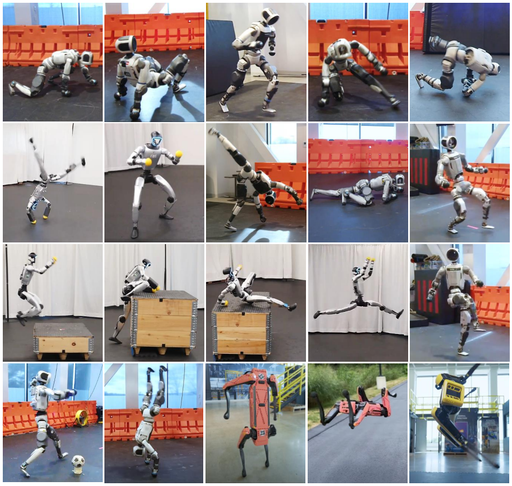
Fig. 1 .Hardware deployment ofZESTacross diverse data sources and robot morphologies.In order of appearance from top left to bottom right, the figure illustrates the following behaviors. From MoCap: Crawl on all fours (Atlas), roll on all fours (Atlas), jog (Atlas), breakdance (Atlas), forward roll (Atlas), cartwheel (G1), table-tennis (G1), cartwheel (atlas), army crawl (Atlas). From ViCap: Dance snippet A (Atlas), jump onto box (G1), climb up/down box (G1), ballet (G1), dance snippet C, soccer kick (Atlas). From Animation: handstand invert (Atlas), handstand balance (Spot), continuous backflip (Spot), barrel roll (Spot).
원문 · CC BY 4.0 · Jean Pierre Sleiman, He Li, Alphonsus Adu-Bredu, Robin Deits, Arun Kumar, Kevin Bergamin, Mohak Bhardwaj, Scott Biddlestone, Nicola Burger, Matthew A. Estrada, Francesco Iacobelli, Twan Koolen, Alexander Lambert, Erica Lin, M. Eva Mungai, Zach Nobles, Shane Rozen-Levy, Yuyao Shi, Jiashun Wang, Jakob Welner, Fangzhou Yu, Mike Zhang, Alfred Rizzi, Jessica Hodgins, Sylvain Bertrand, Yeuhi Abe, Scott Kuindersma, Farbod Farshidian · ZEST: Zero-shot Embodied Skill Transfer for Athletic Robot Control · 원문 그림 인용 · 원본 PDF 3쪽에서 그림 영역을 추출했습니다.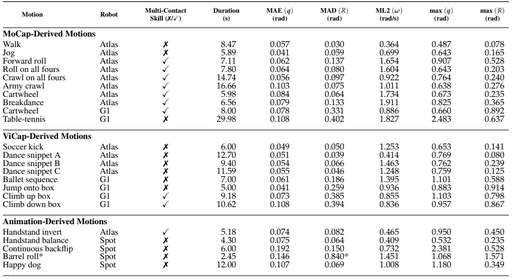
Table 1 .Evaluation across motions, grouped by reference source.A skill is labeled asmulti-contactif any body part other than the feet interacts with the ground. Metrics are reported asmean absolute error (MAE), mean angular distance (MAD), and mean L2 error (ML2)over successful trials; lower is better. MAE(q) is for joint-position error; MAD(R) is for base orientation error; ML2(ω) is for base angular velocity errors, respectively. We also include data for the maximum errors in joint position and orientation, denoted as max(q)and max(R)respectively.
원문 · CC BY 4.0 · Jean Pierre Sleiman, He Li, Alphonsus Adu-Bredu, Robin Deits, Arun Kumar, Kevin Bergamin, Mohak Bhardwaj, Scott Biddlestone, Nicola Burger, Matthew A. Estrada, Francesco Iacobelli, Twan Koolen, Alexander Lambert, Erica Lin, M. Eva Mungai, Zach Nobles, Shane Rozen-Levy, Yuyao Shi, Jiashun Wang, Jakob Welner, Fangzhou Yu, Mike Zhang, Alfred Rizzi, Jessica Hodgins, Sylvain Bertrand, Yeuhi Abe, Scott Kuindersma, Farbod Farshidian · ZEST: Zero-shot Embodied Skill Transfer for Athletic Robot Control · 원문 그림 인용 · 원본 PDF 6쪽에서 그림 영역을 추출했습니다.남은 한계와 가정
저자들이 밝힌 한계는 세 가지입니다. 첫째, 다중 기술 정책을 학습 집합 밖의 미지 모션에 적용하는 일반화 평가는 이 논문에서 수행되지 않았습니다. 둘째, 현재 공식은 본질적으로 고유수용성 기반이며 평탄하고 미끄럽지 않은 지형을 가정하므로 불균일하거나 순응적인 환경의 지각은 다루지 않습니다. 셋째, 시뮬레이션과 실제 로봇의 간극은 합리적인 모델링에 의존하며, 자동화된 시스템 식별은 열린 문제로 남아 있습니다.
논문 정보
- 저자
- Jean Pierre Sleiman, He Li, Alphonsus Adu-Bredu, Robin Deits, Arun Kumar, Kevin Bergamin, Mohak Bhardwaj, Scott Biddlestone, Nicola Burger, Matthew A. Estrada, Francesco Iacobelli, Twan Koolen, Alexander Lambert, Erica Lin, M. Eva Mungai, Zach Nobles, Shane Rozen-Levy, Yuyao Shi, Jiashun Wang, Jakob Welner, Fangzhou Yu, Mike Zhang, Alfred Rizzi, Jessica Hodgins, Sylvain Bertrand, Yeuhi Abe, Scott Kuindersma, Farbod Farshidian
- 학회·저널
- arXiv · 프리프린트
- 최초 공개일
- 2026년 1월 30일
- 등록일
- 2026년 11월 6일
- 수정일
- 2026년 1월 30일
- 버전
- v1
- arXiv
- 2602.00401
- 분류
- cs.RO · cs.AI
- 원문 이용 조건
- CC BY 4.0
- 제공 범위
- 논문 정보, 해설, 허용된 원문 그림
AI 해설은 논문 원문과 별개의 설명이며 오류가 있을 수 있습니다. 원문과 그림은 각 출처의 이용 조건과 따로 표시된 권리를 따릅니다.
초록
Achieving robust, human-like whole-body control on humanoid robots for agile, contact-rich behaviors remains a central challenge, demanding heavy per-skill engineering and a brittle process of tuning controllers. We introduce ZEST (Zero-shot Embodied Skill Transfer), a streamlined motion-imitation framework that trains policies via reinforcement learning from diverse sources -- high-fidelity motion capture, noisy monocular video, and non-physics-constrained animation -- and deploys them to hardware zero-shot. ZEST generalizes across behaviors and platforms while avoiding contact labels, reference or observation windows, state estimators, and extensive reward shaping. Its training pipeline combines adaptive sampling, which focuses training on difficult motion segments, and an automatic curriculum using a model-based assistive wrench, together enabling dynamic, long-horizon maneuvers. We further provide a procedure for selecting joint-level gains from approximate analytical armature values for closed-chain actuators, along with a refined model of actuators. Trained entirely in simulation with moderate domain randomization, ZEST demonstrates remarkable generality. On Boston Dynamics' Atlas humanoid, ZEST learns dynamic, multi-contact skills (e.g., army crawl, breakdancing) from motion capture. It transfers expressive dance and scene-interaction skills, such as box-climbing, directly from videos to Atlas and the Unitree G1. Furthermore, it extends across morphologies to the Spot quadruped, enabling acrobatics, such as a continuous backflip, through animation. Together, these results demonstrate robust zero-shot deployment across heterogeneous data sources and embodiments, establishing ZEST as a scalable interface between biological movements and their robotic counterparts.
원문 인용
Jean Pierre Sleiman, He Li, Alphonsus Adu-Bredu, Robin Deits, Arun Kumar, Kevin Bergamin, Mohak Bhardwaj, Scott Biddlestone, Nicola Burger, Matthew A. Estrada, Francesco Iacobelli, Twan Koolen, Alexander Lambert, Erica Lin, M. Eva Mungai, Zach Nobles, Shane Rozen-Levy, Yuyao Shi, Jiashun Wang, Jakob Welner et al. (2026). ZEST: Zero-shot Embodied Skill Transfer for Athletic Robot Control. arXiv:2602.00401v1. https://arxiv.org/abs/2602.00401v1
BibTeX
@misc{sleiman2026zest,
  title = {{ZEST: Zero-shot Embodied Skill Transfer for Athletic Robot Control}},
  author = {Jean Pierre Sleiman and He Li and Alphonsus Adu-Bredu and Robin Deits and Arun Kumar and Kevin Bergamin and Mohak Bhardwaj and Scott Biddlestone and Nicola Burger and Matthew A. Estrada and Francesco Iacobelli and Twan Koolen and Alexander Lambert and Erica Lin and M. Eva Mungai and Zach Nobles and Shane Rozen-Levy and Yuyao Shi and Jiashun Wang and Jakob Welner and Fangzhou Yu and Mike Zhang and Alfred Rizzi and Jessica Hodgins and Sylvain Bertrand and Yeuhi Abe and Scott Kuindersma and Farbod Farshidian},
  year = {2026},
  eprint = {2602.00401},
  archivePrefix = {arXiv},
  url = {https://arxiv.org/abs/2602.00401v1}
}