논문 해설
Efficiently Learning Robust Torque-based Locomotion Through Reinforcement with Model-Based Supervision
모델 기반 감독을 활용한 강화학습으로 토크 기반 보행을 효율적으로 견고하게 학습하기
- 연구 문제 이족 로봇의 토크 기반 보행은 모델 오차와 센서 잡음 때문에 모델 기반 제어만으로는 불안정해지기 쉽고, 순수 강화학습은 데이터와 보상 설계에 많이 의존합니다.
- 연구 방법 모델 기반 Base 제어기 위에 잔차 RL 정책을 얹고, 학습 중에만 특권 정보를 가진 Oracle 정책의 행동을 지도 손실로 활용합니다.
- 주요 결과 세 이족 로봇 시뮬레이션에서 제안 방법은 Table III 기준 모든 로봇에서 Success Rate 100.0을 보였고, 표준 잔차 RL과 Base 정책보다 우수한 결과를 보고합니다.
토크 기반 이족 보행 학습의 어려움
이족 로봇의 토크 기반 보행은 관절 토크를 직접 제어하므로 반응성과 에너지 효율을 얻을 수 있지만, 고차원 floating-base 동역학과 접촉 불확실성, 센서 잡음, 구동 지연 때문에 불안정해지기 쉽습니다. 모델 기반 제어는 궤적 계획과 전신 제어로 안정적인 보행을 만들지만, 모델과 실제 시스템의 차이가 커지거나 상태 추정이 잡음에 크게 영향을 받으면 성능이 떨어집니다. 반대로 순수 강화학습은 많은 데이터를 요구하고 보상 설계에 민감하며, 모델 기반 방법이 가진 해석 가능성과 안전성 보장이 부족합니다. 이 논문은 두 접근을 결합하여 모델 기반 기반 정책 위에 잔차 강화학습 정책을 얹는 방식으로 이 간극을 다룹니다.
Base 정책, Oracle 정책, 잔차 정책의 구성
제안 방법의 Base 정책은 DCM 궤적 생성기와 역동역학 기반 전신 제어기(WBC)로 구성된 모델 기반 제어기입니다. DCM은 무게중심의 위치와 속도로 정의되며, 이 논문은 VRP 입력으로부터 DCM 궤적을 계획하고 DCM 오차를 보정하는 제어 법칙을 사용합니다. Base 정책은 randomization 매개변수에 접근하지 않고 잡음이 있는 상태 관측과 부정확한 로봇 모델을 사용합니다. 반면 Oracle 정책은 같은 모델 기반 제어기이지만 시뮬레이터의 실제 randomization 설정과 정확한 로봇 모델에 접근하며, 학습 중에만 사용됩니다. 잔차 RL 정책은 Base 정책의 토크에 더해질 보정 토크를 학습하며, 관측으로 관절 상태, Base 토크, 이전 행동, DCM과 발 궤적의 추종 오차를 받고 RNN으로 관측 이력을 처리합니다.
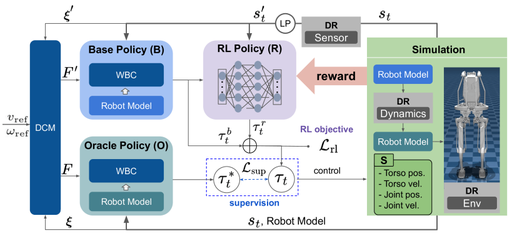
Fig. 1 :Residual Reinforcement Learning with Model-Based Supervision.Our framework integrates three key components: the Base Policy, the Oracle Policy, and the Residual Policy. The Base and Oracle policies are model-based controllers; however, the Oracle, only used in training, has privileged access to true system information, including the robot model, state, and motor parameters, while the Base Policy operates under an inaccurate dynamics model with realistic assumptions without access to the true system information (LP: low-pass filter). The learnable Residual Policy is trained to compensate for the model inaccuracies of the Base Policy. Crucially, the Residual Policy is guided by both the RL objectiveL rl and direct supervision from the Oracle PolicyL sup, enabling efficient learning and improved robustness under real-world uncertainties.
원문 · CC BY 4.0 · Yashuai Yan, Tobias Egle, Christian Ott, Dongheui Lee · Efficiently Learning Robust Torque-based Locomotion Through Reinforcement with Model-Based Supervision · 원문 그림 인용 · 원본 PDF 2쪽에서 그림 영역을 추출했습니다.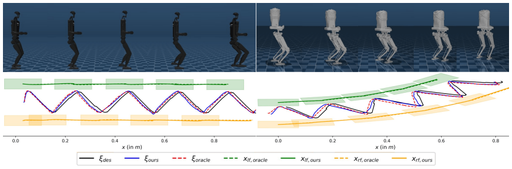
Fig. 4 :Quantitative evaluation on DCM and foot tracking.The H1-2 robot walks straight forward at a speed of0.2m/s, while the Kangaroo is commanded with a linear velocity of0.2m/sand an angular velocity of0.2rad/s.ξ des shows the planned DCM trajectory and the footprints are visualized as polygons in green and orange.
원문 · CC BY 4.0 · Yashuai Yan, Tobias Egle, Christian Ott, Dongheui Lee · Efficiently Learning Robust Torque-based Locomotion Through Reinforcement with Model-Based Supervision · 원문 그림 인용 · 원본 PDF 7쪽에서 그림 영역을 추출했습니다.Oracle 행동을 이용한 지도 손실과 목적함수
학습은 PPO 목적 L_rl과 Oracle 보정 행동에 대한 지도 손실 L_sup을 가중합하여 진행됩니다. 지도 손실은 정책이 Oracle이 보정한 잔차 행동 τ*_t − τ^b_t에 높은 likelihood를 부여하도록 만드는 항이며, 원문은 이를 −log(π_r(τ*_t − τ^b_t | s_t)) 형태로 제시합니다. 전체 목적은 L_total = ω_rl L_rl + ω_sup L_sup이며, 원문은 ω_rl = 1, ω_sup = 10으로 설정했다고 밝힙니다. 토크 추적 보상 R_τ는 적용 토크가 Oracle 토크에 가까워지도록 유도하지만, 지도 손실은 잔차 행동 자체를 직접 모방하도록 하는 별도 항입니다.
따라서 이 논문의 Oracle 감독은 보상 형태와 손실 형태가 함께 쓰이는 구성으로 읽어야 합니다.
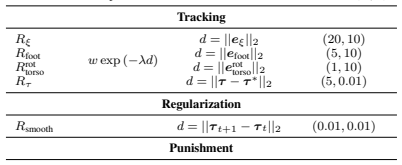
원문 그림 TABLE II:Reward Functions.
원문 · CC BY 4.0 · Yashuai Yan, Tobias Egle, Christian Ott, Dongheui Lee · Efficiently Learning Robust Torque-based Locomotion Through Reinforcement with Model-Based Supervision · 원문 그림 인용 · 원본 PDF 4쪽에서 그림 영역을 추출했습니다.세 이족 로봇에서의 비교 평가
평가는 Kangaroo, Unitree H1-2, Bruce 세 로봇에서 수행되었고, 모든 방법은 domain randomization 설정 β=1에서 평가되었습니다. 각 방법과 로봇마다 10회 시뮬레이션을 수행했고, 각 시뮬레이션은 5초 보행이며 속도 명령을 2초마다 바꿉니다. 비교 대상은 Oracle, Base, 표준 잔차 RL인 ResRL, 지도 학습만 쓰는 IL, 모델 기반 제어기 MBC이며, 제안 방법은 잔차 토크를 학습하는 BOR과 직접 토크를 학습하는 OR로 구분됩니다. 원문은 Table III에서 Ours (BOR)가 세 로봇 모두에서 Success Rate 100.0을 보고했다고 기술합니다.
또한 Base 정책은 성공률 0.0으로 실패했고, 표준 잔차 RL은 고자유도 로봇에서 자주 실패한다고 보고되었습니다.
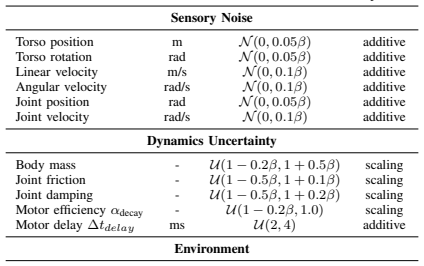
원문 그림 TABLE I:Domain Randomization.We capture variability from dif- ferent sources and use a scaling factorβto control the randomization level during validation. For training, we useβ= 1.
원문 · CC BY 4.0 · Yashuai Yan, Tobias Egle, Christian Ott, Dongheui Lee · Efficiently Learning Robust Torque-based Locomotion Through Reinforcement with Model-Based Supervision · 원문 그림 인용 · 원본 PDF 3쪽에서 그림 영역을 추출했습니다.
원문 그림 TABLE III:Comparison of different approaches. All methods are evaluated with domain randomization (β= 1). The Oracle and Base in the first section indicate our Oracle and Base policies. The second section presents the performance of our baselines. We showcase the benefits of the supervision from our Oracle policy in the last section via the methods OR and BOR. OR indicates the the RL policy learns the direct troque commands, while BOR learns the residual torques of the Base policy.
원문 · CC BY 4.0 · Yashuai Yan, Tobias Egle, Christian Ott, Dongheui Lee · Efficiently Learning Robust Torque-based Locomotion Through Reinforcement with Model-Based Supervision · 원문 그림 인용 · 원본 PDF 5쪽에서 그림 영역을 추출했습니다.학습 효율과 플랫폼별 차이
Kangaroo 학습 진행에서는 제안 방법이 1,500 에피소드 이후 80% 이상의 성공률에 도달했다고 원문이 보고합니다. 이 수치는 단일 환경에서의 학습이며, 표준 잔차 RL은 학습 중 뚜렷한 진전을 보이지 않았다고 설명됩니다. IL은 Kangaroo에서는 BOR과 비슷한 성능을 보였지만 Bruce에서는 유의하게 낮은 성능을 보였습니다. 저자들은 이를 IL이 Oracle의 신뢰성에 더 민감하기 때문이라고 해석합니다. 또한 Table IV의 randomization 수준 분석에서 MBC는 β=0.1에서 성공률 100%였지만 β=0.5에서 50%, β=0.7에서 90% 실패율을 보였고, BOR은 β=1에서 100% 성공률을 유지했습니다.
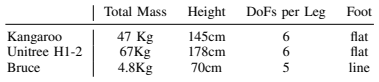
원문 그림 TABLE V:Properties of different robots.
원문 · CC BY 4.0 · Yashuai Yan, Tobias Egle, Christian Ott, Dongheui Lee · Efficiently Learning Robust Torque-based Locomotion Through Reinforcement with Model-Based Supervision · 원문 그림 인용 · 원본 PDF 5쪽에서 그림 영역을 추출했습니다.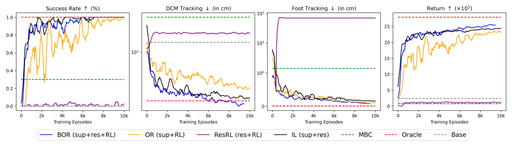
Fig. 2 :Quantitative evaluation on the Kangaroo robot.We evaluate various methods using predefined metrics throughout training. Our method (BOR) shows that residual learning converges substantially faster than directly learning torque commands, even under identical Oracle supervision. Moreover, comparing BOR/OR with other baselines demonstrates that incorporating the supervision term into the optimization objective significantly improves training efficiency, bringing performance much closer to that of the Oracle policies.
원문 · CC BY 4.0 · Yashuai Yan, Tobias Egle, Christian Ott, Dongheui Lee · Efficiently Learning Robust Torque-based Locomotion Through Reinforcement with Model-Based Supervision · 원문 그림 인용 · 원본 PDF 6쪽에서 그림 영역을 추출했습니다.Oracle 의존성과 평평한 바닥 가정
Oracle 정책은 평평한 바닥을 가정하여 계획되며, 울퉁불퉁한 지형의 불확실성은 학습 과정이 다루도록 설계되었습니다. 원문은 uneven terrain에서 Oracle이 불안정한 제어를 보이고 IL이 그 불안정성을 그대로 물려받는 반면, BOR은 강화학습을 통해 Oracle을 넘어서는 적응 행동을 보였다고 보고합니다. 다만 저자들은 Oracle이 실제 상태에 접근하더라도 갑작스러운 명령 변화나 불안정한 접촉 같은 실패를 막지 못할 수 있으며, 특히 매우 확률적인 조건에서 Oracle에 과도하게 의존하면 성능이 제한될 수 있다고 논의합니다.
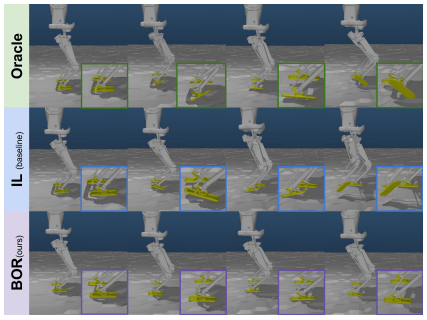
Fig. 5 :Evaluation on uneven terrain.Uneven terrain introduces additional uncertainties in real-world environments, yet even the Oracle policy struggles to explicitly encode ground irregularities. Thanks to the learning paradigms in our framework, our method learns adaptive behaviors that go beyond simply mimicking the Oracle, unlike the baseline IL approach.
원문 · CC BY 4.0 · Yashuai Yan, Tobias Egle, Christian Ott, Dongheui Lee · Efficiently Learning Robust Torque-based Locomotion Through Reinforcement with Model-Based Supervision · 원문 그림 인용 · 원본 PDF 7쪽에서 그림 영역을 추출했습니다.논문 정보
- 저자
- Yashuai Yan, Tobias Egle, Christian Ott, Dongheui Lee
- 학회·저널
- arXiv · 프리프린트
- 최초 공개일
- 2026년 1월 22일
- 등록일
- 2026년 11월 6일
- 수정일
- 2026년 1월 22일
- 버전
- v1
- arXiv
- 2601.16109
- 분류
- cs.RO
- 원문 이용 조건
- CC BY 4.0
- 제공 범위
- 논문 정보, 해설, 허용된 원문 그림
AI 해설은 논문 원문과 별개의 설명이며 오류가 있을 수 있습니다. 원문과 그림은 각 출처의 이용 조건과 따로 표시된 권리를 따릅니다.
초록
We propose a control framework that integrates model-based bipedal locomotion with residual reinforcement learning (RL) to achieve robust and adaptive walking in the presence of real-world uncertainties. Our approach leverages a model-based controller, comprising a Divergent Component of Motion (DCM) trajectory planner and a whole-body controller, as a reliable base policy. To address the uncertainties of inaccurate dynamics modeling and sensor noise, we introduce a residual policy trained through RL with domain randomization. Crucially, we employ a model-based oracle policy, which has privileged access to ground-truth dynamics during training, to supervise the residual policy via a novel supervised loss. This supervision enables the policy to efficiently learn corrective behaviors that compensate for unmodeled effects without extensive reward shaping. Our method demonstrates improved robustness and generalization across a range of randomized conditions, offering a scalable solution for sim-to-real transfer in bipedal locomotion.
원문 인용
Yashuai Yan, Tobias Egle, Christian Ott, Dongheui Lee (2026). Efficiently Learning Robust Torque-based Locomotion Through Reinforcement with Model-Based Supervision. arXiv:2601.16109v1. https://arxiv.org/abs/2601.16109v1
BibTeX
@misc{yan2026efficiently,
  title = {{Efficiently Learning Robust Torque-based Locomotion Through Reinforcement with Model-Based Supervision}},
  author = {Yashuai Yan and Tobias Egle and Christian Ott and Dongheui Lee},
  year = {2026},
  eprint = {2601.16109},
  archivePrefix = {arXiv},
  url = {https://arxiv.org/abs/2601.16109v1}
}