논문 해설
Reward-Guided Iterative Refinement in Diffusion Models at Test-Time with Applications to Protein and DNA Design
테스트 시점 확산 모델에서의 보상 기반 반복 정제: 단백질 및 DNA 설계 응용
- 연구 문제 단일 샷 보상 유도 생성은 생성 중간에 오류를 교정하지 못해 복잡한 보상과 하드 제약을 충분히 최적화하지 못할 수 있습니다.
- 연구 방법 RERD는 현재 설계를 부분적으로 노이즈화한 뒤 보상 유도 디노이징으로 다시 복원하는 과정을 반복하며, 마지막 단계에서 배치 내 재표본추출을 수행합니다.
- 주요 결과 단백질 설계와 세포 유형 특이적 DNA 설계에서 RERD는 보고된 보상 지표에서 SMC, SVDD, GA보다 높은 값을 보고했으며, 이 결과는 지정된 모델과 초기화 조건에서 얻어졌습니다.
단일 샷 보상 유도 생성의 한계
확산 모델은 사전 학습된 분포에서 자연스러운 설계를 생성하며, 여기에 단백질 안정성이나 구조 제약, 결합력 같은 하류 보상을 추론 시점에 반영하려는 수요가 있습니다. 기존의 여러 보상 유도 방법은 노이즈 상태에서 깨끗한 상태로 가는 단 한 번의 디노이징 과정에서 보상을 반영합니다. 이 방식에서는 소프트 가치 함수의 근사 오차가 생겨도 생성 중간에 교정할 기회가 없습니다. 특히 마스크 이산 확산 모델에서는 한 번 복원된 토큰이 종료 시점까지 바뀌지 않으므로, 중간 단계의 부적절한 토큰이 그대로 남습니다. 이 논문은 이러한 문제를 반복적 정제로 다루며, 현재 답하려는 질문은 부분 노이징과 보상 유도 디노이징을 반복하면 복잡한 보상과 하드 제약을 더 잘 최적화할 수 있는지입니다.
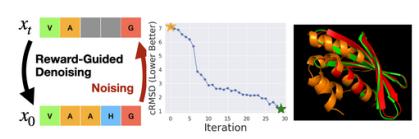
Figure 1 : Our proposed framework follows an iterative pro- cess, with each iteration injecting noise into the sample and then denoising it while optimizing rewards. For sequences, this can be implemented via masked diffusion, initialized from pre-trained diffusion models (left). Our algorithm can continuously refine the outputs by gradually correcting er- rors introduced during reward-guided denoising, improving the design over successive iterations (middle). For instance, for the task of optimizing the similarity (RMSD) of a protein to a target structure (Red), we can progressively minimize the RMSD through refinement, optimizing the design from an initial (Orange) fit to a better final fit (Green), as shown on the right.
원문 · CC BY 4.0 · Masatoshi Uehara, Xingyu Su, Yulai Zhao, Xiner Li, Aviv Regev, Shuiwang Ji, Sergey Levine, Tommaso Biancalani · Reward-Guided Iterative Refinement in Diffusion Models at Test-Time with Applications to Protein and DNA Design · 원문 그림 인용 · 원본 PDF 1쪽에서 그림 영역을 추출했습니다.RERD의 반복 정제 절차
RERD는 각 반복 s에서 현재 설계 x_0^(s)를 전방 노이징 정책으로 노이즈 수준 K까지 부분적으로 노이즈화한 뒤, 보상 유도 디노이징으로 x_0^(s+1)를 만듭니다. 이 과정에서 디노이징은 소프트 최적 정책 p⋆_t를 따르도록 설계되며, 이 정책은 pre-training 정책과 소프트 가치 함수 v_t의 지수 가중으로 정의됩니다. 실제로는 정확한 샘플링이 어렵기 때문에 Algorithm 2는 두 근사를 결합합니다. k=K−1부터 1까지는 pre-training 정책에서 여러 후보를 뽑고 보상 기반 중요도 가중치로 다음 상태를 고르며, 마지막 k=1 단계에서 배치 내 샘플을 보상 가중치로 재표본추출합니다. 이 재표본추출은 진화 알고리즘의 선택 단계에 대응하며, 보상이 낮은 샘플은 이 단계에서 제거될 수 있습니다.
노이즈 수준 K를 작게 두면 한 반복의 변화량이 작아지고 가치 함수 근사가 더 정확한 구간을 쓰게 됩니다.
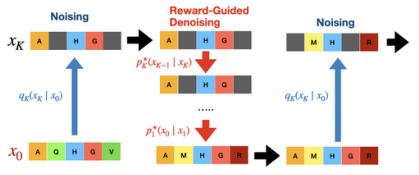
Figure 3 : Summary of RERD: We instantiate it within masked diffusion models. It alternates reward-guided de- noising and noising.
원문 · CC BY 4.0 · Masatoshi Uehara, Xingyu Su, Yulai Zhao, Xiner Li, Aviv Regev, Shuiwang Ji, Sergey Levine, Tommaso Biancalani · Reward-Guided Iterative Refinement in Diffusion Models at Test-Time with Applications to Protein and DNA Design · 원문 그림 인용 · 원본 PDF 4쪽에서 그림 영역을 추출했습니다.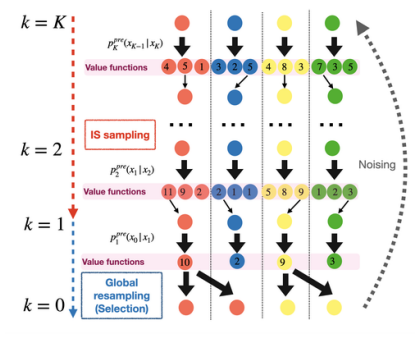
Figure 4 : Visualization of Algorithm 2. A reward-guided denoising consists of two components: local value-weighted sampling for each sample (fromk = K to k = 1) and global resampling among samples in a batch at k = 1.
원문 · CC BY 4.0 · Masatoshi Uehara, Xingyu Su, Yulai Zhao, Xiner Li, Aviv Regev, Shuiwang Ji, Sergey Levine, Tommaso Biancalani · Reward-Guided Iterative Refinement in Diffusion Models at Test-Time with Applications to Protein and DNA Design · 원문 그림 인용 · 원본 PDF 5쪽에서 그림 영역을 추출했습니다.목표 분포에 대한 정리와 가정
이론 분석의 핵심은 Theorem 1입니다. 이 정리는 초기 설계 x_0^(0)가 p(α)를 따르고, 전방 노이징 과정의 주변 분포가 사전 학습된 확산 모델의 학습된 노이징 과정과 일치한다는 두 가정 아래에서, RERD의 출력 x_0^(S)가 exp(r(·)/α)p_pre(·)에 비례하는 목표 분포를 따른다고 말합니다. 여기서 p(α)는 보상 r(x)의 기댓값에서 α를 곱한 KL 발산 항을 뺀 목적을 최대화하는 분포입니다. 정리의 증명은 귀납법으로 진행되며, 노이징 후 분포가 p_pre_K(·)exp(v_K(·)/α)/C 형태이고 디노이징 단계마다 이 형태가 유지되며, k=0에서 p_pre(·)exp(r(·)/α)에 이른다는 논리입니다.
저자들은 실제 적용에서 소프트 최적 정책을 정확히 근사할 수 있다는 가정이 추가로 필요하다고 밝힙니다. 따라서 이 정리는 정확한 근사와 가정이 성립하는 조건에서의 목표 분포 보장으로 읽어야 합니다.
실험 설계와 비교 기준
단백질 설계에서는 EvoDiff를 무조건부 기반 모델로 사용하고, ss-match, cRMSD, globularity, symmetry의 네 가지 구조 보상을 최적화합니다. 비교 대상은 SMC, SVDD, GA이며, RERD는 SVDD로 얻은 설계를 초기 설계로 사용합니다. 평가 지표로는 생성 설계 보상의 95% 분위수 P95와 중앙값 P50을 쓰고, 설계의 자연스러움을 보는 보조 지표로 추정 잔기당 로그우도 LL을 함께 보고합니다. DNA 설계에서는 Enformer 구조로 학습한 HepG2, K562, SKNSH 세포주별 활성 오라클을 보상으로 사용하며, 목표 세포주의 활성을 높이면서 다른 세포주 활성은 log barrier 형식의 제약으로 낮게 유지합니다.
이 실험에서 GA와 RERD는 제약을 만족하는 설계에서 시작합니다. 따라서 결과를 해석할 때에는 이 초기화 조건이 비교에 포함된다는 점을 함께 봐야 합니다.

Table 3 : Additional metrics for experiments in protein design. We have reported the median of pLDDT, pTM, and diversity of generated proteins.
원문 · CC BY 4.0 · Masatoshi Uehara, Xingyu Su, Yulai Zhao, Xiner Li, Aviv Regev, Shuiwang Ji, Sergey Levine, Tommaso Biancalani · Reward-Guided Iterative Refinement in Diffusion Models at Test-Time with Applications to Protein and DNA Design · 원문 그림 인용 · 원본 PDF 13쪽에서 그림 영역을 추출했습니다.주요 결과의 해석 범위
단백질 설계 표에서 RERD의 ss-match P50은 0.86으로, SMC 0.63, SVDD 0.66, GA 0.70보다 높게 보고됩니다. DNA 설계 표에서 RERD의 HepG2 P50은 7.9로, SMC 1.2, SVDD 2.3, GA 2.3보다 높게 보고됩니다. 세포 유형 특이적 설계에서는 RERD가 제약을 점진적 정제로 처리하여 HepG2 활성은 높고 다른 세포주 활성은 낮은 설계를 생성한다고 보고됩니다. 이 결과들은 특정 백본과 오라클, 지정된 초기화에서 얻은 것이며, 다른 데이터나 모델로 일반화하려면 별도 확인이 필요합니다. 또한 cRMSD처럼 낮을수록 좋은 지표와 ss-match처럼 높을수록 좋은 지표를 구분해서 읽어야 합니다.

Table 1 : The results for the protein design task show that our method consistently outperforms the baselines. Note that P50 and P95 represent the median and 95% quantile of the rewards for generated designs, respectively. LL denotes the (estimated) per-residue log-likelihood. Values in parentheses represent the estimated 95% standard deviation.
원문 · CC BY 4.0 · Masatoshi Uehara, Xingyu Su, Yulai Zhao, Xiner Li, Aviv Regev, Shuiwang Ji, Sergey Levine, Tommaso Biancalani · Reward-Guided Iterative Refinement in Diffusion Models at Test-Time with Applications to Protein and DNA Design · 원문 그림 인용 · 원본 PDF 7쪽에서 그림 영역을 추출했습니다.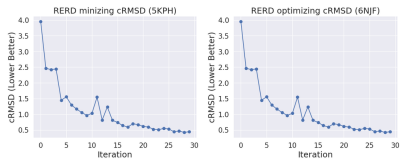
Figure 6 : The refinement step from RERD when optimizing cRMSD in two target backbone structures is demonstrated. Recall that the first iteration corresponds to the result from SVDD. The Y-axis represents the median reward of gener- ated samples (Lower is better).
원문 · CC BY 4.0 · Masatoshi Uehara, Xingyu Su, Yulai Zhao, Xiner Li, Aviv Regev, Shuiwang Ji, Sergey Levine, Tommaso Biancalani · Reward-Guided Iterative Refinement in Diffusion Models at Test-Time with Applications to Protein and DNA Design · 원문 그림 인용 · 원본 PDF 7쪽에서 그림 영역을 추출했습니다.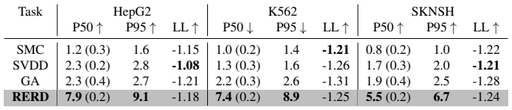
Table 2 : The results for the DNA design task show that our method consistently outperforms the baselines.
원문 · CC BY 4.0 · Masatoshi Uehara, Xingyu Su, Yulai Zhao, Xiner Li, Aviv Regev, Shuiwang Ji, Sergey Levine, Tommaso Biancalani · Reward-Guided Iterative Refinement in Diffusion Models at Test-Time with Applications to Protein and DNA Design · 원문 그림 인용 · 원본 PDF 8쪽에서 그림 영역을 추출했습니다.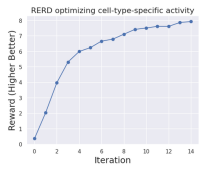
Figure 7 : (Left) The refinement step from RERD is demon- strated. The Y-axis represents the median reward of gener- ated samples (Higher is better), (Right) Generated designs from IRAO. It is seen that the activity in the target cell line HepG2 is only high.
원문 · CC BY 4.0 · Masatoshi Uehara, Xingyu Su, Yulai Zhao, Xiner Li, Aviv Regev, Shuiwang Ji, Sergey Levine, Tommaso Biancalani · Reward-Guided Iterative Refinement in Diffusion Models at Test-Time with Applications to Protein and DNA Design · 원문 그림 인용 · 원본 PDF 8쪽에서 그림 영역을 추출했습니다.한계와 적용 범위
저자들은 RERD의 이점이 정제 단계에서 생기는 교정에 있다고 해석합니다. 그러나 정리의 보장은 초기 설계 분포와 전방 노이징 일치 가정, 그리고 소프트 최적 정책의 정확한 근사라는 조건에 의존합니다. 실제 실험은 근사 알고리즘과 ESMFold 등 예측 모델에 기반한 보상을 사용하므로, 이 조건이 완전히 충족된다고 볼 수는 없습니다. 본문 실험은 주로 단백질과 DNA 설계에 한정되며, 저자들은 소분자 설계를 향후 과제로 남깁니다. 비용 측면에서도 반복 횟수와 샘플 수가 늘어나므로, 이 논문의 결과는 같은 계산 예산에서의 비교로 읽어야 합니다.
논문 정보
- 저자
- Masatoshi Uehara, Xingyu Su, Yulai Zhao, Xiner Li, Aviv Regev, Shuiwang Ji, Sergey Levine, Tommaso Biancalani
- 학회·저널
- arXiv · 프리프린트
- 최초 공개일
- 2025년 2월 20일
- 등록일
- 2026년 10월 29일
- 수정일
- 2025년 2월 20일
- 버전
- v1
- arXiv
- 2502.14944
- 분류
- cs.LG · cs.AI · cs.NE · q-bio.QM · stat.ML
- 원문 이용 조건
- CC BY 4.0
- 제공 범위
- 논문 정보, 해설, 허용된 원문 그림
AI 해설은 논문 원문과 별개의 설명이며 오류가 있을 수 있습니다. 원문과 그림은 각 출처의 이용 조건과 따로 표시된 권리를 따릅니다.
초록
To fully leverage the capabilities of diffusion models, we are often interested in optimizing downstream reward functions during inference. While numerous algorithms for reward-guided generation have been recently proposed due to their significance, current approaches predominantly focus on single-shot generation, transitioning from fully noised to denoised states. We propose a novel framework for inference-time reward optimization with diffusion models inspired by evolutionary algorithms. Our approach employs an iterative refinement process consisting of two steps in each iteration: noising and reward-guided denoising. This sequential refinement allows for the gradual correction of errors introduced during reward optimization. Besides, we provide a theoretical guarantee for our framework. Finally, we demonstrate its superior empirical performance in protein and cell-type-specific regulatory DNA design. The code is available at \href{https://github.com/masa-ue/ProDifEvo-Refinement}{https://github.com/masa-ue/ProDifEvo-Refinement}.
원문 인용
Masatoshi Uehara, Xingyu Su, Yulai Zhao, Xiner Li, Aviv Regev, Shuiwang Ji, Sergey Levine, Tommaso Biancalani (2025). Reward-Guided Iterative Refinement in Diffusion Models at Test-Time with Applications to Protein and DNA Design. arXiv:2502.14944v1. https://arxiv.org/abs/2502.14944v1
BibTeX
@misc{uehara2025reward,
  title = {{Reward-Guided Iterative Refinement in Diffusion Models at Test-Time with Applications to Protein and DNA Design}},
  author = {Masatoshi Uehara and Xingyu Su and Yulai Zhao and Xiner Li and Aviv Regev and Shuiwang Ji and Sergey Levine and Tommaso Biancalani},
  year = {2025},
  eprint = {2502.14944},
  archivePrefix = {arXiv},
  url = {https://arxiv.org/abs/2502.14944v1}
}